How To Build A Talent Pool For Faster, Lower-Cost Hiring
Most recruiters operate in a cycle that looks something like this: a role opens, a scramble begins, job boards get posted, resumes flood in, and weeks later, maybe, someone gets hired. Then the cycle resets. If you've ever wondered how to build a talent pool that breaks this pattern, you're asking the right question. A well-built talent pool means you're not starting from scratch every time a position opens. You're pulling from a curated group of pre-qualified candidates who are already on your radar.
The math is straightforward. Companies that maintain active talent pools cut their time-to-hire significantly, often by weeks, and spend far less per role than those relying purely on reactive job postings. But building one takes more than dumping resumes into a spreadsheet. It requires a system for sourcing, organizing, and engaging candidates over time, along with tools that actually make the process manageable at scale.
That's where this guide comes in, and where a platform like Olibr fits into the picture. With a searchable database of 180,000+ candidate profiles, AI-powered matching, and a community-driven model that grows your candidate pool as you use it, Olibr gives recruiters the infrastructure to build and maintain talent pools without the subscription fees that typically come with that capability. Below, you'll find a step-by-step breakdown of how to build a talent pool that keeps your pipeline full and your hiring costs down.
What a talent pool is and why it matters
A talent pool is a curated database of candidates who have expressed interest in your company or who you've identified as strong fits for roles you hire regularly. These candidates haven't necessarily applied to an active job posting. Some found you through a career event, a LinkedIn connection, or a past application that didn't lead to a hire at the time. Others may have been sourced proactively by your team. The key point is that they're organized, accessible, and warm rather than cold and untouched.
The difference between a talent pool and a pipeline
People often use "talent pool" and "talent pipeline" interchangeably, but they describe different things. A talent pipeline is role-specific and linear. It tracks candidates moving through stages for a particular open position. A talent pool is broader and ongoing. It holds everyone your team wants to stay connected with, regardless of whether a specific role is open right now.
Think of it this way: your pipeline empties when a role fills. Your talent pool should grow continuously. When you understand how to build a talent pool correctly, you create an asset that compounds over time, where every person you screen and tag today becomes a faster path to a hire six months from now.
Why reactive hiring costs more than you think
When a role opens and your team has no existing candidates to draw from, every step takes longer and costs more. You're writing job descriptions under pressure, posting to job boards that charge per listing or per click, and spending hours screening resumes from applicants who may not fit at all. The average time-to-hire across industries sits above 40 days, and a significant portion of that delay comes from the sourcing phase alone.
A talent pool directly attacks that sourcing delay by giving you a set of pre-qualified candidates to contact before or alongside a public job posting.
Companies that maintain active talent pools don't eliminate job postings entirely, but they significantly reduce their dependence on them. When a role opens, they contact three to five warm candidates the same week. Some of those conversations convert quickly. The posting still runs, but it's a backup rather than the primary channel.
What a healthy talent pool actually contains
A talent pool isn't useful if it's just a folder of old resumes. Useful talent pools contain structured data that lets you filter and act quickly. That means every candidate record should include more than a name and a resume file. You need skills tags, experience level, domain specialty, location or remote preference, last contact date, and a note on why this person is in your pool at all.
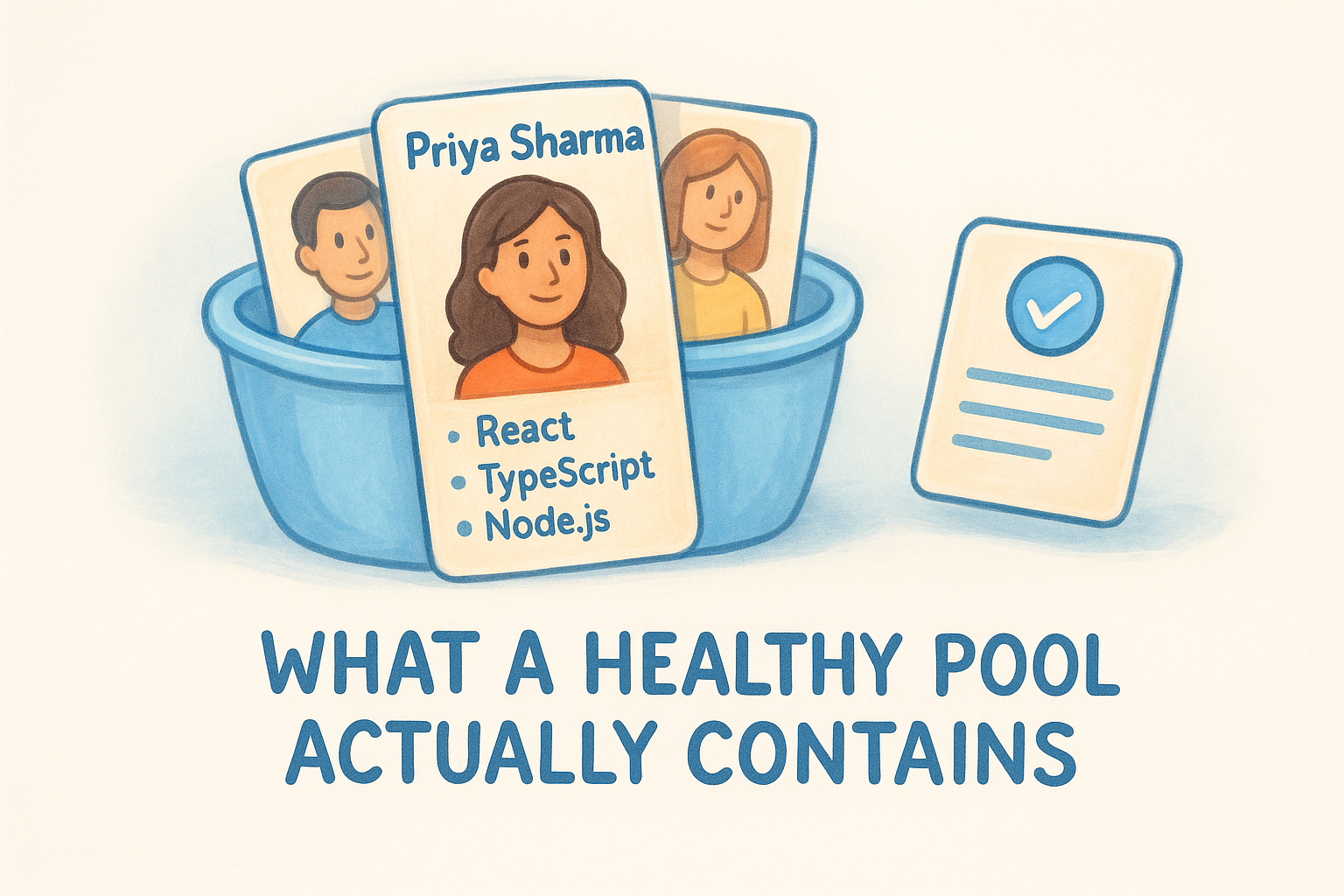
Here's what a well-structured candidate record typically looks like:
| Field | Example |
|---|---|
| Name | Priya Sharma |
| Role fit | Senior Frontend Engineer |
| Skills tags | React, TypeScript, Node.js |
| Experience level | 6 years |
| Location / remote | Bangalore, open to remote |
| Source | LinkedIn outreach, March 2026 |
| Last contacted | April 2026 |
| Status | Warm, passive |
| Notes | Strong portfolio, declined offer at previous company due to comp |
When every record follows this structure, your team can filter by skill, experience, and status in minutes rather than hours. That's the foundation that makes everything else in this guide work.
Step 1. Define roles and ideal candidate profiles
Before you source a single candidate, you need to know who you're actually building the pool for. Skipping this step is the most common reason talent pools become bloated and unusable. When you understand how to build a talent pool that stays useful over time, it starts with getting specific about the roles you hire most often and the exact criteria that define a strong fit for each one.
Start with your recurring roles
Not every role deserves its own talent pool segment. Focus your energy on the positions you hire repeatedly rather than one-off roles that require very niche experience. These recurring roles are your highest-value targets because the effort you put into sourcing today directly reduces hiring time on the next cycle.
Start by listing every role your team has filled more than once in the last 18 months. These are your pool priorities.
Pull your hiring history and identify the three to five roles that appear most frequently. Common examples include software engineers, sales representatives, customer success managers, and data analysts. Once you have that shortlist, you can organize your pool into clear segments that map directly to real hiring demand rather than guesswork.
Build an ideal candidate profile for each role
An ideal candidate profile (ICP) is different from a job description. A job description is public-facing; an ICP is an internal reference document that defines the non-negotiable and preferred attributes for a role. It keeps your team aligned when evaluating candidates across weeks or months of sourcing.
Use this template to build one for each priority role:
| Field | What to fill in |
|---|---|
| Role title | e.g., Senior Backend Engineer |
| Must-have skills | e.g., Python, REST APIs, 5+ years |
| Nice-to-have skills | e.g., Kubernetes, distributed systems |
| Experience type | Startup, enterprise, or both |
| Location or remote policy | On-site, hybrid, or fully remote |
| Red flags | e.g., under 12 months at multiple consecutive roles |
| What "good" looks like | A one-sentence benchmark for your team |
Share this document with every person on your team who touches candidate evaluation. When everyone works from the same ICP, your tagging and scoring in later steps stays consistent, which makes the pool far more actionable when a role opens.
Step 2. Set up your talent pool structure and data
Once you know who you're sourcing for, you need a place to store and organize that data in a way your team can actually use. This is the structural foundation of how to build a talent pool that scales. Without a consistent system, candidate records become inconsistent, searches return incomplete results, and your pool loses value fast. The goal here is to standardize your data model before a single candidate enters the system.
Choose where to store your candidate data
Your storage choice depends on your team's size and how many roles you're hiring across. A spreadsheet works for very early-stage teams, but it breaks down quickly as candidate volume grows and multiple people need to access the same records. Most teams benefit from a proper applicant tracking system (ATS) that supports custom fields, status tracking, and filtering by multiple attributes at once.
Whatever tool you choose, the system only works if every team member inputs data the same way, every time.
Here's a simple decision framework:
| Team size | Recommended approach |
|---|---|
| 1-2 recruiters, under 200 candidates | Structured spreadsheet with locked columns |
| 3-10 recruiters, 200-2,000 candidates | ATS with custom fields and role segments |
| 10+ recruiters or 2,000+ candidates | ATS with AI matching and bulk import capability |
Standardize your tagging system
Tags are how you find the right candidate in three minutes instead of three hours. Inconsistent tagging is the most common reason talent pools fail, because one recruiter writes "React.js" while another writes "ReactJS" and a third writes "React Developer," and now your filter returns incomplete results.
Build a locked tag library before anyone starts adding candidates. Define the exact format for skills, seniority levels, availability status, and source labels, then share that list with your full team. Here's an example tag structure to adopt:
- Skills: Use the official tool or language name in full (e.g., "TypeScript," not "TS")
- Seniority: Use consistent levels (Junior, Mid, Senior, Lead, Principal)
- Status: Active seeker, Passive, Not interested, Hired
- Source: LinkedIn outreach, Referral, Past applicant, Career fair, Chrome extension
When your tags are clean and uniform, filtering by role segment, skill set, or availability becomes a reliable action rather than an approximation.
Step 3. Source candidates continuously
A talent pool that doesn't grow becomes stale fast. Even if your current candidate records are well-organized and tagged correctly, the pool loses value as people change roles, leave the market, or simply stop responding. Sourcing continuously means you're adding new candidates regularly across multiple channels rather than running one big sourcing push and calling it done.
Build a multi-channel sourcing system
No single source gives you enough coverage on its own. To understand how to build a talent pool that stays full, you need at least three to four active sourcing channels running at the same time. Each channel attracts a different type of candidate, so spreading your sourcing reduces the risk of gaps in specific skill areas.

The recruiters who maintain the healthiest talent pools treat sourcing as a weekly habit, not a project they kick off when a role opens.
Here are the primary channels to activate:
- Past applicants: Every rejected applicant who nearly made the cut is a warm lead. Tag them correctly and re-engage when a better-fit role opens.
- LinkedIn and professional networks: Use search filters to identify passive candidates by title, skill, and tenure. Save promising profiles before outreach.
- Employee referrals: Your existing team knows strong candidates in their networks. A lightweight referral program, even without financial incentives, surfaces names you'd never find through a job board.
- Career fairs and events: Candidates you meet in person tend to be more responsive to future outreach than cold contacts, making events a high-quality sourcing channel worth tracking separately.
- Platform databases: A searchable candidate database like Olibr's 180,000+ profile pool lets you filter by skill, experience, and location to find pre-vetted candidates without posting a single job listing.
Set a weekly sourcing target
Without a concrete number to hit, sourcing slips when hiring pressure drops. Set a specific weekly addition target for each role segment in your pool. Ten new candidates per week across three segments adds over 1,500 new records in a year. Start with a number your team can realistically maintain, not an ambitious figure that gets abandoned after two weeks.
Review your sourcing numbers monthly. If one channel consistently underperforms relative to the time you invest in it, reallocate that effort to a channel that's actually producing qualified candidates worth keeping.
Step 4. Screen, tag, and score for reusability
Adding every candidate you find to your pool without a screening layer wastes the work you did in Steps 1 and 2. The goal here isn't to build the largest possible database; it's to build a useful one. Screening, tagging, and scoring candidates at the point of entry means that when a role opens, every record in your pool is already evaluated and actionable rather than raw and unprocessed.
Create a scoring rubric for each role segment
A scoring rubric gives your team a consistent evaluation framework that maps directly to your ideal candidate profiles. Without one, two recruiters looking at the same resume will reach different conclusions, and your pool fills up with inconsistently rated records that nobody trusts. Build a simple 1-5 scale rubric for each role segment and apply it every time a new candidate enters the system.
Here's an example rubric for a Senior Frontend Engineer segment:
| Criterion | Weight | Score (1-5) |
|---|---|---|
| Core skills match (React, TypeScript) | 40% | |
| Years of relevant experience | 25% | |
| Career trajectory (growth, tenure) | 20% | |
| Portfolio or project evidence | 15% |
Multiply each score by its weight, total the results, and you get a weighted score between 1 and 5. Candidates who score 4 or above go into your active pool segment. Those between 3 and 4 go into a watch list. Below 3 means they don't enter the pool at all.
A scored candidate record is worth five unscored ones because you can act on it immediately without re-screening.
Apply tags at the moment of screening
Don't batch your tagging at the end of the week. Tag each candidate immediately after screening, while the context is fresh. Pull up your locked tag library from Step 2 and apply skills tags, seniority level, status, and source in a single session per record. This keeps your data clean and your filtering reliable when a role opens on short notice.
Platforms like Olibr make understanding how to build a talent pool at scale significantly more manageable because AI parsing extracts and applies skills tags automatically from uploaded resumes. That removes a major manual bottleneck and keeps your tagging consistent across high-volume sourcing periods, even when your team is working across multiple role segments simultaneously.
Step 5. Nurture relationships and stay compliant
Sourcing and scoring candidates gets them into your pool. Consistent outreach is what keeps them there. A candidate who scored 4.2 on your rubric six months ago and hasn't heard from you since has almost certainly moved on mentally, even if they're still passively open to opportunities. Knowing how to build a talent pool that stays warm requires a structured nurture cadence that keeps your company on their radar without overwhelming their inbox.
Build a simple outreach cadence
Most recruiters skip nurture entirely because it feels time-consuming. The fix is to systematize it so it requires minimal effort per candidate. Set a recurring reminder for each pool segment and use a short message template that personalizes quickly. You're not pitching a role every time; you're maintaining a relationship.
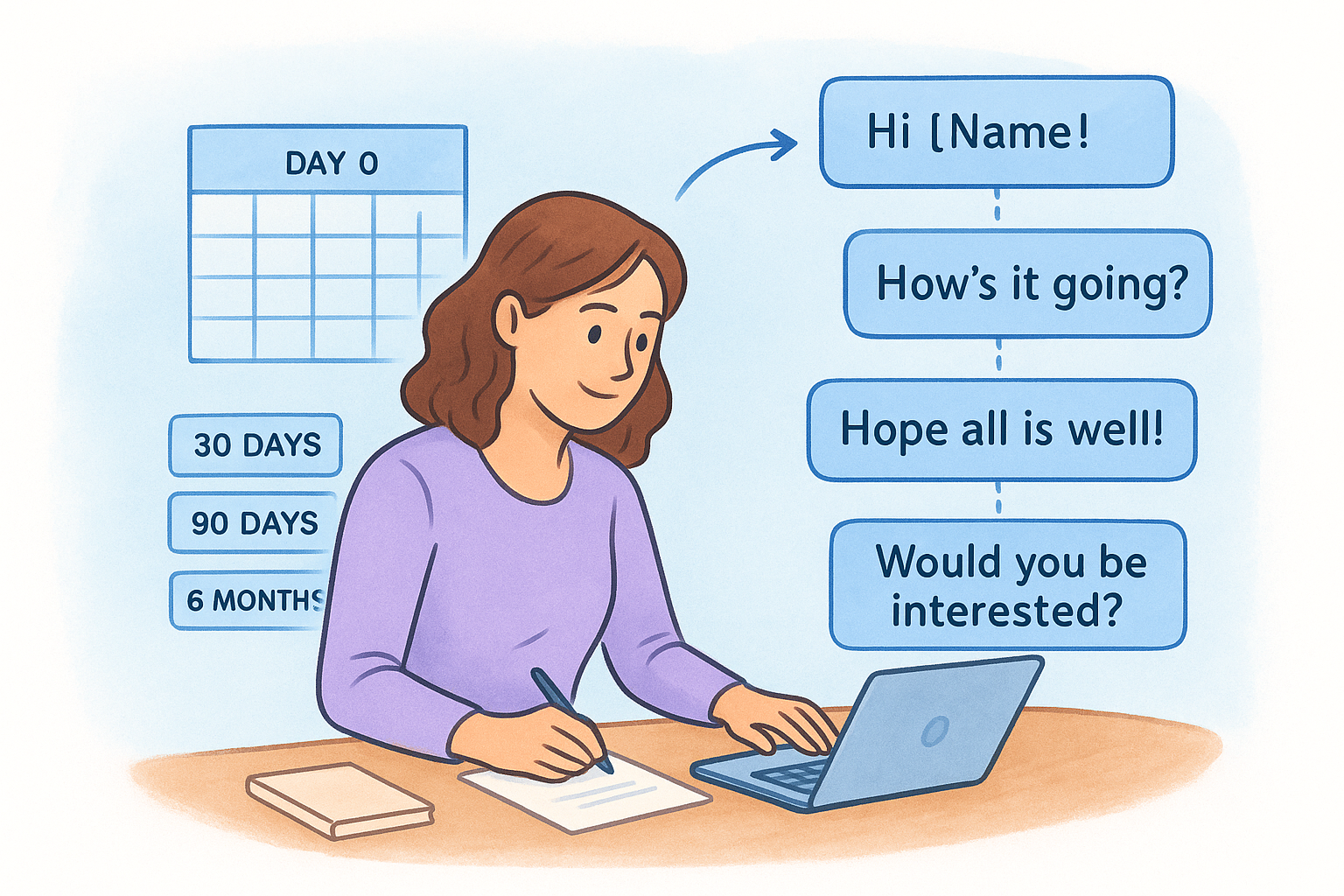
Here's a cadence template your team can follow:
| Touchpoint | Timing | Message type |
|---|---|---|
| Initial add to pool | Day 0 | Brief intro, no role pitch |
| First follow-up | 30 days | Share relevant company news or insight |
| Check-in | 90 days | Ask about their current situation |
| Re-engagement | 6 months | Mention a relevant opening if one exists |
Keep messages short and specific to the person. Reference their skills or background in one line. A two-sentence message that feels personal gets a higher response rate than a detailed pitch that clearly went to fifty people.
Candidates who hear from you consistently before a role opens are far more likely to respond quickly when one does.
Stay compliant with data privacy rules
Data privacy is not optional, and it's one of the most overlooked parts of building a talent pool. If you're storing candidate information, especially across international markets like India and the US, you need to follow applicable data protection rules. In the US, this includes understanding FTC guidelines and state-level privacy laws like the CCPA for California-based candidates. In India, the Digital Personal Data Protection Act (DPDPA) governs how you collect and store personal data.
Practically, this means getting [explicit consent](https://olibr.com/blog/candidate-experience-best-practices) from every candidate before storing their record, documenting how and when you obtained that consent, and giving candidates a clear way to request removal. Build a consent log into your ATS from the start. Retrofitting compliance onto an existing pool is significantly harder than building it in from day one.
Step 6. Measure talent pool health and improve
A talent pool that nobody measures decays quietly. Candidates go stale, segments grow unbalanced, and your team keeps adding records without ever asking whether the existing ones are working. Measuring pool health turns your database from a static archive into a living system that gets more useful over time.
Track the right metrics
Most teams track time-to-hire at the company level but never break it down by sourcing channel or candidate origin. That gap hides the real value of your talent pool. When you know how to build a talent pool that improves each quarter, you track specific numbers that tell you whether the pool is actually shortening your hiring cycles or just growing in size.
A large pool with poor candidate quality is harder to use than a smaller pool where every record is scored and current.
These are the four metrics that matter most:
| Metric | What it tells you |
|---|---|
| Pool-to-hire rate | What percentage of hires came from existing pool candidates vs. new applicants |
| Time-to-contact | How many days pass between a role opening and your first outreach to a pool candidate |
| Candidate recency | What percentage of your pool records have been contacted in the last 6 months |
| Segment coverage | Whether each priority role segment has at least 20-30 active, scored candidates |
Review these numbers monthly, not quarterly. Monthly visibility lets you catch a coverage gap or a drop in pool-to-hire rate early enough to act before a role opens and you're scrambling.
Run a quarterly pool audit
Every three months, set aside time to clean your data. Mark candidates who haven't responded to two consecutive outreach attempts as inactive rather than leaving them in your active segment. Remove records with missing skills tags or scores. Identify which segments are understaffed and redirect sourcing effort toward them.
Use this simple audit checklist:
- Candidates not contacted in 6+ months: move to inactive status
- Records missing skills tags or a score: either complete them or remove them
- Segments with fewer than 20 scored candidates: flag for sourcing priority
- Candidates who changed roles since last contact: update their record with current title and company
Running this quarterly audit keeps your pool accurate and ensures your team trusts the data enough to use it when a role opens.
Next steps
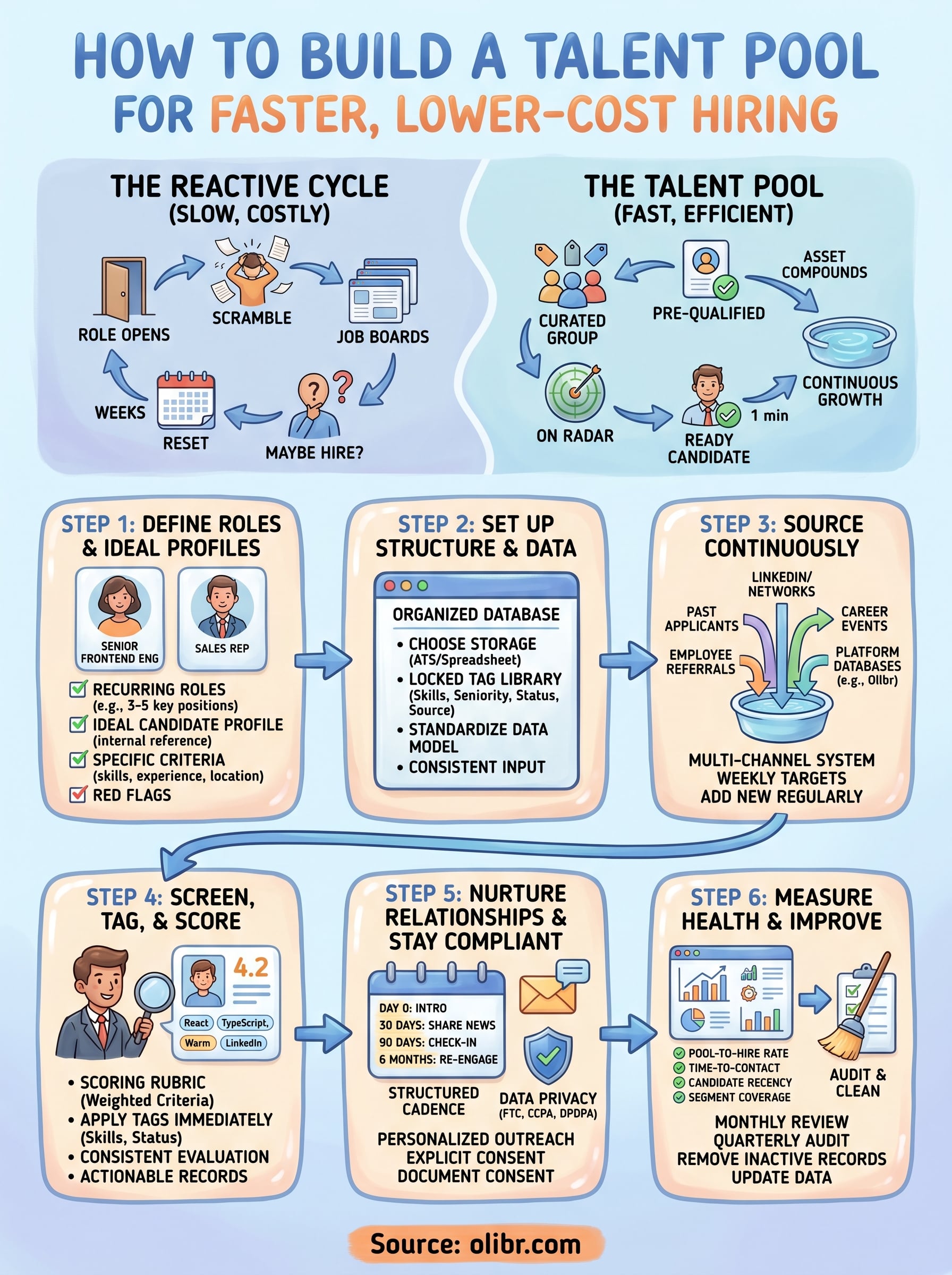
You now have a complete system for how to build a talent pool that cuts hiring time, reduces cost per hire, and keeps your pipeline full between open roles. The six steps in this guide work together: clear candidate profiles feed clean data, clean data makes sourcing meaningful, and consistent nurture turns sourced candidates into hires you can close quickly. None of it requires a large budget, just a repeatable process and the right infrastructure to support it.
The fastest way to start is to pick your top two recurring roles, build their ideal candidate profiles today, and begin adding scored records this week. If you want a platform that handles the sourcing database, AI matching, and candidate tracking without a monthly subscription, start building your talent pool on Olibr. With 180,000+ searchable candidate profiles and AI-powered screening built in, you can skip the slow ramp and start hiring smarter from day one.
For hiring teams
Search 180,000+ candidate profiles — free.
Olibr is a community-funded recruiting platform: full ATS, AI interviews, and a shared resume database. No per-seat fees.