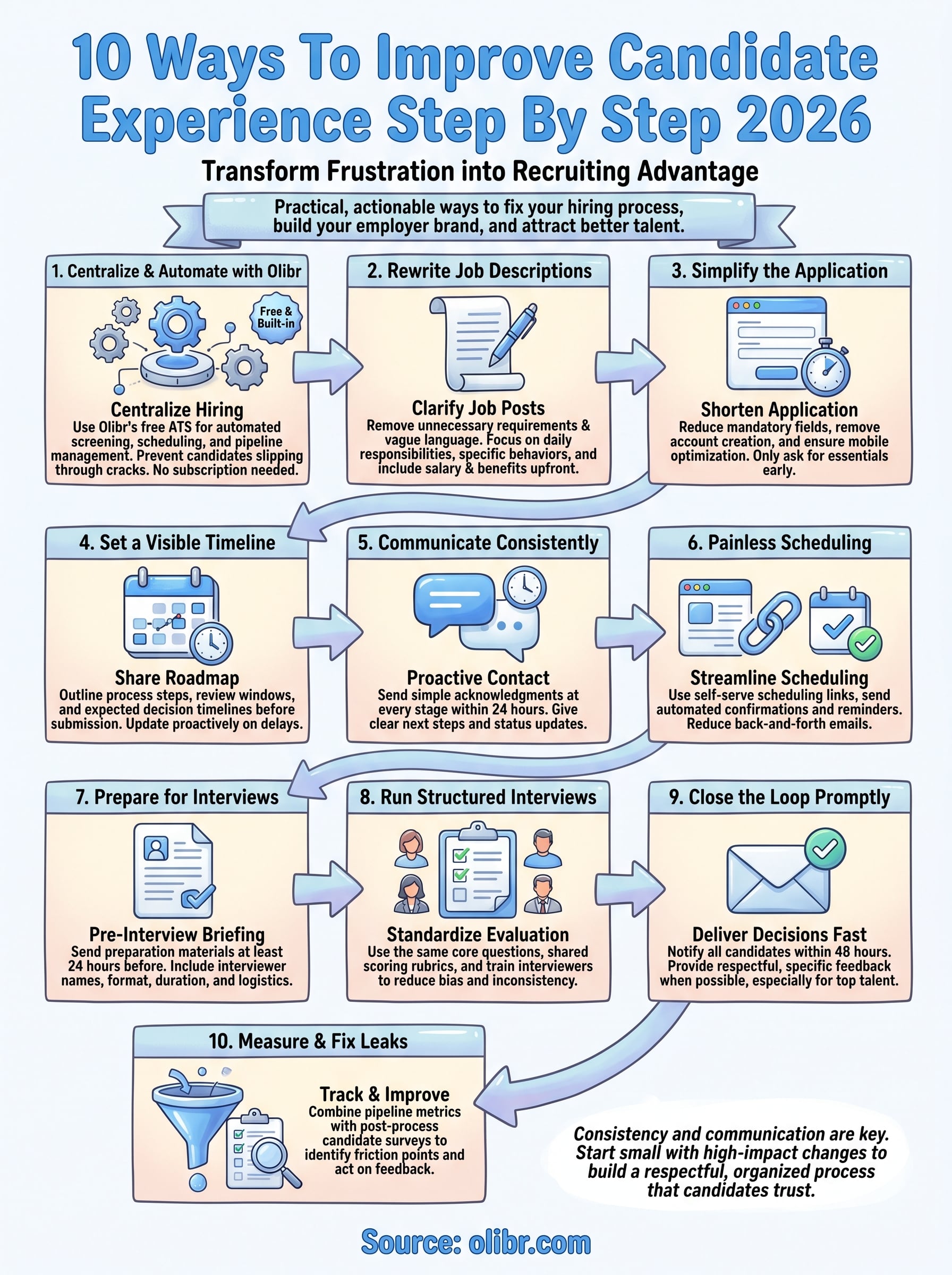
10 Ways To Improve Candidate Experience Step By Step 2026
Most recruiters think their hiring process is smooth. Candidates disagree. Research consistently shows a major gap between how companies perceive their recruitment process and how applicants actually experience it. If you want to know how to improve candidate experience, start by accepting that your current process probably frustrates more people than it impresses, and that every frustration costs you talent.
A poor experience doesn't just lose you one candidate. It ripples outward through reviews on Glassdoor, conversations with peers, and decisions to never apply again. On the flip side, candidates who feel respected during hiring, even if they don't get the job, are more likely to refer others and reapply later. That's a recruiting advantage you can't buy with a bigger job ad budget.
This guide breaks down 10 practical ways to fix the parts of your hiring process that drive candidates away. Each step is something you can act on immediately, whether you're a solo recruiter or part of a larger talent acquisition team. And if you're using a platform like Olibr, where AI-powered interviews, automated screening, and a full ATS come built in at no cost, you already have the tools to put most of these improvements into practice right away.
1. Use Olibr to centralize and automate hiring
When your hiring process runs across spreadsheets, email threads, and disconnected tools, candidates slip through the cracks and your team loses context fast. Olibr pulls everything into one place: job postings, a candidate database with 180,000+ profiles, AI-powered screening, interview scheduling, and pipeline management, all free with no subscription required.
What this improves in the candidate journey
Scattered tools create delays that candidates actually feel. When a recruiter has to dig through emails to find where someone left off, responses slow down, and the candidate starts to wonder if anyone is paying attention. Olibr's centralized ATS gives every team member a clear view of where each applicant stands, so no one waits longer than necessary for an update. If you're working through how to improve candidate experience at scale, removing this kind of internal disorganization is one of the highest-impact moves you can make.
A unified hiring system removes delays that candidates notice but never tell you about.
How to set it up step by step
Getting started on Olibr takes less time than you'd expect, and you don't need to disrupt your existing workflow to make the switch. The bulk resume upload with AI parsing means you can bring your current candidate database in immediately, while the built-in ATS handles pipeline tracking from your very first job post. Follow this order:
- Create your free account and complete your company profile on Olibr.
- Upload your existing resume database using the bulk upload feature with AI parsing.
- Post your open roles with structured descriptions and configure your pipeline stages.
- Use the AI matching tool to shortlist candidates based on fit, not just keywords.
- Schedule AI-conducted interviews through the platform and review the automated scoring reports.
- Assign team roles and permissions so every recruiter sees the right information at the right time.
Metrics to track in Olibr
Once your process runs through Olibr, you can measure what actually matters. Time-to-shortlist tells you how quickly your screening moves from application to a qualified candidate list. Track candidate response rate to outreach messages, which signals whether your initial communication lands well. You should also monitor your pipeline conversion rate at each stage to spot where candidates stop progressing and whether that pattern points to a process problem or a fit problem.
2. Rewrite job descriptions for clarity and fit
A confusing job description is where bad candidate experience often begins. When candidates can't tell what the role involves or whether they're a real fit, they either skip applying or submit without confidence, which wastes everyone's time. Clear, honest job posts attract better-matched applicants and set accurate expectations before anyone clicks apply.
What to change in every job post
Most job descriptions carry unnecessary requirements and vague language that push qualified candidates away. Audit every post and remove anything that doesn't directly affect job performance. Cut inflated "nice-to-have" skill lists that make the bar look impossibly high, and drop corporate filler that tells candidates nothing about the actual work.
A job post is your first real communication with a candidate, and it signals whether your company respects their time.
- Remove degree requirements unless the role legally demands them
- Reduce required years of experience to what actually reflects job complexity
- Replace vague phrases with specific behaviors and day-to-day responsibilities
- Include salary range and core benefits upfront so candidates can self-select accurately
How to write a clear, candidate-friendly description
Structure the post so candidates can scan it in under two minutes and know whether to apply. Lead with what the role does daily, then list requirements, then compensation and team context. Keeping each section short and specific is one of the most direct ways to improve candidate experience at the top of your funnel.
Metrics to track
Track your application-to-qualified-candidate rate to see if descriptions attract people who actually fit the role. Watch time-on-page for your job listings through your careers site analytics to gauge whether candidates read fully or leave early.
3. Shorten and simplify the application
A long application process is one of the fastest ways to lose strong candidates before your team ever meets them. When you ask for too much too early, people abandon mid-form and apply somewhere else. If you're serious about how to improve candidate experience, trimming your application to what you genuinely need is one of the most immediate changes you can make.
Where candidates usually drop off
Most applications lose qualified people at predictable points. Watch for these common drop-off triggers:
- Mandatory account creation before submitting a resume
- Forms that require manually re-entering data already in the uploaded file
- Long assessments placed at the first stage, before any human interaction
- Non-mobile-optimized layouts that frustrate candidates applying from their phones
Every extra step in your application is a decision point where a qualified candidate can choose to walk away.
How to reduce friction step by step
Cutting your application to the bare essentials keeps more qualified people moving through your funnel. Work through these changes in order:
- Reduce required fields to name, contact details, and resume upload only
- Remove mandatory account creation before submission
- Confirm your form works cleanly on mobile devices
- Move assessments and additional screening questions to later stages
- Display a clear estimated completion time at the top of the form
Metrics to track
Watch these three numbers to measure how well your simplified application performs. If any stagnate, revisit the specific step where candidates exit.
- Application completion rate
- Drop-off rate by device type
- Average time to complete the form
4. Set expectations with a visible hiring timeline
Candidates don't mind waiting. They mind not knowing how long they'll wait. When your process runs without any transparency, your strongest applicants accept competing offers while you're still reviewing applications. One of the most underused answers to how to improve candidate experience is simply telling people what comes next before they have to ask.
What to share at each stage
Give candidates a clear picture of your process before they submit their application. Outline every step so they know exactly what's coming and when to expect contact from your team. At minimum, share the following at the application confirmation stage:
- Application review window
- Screening call or assessment stage
- Interview rounds and format
- Expected decision timeline
How to build a simple hiring roadmap
You don't need a complex system to pull this off. A one-page hiring roadmap sent in your confirmation email covers the basics. List each stage, the typical duration, and who contacts the candidate at each step. Update candidates immediately when your timeline shifts, because small adjustments communicated proactively show far more respect for their time than silence followed by a delayed apology.
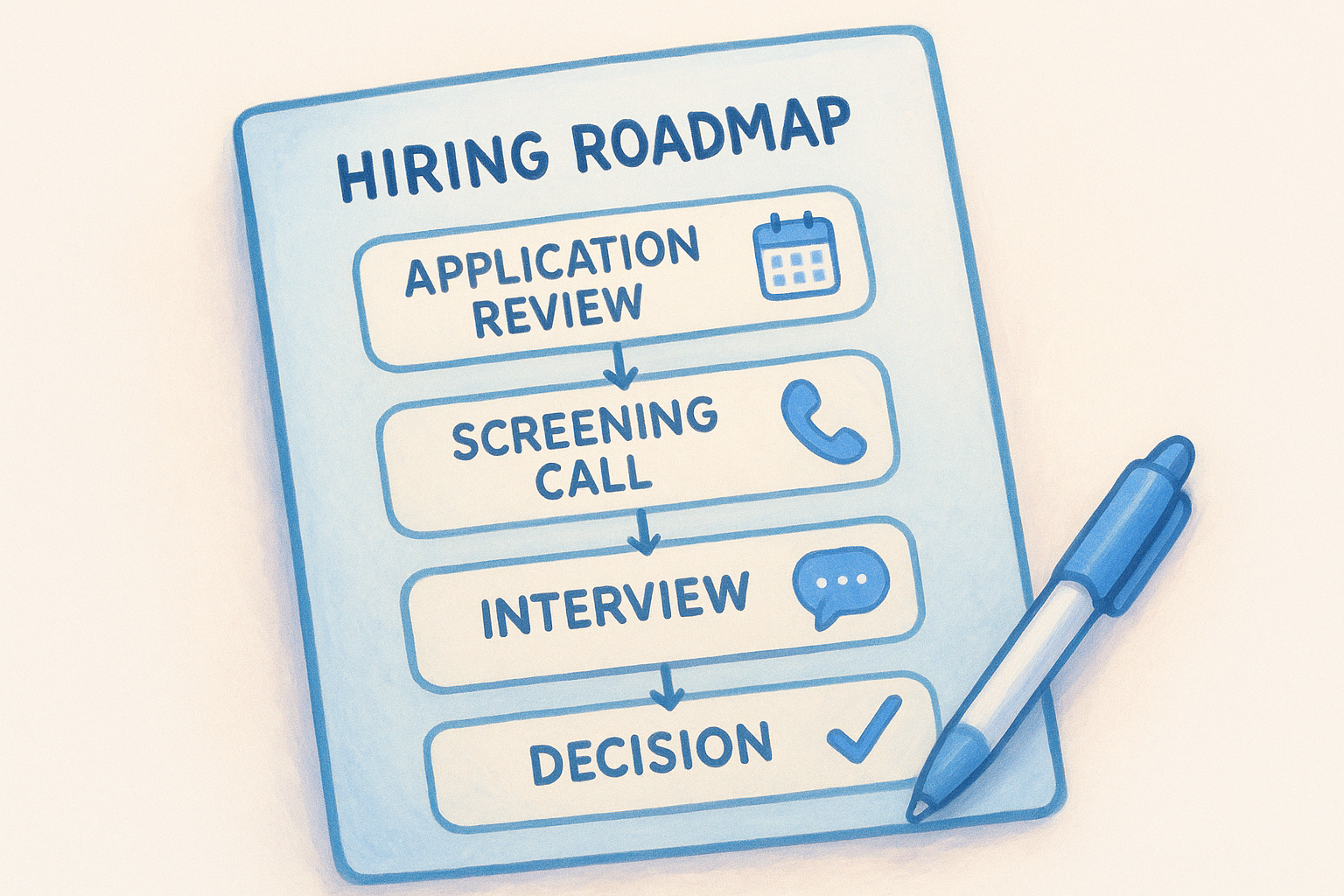
Candidates who know what to expect stay engaged longer and are far less likely to accept competing offers mid-process.
Metrics to track
Track your offer acceptance rate to see whether timeline transparency keeps top candidates engaged through to the end. Monitor your stage-to-stage drop-off rate as well, since sudden drops often reveal where communication gaps are pushing people out of your funnel rather than poor candidate fit.
5. Communicate consistently with fast response times
Silence is one of the biggest complaints candidates have about hiring. When your team goes quiet after an application or interview, candidates assume the worst and start pursuing other roles. If you want to know how to improve candidate experience, consistent, proactive communication is one of the most impactful changes you can make, and it costs you almost nothing.
What candidates want to hear and when
Your applicants want acknowledgment at every stage, not just when you have a final decision. They need to know their application arrived, when to expect a response, and where they stand after each interaction. A simple status update sent within 24 hours of any activity keeps candidates engaged and signals that your team is organized and respectful of their time.
Candidates who feel informed stay in your pipeline longer and accept offers at higher rates.
How to create a communication cadence step by step
Build a repeatable communication schedule so nothing slips through. Follow this order to keep every applicant informed from start to finish:
- Send an automated confirmation within minutes of application submission
- Deliver a screening outcome within 3 business days
- Follow up after each interview within 48 hours with a clear status note
- Notify all candidates of final decisions, including those not selected
Metrics to track
Track your average response time per stage to see where delays cluster in your process. Monitor your candidate satisfaction score collected through post-process surveys, and watch your offer acceptance rate as a downstream signal of how well your communication holds up throughout hiring.
6. Make scheduling painless for candidates
Scheduling is one of the most friction-heavy parts of hiring, and most teams underestimate how much damage it causes. When candidates send multiple emails back and forth just to lock in a 30-minute call, they form negative impressions before the interview even begins. If you're thinking through how to improve candidate experience, fixing your scheduling process is a fast, high-impact change that directly reduces drop-off at a critical stage.
Common scheduling problems that ruin experience
Poor scheduling shows up in predictable patterns your team can spot and correct quickly. Watch for these common friction points that push qualified candidates away mid-process:
- Requiring candidates to email your team to request a slot
- Sending unavailable time windows or asking candidates to propose their own times without structure
- Rescheduling interviews at short notice without a clear explanation
- Using slow email chains to coordinate across multiple interviewers
How to run scheduling smoothly step by step
Removing back-and-forth from your scheduling gives candidates a faster, cleaner experience and saves your recruiters real time. Follow these steps to tighten up your process:
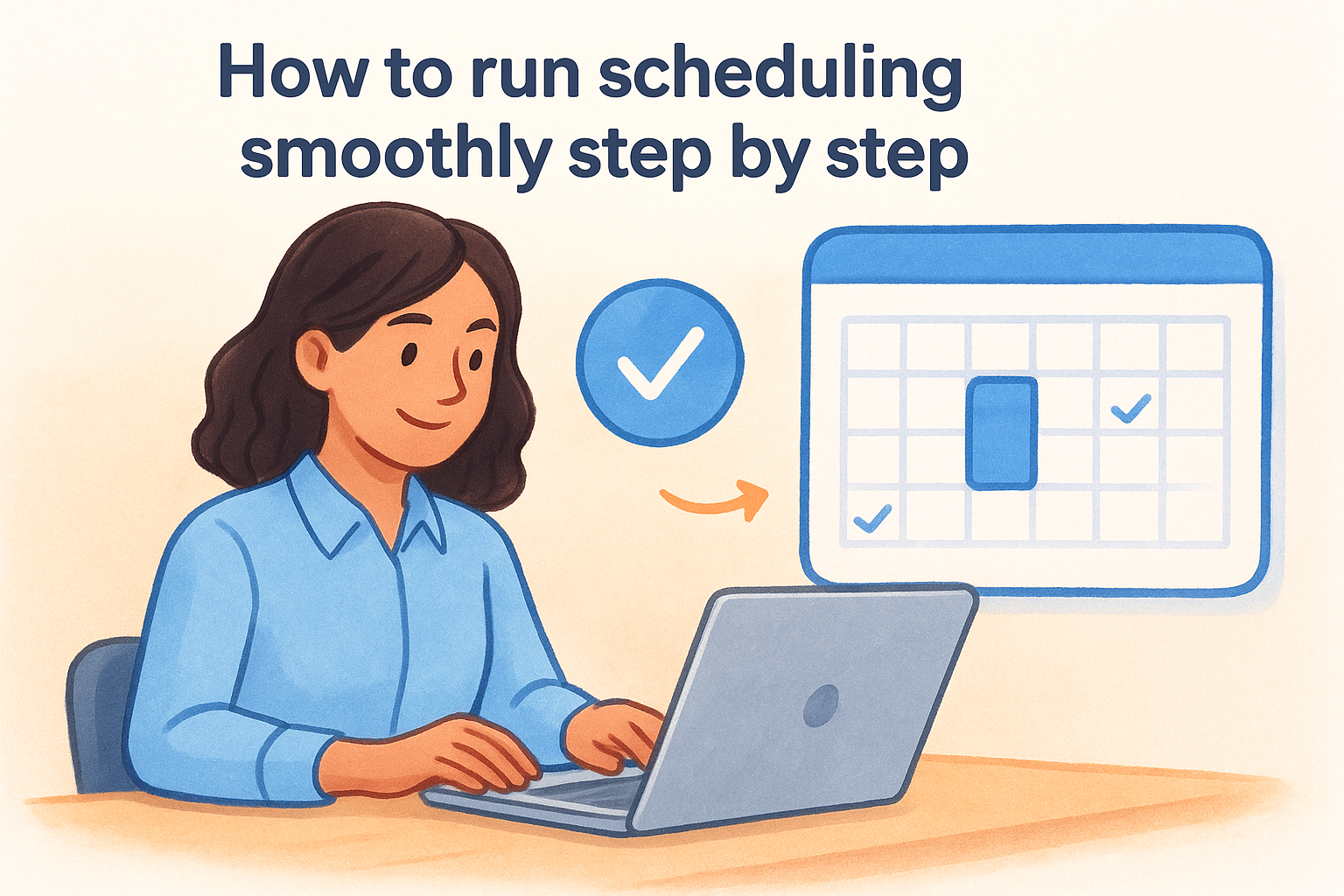
- Share a self-serve scheduling link with every interview invitation
- Keep your calendar availability updated so candidates see accurate open slots
- Send automated confirmation and reminder messages 24 hours before each interview
- Build a standard rescheduling policy and communicate it upfront
Candidates who can schedule without friction are more likely to show up prepared and engaged.
Metrics to track
Watch your interview no-show rate as the clearest signal that scheduling friction is causing problems. Also track your average scheduling lead time, the number of days between sending an invitation and confirming a slot, since a long lead time often points to unnecessary steps in your process.
7. Prepare candidates for interviews and assessments
Sending a candidate into an interview without preparation materials sets them up to perform below their actual ability. This hurts both sides: you get an inaccurate read on their skills, and they leave with a negative impression of your company. One of the most overlooked answers to how to improve candidate experience is simply giving candidates what they need to show up ready.
What to send before each interview
Your preparation email should go out at least 24 hours before the scheduled interview and cover everything a candidate needs to walk in confident. Keep it specific and practical rather than generic.
- Interviewer names and brief bios
- Interview format (panel, one-on-one, case study, or technical test)
- Estimated duration for each stage
- Any tools or materials they should bring or have ready
- Logistics: video link, office location, or access instructions
How to help candidates prepare without bias
Sharing clear role expectations before an interview doesn't give candidates an unfair advantage; it gives every candidate an equal one. Send a brief summary of the competencies or topics the interview will cover so prepared candidates can demonstrate genuine ability rather than rely on luck.
Candidates who know what to expect in an interview show up more confident, which gives you a more accurate read on their actual skills.
Avoid sharing specific questions, but outlining the areas of focus keeps your process fair and your results more reliable. This also signals respect for their time, which feeds directly into a stronger overall impression of your company.
Metrics to track
Track your interview completion rate to see whether sending preparation materials reduces no-shows. Also monitor your post-interview candidate satisfaction score to measure whether candidates felt informed and respected throughout the process.
8. Run structured, respectful interviews every time
Unstructured interviews introduce bias and inconsistency that candidates can feel, even when they can't name it. When different interviewers ask different questions and score candidates on gut instinct alone, your evaluations become unreliable and your process feels arbitrary to anyone sitting in the hot seat. If you're thinking through how to improve candidate experience, standardizing what happens inside the interview room is one of the most direct fixes available.
What a structured interview looks like
A structured interview means every candidate for the same role answers the same core questions in the same order, evaluated against the same scoring criteria. This removes the random variation that makes one candidate's experience feel completely different from another's.
Candidates who go through a fair, consistent interview are more likely to trust your process, regardless of the outcome.
Your interviewers should open with a clear agenda, tell candidates how long each section runs, and leave time at the end for candidate questions. Starting on time and ending on time is a small signal that carries real weight.
How to train interviewers and standardize scoring
Build a shared scoring rubric tied to the specific competencies the role requires, and make sure every interviewer reviews it before the session. Run short calibration sessions where your team scores sample answers and discusses where they land, which closes gaps in interpretation before they affect real candidates.
Metrics to track
Track your interviewer consistency score by comparing ratings across interviewers for similar candidates. Also monitor your post-interview candidate satisfaction score to catch patterns where specific interviewers or formats consistently score lower.
9. Close the loop with decisions and feedback
Leaving candidates in silence after a final interview is one of the most damaging things your team can do. Whether someone gets the job or not, every applicant deserves a clear answer in a reasonable timeframe. Closing the loop properly is a core part of how to improve candidate experience, and it's one of the simplest wins available to any hiring team.
How to reject candidates without damaging trust
A rejection handled well preserves your employer brand and keeps the door open for future applications. Send your decision within 48 hours of making it, and use a message that's brief, respectful, and personal enough that it doesn't read like a form letter. Avoid vague phrases like "we've decided to move forward with other candidates" that carry no context and leave the person with nothing useful.
Candidates who receive a respectful rejection are far more likely to reapply and recommend your company to others.
How to deliver fast decisions and useful feedback
Speed matters as much as honesty here. Notify your top candidates first so you don't lose them to competing offers while you finalize internal approvals. For candidates who request feedback, give them specific, actionable observations tied directly to the role requirements rather than generic comments that tell them nothing about where they actually stood.
Metrics to track
Track your time-to-decision from final interview to candidate notification as your primary signal for responsiveness. Also monitor your rejected candidate reapplication rate over time, since candidates who return are a direct indicator that your closing process left a genuinely positive impression on them.
10. Measure candidate experience and fix the leaks
You can't fix what you don't measure. Most hiring teams make changes based on instinct rather than data, which means the same friction points keep costing them candidates without anyone spotting the pattern. Knowing how to improve candidate experience at a structural level starts with building a feedback loop that catches problems before they become habits.
What to measure across the funnel
Your funnel data tells you where candidates stop engaging, but it doesn't always tell you why. Combine quantitative pipeline metrics with direct candidate feedback to get a complete picture of where your process holds up and where it breaks down.
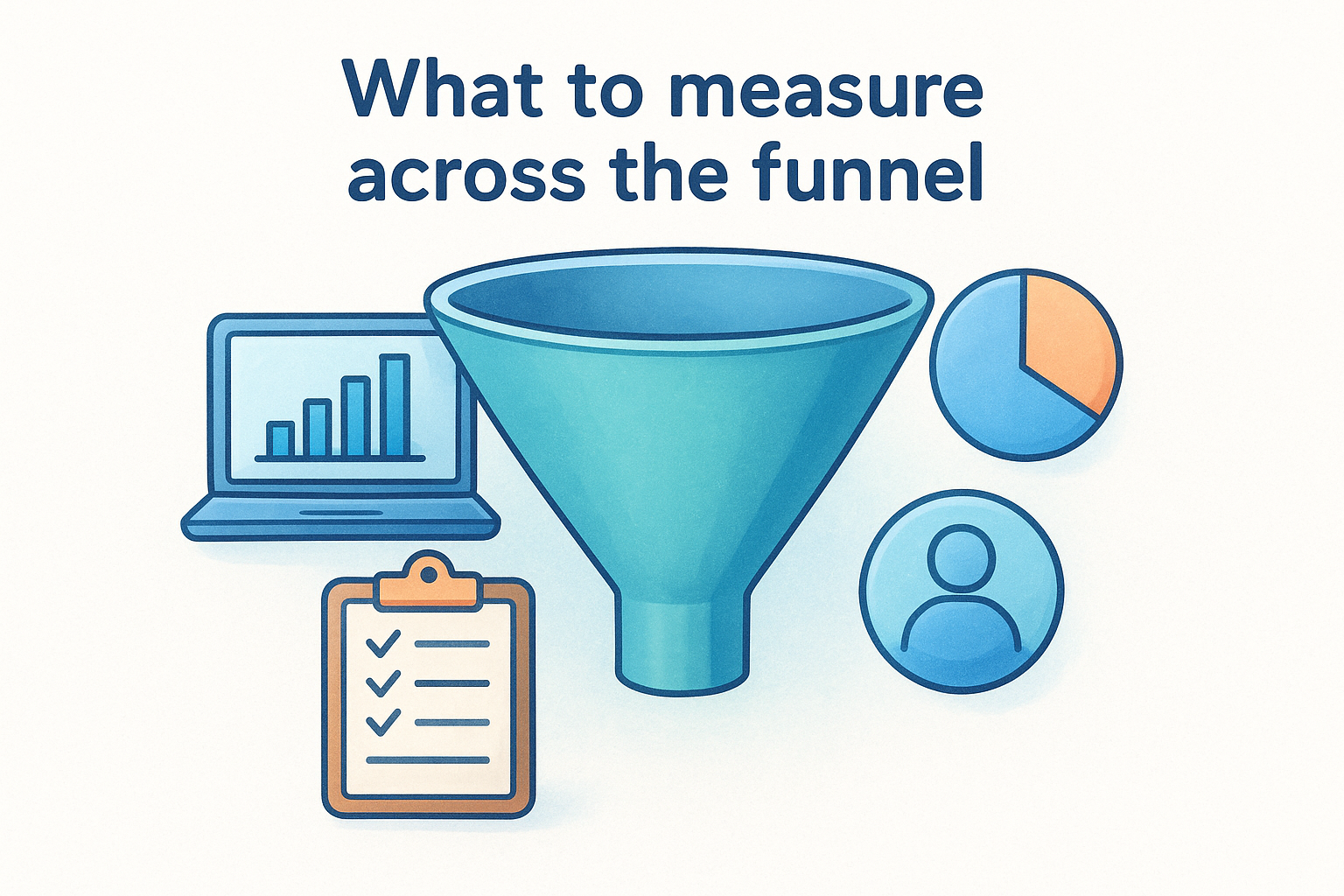
- Application completion rate by device and source
- Stage-to-stage conversion rate across your full pipeline
- Average time spent at each hiring stage
- Offer acceptance rate compared to total offers extended
How to collect feedback and act on it
Send a short post-process survey to every candidate who reaches the interview stage, regardless of outcome. Keep it under five questions and focus on specific touchpoints rather than general impressions.
Candidates who didn't get the job often give your most honest feedback, and that feedback is where your real improvement opportunities live.
Ask about communication clarity, scheduling ease, interview structure, and overall respect for their time. Review responses monthly with your hiring team, identify the two or three issues that appear most often, and assign a specific owner to each fix.
Metrics to track
- Candidate Net Promoter Score (cNPS) from post-process surveys
- Survey response rate as a signal of overall candidate engagement
- Time to resolve identified process issues after feedback review
What to do next
You now have a clear, step-by-step picture of how to improve candidate experience across every stage of your hiring process. The gap between a frustrating process and a respectful one rarely comes down to budget. It comes down to consistency, communication, and the right tools running in the background so nothing slips through.
Start with the changes that create the most immediate impact: simplify your application, set a visible hiring timeline, and close every loop with a real decision. Then build out your measurement system so you can spot friction before it costs you candidates you actually want.
If you want to put most of this into practice without adding new costs to your recruiting budget, Olibr gives you a full ATS, AI-powered screening, and automated interviews for free. There are no feature gates and no subscription tiers. Start hiring smarter with Olibr and give every candidate the experience your employer brand depends on.
For hiring teams
Search 180,000+ candidate profiles — free.
Olibr is a community-funded recruiting platform: full ATS, AI interviews, and a shared resume database. No per-seat fees.