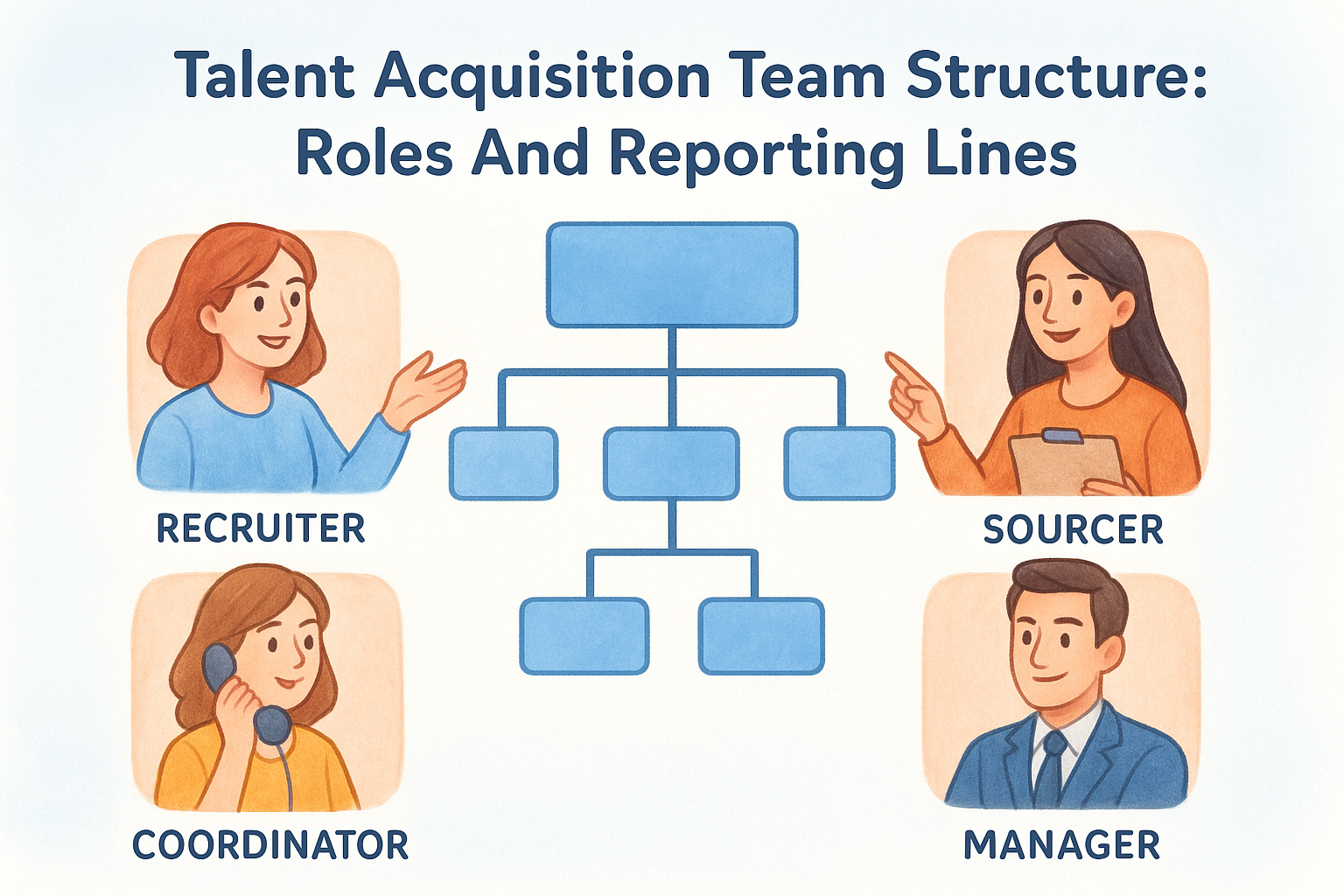
Talent Acquisition Team Structure: Roles And Reporting Lines
A recruiting function is only as effective as the people running it, and how those people are organized matters more than most leaders realize. Whether you're building a hiring team from scratch or restructuring one that's outgrown its original design, getting your talent acquisition team structure right determines how quickly you fill roles, how well candidates experience your process, and how much budget you burn along the way.
The problem is, there's no single "correct" org chart. Team size, hiring volume, and geographic reach all shape what works. A five-person startup team needs a fundamentally different setup than a 50-recruiter enterprise operation spanning multiple countries. The roles change, the reporting lines shift, and the specializations deepen.
This guide breaks down the core roles found in high-performing TA teams, the most common reporting hierarchies, and the organizational models you can adopt based on your company's stage and needs. We also cover how platforms like Olibr fit into the picture, giving lean teams access to AI-powered sourcing, interviews, and candidate matching without adding headcount or subscription costs, so your structure can stay efficient even as hiring demands grow.
What team structure means in talent acquisition
Team structure is the map that tells every person on your recruiting team what they own, who they answer to, and how decisions get made. Without it, recruiters overlap on the same candidates, hiring managers receive inconsistent service, and no one knows who owns the offer stage. A well-designed talent acquisition team structure defines roles clearly enough that work moves forward without someone manually routing every task every day.
Why structure affects hiring outcomes
Structure shapes outcomes more directly than most hiring leaders expect. When roles are unclear, time-to-fill stretches because tasks bounce between people who each assume someone else is handling them. When reporting lines are blurry, accountability disappears and it becomes nearly impossible to identify what's broken when a hire falls through or a candidate drops off mid-process.
A recruiting team where everyone recruits for everything and no one owns any specific piece rarely performs at a high level, regardless of how talented the individuals are.
Consider a 10-person TA team with no defined specializations. Sourcers spend half their day scheduling interviews because no coordinator role exists. Senior recruiters handle both executive searches and high-volume hourly roles because the team has no segment separation. The VP of Talent gets pulled into offer negotiations that a recruiter should own. Structure prevents each of these problems by making role boundaries explicit and workflow handoffs predictable. When you draw clear lines around ownership, work stops falling through the gaps.
The three dimensions of TA structure
Your team structure operates across three dimensions simultaneously: role design, reporting hierarchy, and operational model. Each dimension affects a different part of how work actually moves through your function.

Role design defines what each person is responsible for, what skills they need, and what outcomes they're accountable for. Reporting hierarchy defines who manages whom, how teams group together, and where decisions escalate when there's a disagreement or a gap. The operational model defines whether your team is centralized, decentralized, or a hybrid, which determines how recruiters align to specific business units and geographies.
You can have strong role design but a weak operational model and still end up with serious misalignment between your recruiting team and the business it serves. All three dimensions need to work together. A useful way to think about it: role design answers "who does what," reporting hierarchy answers "who is accountable," and the operational model answers "how does this connect to the rest of the business."
What a structure actually controls
Structure directly controls four operational outcomes: speed, quality, consistency, and cost. Speed improves when handoffs between roles are clearly defined and no one waits for permission to move a candidate to the next stage. Quality improves when specialists own specific parts of the funnel instead of generalists handling everything with variable depth and results.
Consistency improves when every hiring manager across the business gets a recruiter who follows the same intake process, uses the same structured interview kit, and communicates at the same cadence. Cost drops when you eliminate role overlap, reduce time-to-fill, and avoid relying on external agency fees to cover gaps that a better-structured internal team would have handled directly.
Your structure also determines how quickly your team scales. A team built entirely around generalist recruiters is harder to scale because adding headcount to a generalist model doesn't automatically increase throughput in any specific area. A structured team with defined specialist roles can add a coordinator, a sourcer, or a segment-specific recruiter and immediately see the impact in that exact part of the funnel. Clarity in structure makes growth predictable rather than chaotic, and that predictability is what separates high-performing TA functions from ones that constantly feel like they're catching up.
Core TA roles and what they own
Every effective talent acquisition team structure includes a defined set of roles with specific ownership areas. When you know exactly what each person controls, handoffs get clean and accountability becomes traceable. The table below shows the four core roles most TA teams build around, followed by specifics on what each role actually owns day-to-day.
| Role | Primary ownership |
|---|---|
| Recruiter / TA Partner | Full-cycle hiring for assigned requisition load |
| Sourcer | Top-of-funnel pipeline generation |
| Recruiting Coordinator | Scheduling, logistics, candidate communication |
| TA Manager / Director | Team performance, process design, stakeholder alignment |
Recruiter or TA partner
The recruiter owns the candidate experience from intake to offer. That means running the intake meeting with the hiring manager, reviewing or writing the job description, moving qualified candidates through the pipeline, and owning the offer conversation. Recruiters should control their requisition load fully, meaning no routing standard updates or feedback collection to managers for tasks a recruiter can handle directly.
In a structured team, each recruiter typically carries between 15 and 25 active requisitions, depending on role complexity. A recruiter filling senior engineering positions manages fewer reqs than one filling high-volume customer support roles, because the interview depth and stakeholder coordination are heavier.
Sourcer
The sourcer's job is to build pipeline before a recruiter even needs it. They own Boolean searches, outreach sequences, and talent pool maintenance for roles that require proactive hunting rather than inbound applications. Sourcers hand off candidates to recruiters only after an initial qualifying conversation confirms basic fit.
The sourcer-to-recruiter handoff is one of the most critical boundaries you can define, because unclear ownership here creates duplicate outreach and a fractured candidate experience.
Recruiting coordinator
The coordinator owns all scheduling, interview logistics, and candidate communication that doesn't require a recruiter's direct judgment. Offloading these tasks from recruiters to a dedicated coordinator saves each recruiter roughly five to eight hours per week. Common coordinator tasks include:
- Sending and confirming interview calendar invites
- Collecting structured feedback from interviewers after panels
- Managing offer letter workflows and DocuSign routing
- Updating ATS candidate statuses and pipeline stages
TA manager or director
The TA manager owns team performance, process health, and the relationship with HR and business leadership. They run weekly pipeline reviews, own decisions around the TA tech stack, and act as the escalation point when a hiring manager and recruiter disagree on a candidate assessment. In smaller teams, this person often carries a requisition load as well, but as the team grows past six to eight recruiters, a full-time leadership focus becomes necessary to maintain consistency across the function.
Common TA org models and reporting lines
How your talent acquisition team structure maps to the business determines whether recruiters stay aligned with hiring manager needs or drift into an isolated function. Three org models dominate most recruiting organizations, and your company's size, geographic footprint, and hiring volume will push you toward one of them.

Centralized TA model
In a centralized model, all recruiters report up through a single TA function and get assigned to business units as needed, rather than embedded within them permanently. The head of TA owns all hiring standards, tools, processes, and budget decisions in one place. This gives you strong consistency across the business: every candidate moves through the same intake process, every hiring manager gets the same service level, and you can redeploy recruiters quickly when one part of the organization spikes in hiring volume.
This model works best when your company is under 500 employees or when hiring needs are fairly uniform across teams. The tradeoff is that centralized teams can feel slow to business leaders who want a recruiter who deeply understands their specific domain rather than rotating in from a shared pool.
Decentralized TA model
In a decentralized model, recruiters sit directly inside business units and report to the functional leader or a local HR business partner, not to a central TA head. An engineering recruiter reports into the engineering org, for example. This builds deep domain expertise and tight hiring manager relationships because the recruiter lives inside the function they support day-to-day.
The cost of decentralization is fragmentation: each team builds its own process, tools multiply, and you lose the ability to shift headcount across business units when hiring priorities change.
This model is common in large enterprises above 2,000 employees where each division operates nearly as an independent company and the speed advantage from domain embeddedness outweighs the coordination overhead.
Hybrid center of excellence model
The hybrid model keeps a central TA team that owns process standards, technology, employer branding, and reporting while embedding individual recruiters or small pods within business units for day-to-day relationship management. Embedded recruiters follow the central team's playbook but maintain tight loops with their assigned functions. This structure captures the consistency benefit of a centralized model alongside the partnership quality of a decentralized one.
Reporting lines in this model typically run dual-track: embedded recruiters carry a dotted line to the central TA leader and a solid line to the HR business partner supporting their unit, or the reverse depending on where you want decision authority to sit. This model fits mid-size companies between 500 and 2,000 employees best, where neither a fully centralized nor fully decentralized approach handles the range of hiring demands cleanly on its own.
How to size your TA team and add roles
Sizing your talent acquisition team structure starts with one number: annual hiring volume. Before you decide how many recruiters you need or which specialist roles to add, you need a clear count of how many hires you expect to make in the next 12 months, broken down by role type and complexity. Without that baseline, you end up either understaffed and burning out your team or overstaffed and creating a budget problem you'll need to fix later.
Start with a recruiter-to-hire ratio
The standard benchmark for a full-cycle recruiter is 40 to 60 hires per year for mid-complexity roles like software engineers, account executives, or operations managers. For high-volume roles such as customer support or warehouse staff, one recruiter can manage 80 to 120 hires annually because the process is shorter and more repeatable. Executive and highly specialized technical searches drop that number closer to 20 to 30 hires per year given the depth of sourcing and stakeholder coordination involved.
Use these ranges as a starting point, not a fixed rule. Your actual capacity will vary based on how much coordinator support each recruiter has and how efficient your ATS and sourcing tools are.
Use the table below to calculate your baseline recruiter count:
| Hire type | Annual hires | Hires per recruiter | Recruiters needed |
|---|---|---|---|
| Mid-complexity roles | 120 | 50 | 2.4 |
| High-volume roles | 200 | 100 | 2.0 |
| Executive / specialized | 20 | 25 | 0.8 |
| Total | 340 | 5.2 (round to 6) |
Round up rather than down, because time-to-fill pressure and unexpected attrition will consume any slack you thought you had in the model.
When to add specialist roles
Adding specialist roles follows a clear trigger: when a generalist recruiter spends more than 30% of their week on a task that doesn't require their direct judgment, that task needs a dedicated owner. The four most common addition triggers are:
- Sourcing load exceeds inbound: Add a dedicated sourcer when more than half your open roles require proactive outreach rather than application review.
- Scheduling takes 6+ hours per recruiter weekly: Add a recruiting coordinator to free recruiter capacity for candidate evaluation and stakeholder work.
- Hiring volume hits 150+ annual hires: Add a TA manager to own process quality and hiring manager relationships instead of having a senior recruiter absorb both.
- Geographic expansion: Add a regional recruiter with local market knowledge before you open headcount in a new country or city.
Treat each role addition as a decision tied to a specific operational bottleneck, not a headcount request justified by general growth.
How to set ownership with RACI and SLAs
Even a well-designed talent acquisition team structure breaks down when two people both think they own the same decision. A RACI matrix and a set of written service-level agreements (SLAs) solve this by making ownership and turnaround expectations explicit for every stage of the hiring process, not just the obvious ones.
Build a RACI for your recruiting process
A RACI assigns one of four labels to each person involved in a task: Responsible (does the work), Accountable (owns the outcome), Consulted (provides input before a decision), or Informed (receives updates after a decision). Each row in the matrix is a specific hiring activity, and each column is a role on your team or in the business. The rule that makes a RACI work is this: every row must have exactly one Accountable owner, not two, not zero.

If two people share the Accountable label on the same task, you effectively have no accountable owner, because each person assumes the other will catch any gaps.
Use the template below as your starting point, then adjust the roles and activities to match your actual process:
| Activity | Recruiter | Sourcer | Coordinator | TA Manager | Hiring Manager |
|---|---|---|---|---|---|
| Write job description | R | I | I | A | C |
| Source candidates | C | R/A | I | I | I |
| Screen applications | R/A | I | I | C | I |
| Schedule interviews | C | I | R/A | I | I |
| Collect interview feedback | C | I | R | A | R |
| Extend offer | R | I | C | A | C |
Define SLAs for each stage
An SLA is a written commitment that a specific action gets completed within a defined timeframe. SLAs create accountability between your recruiting team and the hiring managers you support, and they give you a measurable baseline to improve against. Without them, "we'll get back to you" becomes your default standard, and that standard produces inconsistent candidate experiences and long hiring cycles.
Set your SLAs at the handoff points between roles, because that is where delays accumulate. Common SLA targets for a mid-size TA team include:
- Intake meeting scheduled: Within 2 business days of a req opening
- First candidate slate delivered: Within 5 business days of intake
- Interview feedback submitted: Within 1 business day of the interview
- Offer letter sent: Within 1 business day of verbal acceptance
Review your SLA adherence monthly and adjust targets based on actual team capacity, not idealized benchmarks you cannot consistently hit.
Metrics to run and improve hiring
Running a talent acquisition team structure without tracking performance data is like managing a sales team without a pipeline report. You need a focused set of metrics that tell you where your process moves fast, where it stalls, and which roles or business units create the most friction. The goal is not to collect every data point your ATS can produce but to track the numbers that connect directly to decisions you can act on immediately.
The four metrics every TA team tracks
Your core metrics should cover speed, quality, efficiency, and experience. These four dimensions give you a complete picture of team performance without drowning your weekly reviews in data no one uses.
- Time-to-fill: Days from req opening to accepted offer. Target 30 to 45 days for most mid-complexity roles.
- Time-to-hire: Days from first candidate contact to accepted offer. This isolates your process speed from the time it takes to open a req.
- Offer acceptance rate: Percentage of offers extended that candidates accept. A rate below 85% signals a compensation, process, or candidate experience problem.
- Hiring manager satisfaction score: A short 3-question survey sent after each hire closes, covering recruiter responsiveness, candidate quality, and process clarity.
Tracking time-to-fill without also tracking time-to-hire hides where your delays actually live, because a slow req approval process looks identical to a slow recruiting process in the data.
Beyond these four, add source-of-hire tracking to understand which channels produce candidates who reach the offer stage, not just which channels generate application volume. A job board that generates 200 applications but zero hires is not a productive source, and your ATS should already capture this data if you tag candidates at the point of first contact.
How to build a metrics review cadence
Measuring without reviewing on a set schedule produces no change. Set a weekly pipeline review where each recruiter reports time-to-fill by req and flags any role that has stalled past your SLA thresholds. Use a monthly review to assess offer acceptance rate and source-of-hire trends across the full team.
The template below gives you a clear structure for your monthly TA metrics report:
| Metric | This month | Last month | Target | Status |
|---|---|---|---|---|
| Time-to-fill (avg days) | 38 | 44 | 40 | On track |
| Time-to-hire (avg days) | 22 | 26 | 25 | On track |
| Offer acceptance rate | 81% | 88% | 85% | Off target |
| Source-of-hire: top channel | Any | Review | ||
| Hiring manager satisfaction | 4.1/5 | 3.9/5 | 4.0/5 | On track |
For each off-target metric, assign one specific owner to investigate the root cause and bring a recommendation to the following week's pipeline review. Rotating that accountability across the team, rather than defaulting it to the TA manager, builds diagnostic skills across your entire function.

Bring it together
A strong talent acquisition team structure comes down to making clear decisions about roles, reporting lines, and ownership before problems force your hand. You now have the frameworks to design your team around hiring volume and business stage, assign accountability at every handoff point, and measure what actually matters. None of it requires a large budget or a big team to start.
Pick the org model that matches your current size, build your RACI for the stages where ownership gaps cost you the most time, and set SLAs you can realistically hit in the next 30 days. Start with those three moves and adjust from there as your data tells you where the friction lives.
If you want to run a leaner team without sacrificing candidate quality, explore what Olibr's free recruiting platform offers, including AI-powered matching, pay-as-you-go automated interviews, and a searchable database of over 180,000 candidates, all at no subscription cost.
For hiring teams
Search 180,000+ candidate profiles — free.
Olibr is a community-funded recruiting platform: full ATS, AI interviews, and a shared resume database. No per-seat fees.