
What Is Candidate Sourcing? Process, Tools, And Examples
Most recruiters spend their days reacting, sifting through applications, fielding referrals, hoping the right person shows up. But the strongest hires rarely come from inbound pipelines alone. They come from proactive outreach, and that's exactly what candidate sourcing is built to do.
Sourcing flips the script on traditional recruiting. Instead of waiting for applicants, you go find them, identifying people who match your requirements before they ever hit "apply." When done well, it shortens time-to-hire, improves candidate quality, and fills roles that job boards alone can't touch. When done poorly, it burns hours with little to show for it.
This article breaks down candidate sourcing from the ground up: what it actually means, how it differs from recruiting, the step-by-step process behind it, and the tools that make it scalable. We'll also cover real examples and strategies you can put to work immediately. If you're using Olibr's searchable database of 180,000+ candidate profiles and AI-powered matching, you already have a head start, but understanding the fundamentals will help you get far more out of every search.
Why candidate sourcing matters
If you've ever posted a job and spent weeks waiting for a qualified applicant, you already understand the core problem. Reactive hiring puts you at the mercy of who happens to be looking at that moment, which is often a narrow slice of the available talent pool. Understanding what is candidate sourcing and applying it consistently changes that equation. You stop depending on timing and start building deliberate pipelines to the people you actually want to hire.
The talent gap is real
Most industries operate in conditions where qualified candidates are scarce relative to open roles. Demand for skilled workers in tech, finance, and healthcare consistently outpaces supply. When competition is tight, waiting for applications means you lose candidates to organizations that are already in conversation with them. Sourcing gives you a first-mover advantage by identifying and engaging qualified people before a role is even posted publicly.
Proactive sourcing doesn't just fill roles faster; it gives you access to candidates your competitors haven't found yet.
Research consistently shows that roughly 70% of the global workforce is made up of passive candidates, people who are employed and not actively browsing job boards but open to the right opportunity. If you only post and wait, you're fishing in the remaining 30% of that pool, and competing with every other employer doing the same thing.
Passive candidates tend to perform better
Passive candidates are often stronger hires. They're typically employed because they deliver results, and they haven't spent months in a frustrated job search. When you reach out with a specific, relevant opportunity, you start the relationship from a position of mutual value rather than desperation. That framing matters to candidates, and it shows in how they engage.
Retention data reinforces this point. Candidates who are thoughtfully recruited into a role, rather than applying out of urgency, tend to stay longer. Sourcing is not just a speed tactic; it's a quality investment that pays off across the employee's entire tenure with your organization.
Sourcing lowers cost-per-hire over time
Every day a critical role sits open costs your organization in lost productivity, overtime for existing staff, and potential revenue missed. Sourcing compresses that timeline by giving you warm candidates ready to engage the moment a position opens, rather than starting from zero each time.
Pre-built talent pipelines reduce your dependence on expensive job boards and external recruiting agencies. When you already know who your strongest prospects are, you spend less on advertising spend and third-party search fees. Over multiple hiring cycles, that reduction compounds meaningfully. High-performing talent acquisition teams treat sourcing as a core, ongoing function precisely because the upfront effort delivers returns that scale with every future hire.
Candidate sourcing vs recruiting
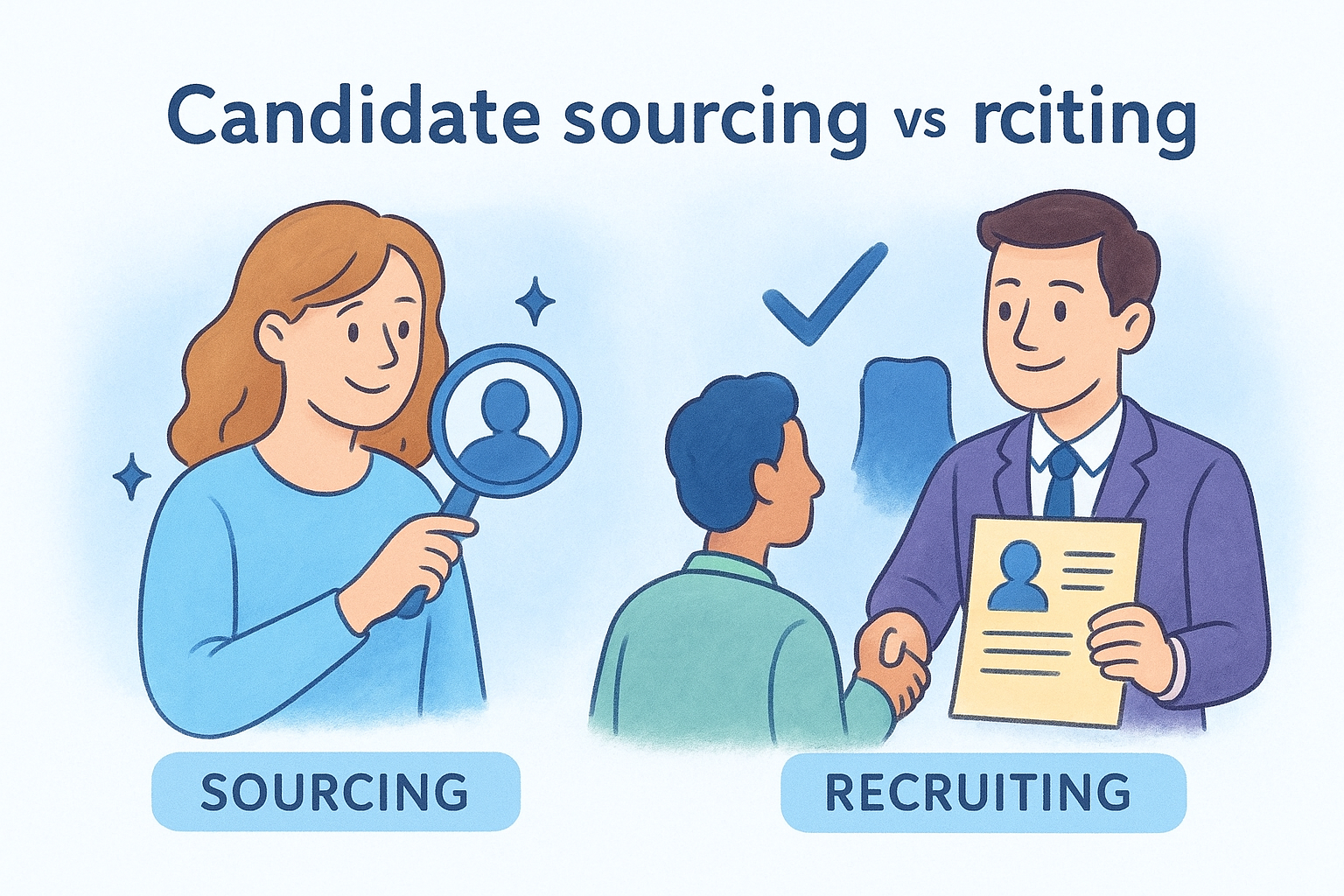
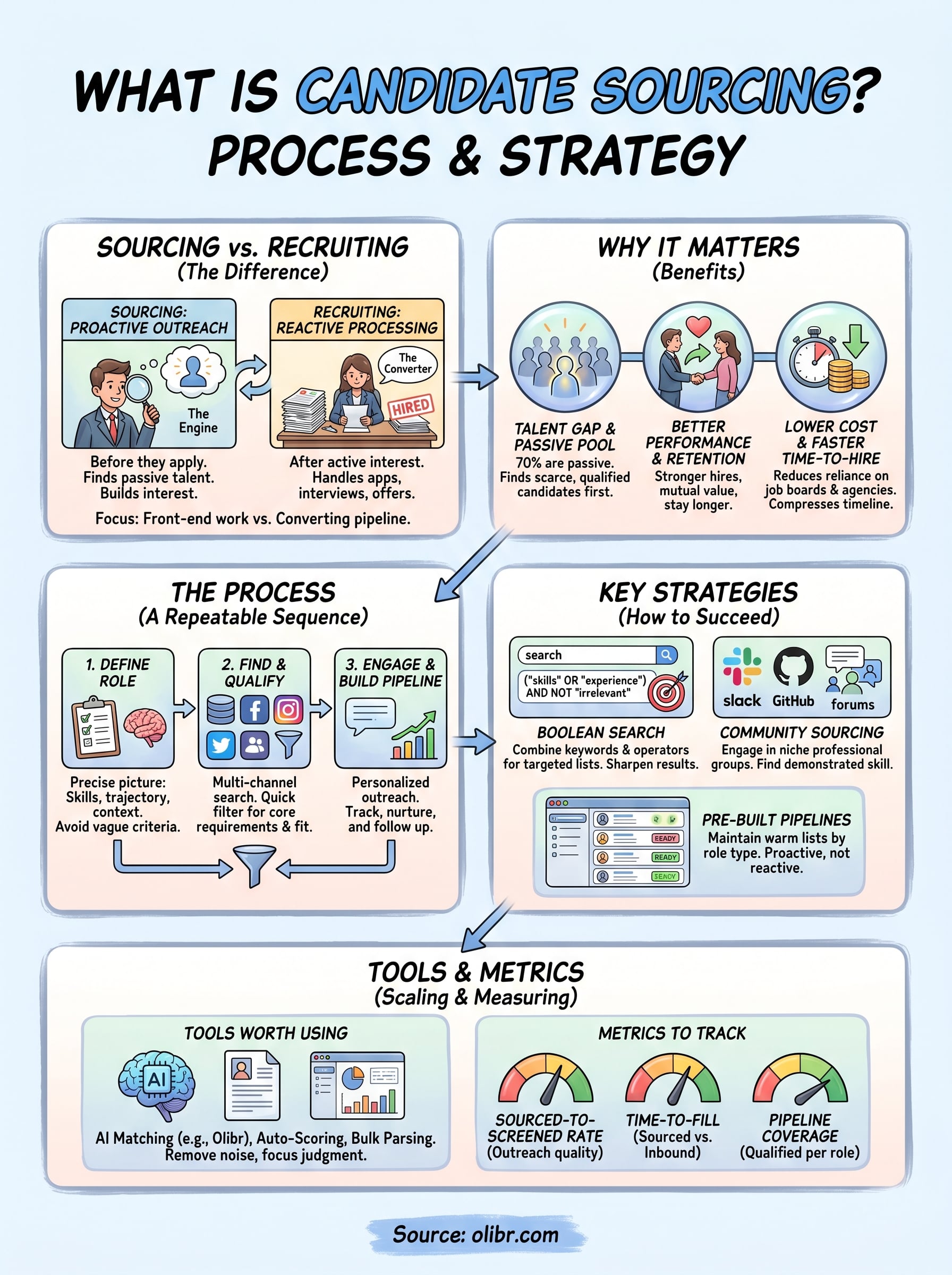
People use "sourcing" and "recruiting" interchangeably, but they describe different stages of the hiring process. Sourcing is the front-end work of finding and building interest with potential candidates before a formal conversation begins. Recruiting picks up after that, handling applications, interviews, offers, and closing. Understanding what is candidate sourcing means recognizing that it's the engine that feeds recruiting, not a synonym for it.
The core difference in timing and intent
Sourcing happens before a candidate shows any interest. You're the one initiating contact, identifying people who fit your criteria and reaching out cold or building relationships in advance of an open role. Recruiting, by contrast, operates on active interest, working with people who have already applied or responded to an outreach.
Sourcing fills your pipeline; recruiting converts that pipeline into hires.
The mindset behind each activity differs too. Sourcers think like researchers and marketers, they map talent landscapes, identify patterns, and craft outreach that cuts through noise. Recruiters think more like sales professionals and project managers, moving qualified candidates through a defined process toward a decision.
Why both functions need each other
Strong sourcing without solid recruiting wastes effort. You can build a pipeline full of interested, qualified people and still lose them to a slow interview process, poor communication, or an unclear offer. The handoff between sourcing and recruiting determines whether your front-end investment actually produces hires.
Equally, recruiting without sourcing leaves you dependent on whoever applies, which limits your reach and candidate quality. Organizations that separate the two functions and resource both appropriately consistently outperform those that treat hiring as a single reactive workflow. Whether you run a small team where one person handles both or a larger operation with dedicated roles, keeping these two distinct activities clearly defined helps you diagnose where your process breaks down and fix the right problem instead of guessing.
How the candidate sourcing process works
Understanding what is candidate sourcing at a conceptual level is useful, but the real value comes from knowing how each step connects to the next. Sourcing isn't a single action. It's a repeatable sequence that moves from role clarity through outreach and pipeline management, and skipping any step weakens every step that follows.
Define the role before you search
Before you open a single database or send one message, you need a precise picture of who you're looking for. Work with the hiring manager to go beyond the job description. Identify the specific skills, experience types, and professional backgrounds that predict success in the role, not just the minimum requirements listed on paper.
Vague criteria produce vague results. If you search for "software engineer with Python experience," you'll surface thousands of profiles with no real way to prioritize them. Narrow your criteria to include things like industry context, career trajectory, and portfolio indicators, and your search returns a much smaller, higher-quality set of prospects.
Find and qualify candidates
With clear criteria in hand, you source across multiple channels: your internal ATS, candidate databases, LinkedIn, professional communities, referrals, and alumni networks. Each channel reaches a different segment of the talent pool, so using only one guarantees blind spots.
Don't evaluate every profile equally. Prioritize candidates whose career patterns suggest they're ready for the next move, not just technically qualified on paper.
Qualification at this stage is a quick filter, not a full assessment. You're asking whether someone meets the core requirements and shows enough relevant context to warrant an outreach, not whether they'd pass a final interview.
Engage and build the pipeline
Outreach is where sourcing either gains momentum or stalls. Personalized messages that reference specific details from a candidate's background consistently outperform generic templates. Reference a project they worked on, a skill that's directly relevant, or a career shift that aligns with the opportunity.
Candidates who don't respond immediately aren't dead leads. Track every contact, note where they are in their careers, and follow up when timing improves or a better-fit role opens.
Best candidate sourcing strategies and examples
At its core, what is candidate sourcing if not a method for finding people others miss? The strategies below work because they reach candidates through channels your competitors overlook and engage them with messages that feel relevant rather than generic. Each one can be applied immediately, regardless of how large your team is.
Use Boolean search to sharpen your results
Boolean search lets you combine keywords with operators like AND, NOT, and OR to filter candidate databases and search engines with precision. Instead of searching "marketing manager," you search ("marketing manager" OR "growth lead") AND ("SaaS" OR "B2B") NOT "freelance". The result is a tighter, more targeted list that saves hours of manual filtering.
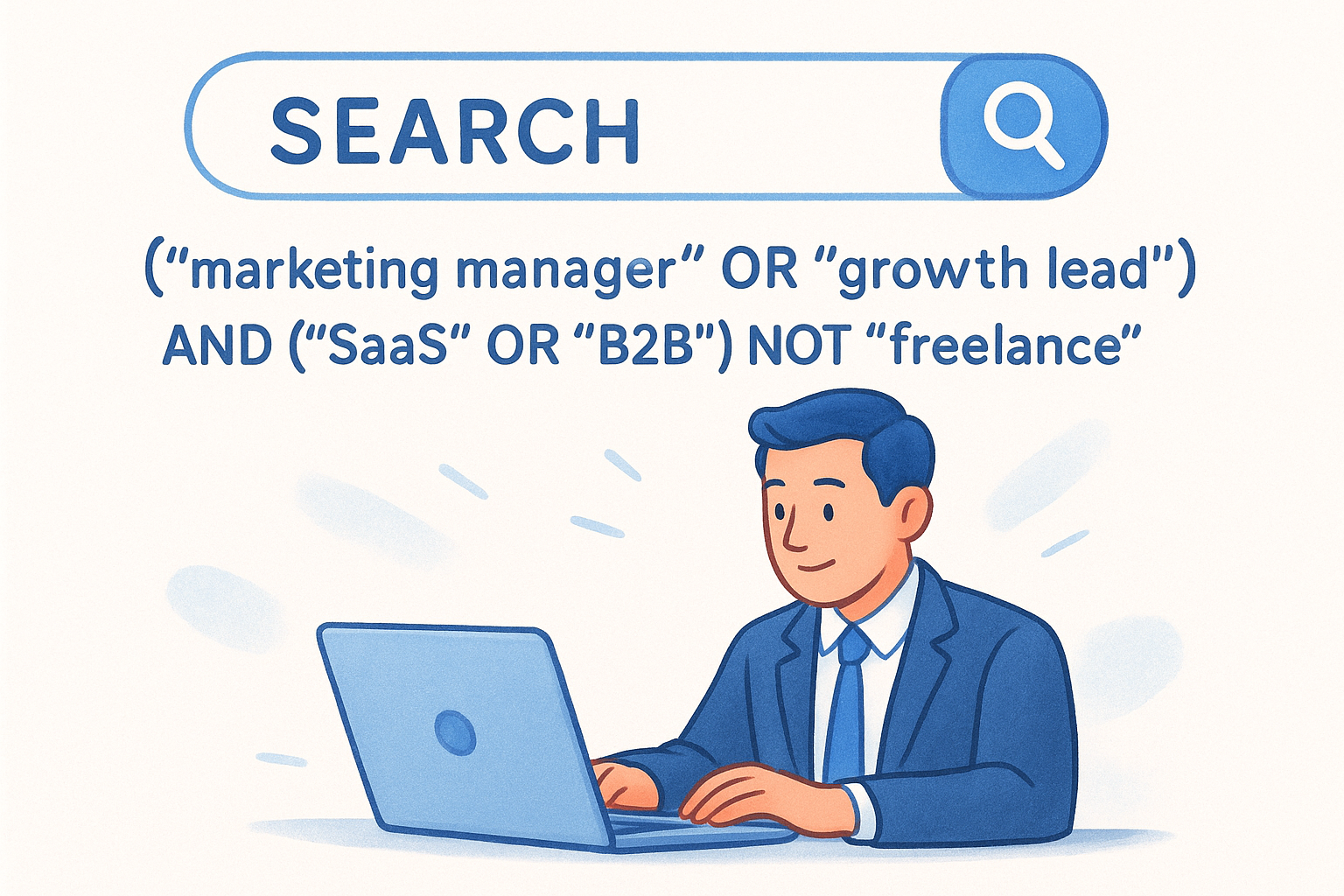
For example, if you're sourcing a backend engineer, a Boolean string that includes specific frameworks, excludes irrelevant roles, and filters by location gives you candidates who fit the brief from the first page of results rather than page ten.
The more specific your Boolean logic, the less time you spend reviewing profiles that don't belong in your pipeline at all.
Source from professional communities and niche spaces
Professional Slack groups, GitHub repositories, open-source contributor lists, and industry forums give you direct access to candidates who are active and engaged in their field. Someone who contributes consistently to an open-source project or answers questions in a niche community is demonstrating skill in real time.
Identify two or three active communities relevant to the roles you hire most often and spend time there before you need a candidate. When you reach out, you're not a stranger with a job pitch; you're someone who understands their world.
Build talent pipelines before roles open
Reactive sourcing under pressure produces mediocre results. The most effective sourcing teams maintain warm lists of qualified candidates organized by role type, so when a position opens, they already have people to contact.
Tag profiles in your ATS by skill, availability signals, and engagement history. Review and refresh these lists quarterly so they stay accurate and actionable rather than becoming outdated archives.
Tools and metrics to improve sourcing
Understanding what is candidate sourcing only takes you so far. The real difference between a sourcing function that scales and one that stalls comes down to the tools you use to find candidates and the metrics you track to know whether your effort is actually working. Both deserve deliberate attention.
Sourcing tools worth using
The right tools reduce manual effort and surface candidates you'd miss with a basic search. AI-powered matching platforms analyze resumes against job descriptions at a level of depth that keyword searches can't replicate, flagging candidates based on career trajectory and skill relevance rather than surface-level terms. Platforms like Olibr pair a searchable database of 180,000+ profiles with AI-driven matching and automated interview scoring, which means you spend less time filtering and more time engaging the right people.
The best sourcing tools don't replace your judgment; they remove the noise so your judgment focuses on the right candidates.
A Chrome extension that captures LinkedIn or Naukri profiles directly into your ATS also eliminates the manual data entry that slows most sourcers down and introduces errors into your pipeline. Pair that with bulk resume parsing and AI-powered candidate intelligence dashboards, and you can build and maintain a live pipeline without managing a spreadsheet.
Metrics that tell you if sourcing is working
Tracking the right numbers shows you where your sourcing process gains traction and where it leaks. Sourced-to-screened rate measures how many of your outreach contacts convert to actual screening conversations, a low rate usually signals either poor targeting or weak messaging. Time-to-fill for sourced hires compared to inbound hires shows you directly whether proactive outreach is compressing your hiring cycles.
Pipeline coverage ratio, meaning the number of qualified candidates per open role, tells you whether you have enough depth to fill positions without scrambling. Review these metrics monthly, not quarterly, so you can correct course before a bad pattern becomes an expensive habit.
Next steps
What is candidate sourcing at its best? It's a proactive, repeatable system that puts the right candidates in your pipeline before your competitors find them. You now have the full picture: what sourcing means, how it differs from recruiting, the step-by-step process that makes it work, and the strategies and tools that turn it into a competitive advantage.
The gap between knowing this and applying it is smaller than you think. Start with one strategy, whether that's Boolean search, community sourcing, or building a pre-loaded talent pipeline, and run it through two or three hiring cycles. Track your metrics, tighten your outreach, and build from there.
Your candidate database and outreach quality will improve with every iteration if you stay consistent. When you're ready to speed that process up significantly, start sourcing on Olibr for free to search 180,000+ candidate profiles, run AI-powered matching, and build pipelines without paying a subscription fee.
For hiring teams
Search 180,000+ candidate profiles — free.
Olibr is a community-funded recruiting platform: full ATS, AI interviews, and a shared resume database. No per-seat fees.