12 Best Applicant Tracking Systems for Recruiters in 2026
Recruiters lose hours every week to manual resume screening, scattered candidate data, and clunky hiring workflows. The right ATS eliminates most of that friction, but picking the best applicant tracking system for recruiters means sorting through dozens of platforms that all claim to do the same thing. Feature lists blur together, and pricing models range from free to six figures annually, making the decision even harder.
What actually separates a good ATS from a great one comes down to how well it fits your team's workflow, budget, and hiring volume. Some platforms excel at AI-powered screening but charge a premium for it. Others offer robust collaboration tools but lock core features behind expensive tiers. A few, like our own platform, Olibr, take a completely different approach by giving recruiters full ATS functionality, AI-conducted interviews, and access to 180,000+ candidate profiles without charging a subscription fee.
We built Olibr because we know how much recruiters spend on tools that should just work out of the box. That experience also gives us a clear-eyed view of what matters in an ATS and where each platform falls short. In this guide, we break down 12 applicant tracking systems worth evaluating in 2026, covering their standout features, pricing, and the types of teams they serve best. Whether you're hiring across India, the US, or both, this list will help you narrow your options and pick the right fit.
1. Olibr
Olibr is the only platform on this list that gives you full ATS functionality with no subscription fees, no feature gates, and no paid tiers to unlock. If your team is tired of paying monthly fees for tools that still require manual workarounds, Olibr is worth a close look.
What Olibr does best
The platform combines AI-powered candidate matching, automated interviews, a full ATS pipeline, and a searchable database of 180,000+ profiles into a single workspace. You get every feature from day one, which means your team spends time hiring instead of navigating upgrade prompts. Key capabilities include:
- AI resume parsing and bulk upload
- AI-conducted interviews with facial expression analysis and automated scoring
- Candidate intelligence dashboard showing career trajectory and portfolio strength
- Chrome extension for LinkedIn and Naukri profile capture
- Team collaboration with role-based permissions
How Olibr handles sourcing and the shared database model
Olibr runs on a community contribution model: when you upload resumes to the platform, you earn credits that unlock access to the full candidate database. That database is searchable by skills, experience, location, domain, and career background, so finding qualified candidates takes minutes rather than days. Most recruiters already have unused resume files sitting in folders or spreadsheets, and Olibr converts that existing data into platform access instead of a monthly bill.
If you already have a resume database, you can upload it directly to earn credits and start searching the full candidate pool the same day.
You can also capture profiles from LinkedIn or Naukri using the Olibr Chrome extension, which pulls candidate data without manual entry and keeps your pipeline current without adding steps to your sourcing workflow.
How Olibr handles ATS basics
The ATS pipeline covers all standard stages: job posting, application tracking, candidate reviews, and pipeline management with role-based permissions for your team. The interface is clean enough that new team members can get up to speed without a dedicated onboarding session. For teams evaluating the best applicant tracking system for recruiters, Olibr delivers core ATS functionality without the bloat that slows down high-volume hiring.
How Olibr handles AI matching and AI interviews
Olibr's AI matching engine analyzes job descriptions against candidate profiles to predict fit beyond keyword overlap. It evaluates career trajectory, experience type, and portfolio strength, which surfaces strong candidates that a standard keyword filter would miss entirely.

The AI-conducted interview feature sets Olibr apart from every other platform on this list. Candidates complete automated interviews that include facial expression analysis and automated scoring, giving your team structured, comparable data on each candidate before a human review. This cuts early-stage screening workload significantly, especially when you're filling multiple roles at once.
Who should use Olibr
Olibr fits in-house recruiting teams and talent acquisition professionals in India and the US who want to cut platform costs without losing functionality. It works particularly well for:
- Teams with existing resume databases they have not fully utilized
- Companies hiring across multiple roles simultaneously
- Organizations scaling from small teams to 500+ active recruiters
Olibr pricing
The platform is completely free with no paid tiers, no per-seat fees, and no feature restrictions. Access scales with the number of candidate profiles you contribute to the shared database, and you can start using the full platform the same day you create an account.
2. Greenhouse
Greenhouse is one of the most recognized ATS platforms among mid-size and enterprise companies. It has built its reputation on structured hiring workflows and a clean, consistent interface that keeps hiring teams aligned across every open role without requiring heavy configuration upfront.
What Greenhouse does best
The platform excels at bringing standardized evaluation criteria to every stage of your hiring funnel. Greenhouse enforces interview kits, scorecards, and role-specific question guides so that every candidate gets assessed the same way, regardless of which interviewer they meet. For teams evaluating the best applicant tracking system for recruiters who manage complex, multi-stage pipelines, Greenhouse delivers a reliable and repeatable framework.
How Greenhouse supports structured hiring
Greenhouse's interview plan builder lets you define exactly what each hiring stage looks like before a single candidate moves through it. Every interviewer receives a customized guide with specific questions tied to the role, and scorecard-based feedback flows directly into the candidate profile once the interview is complete. Hiring managers can review structured data from every touchpoint without chasing down notes or syncing across email threads.
Structured hiring consistently improves quality-of-hire, and Greenhouse is built from the ground up to enforce that structure across your entire team.
How Greenhouse supports candidate experience and DEI
Built-in DEI reporting tools track demographic data across the hiring funnel so you can spot where underrepresented candidates drop off and act on that data before it becomes a pattern. The candidate-facing side of the platform is mobile-friendly and polished, with automated status updates and a clear application flow that reflects positively on your employer brand.
Who should use Greenhouse
Greenhouse fits mid-size to enterprise organizations that run structured, high-stakes hiring processes across multiple departments and hiring managers. It works best for teams with a dedicated talent acquisition function rather than solo recruiters handling everything themselves.
Greenhouse pricing
Greenhouse does not publish pricing publicly. You need to request a demo for a quote, and costs scale based on company size and feature requirements. Most users place it in the mid-to-high price range relative to other ATS platforms on this list.
3. Lever
Lever takes a different approach from most ATS platforms by treating candidate relationship management as a core function rather than an add-on. The result is a platform that handles both tracking and nurturing without requiring a separate CRM tool running alongside it.
What Lever does best
Lever's main strength is its unified pipeline view, which gives your team full visibility into where every candidate stands across active and passive roles. The interface is clean and the workflow is intuitive, which means your team can move candidates through stages, leave feedback, and collaborate without jumping between multiple tools.
How Lever combines ATS and CRM
Lever merges applicant tracking and candidate relationship management into a single system called LeverTRM. This means you can manage active applicants and build long-term talent pools from the same workspace. Candidate records carry full interaction history, so when a passive contact becomes ready to move, your team already has context on every previous touchpoint.
If your team spends time rebuilding candidate relationships from scratch every hiring cycle, a combined ATS and CRM like Lever can cut that overhead significantly.
How Lever supports sourcing and nurture workflows
Lever includes built-in email sequencing tools that let your team run outreach campaigns directly from the platform. You can segment talent pools by skill, role type, or engagement history and send targeted messages without exporting data to a separate email tool. This makes Lever one of the stronger options when evaluating the best applicant tracking system for recruiters who prioritize proactive sourcing alongside inbound applications. Automated reminders and follow-up triggers keep candidates warm between hiring cycles without requiring manual effort from your team.
Who should use Lever
Lever fits mid-size companies with dedicated recruiting teams that source proactively and need to maintain long-term candidate pipelines. It works best when your team hires regularly enough to benefit from nurture workflows rather than just reacting to open roles.
Lever pricing
Lever does not publish standard pricing. Costs are quote-based and scale with company size and feature needs. Most users report it falls in a mid-to-high price range similar to Greenhouse.
4. Ashby
Ashby has carved out a strong position among data-driven recruiting teams by combining a full ATS with built-in analytics and automation tooling that most platforms treat as premium add-ons. The platform is relatively newer compared to others on this list, but it has gained serious traction with teams that need both operational control and clear hiring data in one place.
What Ashby does best
Ashby's core strength is giving your team granular visibility into every stage of the hiring funnel without exporting data to a separate analytics tool. The platform was designed with reporting as a first-class feature, not something bolted on after the fact, which makes it a strong contender when evaluating the best applicant tracking system for recruiters who present hiring metrics to leadership on a regular basis.
How Ashby handles reporting and analytics
Ashby's reporting suite covers pipeline health, time-to-hire, conversion rates, and offer acceptance rates across every role and department in real time. You can build custom dashboards, filter by team or recruiter, and share live reports without needing a data analyst to configure anything.

If your team makes headcount decisions based on pipeline data and regularly reports recruiting performance to leadership, Ashby's analytics depth is hard to match at this price tier.
How Ashby supports automation and scheduling
Ashby includes native scheduling tools that sync with your team's calendars and send candidates self-service booking links without a third-party scheduler running alongside it. Automated stage transitions and email triggers handle routine candidate communications so your recruiters stay focused on conversations that actually advance a hire rather than administrative follow-ups.
Who should use Ashby
Ashby fits growth-stage and enterprise companies that hire at consistent volume and need reliable data to improve their process over time. Teams that already treat metrics and funnel analysis as part of their daily recruiting workflow will get the most out of what the platform offers.
Ashby pricing
Ashby uses a tiered pricing model that scales with company size and feature requirements. Pricing is quote-based, so you'll need to contact their sales team for an exact number. Most users report it sits in the mid-to-high price range relative to simpler ATS tools.
5. Workable
Workable has been a go-to option for small to mid-size teams that want a full-featured platform without the complexity of enterprise-grade systems. It covers sourcing, job distribution, screening, and collaboration in one interface that most recruiters can get comfortable with quickly.
What Workable does best
The platform's biggest strength is its breadth of features relative to its price point. You get access to a large job board network, built-in sourcing tools, AI-powered candidate suggestions, and a clean pipeline view without needing extensive configuration. For teams evaluating the best applicant tracking system for recruiters who want meaningful functionality at a predictable cost, Workable delivers a solid baseline.
How Workable supports sourcing and job distribution
Workable posts your open roles to 200+ job boards simultaneously with a single submission, which cuts the manual work of managing individual postings across multiple channels. The platform also includes a passive candidate sourcing tool called People Search, which surfaces potential candidates from across the web based on your job requirements. This gives your team more options beyond inbound applicants without requiring a separate sourcing tool.
Posting to 200+ job boards from a single submission can meaningfully cut your time-to-first-applicant, especially for hard-to-fill roles.
How Workable supports screening and collaboration
Workable includes customizable screening questionnaires that filter candidates at the application stage before your team reviews a single resume. Hiring managers and interviewers can leave structured feedback directly on candidate profiles using scorecard-style evaluations, and all comments stay tied to the candidate record so nothing gets lost in email threads.
Who should use Workable
Workable fits small to mid-size companies that want a capable ATS without a long implementation process or a large IT team supporting it. It works well for teams that hire across multiple roles and channels but do not yet need the deep customization of an enterprise platform.
Workable pricing
Workable offers a pay-per-job model starting at around $189 per job per month, along with annual plans that scale by company size. A free trial is available, and pricing details are listed on their website.
6. Breezy HR
Breezy HR sits in a comfortable middle ground between lightweight tools and more complex enterprise platforms. It gives small to mid-size teams a solid set of hiring features without requiring a long setup process, making it a practical option when evaluating the best applicant tracking system for recruiters who need to move quickly without a steep learning curve.
What Breezy HR does best
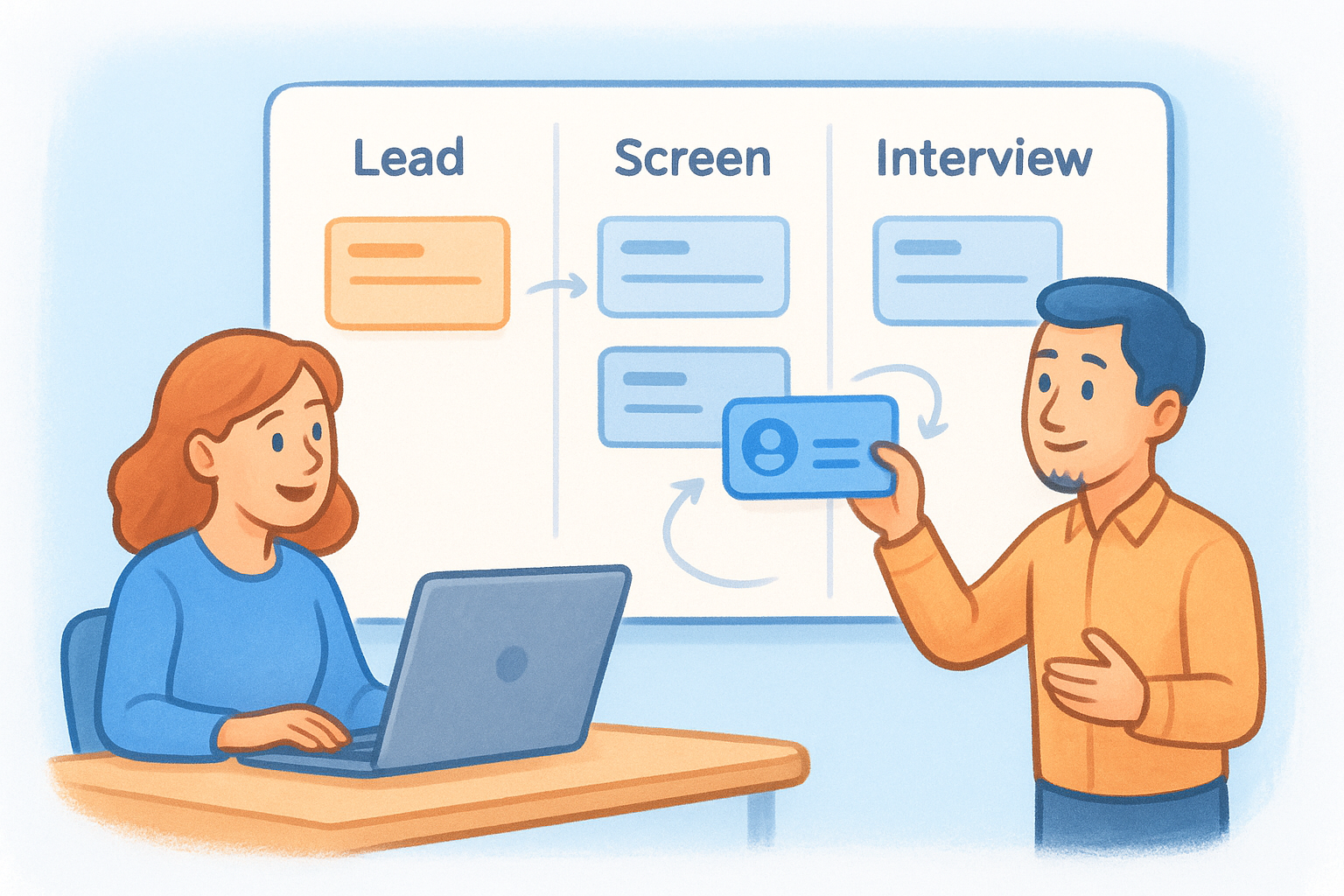
The platform's standout quality is its visual drag-and-drop pipeline, which makes managing candidate stages feel more like organizing a board than navigating a database. The interface is clean and intuitive, so hiring teams spend less time learning the tool and more time moving candidates through the funnel.
How Breezy HR manages pipelines and collaboration
Your team can build custom hiring stages for each role and shift candidates between them with a simple drag action. Every stage carries specific tasks, notes, and scorecards tied to it, so interviewers always know what they need to complete before a candidate advances. Hiring managers can review profiles, leave structured feedback, and approve or decline candidates directly from the platform without coordinating over email.
How Breezy HR supports automation and messaging
Breezy HR lets you set up automated email and SMS sequences that trigger based on where a candidate sits in your pipeline. When a candidate moves to a new stage, the platform can send a notification, request availability, or deliver a status update without your recruiter taking manual action on each message. This keeps communication consistent and cuts the follow-up overhead that slows down high-volume hiring.
Automated candidate communication at each pipeline stage keeps your process moving even when your team is focused on interviews or filling new roles.
Who should use Breezy HR
Breezy HR fits small to mid-size teams that want a visual, easy-to-manage ATS without heavy configuration. It works especially well for companies hiring fewer than 50 roles per year who still want automated communication and structured feedback built into the process.
Breezy HR pricing
The platform offers a free plan with limited features, and paid plans start at around $157 per month for unlimited positions. Pricing scales with the number of users and features required, and annual billing reduces the monthly rate.
7. Teamtailor
Teamtailor built its reputation on making the candidate-facing side of hiring look and feel professional from the first touchpoint. It gives recruiting teams a platform that covers pipeline management, automation, and employer branding in one place, which makes it a practical option when evaluating the best applicant tracking system for recruiters who care about how candidates experience the process.
What Teamtailor does best
Teamtailor's strongest feature is its career site builder, which lets your team design and publish a branded careers page without writing a single line of code. The platform treats employer brand as a hiring tool, not an afterthought, and gives you the structure to show candidates what your company is actually like before they apply. The result is a more engaged applicant pool with fewer drop-offs at the top of the funnel.
How Teamtailor supports workflows and automation
Teamtailor includes trigger-based automation that fires actions when a candidate moves between pipeline stages. You can set up automatic emails, internal task assignments, and status notifications based on stage transitions, which keeps your process consistent without requiring manual follow-up at every step. The platform also supports custom hiring pipelines that match how your team actually operates rather than forcing you into a rigid default structure.
Consistent automated communication at each pipeline stage keeps candidates engaged and reduces the number of applicants who go quiet mid-process.
How Teamtailor supports employer branding
The career site builder lets you add team videos, employee stories, department pages, and role-specific landing pages that give candidates a real view of your company. Every page is mobile-optimized and connected directly to your live job listings, so candidates move from your brand content to an application in one click without landing on a generic third-party job board.

Who should use Teamtailor
Teamtailor fits mid-size companies that actively compete for talent on brand perception and want their careers page to reflect that effort. It works particularly well for teams that hire across multiple departments or locations and need a consistent candidate experience across all of them.
Teamtailor pricing
Teamtailor uses company-size-based pricing that scales with your headcount. Pricing is not listed publicly, so you need to request a quote through their website. Most users report it falls in the mid-range tier compared to other ATS platforms on this list.
8. SmartRecruiters
SmartRecruiters positions itself as an enterprise hiring platform built to handle the scale and complexity that most ATS tools avoid. It covers everything from job distribution to offer management in a single system, making it a legitimate option when your team is evaluating the best applicant tracking system for recruiters operating across multiple countries and business units.
What SmartRecruiters does best
SmartRecruiters excels at giving large, distributed hiring teams a single platform that works consistently regardless of which region, department, or hiring manager is using it. The platform is designed to handle high requisition volumes without the workflow breakdowns that typically emerge when too many stakeholders are involved in a single hire.
How SmartRecruiters supports enterprise and global hiring
The platform supports multi-language job postings and localized hiring workflows, which means your team can run hiring processes in different regions without building separate systems for each one. SmartRecruiters also integrates with hundreds of job boards and sourcing channels globally, so your open roles reach relevant candidates in each market from a single posting action.
If your team hires across multiple countries and needs consistent process enforcement in every location, SmartRecruiters handles that complexity without requiring custom configuration for each region.
How SmartRecruiters supports compliance and approvals
SmartRecruiters includes built-in approval workflows that route job requisitions, offers, and hiring decisions through the right stakeholders before anything moves forward. This matters most in organizations where legal, finance, or executive sign-off is required at specific stages, and where skipping that step creates risk. The platform also supports GDPR and EEOC compliance tooling to keep your process defensible across different regulatory environments.
Who should use SmartRecruiters
SmartRecruiters fits enterprise organizations that hire at scale across multiple regions, business units, or legal entities. It works best when your team has a dedicated talent operations function and needs a platform that enforces process consistency across a large number of hiring managers.
SmartRecruiters pricing
SmartRecruiters does not publish pricing publicly. Costs are quote-based and scale with company size and feature requirements, placing it firmly in the enterprise price range on this list.
9. iCIMS
iCIMS is one of the longest-standing enterprise ATS platforms on the market, with a reputation built on handling high-volume hiring at scale across complex organizations. When your team is evaluating the best applicant tracking system for recruiters managing thousands of requisitions annually, iCIMS belongs in the conversation.
What iCIMS does best
iCIMS focuses on giving large organizations a centralized hiring system that holds up under pressure. The platform supports every stage of the talent acquisition process, from sourcing and screening through offer management and onboarding handoff, without requiring your team to stitch together separate tools for each phase. Its strength is consistency at scale rather than flexibility for smaller, fast-moving teams.
How iCIMS supports high-volume hiring
iCIMS is purpose-built for companies that open hundreds or thousands of roles per year and need a system that enforces process without creating bottlenecks. The platform includes automated screening, candidate ranking, and communication workflows that keep your pipeline moving even when the volume would overwhelm a lighter-weight tool.
For enterprise teams running continuous hiring across dozens of departments, iCIMS provides the operational backbone that prevents pipeline chaos at high requisition volume.
Your team can configure role-specific workflows, approval chains, and screening criteria that apply consistently across every open position, which reduces the manual overhead of managing individual pipelines separately.
How iCIMS supports integrations and marketplaces
iCIMS maintains a large integration marketplace that connects the platform to hundreds of third-party tools, including HRIS systems, background check providers, job boards, and assessment vendors. This means your existing tech stack connects to iCIMS without custom development work, and your team gets a more unified view of candidate data across every tool you already use. Pre-built connectors cover most major HR and recruiting software vendors.
Who should use iCIMS
iCIMS fits large enterprises with dedicated talent acquisition teams, high annual hiring volume, and complex approval workflows. Smaller teams rarely need what iCIMS offers and will find the platform more than necessary for their use case.
iCIMS pricing
iCIMS does not publish pricing publicly. Costs are quote-based and scale with company size, hiring volume, and module requirements, placing it at the enterprise end of the pricing spectrum on this list.
10. BambooHR
BambooHR is a well-known name in the small business HR software space, and its built-in ATS reflects the same philosophy as the rest of the platform: keep things simple, practical, and connected. For teams evaluating the best applicant tracking system for recruiters who also manage HR functions, BambooHR offers a tighter integration between hiring and people management than most standalone ATS tools can match.
What BambooHR does best
BambooHR's strongest quality is its ability to connect the full employee lifecycle from the moment a candidate applies to the day they complete onboarding. The ATS module does not operate in isolation. It feeds directly into the HR system, so the data your team captures during recruiting carries forward without re-entry or manual syncing between tools.
How BambooHR connects hiring to onboarding
When a candidate accepts an offer in BambooHR, the platform automatically creates an employee record and triggers the onboarding workflow without your team having to export or re-enter anything. New hire paperwork, task assignments, and welcome emails all flow from the same system that ran the hiring process. This saves meaningful time during the transition period and reduces the errors that come with copying candidate data across multiple platforms.
Connecting hiring and onboarding in one system removes the handoff gap that causes delays and data errors between your recruiting team and HR.
How BambooHR fits first-time ATS teams
The setup process is straightforward, and the interface requires minimal training for teams moving off spreadsheets or basic email-based hiring. BambooHR walks new users through configuration and does not require a dedicated administrator to keep the system running. This makes it a realistic option for small HR teams wearing multiple hats who need a functional ATS without a long implementation timeline.
Who should use BambooHR
BambooHR fits small to mid-size companies that want their ATS and HR system to operate as one rather than two separate tools. It works best when the same team handles both recruiting and HR administration.
BambooHR pricing
BambooHR does not publish exact pricing. Costs are quote-based and scale with headcount, and you need to contact their sales team for a number. Most users place it in the mid-range tier on this list.
11. Rippling
Rippling is not a traditional ATS. It is a unified workforce platform that treats recruiting as one piece of a larger system that also handles HR, IT, and payroll. For teams evaluating the best applicant tracking system for recruiters who also need to manage every other part of the employee lifecycle in one place, Rippling covers more ground than almost any other platform on this list.
What Rippling does best
Rippling's standout quality is its ability to connect hiring, onboarding, device provisioning, and payroll inside a single platform. Most tools stop at the offer letter. Rippling keeps going, automating what happens after a candidate accepts so your HR and IT teams do not spend their first week chasing down paperwork and login credentials for a new hire.
How Rippling connects ATS to HR, IT, and payroll
When a candidate moves to hired in Rippling, the platform triggers a cascade of automated actions across every relevant system. Your new hire gets added to payroll, assigned the right benefit packages, and set up with the apps and devices they need, all without your team manually coordinating between departments. This removes the handoff gap that typically slows down new hire readiness by several days.
Automating the post-offer workflow means your new hires show up on day one with everything they need, and your team does not spend the week before chasing down IT tickets.
How Rippling supports reporting across workforce data
Rippling pulls recruiting metrics and workforce data into the same reporting layer, so you can build reports that connect time-to-hire with headcount costs, payroll impact, and retention rates. These are the kinds of cross-functional insights that matter to leadership but are nearly impossible to produce when your ATS and HR system live in separate tools.
Who should use Rippling
Rippling fits mid-size to enterprise companies that want their recruiting function fully integrated with IT and finance operations. Teams that already use Rippling for HR will find the ATS addition straightforward.
Rippling pricing
Rippling uses modular pricing that scales based on the products you activate and the number of employees in your account. You need to contact their sales team for a quote.
12. JazzHR
JazzHR is a straightforward ATS built specifically for small businesses and growing teams that need reliable hiring tools without the complexity or cost of enterprise platforms. The platform keeps things simple: post jobs, screen candidates, and manage your pipeline in one place without spending weeks configuring the system before your first hire.
What JazzHR does best
JazzHR's core strength is making the fundamentals of structured hiring accessible to teams without a dedicated recruiter or talent operations function. The platform gives you job posting, candidate tracking, and interview coordination without requiring technical expertise to set up or maintain. Core features include:
- Customizable hiring pipelines for each role
- Team collaboration tools with feedback and notes on every candidate record
- Interview scheduling and task assignment across hiring managers
How JazzHR covers core ATS needs for small teams
Small teams evaluating the best applicant tracking system for recruiters often need a tool that handles the basics well rather than one that overwhelms them with features they will never use. JazzHR delivers customizable pipelines and structured feedback tools that keep your process organized without a steep learning curve.
If your team is moving off spreadsheets or email-based hiring for the first time, JazzHR's interface requires minimal onboarding to get productive.
Each candidate record holds all application materials, notes, and interview feedback in one place, so your hiring team stays aligned without chasing updates across separate threads.
How JazzHR handles job posting and screening
JazzHR distributes your open roles to multiple job boards from a single submission, including free and sponsored options, which cuts the time your team spends managing individual postings. The platform also includes customizable application forms and knockout screening questions that filter candidates at the entry point before your team reviews a single resume.
Who should use JazzHR
JazzHR fits small businesses and early-stage companies with limited hiring volume and a lean HR function. It works best for teams that need a structured process without the overhead of a more complex platform.
JazzHR pricing
The platform offers tiered pricing starting at $75 per month, with higher tiers unlocking additional features like e-signatures and enhanced reporting. Pricing scales with the features your team needs rather than your headcount.
Wrap-up and next steps
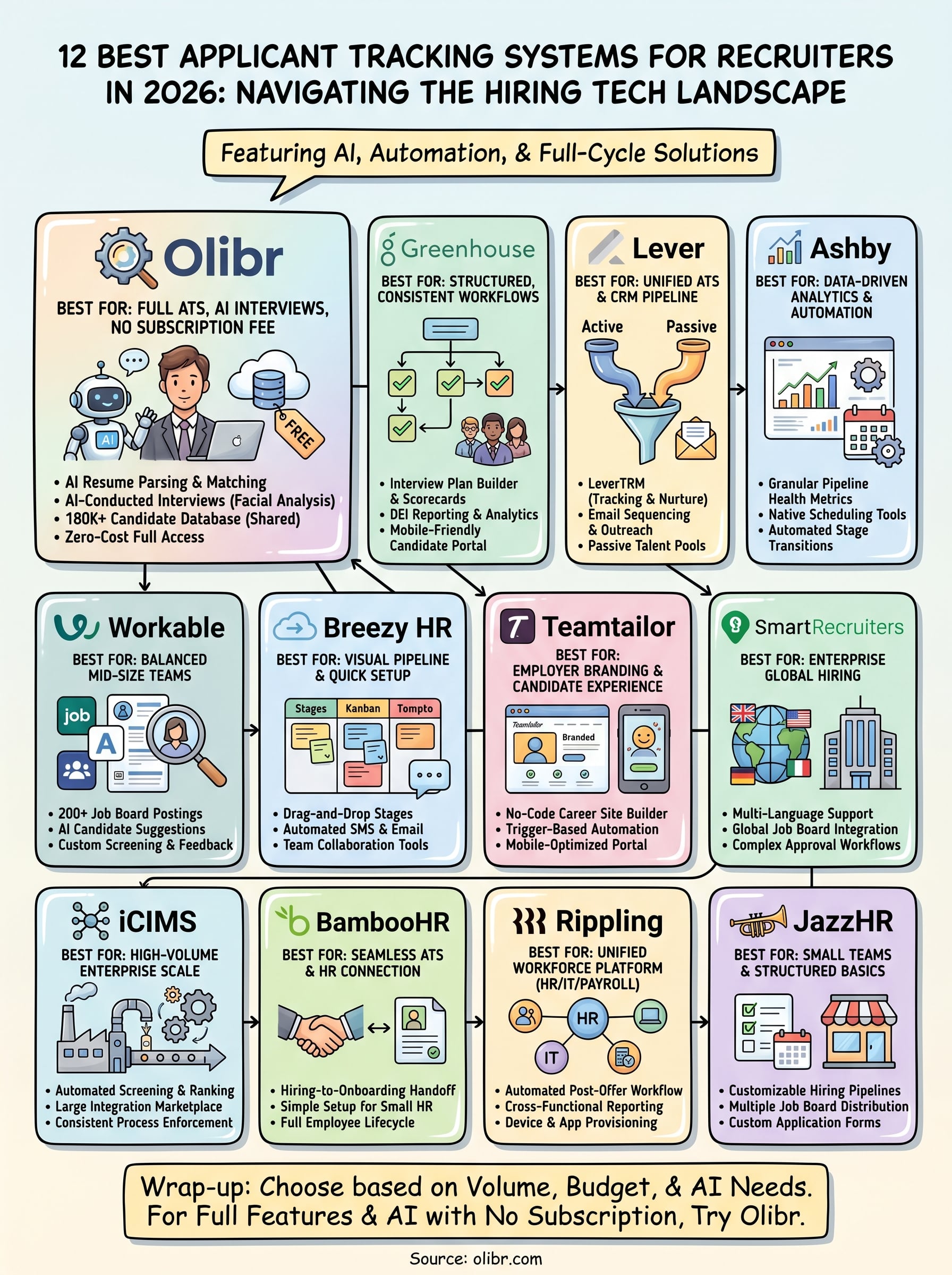
Every platform on this list solves a real problem for a specific type of team. Greenhouse and Ashby suit structured, data-driven hiring teams. SmartRecruiters and iCIMS handle enterprise scale. BambooHR and JazzHR keep things simple for smaller organizations. Lever and Workable sit in the middle and cover a broad range of mid-size use cases.
Picking the best applicant tracking system for recruiters comes down to your hiring volume, your budget, and how much your team needs AI screening and sourcing built in from the start. If cost is a real constraint and you want full ATS functionality, AI interviews, and a searchable candidate database without paying a monthly fee, one option stands above the rest on this list.
Try Olibr for free and start sourcing from 180,000+ candidate profiles the same day you sign up, with no subscription required and no features locked behind a paywall.
For hiring teams
Search 180,000+ candidate profiles — free.
Olibr is a community-funded recruiting platform: full ATS, AI interviews, and a shared resume database. No per-seat fees.