Time To Hire vs Time To Fill: Definitions, Formulas & KPIs
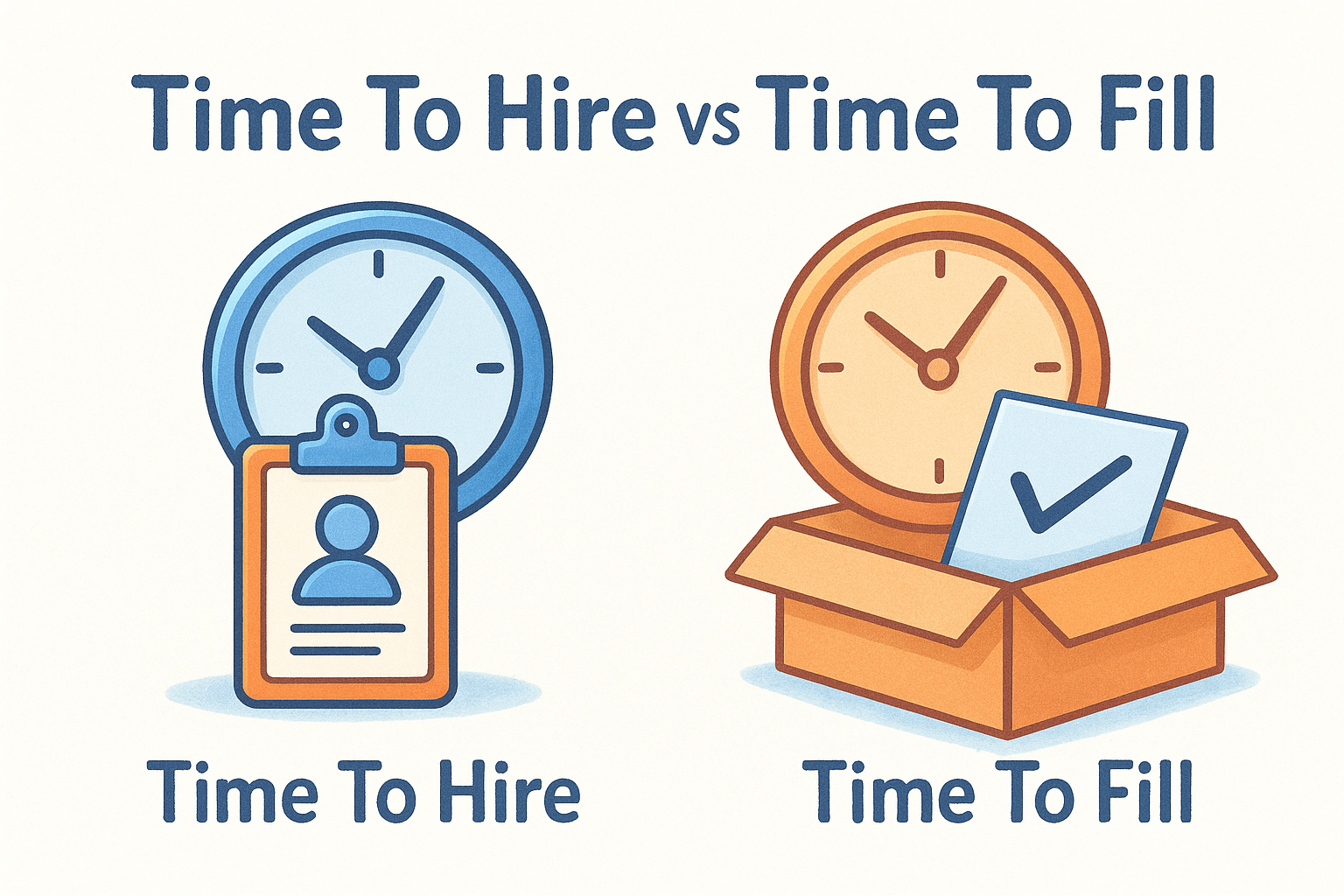
Most recruiting teams track either time to hire or time to fill, and many use the terms interchangeably. That's a problem. While time to hire vs time to fill sound similar, they measure different stages of your recruiting process and answer fundamentally different questions. One tells you how quickly candidates move through your pipeline. The other tells you how long a role sits open before someone accepts an offer. Mixing them up leads to misleading reports and misguided process changes.
Understanding both metrics matters because each one exposes a different bottleneck. A long time to fill might point to sourcing issues or a slow req approval process. A long time to hire might reveal interview scheduling delays or sluggish decision-making from hiring managers. Without separating the two, you're diagnosing the wrong problem.
This article breaks down the exact definitions, formulas, and benchmarks for both KPIs, so you can measure them correctly and actually act on the data. We'll also cover how tools like Olibr's AI-powered recruiting platform help teams reduce both metrics by automating candidate matching, screening, and interviews, cutting weeks off hiring cycles that currently stretch past 45 days.
What time to hire and time to fill mean
Both metrics sound like they track the same thing, but they measure different windows of time in your hiring process. Time to hire follows a specific candidate from their first touchpoint with your company to the moment they accept an offer. Time to fill follows a job requisition from the day it opens to the day someone accepts the offer for it. One centers on the candidate's journey. The other centers on the role itself. Knowing what each one actually measures is the foundation for understanding where your recruiting process breaks down.
Time to hire: what it actually measures
Time to hire starts the clock from the moment a candidate enters your pipeline, whether that's the day they applied or the day a recruiter first reached out to them. It ends when the candidate accepts an offer. This metric captures the candidate's direct experience of your process: how fast you screen applications, how quickly you schedule interviews, and how decisively your hiring team moves from one stage to the next.
Time to hire reflects how your process feels from the candidate's side, which directly affects whether strong candidates stay engaged or take a competing offer before you finish your rounds.
Because time to hire focuses on individual candidates moving through your pipeline, you can calculate it per role, per department, or across your entire organization. A long time to hire often points to specific friction points: slow interview scheduling, too many interview rounds, or delayed feedback from hiring managers. If your time to hire is consistently high, candidates are sitting in your pipeline longer than necessary, and you risk losing the best ones to faster-moving competitors.
Time to fill: what it actually measures
Time to fill starts earlier than time to hire. The clock begins the day the job requisition opens, sometimes weeks before a single candidate applies. It ends the same way: when a candidate accepts the offer. This metric captures everything upstream from candidate engagement, including how long it takes to get req approval, write the job description, get it posted, and start generating a qualified applicant pool.
When you compare time to hire vs time to fill for the same role, the gap between the two numbers tells you something concrete. If time to fill runs 60 days but time to hire is only 12 days, your sourcing and req approval process is consuming the bulk of the cycle. That's where your improvement work belongs, not in the interview rounds.
Time to fill also varies significantly by role type and seniority level. Senior or highly specialized positions take longer to fill because the qualified candidate pool is smaller and sourcing takes more effort. Entry-level roles with a large applicant pool tend to have shorter time to fill, though time to hire can still run long if your screening process is entirely manual. Tracking both metrics separately gives your team the precision to identify which part of the pipeline actually needs fixing, rather than applying broad changes that address the wrong bottleneck entirely.
Time to hire vs time to fill at a glance
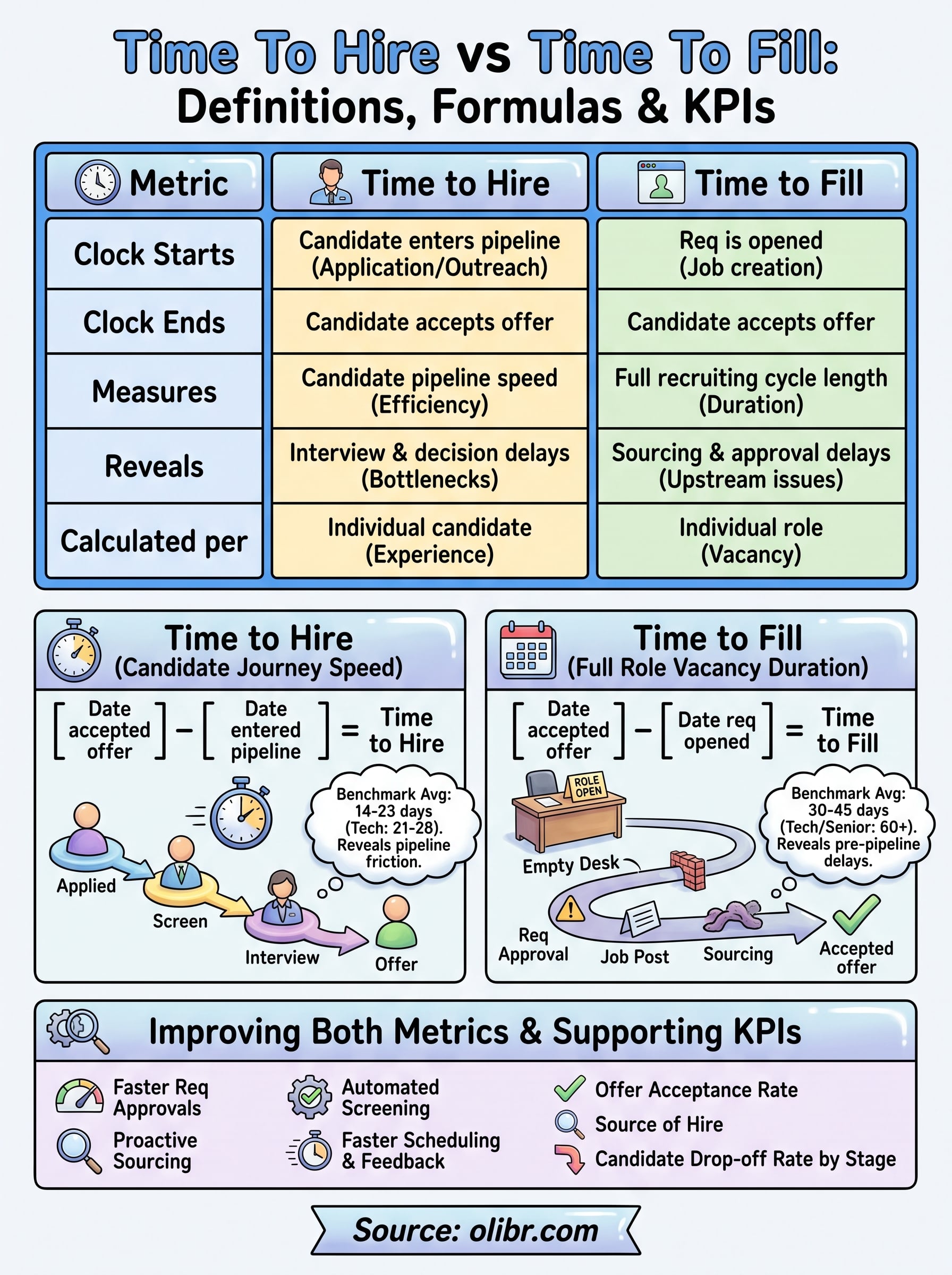
When you put time to hire vs time to fill side by side, the core difference comes down to where each clock starts. Both metrics end at the same point, an accepted offer, but they capture entirely different windows of your hiring process. The table below maps out the key distinctions so you can see exactly what each metric covers.

| Time to Hire | Time to Fill | |
|---|---|---|
| Clock starts | Candidate enters pipeline | Req is opened |
| Clock ends | Candidate accepts offer | Candidate accepts offer |
| Measures | Candidate pipeline speed | Full recruiting cycle length |
| Reveals | Interview and decision delays | Sourcing and approval delays |
| Calculated per | Individual candidate | Individual role |
What each metric tells you
Time to hire gives you a direct read on how efficiently your team moves a candidate from first contact to accepted offer. It surfaces delays inside your pipeline, specifically slow interview scheduling, excessive rounds, or hiring managers who take days to return feedback. Time to fill captures everything before a candidate even applies, including how long it takes to approve a req, write a job description, and get it in front of qualified people.
Tracking only one of these metrics gives you half the story. You need both to pinpoint exactly where your hiring cycle loses time.
Neither metric outranks the other in importance. They're complementary data points, and reading them together tells you far more than either one alone. If time to fill is high but time to hire is short, your upstream sourcing process needs attention. If both numbers run high, you likely have problems at multiple stages of the cycle.
When to use each metric
Use time to hire when you want to evaluate interview process efficiency and internal decision speed. If your team consistently loses candidates to competing offers, this is the number to audit first. A high time to hire signals friction inside your pipeline that you can often fix without overhauling your sourcing approach entirely.
Reach for time to fill when you're planning workforce strategy or making a case for more recruiting resources to leadership. It captures the full duration of a vacancy and helps stakeholders understand the real cost of slow hiring decisions. When time to fill stays high despite a reasonable time to hire, the fix is almost always upstream: delayed req approvals, a weak job description, or insufficient sourcing capacity.
Formulas and examples to calculate both
Once you understand what separates time to hire vs time to fill, calculating each metric is straightforward. Both use simple date subtraction, but they start at different points in the recruiting process, so pulling the correct data from your ATS before running the numbers matters. Using the wrong start date is the single most common reason teams end up reporting inaccurate figures and drawing the wrong conclusions from them.
Time to hire formula
Time to hire = Date candidate accepted offer - Date candidate entered pipeline
For example, if a candidate applied on June 1 and accepted an offer on June 19, your time to hire for that candidate is 18 days. If you're calculating it across a group of recent hires, average the individual results first to get a reliable benchmark for a specific role or department before rolling those numbers into a team-wide figure.
When combining time to hire across multiple roles, separate different role types before averaging them together. Mixing a senior engineer hire with an entry-level coordinator hire in the same calculation produces a number that doesn't accurately represent either position.
Some teams define "entered pipeline" as the application date. Others use the date a recruiter first reached out to a sourced candidate. Pick one definition and apply it consistently across all roles, otherwise you're comparing numbers that don't actually measure the same window of time.
Time to fill formula
Time to fill = Date candidate accepted offer - Date job requisition opened
If a req opened on May 1 and a candidate accepted on June 19, your time to fill for that role is 49 days. Comparing that figure to the 18-day time to hire from the example above reveals that 31 days were spent entirely on pre-pipeline activity: req approval, job description writing, posting, and sourcing before a single qualified candidate entered the process.
That gap between the two numbers is where many teams lose significant time without realizing it. Bringing both figures to your hiring manager or leadership team with a clear breakdown gives you a data-backed case for faster req approvals or additional sourcing resources. Without running both calculations separately, the upstream delay stays invisible in your reporting entirely.
Benchmarks, targets, and common ranges
Knowing the formula is only half the work. You also need a reference point to evaluate whether your numbers are healthy or indicate a real problem. Industry benchmarks for both metrics vary by role type, seniority level, and sector, so applying a one-size-fits-all target will often mislead you. Use external benchmarks as rough calibration tools, then build internal targets based on your own historical data over time.
Time to hire benchmarks
Across most industries, time to hire averages between 14 and 23 days. Technology and engineering roles sit at the higher end of that range, often landing between 21 and 28 days, largely because multiple technical interview rounds add time even when scheduling runs smoothly. Administrative and customer-facing roles typically close faster, often in 10 to 14 days, when the applicant pool is large and screening is mostly competency-based.
If your time to hire consistently exceeds 28 days, candidates are almost certainly waiting on your team between stages, not progressing through them.
For senior or highly specialized roles, a time to hire of 30 to 45 days is not unusual. What matters is that you track this figure by role category rather than lumping all positions into a single average, which will mask the outliers that actually need attention.
Time to fill benchmarks
Time to fill tends to run longer than time to hire because it captures everything before a candidate enters your pipeline. The average across industries falls somewhere between 30 and 45 days, with technical and leadership roles regularly exceeding 60 days. SHRM research has historically placed the average closer to 42 days across all role types.
When you compare time to hire vs time to fill for the same role, a gap of two to four weeks between the two numbers is generally expected. That window represents req approval, job description finalization, and initial sourcing. A gap larger than four weeks in the pre-pipeline phase is a signal that your upstream process is the primary drag on your overall hiring cycle, and that's where your improvement efforts should focus first. Roles with consistently long time to fill but short time to hire almost always have a sourcing or approval bottleneck, not a candidate evaluation problem.
KPIs to track and ways to improve them
Tracking time to hire vs time to fill gives you a strong foundation, but these two metrics don't tell the whole story on their own. Pairing them with a small set of supporting KPIs helps you pinpoint exactly which stage of your process is dragging and gives you more precise data to act on before a problem compounds into a prolonged vacancy.
Supporting KPIs to pair with your tracking
Offer acceptance rate tells you whether candidates are saying yes once you reach the offer stage. A low acceptance rate combined with a high time to hire often means candidates received competing offers while waiting on your team. Source of hire tells you which channels are producing candidates who actually convert to hires, which helps you direct sourcing effort toward the channels that perform and pull back from the ones that don't.
Candidate drop-off rate by stage shows you where candidates exit your pipeline before you want them to. If most drop-offs happen between the screening call and the first interview, scheduling friction is the likely cause. Tracking this alongside time to hire gives you a stage-by-stage view of where your process loses candidates, not just an overall speed number.
Practical ways to reduce both metrics
Cutting time to fill almost always starts before a candidate applies. Getting req approvals faster, maintaining ready-to-post job description templates for common roles, and building a warm candidate pipeline before a role opens all reduce the pre-pipeline gap significantly. Proactive sourcing into a searchable candidate database means you're not starting from zero every time a new position opens.
Reducing time to hire requires removing friction inside your pipeline, which usually means faster scheduling, fewer unnecessary interview rounds, and prompt feedback from hiring managers after each stage.
Tools that automate resume screening and initial interviews remove the manual work that creates waiting time between stages. Platforms like Olibr handle AI-powered candidate matching and automated interviews, so your team spends energy on final-stage decisions rather than early filtering. Faster early-stage screening directly compresses both metrics without cutting corners on candidate quality.
Wrap-up
Time to hire vs time to fill are two distinct metrics that measure different stages of your recruiting process. Time to hire tracks how fast candidates move through your pipeline. Time to fill captures the full cycle from the day a req opens to the day someone accepts. When you track both separately, you stop guessing about where your hiring cycle loses time and start fixing the right problems with the right solutions.
The benchmarks and formulas in this article give you a baseline to evaluate your current numbers against. Pairing these two KPIs with supporting metrics like offer acceptance rate and stage-by-stage drop-off gives you a complete picture of your recruiting health. The faster you screen, schedule, and decide, the shorter both numbers become.
If you want to cut weeks off your hiring cycle without adding headcount, explore Olibr's free AI-powered recruiting platform and see how automated matching and interviews change your process from day one.
For hiring teams
Search 180,000+ candidate profiles — free.
Olibr is a community-funded recruiting platform: full ATS, AI interviews, and a shared resume database. No per-seat fees.