12 Best AI Tools for Talent Acquisition in 2026
Recruiters spend roughly 30 hours a week on manual tasks like resume screening, interview scheduling, and candidate outreach. That's time pulled away from what actually matters, evaluating people and making hiring decisions. AI tools for talent acquisition are built to take over those repetitive steps, and in 2026, the options have matured well beyond basic keyword matching. The best tools now analyze career trajectories, predict candidate fit, and even conduct structured interviews autonomously.
But with dozens of platforms claiming AI-powered everything, it's hard to separate the tools that genuinely save time from the ones that just added a chatbot and called it innovation. The difference usually comes down to how deeply AI is integrated into the recruiting workflow, and whether it actually reduces your dependency on manual screening or just moves the bottleneck somewhere else. That's exactly what we evaluated when building this list.
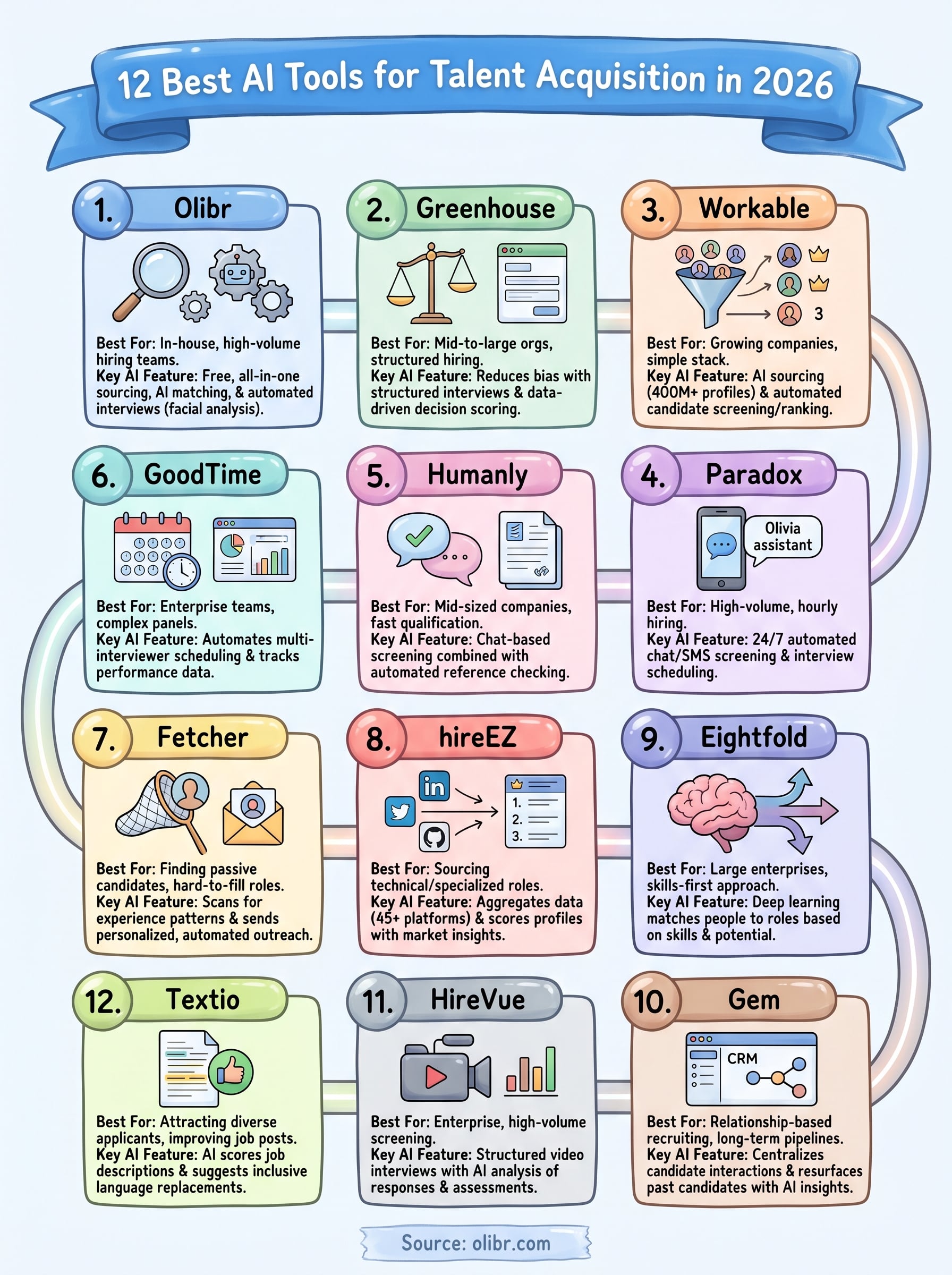
At Olibr, we've seen this problem firsthand. Our platform uses AI matching, automated interviews with facial expression analysis, and a searchable database of 180,000+ candidate profiles, all without charging recruiters a subscription fee. So we know what good AI recruiting technology looks like in practice, not just on a features page. Below, we've rounded up 12 tools worth your attention in 2026, covering everything from sourcing and screening to engagement and hiring analytics.
1. Olibr
Olibr is a free recruiting platform built for hiring teams that want full AI tools for talent acquisition without paying monthly subscription fees. It serves both India and US markets, making it one of the few platforms with genuine dual-market capability built into the core product rather than added on as an afterthought.
What Olibr is best for
Olibr works best for in-house recruiters and talent acquisition teams who fill multiple positions on a regular basis. High-volume hiring teams get the most out of it because the platform combines sourcing, screening, and interviewing in one place rather than forcing you to stitch together three separate tools.
It's particularly well-suited for teams that:
- Have an existing resume database they want to put to work
- Hire across multiple roles simultaneously and need a structured pipeline
- Want to cut screening time without paying enterprise software prices
Key AI features for talent acquisition
The platform's AI matching engine analyzes job descriptions and resumes together, predicting fit based on career trajectory, experience type, and portfolio strength rather than just keywords. A candidate with a non-linear background who still fits the role won't get filtered out before you ever see their name.
The AI-conducted interviews include facial expression analysis and automated scoring, which adds a behavioral layer that most standard screening tools simply don't offer.
Beyond matching, Olibr handles bulk resume uploads with AI parsing, so you can bring your existing candidate database into the system without manual data entry. The candidate intelligence dashboard then gives you context on each person's career background, domain expertise, and experience level.
How Olibr fits into your workflow
You post a job, and the system immediately starts pulling matched candidates from a database of 180,000+ profiles, ranked by predicted fit. From there, you trigger AI-conducted interviews for shortlisted candidates directly inside the platform and review scored results on your own schedule.
The Chrome extension captures LinkedIn and Naukri profiles without leaving your browser, adding them directly to your pipeline. Role-based permissions let multiple team members collaborate on the same requisition without overwriting each other's work or losing track of candidate status.
Limitations to know before you use it
Olibr runs on a contribution model, meaning you gain full platform access by uploading candidate resumes to the shared database. If your team has a small existing database to contribute, the onboarding requires more upfront effort. The platform also delivers the most value at volume, so teams hiring for one or two occasional roles won't fully use what the AI systems are built to handle.
Olibr pricing
Olibr's ATS is free with no paid tiers and no hidden costs; AI features are paid per use from a wallet. Every user accesses the same full feature set from day one, whether you're a solo recruiter or part of a large hiring team. You earn platform credits by contributing candidate profiles to the shared database, which keeps the model self-sustaining without anyone paying a monthly fee.
2. Greenhouse
Greenhouse is an applicant tracking system built for structured hiring, used by companies like Airbnb, DoorDash, and Squarespace. It focuses on reducing bias and improving hiring consistency through structured interviews and data-driven decision-making, making it one of the more established enterprise-level platforms in the recruiting space.
What Greenhouse is best for
Greenhouse works best for mid-to-large organizations that already have dedicated recruiting operations and want to standardize their hiring process across departments. Teams that need detailed analytics and compliance reporting across dozens of open roles simultaneously get the most value from what Greenhouse is built to handle.
Key AI features for talent acquisition
As one of the more structured ai tools for talent acquisition, Greenhouse uses AI to surface recommended candidates, auto-populate job requisitions, and score applicants based on structured interview data. Its AI layer focuses less on sourcing and more on improving the quality of decisions once candidates are already inside your pipeline.
Greenhouse's strength isn't finding candidates from scratch, it's helping your team evaluate them more consistently once they arrive.
How Greenhouse fits into your workflow
You build out interview plans and scorecards before a role opens, and Greenhouse keeps every interviewer aligned to the same criteria throughout the process. The platform integrates with over 400 tools, including HRIS systems, background check providers, and job boards, so it connects to most existing recruiting stacks without requiring heavy customization work on your end.
Limitations to know before you use it
Greenhouse is not a sourcing tool. If your primary challenge is finding candidates rather than organizing them, you'll need to pair it with a separate sourcing platform. The setup process is also time-intensive, and smaller teams without dedicated recruiting operations support often find the configuration overhead more demanding than expected.
Greenhouse pricing
Greenhouse does not publish pricing publicly. Plans are quote-based and scale with company size. Based on widely reported user data, costs typically fall in the range of $6,000 to $25,000+ annually, depending on headcount and the features your team selects.
3. Workable
Workable is an all-in-one recruiting platform that combines an applicant tracking system with built-in sourcing tools, making it one of the more self-contained options available for small and mid-sized hiring teams. It's designed to reduce the number of tools recruiters need to manage a full hiring cycle from a single interface.
What Workable is best for
Workable works best for growing companies that need to hire across several roles at once without building out a complex recruiting stack. Teams that want sourcing, screening, and collaboration bundled together rather than integrated from separate vendors tend to find it a strong fit.
Key AI features for talent acquisition
As one of the more accessible ai tools for talent acquisition, Workable uses an AI sourcing engine that searches over 400 million candidate profiles across the web and surfaces matches based on your job description. It also includes an AI-powered candidate screening tool that ranks applicants automatically and flags the strongest profiles for your review.
Workable's AI sourcing is particularly useful for roles where your inbound application volume is low and you need to proactively reach out to passive candidates.
How Workable fits into your workflow
You write a job description, and Workable's AI sourcing tool immediately generates a candidate shortlist without requiring you to manually search job boards. From there, you manage applications, schedule interviews, and collect structured feedback from your hiring team through a shared pipeline that keeps everyone on the same page without back-and-forth email chains.
Limitations to know before you use it
Workable's AI features are less sophisticated than enterprise-focused platforms when it comes to predictive analytics and deep candidate intelligence. Larger teams with complex hiring workflows sometimes find the reporting and customization options too limited to meet their needs at scale.
Workable pricing
Workable offers a Starter plan at $189 per month for smaller teams with limited hiring needs. Its Standard and Premier plans are quote-based and scale with the number of active jobs and employees at your company.
4. Paradox
Paradox is a conversational AI platform built around its AI assistant Olivia, which handles candidate communication and interview scheduling autonomously. The platform targets hiring environments where response speed directly determines whether a candidate stays engaged or disappears before your recruiter ever speaks with them.
What Paradox is best for
Paradox works best for companies running high-volume hiring in sectors like retail, healthcare, logistics, and hourly labor markets. If your team consistently loses candidates between application and interview because responses take too long, Paradox is designed to close that gap by keeping communication moving around the clock.
Key AI features for talent acquisition
As one of the more conversational ai tools for talent acquisition, Paradox uses Olivia to screen applicants through SMS or web chat, collect application details, answer role-specific questions, and book interview slots without recruiter involvement. The system runs 24/7, meaning a candidate who applies at midnight gets a response in seconds rather than waiting until the next business day.
Olivia can take a candidate from initial application to confirmed interview in under five minutes, which creates a real competitive edge in industries where talent moves fast.
How Paradox fits into your workflow
You connect Paradox to your existing ATS, and Olivia begins handling candidate-facing communication automatically from that point forward. The chatbot screens applicants against your defined criteria, schedules interviews directly into your team's calendar, and sends automated reminders that reduce no-show rates before your recruiters ever enter the conversation.
Limitations to know before you use it
Paradox is purpose-built for high-volume and hourly hiring, so its feature depth is narrower than full-cycle platforms. Teams hiring for specialized, technical, or senior-level roles where nuanced evaluation carries more weight than speed will find the conversational screening model less useful for those positions.
Paradox pricing
Paradox does not publish its pricing publicly, so you need to contact their sales team directly for a quote. User-reported data consistently positions it at an enterprise price point, making it most practical for larger organizations with the hiring volume to justify the investment.
5. Humanly
Humanly is a conversational AI platform focused on candidate screening, engagement, and reference checking. It targets mid-market recruiting teams that want to automate early-stage communication without replacing the human elements that matter during later stages of the hiring process.
What Humanly is best for
Humanly works best for mid-sized companies that handle a consistent flow of applicants and need to qualify candidates faster than a traditional recruiter review cycle allows. Teams hiring for customer-facing, operational, or administrative roles at volume get the most out of what the platform is built to do.
Key AI features for talent acquisition
Among ai tools for talent acquisition, Humanly stands out for combining chat-based screening with automated reference checking in a single platform. Its AI conducts structured screening conversations through chat, collects candidate responses, scores them against your criteria, and flags qualified applicants for recruiter follow-up without manual intervention.
Humanly's reference checking automation is one of the more practical differentiators in this space, turning a step that typically takes days into one that resolves in hours.
How Humanly fits into your workflow
You connect Humanly to your existing ATS, and the platform takes over candidate-facing communication from the moment an application arrives. Screened candidates who meet your defined thresholds move forward automatically, while others receive timely responses that keep your employer brand intact even when you can't personally respond to every applicant.
Limitations to know before you use it
Humanly's screening depth is limited to conversational inputs, so it works better for roles with clear, defined criteria than for positions that require complex evaluation of technical skills or specialized experience. Larger enterprise teams may also find the analytics and reporting features less robust than what dedicated enterprise ATS platforms offer.
Humanly pricing
Humanly does not list pricing publicly and requires you to request a demo before receiving a quote. Based on available user feedback, the platform sits at a mid-market price point, making it most accessible for companies with moderate but consistent hiring volume rather than occasional or single-role needs.
6. GoodTime
GoodTime is an interview scheduling and hiring intelligence platform designed to eliminate the back-and-forth coordination that bogs down recruiting teams once candidates enter the interview phase. The platform's core focus is reducing time-to-hire by automating scheduling across multiple interviewers and time zones, a problem most recruiting tools address poorly.
What GoodTime is best for
GoodTime works best for enterprise hiring teams and talent acquisition operations that manage complex, multi-round interview processes. If your team regularly coordinates panels of three or more interviewers across different departments, GoodTime is built specifically to handle that scheduling complexity without requiring a recruiter to manually hunt for open calendar slots.
Key AI features for talent acquisition
Among ai tools for talent acquisition, GoodTime's AI layer focuses on interviewer selection and scheduling intelligence rather than candidate sourcing or screening. The platform uses AI to match candidates with the right interviewers based on availability, hiring stage, and historical performance data, then books everything automatically without manual intervention.
GoodTime's hiring intelligence dashboard tracks interviewer performance and candidate experience scores, giving you data to improve your process rather than just speed through it.
How GoodTime fits into your workflow
You connect GoodTime to your existing ATS and calendar systems, and the platform takes over scheduling coordination from that point forward. Candidates receive self-scheduling links that let them pick interview times without recruiter involvement, while the system automatically handles rescheduling requests, reminders, and confirmation messages on your behalf.
Limitations to know before you use it
GoodTime focuses almost entirely on the scheduling and interview coordination layer of recruiting, so it does not replace a full ATS or sourcing tool. Your team still needs separate platforms to manage applications and find candidates, and teams that primarily handle simple, single-round interviews will find the platform's depth exceeds what their hiring process actually requires.
GoodTime pricing
GoodTime does not list pricing publicly, so you need to contact their team directly for a quote. The platform is positioned as an enterprise solution, meaning cost scales with interview volume and overall team size.
7. Fetcher
Fetcher is an AI-powered sourcing platform that automates candidate discovery and outreach, handling the top-of-funnel recruiting work that typically consumes the most recruiter hours. The platform is designed specifically to surface passive candidates who match your open roles and engage them through automated email sequences before a recruiter ever needs to get directly involved.
What Fetcher is best for
Fetcher works best for recruiting teams that struggle to fill their top-of-funnel with enough qualified candidates from inbound applications alone. Companies hiring for technical, specialized, or hard-to-fill roles where passive candidate outreach is the primary sourcing strategy tend to get the most return from what the platform is built to do.
Key AI features for talent acquisition
Among ai tools for talent acquisition, Fetcher's AI scans candidate profiles across the web and matches them to your job criteria, going well beyond keyword matching to analyze experience patterns and career signals that indicate a genuine fit. The platform then generates personalized email sequences and sends them automatically on a schedule your team defines.
Fetcher's AI refines its sourcing over time based on the feedback your team gives on each candidate batch, meaning match quality improves the longer you use it.
How Fetcher fits into your workflow
You connect Fetcher to your existing ATS, define the role criteria, and the platform delivers batches of matched candidates on a regular cadence. From there, you mark each profile as a strong fit or a pass, and the AI uses that signal to calibrate future results. Interested candidates who respond to outreach flow directly into your ATS pipeline without any manual data transfer on your end.
Limitations to know before you use it
Fetcher focuses exclusively on sourcing and outreach, so it does not handle screening, interviewing, or pipeline management. Your team still needs a separate ATS to manage candidates once they respond, and teams that already have strong inbound volume may find limited incremental value from the platform's core feature set.
Fetcher pricing
The platform does not publish pricing publicly, so you need to contact their team directly for a quote. Fetcher is generally positioned at a mid-to-enterprise price point, making it most practical for teams with consistent, ongoing sourcing needs rather than occasional hiring surges.
8. hireEZ
hireEZ is an outbound recruiting platform that uses AI to source, engage, and track passive candidates across more than 45 platforms, including GitHub, LinkedIn, and professional databases. It's built for recruiting teams that need to move beyond inbound applications and actively build their candidate pipelines through targeted outreach.
What hireEZ is best for
hireEZ works best for talent acquisition teams hiring for technical, engineering, or specialized roles where the best candidates are rarely applying to job boards. If you spend a significant portion of your day manually searching multiple platforms to find the right profiles, hireEZ consolidates that process into a single interface with AI doing the heavy lifting.
Key AI features for talent acquisition
Among ai tools for talent acquisition, hireEZ uses AI to aggregate candidate data across dozens of sources and score profiles based on how closely they match your defined role criteria. The platform also includes market insights powered by real-time labor data, so you can see salary benchmarks, talent supply trends, and competitive hiring activity before you even start your search.
hireEZ's AI ranking system evaluates candidates on more than 50 attributes, which gives your team a clearer signal on who to prioritize without manual filtering.
How hireEZ fits into your workflow
You define your search criteria, and hireEZ surfaces a ranked list of matched candidates from across its aggregated data sources. From there, you build email sequences inside the platform and launch outreach campaigns directly, without switching between tools. Candidate responses and engagement data sync back into the platform so your team can track pipeline progress from one dashboard.
Limitations to know before you use it
hireEZ is built for sourcing and outreach, not full-cycle recruiting, so you still need a separate ATS to manage candidates past the initial engagement stage. Teams focused on high-volume hourly hiring rather than targeted passive outreach will find the platform's strengths don't align well with that use case.
hireEZ pricing
hireEZ does not publish pricing publicly and requires a direct conversation with their sales team for a quote. The platform is generally positioned at a mid-to-enterprise price point that scales with team size and the volume of outreach your recruiters run each month.
9. Eightfold
Eightfold is a Talent Intelligence Platform that uses deep learning to match people to roles based on skills and potential rather than just job titles or employer names. It's built for organizations that want to take a skills-first approach to hiring, covering both external recruitment and internal talent mobility across their workforce.
What Eightfold is best for
The platform works best for large enterprises that need to manage talent at scale, across both external hiring pipelines and internal workforce planning. Companies that want to identify high-potential candidates based on skill adjacencies rather than direct experience get the most value from how Eightfold approaches matching.
Key AI features for talent acquisition
Among the more differentiated ai tools for talent acquisition, Eightfold's deep learning model analyzes hundreds of millions of career paths to predict which candidates have the skills and trajectory to succeed in a given role. The platform also surfaces internal candidates who are ready to step into open positions, reducing external hiring costs by making better use of your existing workforce first.
Eightfold's skills-based matching means candidates with unconventional backgrounds who could genuinely perform the role won't get filtered out before a recruiter ever sees their profile.
How Eightfold fits into your workflow
You connect Eightfold to your existing HRIS and ATS, and the platform begins analyzing your full talent pool against your open roles, covering both internal employees and external candidates simultaneously. Recruiters receive a ranked list of profiles with clear explanations of why each person was surfaced, which reduces the time spent manually reviewing candidates who don't meet the bar.
Limitations to know before you use it
The platform carries an enterprise price point and implementation complexity that puts it out of reach for smaller hiring teams. Onboarding requires significant data integration work, and teams without a dedicated HR technology function to manage the setup often find the initial ramp-up considerably more demanding than expected.
Eightfold pricing
Eightfold does not publish pricing publicly and requires a direct conversation with their sales team for a quote. The platform is designed for enterprise clients, so costs scale with headcount and the scope of modules your organization activates.
10. Gem
Gem is a recruiting CRM and sourcing platform that helps talent acquisition teams manage candidate relationships, track outreach, and build long-term pipelines rather than starting from scratch every time a new role opens. The platform sits between your ATS and your sourcing tools, giving recruiters a centralized place to track every candidate interaction across the full hiring lifecycle.
What Gem is best for
Gem works best for talent acquisition teams that rely heavily on relationship-based recruiting and need visibility into where every candidate stands across multiple ongoing pipelines. Companies that hire in waves or maintain long-term pipelines for hard-to-fill roles get strong returns from the platform's CRM-style candidate tracking.
Key AI features for talent acquisition
Among the available ai tools for talent acquisition, Gem uses AI to surface candidates from your existing CRM who match newly opened roles, so you spend less time re-sourcing candidates your team already engaged months ago. The platform also provides AI-generated insights on outreach performance, helping you identify which messages, sequences, and channels produce the highest response rates over time.
Gem's ability to resurface previously engaged candidates is one of its most practical features, turning your historical recruiting activity into an active sourcing asset.
How Gem fits into your workflow
You connect Gem to your existing ATS and sourcing channels, and the platform begins centralizing candidate data, email activity, and pipeline status in one dashboard. Your recruiting team can build and send automated outreach sequences directly from Gem while tracking opens, replies, and pipeline movement without switching between multiple tools.
Limitations to know before you use it
Gem is strongest as a CRM and outreach layer rather than a standalone sourcing engine, so teams that need help finding net-new candidates rather than managing existing relationships will need to pair it with a dedicated sourcing tool. Smaller teams without established candidate databases to work from may find its CRM functionality underutilized relative to the platform's cost.
Gem pricing
Gem does not publish pricing publicly and requires you to contact their sales team directly for a quote. The platform is generally positioned at a mid-to-enterprise price point that scales with team size and outreach volume.
11. HireVue
HireVue is a video interviewing and assessment platform that uses AI to evaluate candidate responses at scale. The platform is built for organizations that need to screen large numbers of applicants through structured video interviews without pulling recruiters into every early-stage conversation.
What HireVue is best for
HireVue works best for enterprise hiring teams running high-volume screening across consumer-facing industries like finance, retail, and healthcare. Companies that receive thousands of applications per role and need a consistent, structured way to evaluate candidates before advancing them to live interviews tend to get the clearest return from the platform.
Key AI features for talent acquisition
Among the enterprise-grade ai tools for talent acquisition, HireVue uses AI to analyze candidate video responses across factors like word choice, communication patterns, and role-relevant competencies, then scores each interview against the criteria your team defines. The platform also offers game-based cognitive assessments that add a behavioral and problem-solving dimension beyond what a standard screening conversation captures.
HireVue's AI scoring gives your team a consistent evaluation baseline across every candidate, which reduces the variability that typically creeps in when multiple recruiters are screening independently.
How HireVue fits into your workflow
You send candidates a structured video interview link after they apply, and HireVue collects their recorded responses automatically without requiring a recruiter to be present. Completed interviews feed directly into your dashboard with AI-generated scores and summaries, so your team reviews results on their own schedule rather than coordinating live availability across dozens of candidates at once.
Limitations to know before you use it
HireVue's AI assessment approach has drawn documented scrutiny around bias in automated scoring, which is worth factoring in before deploying the platform for high-stakes hiring decisions. Candidates also report lower engagement with asynchronous video formats compared to live conversations, which can affect your response rates for senior or specialized roles where candidate experience carries more weight.
HireVue pricing
HireVue does not publish pricing publicly and requires direct contact with their sales team for a quote. The platform sits firmly at an enterprise price point, so smaller hiring teams will find the cost difficult to justify without consistent, high-volume screening needs.
12. Textio
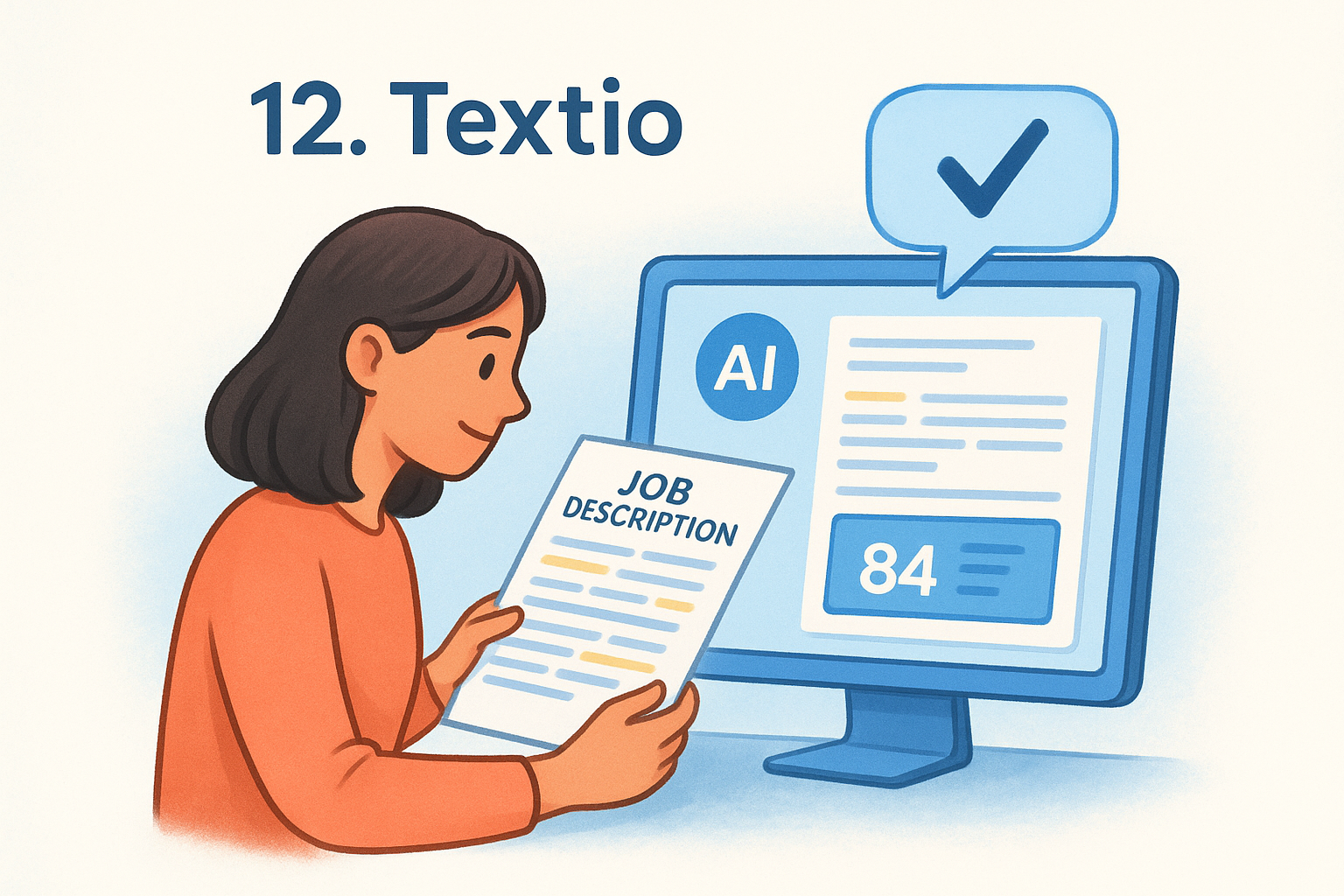
Textio is a language analysis platform that uses AI to improve the quality of your job descriptions, performance reviews, and candidate-facing communications. Unlike most recruiting tools that focus on sourcing or screening, Textio targets the written content your team produces, making it one of the more specialized ai tools for talent acquisition on this list.
What Textio is best for
Textio works best for talent acquisition teams and HR leaders who want to attract a broader, more qualified applicant pool by fixing the language problems that quietly filter candidates out before they ever click apply. Companies focused on improving diversity in their candidate pipeline through better job posting language get strong returns from what Textio is designed to do.
Key AI features for talent acquisition
Textio's AI analyzes your job descriptions in real time and scores the language against performance data from millions of postings to predict how well the text will attract applicants. The platform flags specific phrases that tend to deter certain candidate groups and suggests replacements that produce stronger application rates based on actual hiring outcomes.
The performance prediction score gives your team a clear, data-backed signal on whether a job posting is likely to underperform before you publish it.
How Textio fits into your workflow
You write or paste your job description directly inside Textio, and the platform highlights problem areas and scoring gaps as you type. Most teams integrate it into their job creation step so every posting goes through a language review before it reaches any job board or careers page.
Limitations to know before you use it
Textio focuses entirely on written language optimization and does not touch sourcing, screening, scheduling, or any other recruiting function. Teams looking for an end-to-end solution will still need a separate ATS and sourcing platform to cover the rest of the hiring process.
Textio pricing
Textio does not publish pricing publicly and requires you to contact their sales team directly for a quote. The platform is generally positioned as a mid-to-enterprise tool that scales with the size of your hiring team and the volume of content you produce.
Next steps
Every tool on this list solves a different piece of the recruiting puzzle. Some handle sourcing, others manage scheduling, and a few focus entirely on the language your team uses to attract applicants. The right ai tools for talent acquisition for your team depend on where your current process breaks down most often, whether that's finding candidates, screening them efficiently, or keeping them engaged long enough to reach an offer.
If cost is a real constraint and you want a platform that covers sourcing, AI matching, automated interviewing, and pipeline management without a monthly subscription, Olibr is worth testing before you commit to anything else. You get access to the full feature set from day one, and the credit model means contributing your existing resume database directly offsets what you'd otherwise pay.
Start recruiting on Olibr for free and see how much of your current manual workload the platform can absorb.
For hiring teams
Search 180,000+ candidate profiles — free.
Olibr is a community-funded recruiting platform: full ATS, AI interviews, and a shared resume database. No per-seat fees.