How To Reduce Cost Per Hire: Formula, Benchmarks, Tips
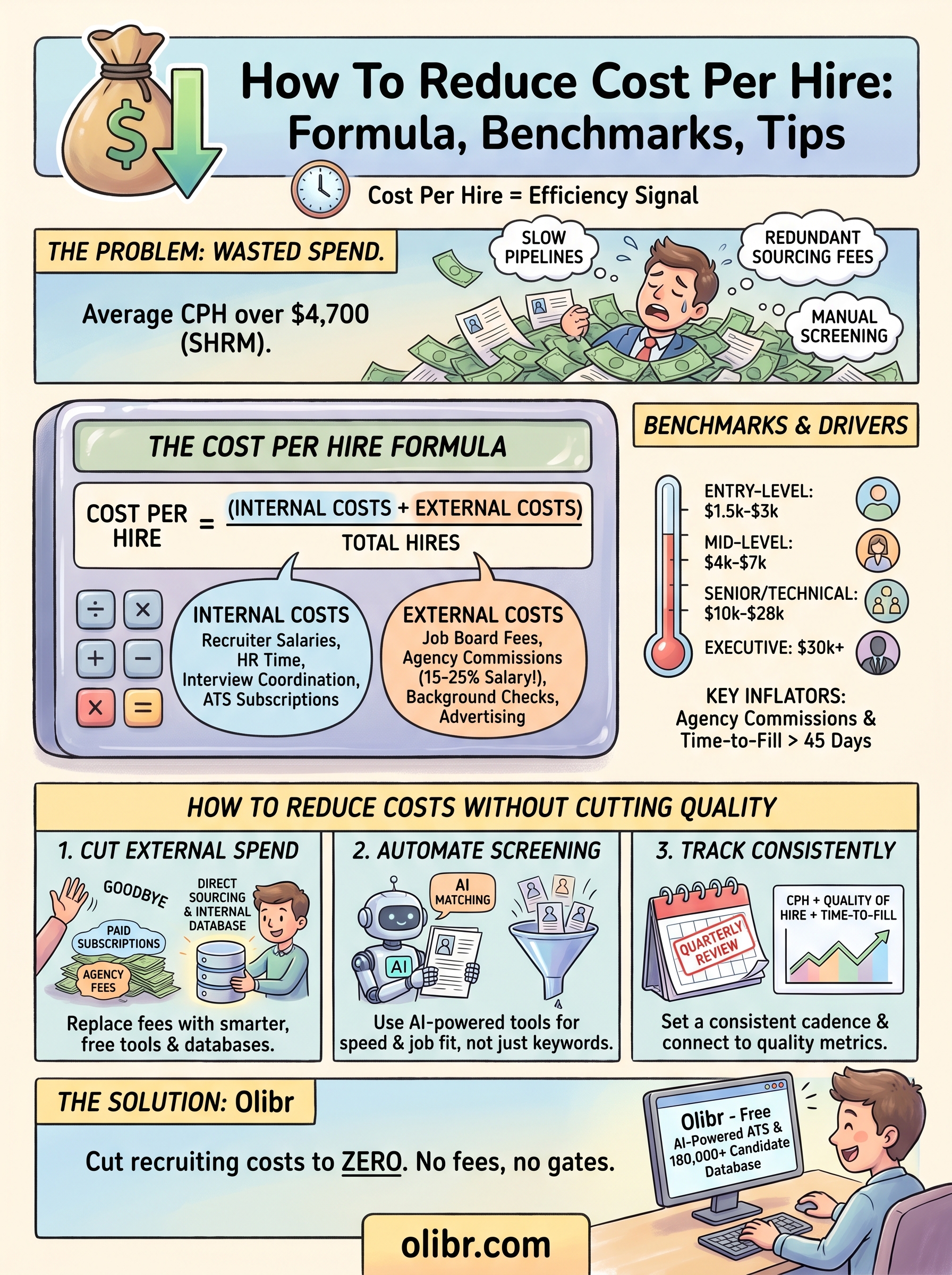
Every new hire comes with a price tag, and it's probably higher than you think. Between job board fees, recruiter hours, screening tools, and interview logistics, the average company spends over $4,700 per hire, according to SHRM. For organizations filling dozens or hundreds of roles a year, those costs compound fast. Understanding how to reduce cost per hire without cutting corners on candidate quality is one of the most impactful moves a recruiting team can make.
The problem is that most cost-reduction advice boils down to "spend less on tools." But that ignores where the real waste happens: slow pipelines, redundant sourcing fees, and manual screening that eats hours recruiters could spend closing candidates. The formula for cost per hire is straightforward, total recruiting costs divided by number of hires, but the levers you can pull to improve it are more nuanced than the math suggests. You need to know which costs are fixed, which are inflated, and which can be eliminated entirely.
That's exactly what this article breaks down. You'll get the cost per hire formula, current benchmarks worth measuring against, and practical strategies that actually move the number. We also cover how platforms like Olibr help teams cut recruiting costs to zero by replacing paid subscriptions with a free, AI-powered ATS and a shared database of 180,000+ candidate profiles, no feature gates, no monthly fees. Whether you're an in-house recruiter or running an agency, the goal is the same: hire better people for less money.
Why cost per hire matters
Cost per hire is more than a line item on a finance report. It's a signal that tells you how efficiently your recruiting process is working. When the number climbs, it usually means something upstream is broken: you're paying for the same candidates through multiple channels, spending too many hours on manual screening, or relying on agency fees you could cut with the right tools. When cost per hire drops, your sourcing strategy is sharper, your pipeline moves faster, and your team's time goes toward decisions rather than data entry.
It affects your entire recruiting budget
A single high-cost hire might not register as a problem. But when you're filling 20, 50, or 200 roles a year, the aggregate cost becomes one of your largest operational expenses. SHRM data puts the average cost per hire in the US above $4,700, and many companies in technical or specialized fields push well past $10,000 per role. Those numbers add up to budget conversations that HR teams often lose because they can't show a clear path to improvement.
Tracking cost per hire gives you the data to make that argument, and without the number, you're left guessing where the money went.
The costs that drive this figure fall into two buckets:
- Internal costs: recruiter salaries, HR staff time, interview coordination, and ATS subscriptions
- External costs: job board fees, agency commissions, background checks, and advertising spend
- Indirect costs: lost productivity from vacant roles, estimated by SHRM at roughly one-third of an employee's annual salary for every open position
It reveals where your process breaks down
Most recruiting leaders already know how to reduce cost per hire in theory: use fewer paid channels, screen faster, and close candidates before they drop off. The harder part is knowing exactly where your money is going right now. Cost per hire breaks into internal and external spending, and the split is usually uneven. Many teams discover they're spending 60 to 70 percent of their budget on job board subscriptions and agency fees for roles they could fill through direct sourcing with a better candidate database.
Your cost per hire also exposes pipeline inefficiencies that don't appear in other metrics. If your average time to fill runs past 45 days, you're likely spending recruiter hours re-engaging candidates who went cold, scheduling interviews that could be automated, and losing top applicants to faster competitors. Each additional day a role stays vacant adds indirect cost that rarely gets counted in the official number but absolutely affects your bottom line.
How to calculate cost per hire
The formula itself is simple: add your total internal and external recruiting costs, then divide by the number of hires made in a given period. Where most teams go wrong is in deciding what to include. If you only count job board fees and agency commissions, you'll undercount by a significant margin, and any plan you build around how to reduce cost per hire will be working from incomplete data.
Getting the formula right matters because an undercount creates a false sense of efficiency that makes the real problem harder to find.
The standard cost per hire formula
The formula recognized by SHRM and widely used across HR teams is:
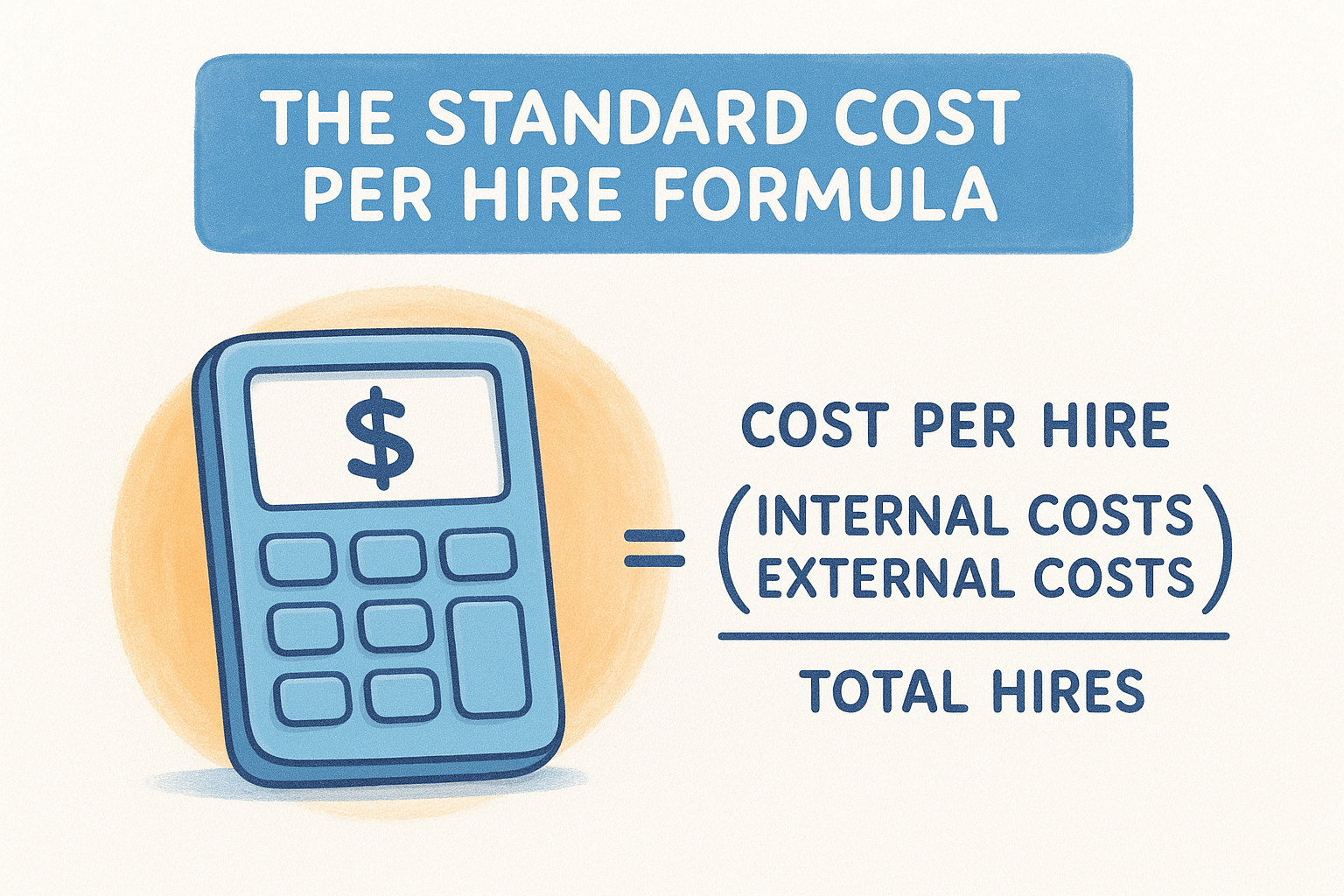
Cost Per Hire = (Internal Costs + External Costs) / Total Hires
You calculate this over a defined window, typically a quarter or fiscal year, to smooth out fluctuations from high-volume hiring periods. If your team spent $94,000 on recruiting in a quarter and made 20 hires, your cost per hire is $4,700. That number becomes your baseline, the figure you measure every future improvement against.
What to include in each category
Internal costs cover everything your team spends internally: recruiter salaries (prorated to time spent recruiting), HR coordination hours, ATS subscription fees, and any internal referral bonuses paid out. These costs are easy to overlook because they don't show up on an invoice, but they represent real money your organization is spending.
External costs include job board fees, agency commissions, background check vendors, pre-employment assessments, and paid advertising. Agencies alone can represent 15 to 25 percent of a candidate's first-year salary, which makes them the single largest line item for most teams. Tracking both categories separately lets you see exactly where cuts will have the biggest impact.
Cost per hire benchmarks and key drivers
Before you can figure out how to reduce cost per hire, you need a realistic target. The SHRM benchmark puts the average US cost per hire at $4,700, but that number varies significantly by industry, role type, and company size. Knowing where your number sits relative to comparable organizations tells you whether you have a minor gap to close or a systemic problem to fix.
Industry and role benchmarks
Your cost per hire will look very different depending on what you're hiring for. Entry-level and high-volume roles typically land between $1,500 and $3,000 per hire, while specialized technical and senior leadership roles can easily exceed $10,000 to $28,000. Here's a rough breakdown by category:
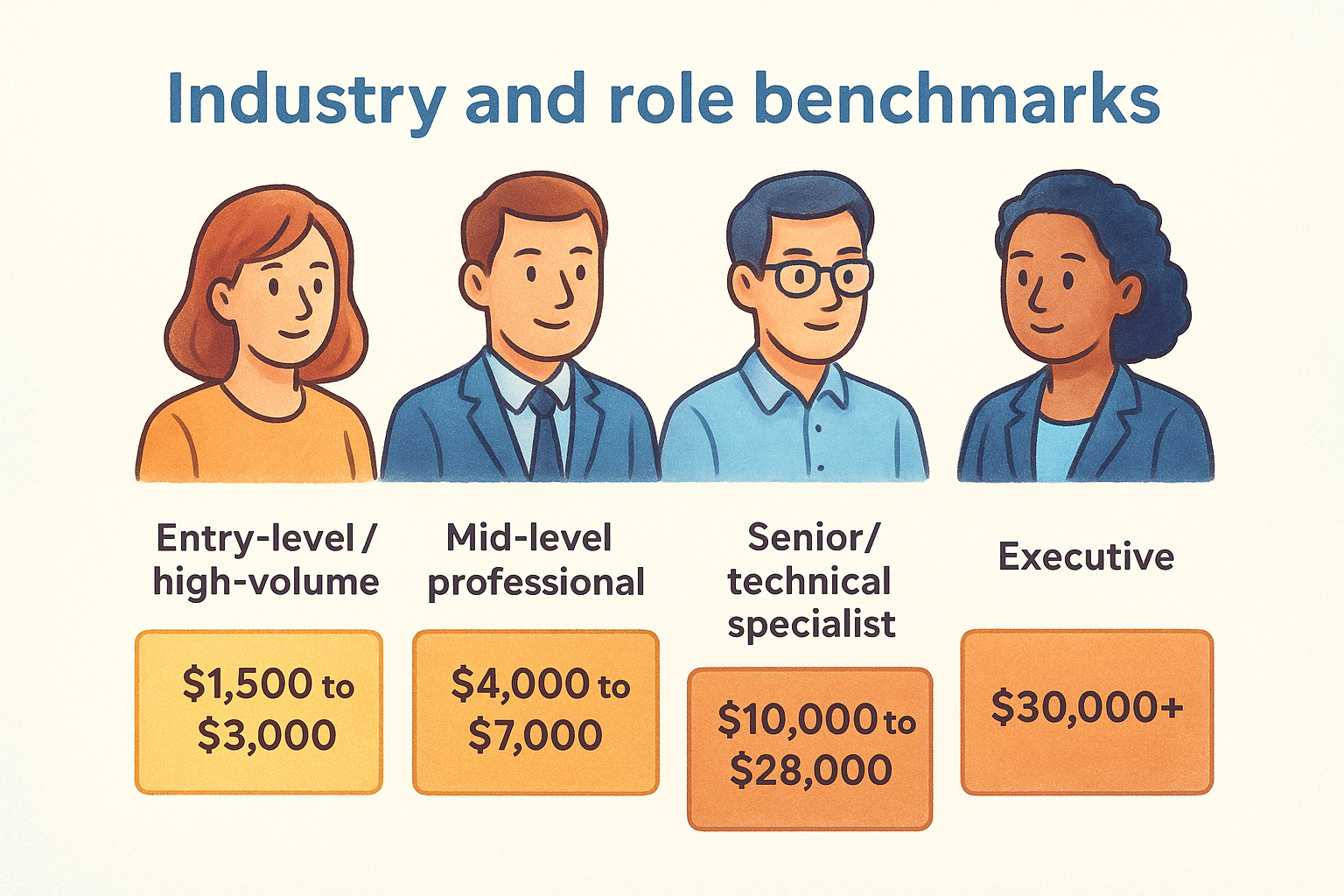
| Role Type | Estimated Cost Per Hire |
|---|---|
| Entry-level / high-volume | $1,500 to $3,000 |
| Mid-level professional | $4,000 to $7,000 |
| Senior / technical specialist | $10,000 to $28,000 |
| Executive | $30,000+ |
If your cost per hire consistently runs above the upper end for your role type, that gap represents money your team can recover with the right process changes.
What pushes the number higher
Several factors drive cost per hire above benchmark, and most of them are preventable with better tooling or process design. Agency commissions are the largest single inflator. When you route even 30 percent of your hires through third-party agencies charging 15 to 25 percent of first-year salary, your blended cost per hire climbs fast regardless of how efficient everything else is.
Slow pipelines create a second category of cost that rarely gets measured directly. Every extra week a role stays open adds recruiter hours, re-engagement emails, and repeat interview cycles. Companies with time-to-fill above 45 days almost always carry a higher cost per hire than those closing roles in under three weeks, even when their external spend looks identical on paper.
How to reduce cost per hire and keep quality
Cutting costs in recruiting is easy if you're willing to lower your standards. The real challenge is how to reduce cost per hire while still filling roles with people who can actually do the job. The good news is that most of the money your team wastes doesn't buy you better candidates. It buys redundancy, slow processes, and vendor fees you could replace with smarter tooling.
The fastest way to lower cost per hire is to stop paying for access to candidates you could reach for free.
Cut external spend first
External costs are the highest-impact area to target because they're both the largest expense category and the most replaceable. Agency commissions alone can run 15 to 25 percent of a candidate's first-year salary, and most teams use agencies because they lack a reliable candidate database, not because agencies consistently outperform direct sourcing. Building a searchable internal database of pre-screened profiles eliminates the need to route every hard-to-fill role through a third party. Platforms like Olibr give your team access to 180,000+ candidate profiles at no cost, which directly removes the line item that inflates most recruiting budgets.
Automate screening without cutting rigor
Manual resume review is where recruiter hours disappear fastest. When a single job post generates 200+ applications, your team spends days on work that AI can handle in minutes. Using AI-powered matching and automated interviews means your recruiters only spend time on candidates who already meet your criteria, keeping quality high while cutting the labor cost that drives your internal cost per hire figure upward. The key is choosing tools that score candidates on job fit rather than just keyword overlap, so speed doesn't come at the expense of hire quality.
How to track cost per hire over time
Calculating cost per hire once gives you a data point. Tracking it consistently gives you a trend line you can act on. Without regular measurement, any progress you make on how to reduce cost per hire becomes invisible, and budget conversations with leadership stay speculative instead of grounded in numbers.
Set a consistent measurement cadence
Your tracking cadence should match your hiring volume. Most teams find that a quarterly review works well because it smooths out month-to-month spikes caused by high-volume hiring pushes or seasonal demand. If you're filling 50+ roles annually, calculate cost per hire at the end of every quarter using the same formula: total internal and external costs divided by total hires made during that period. Store each result in a shared dashboard or spreadsheet so you can compare periods side by side.
Consistency in what you measure matters as much as how often you measure it, so lock down your cost categories before your first tracking period and don't change them mid-year.
Make sure the same cost inputs apply every quarter. If you include recruiter salary allocation in Q1, include it every quarter. Changing your inputs mid-year creates false comparisons that make progress look better or worse than it actually is.
Connect cost per hire to other recruiting metrics
Cost per hire tells you how much you spent, but it only becomes useful when you pair it with quality-of-hire and time-to-fill data. A lower cost per hire looks like progress until you realize your offer acceptance rate dropped and half those hires left within six months. Tracking all three together gives you a complete picture of whether your process is actually improving or just getting cheaper in the short term. Review all three metrics on the same schedule so patterns become visible across your full recruiting operation.
What to do next
You now have the formula, the benchmarks, and the specific levers that actually move your recruiting costs in the right direction. The next step is putting it into practice: calculate your current number, identify whether external spend or slow pipelines are your biggest drain, and pick one area to fix first. Knowing how to reduce cost per hire is only useful if you act on the data you collect.
Most teams find the fastest win is cutting paid subscriptions they no longer need. If you're paying monthly fees for job boards or an ATS when free alternatives exist, that's money leaving your budget for no reason. Olibr gives your team a full ATS, AI-powered screening, and access to 180,000+ candidate profiles at zero cost, with no feature gates or paid tiers. That single change can drop your cost per hire significantly before you touch anything else in your process. Start hiring for free on Olibr and see the difference it makes.
For hiring teams
Search 180,000+ candidate profiles — free.
Olibr is a community-funded recruiting platform: full ATS, AI interviews, and a shared resume database. No per-seat fees.