7 LinkedIn Recruiter Alternatives for Affordable Sourcing
LinkedIn Recruiter is a powerful sourcing tool, until you look at the price tag. At $8,000+ per seat annually, it's one of the most expensive recruiting subscriptions on the market. And for many hiring teams, especially those scaling quickly or working across multiple roles, that cost is hard to justify when LinkedIn Recruiter alternatives offer comparable (or better) features at a fraction of the price.
The good news: you're not locked in. A growing number of platforms now give recruiters access to large candidate databases, AI-driven matching, and automation tools, without the hefty monthly bill. Some tap into talent pools LinkedIn doesn't even reach, like GitHub, Stack Overflow, or niche industry communities, giving you a wider lens on qualified candidates.
At Olibr, we built a completely free recruiting platform with AI-powered interviews, a searchable database of 180,000+ profiles, and a full ATS, no subscription fees, no feature gates. We know firsthand that effective sourcing doesn't require an enterprise budget. This article breaks down seven alternatives worth considering, whether you're looking to cut costs, diversify your candidate pipeline, or both.
1. Olibr
Olibr is a free, full-featured recruiting platform built for teams that need sourcing, screening, and pipeline management in one place without a monthly bill attached.
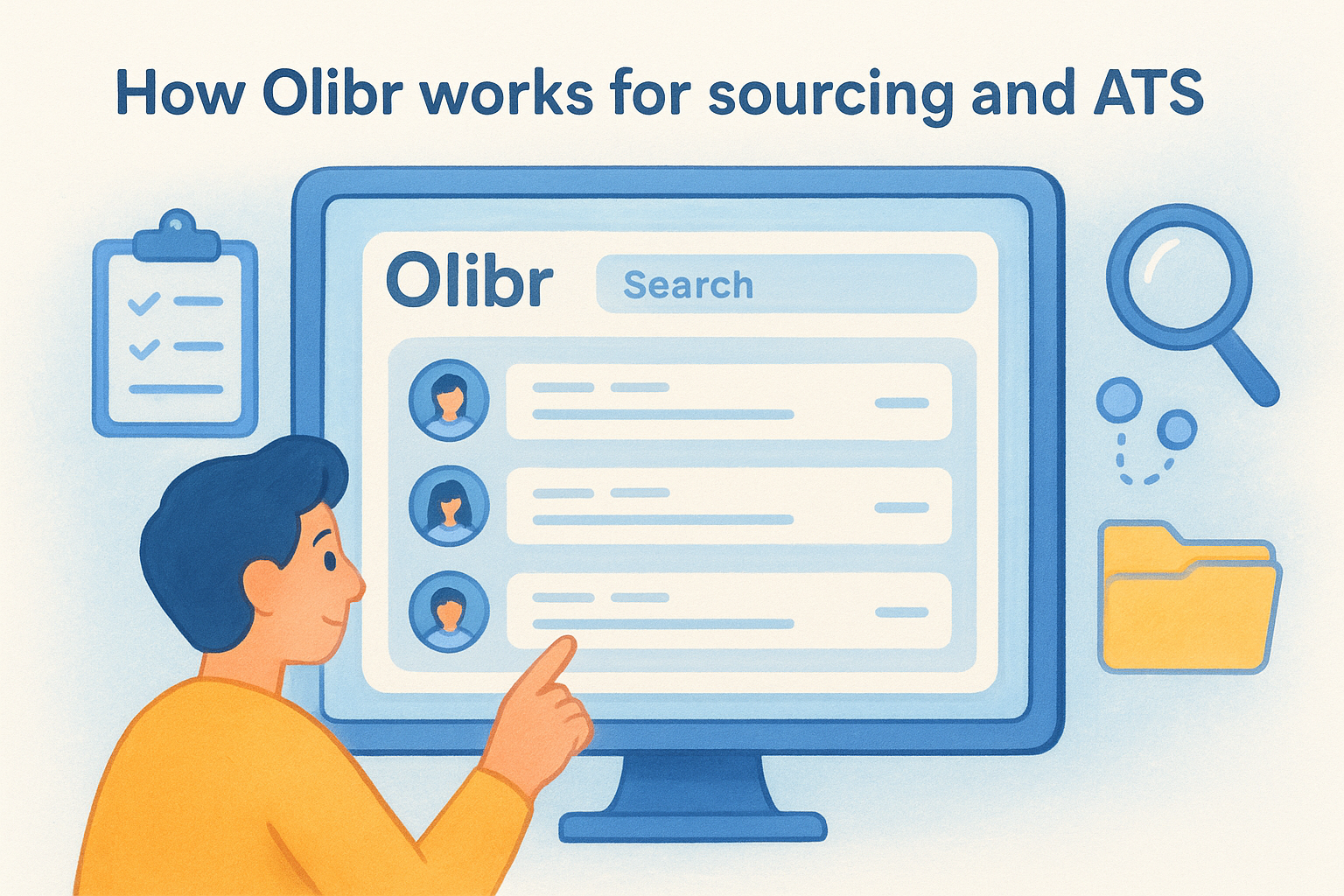
How Olibr works for sourcing and ATS
Olibr gives you a searchable database of 180,000+ candidate profiles with filters for skills, experience level, location, domain, and career trajectory. You can post jobs, manage candidate pipelines with a built-in ATS, and run AI-powered interviews that include facial expression analysis and automated scoring, all from a single dashboard. A Chrome extension lets you capture profiles directly from LinkedIn or Naukri without manual data entry.
When Olibr beats LinkedIn Recruiter
Olibr stands out among linkedin recruiter alternatives when your priority is eliminating recruiting costs without losing features. You get access to the full platform from day one, with no paid tiers, no feature gates, and no seat-based pricing. LinkedIn Recruiter charges $8,000+ per seat annually. Olibr charges nothing.
If budget is the primary reason you're exploring alternatives, Olibr removes that constraint entirely.
Where Olibr fits best for US and India hiring
Olibr is built for both US and India hiring markets, with local compliance considerations for each region. Whether your team is filling software engineering roles in Bangalore or product roles in Austin, the candidate intelligence dashboard surfaces relevant profiles with context on experience type, career trajectory, and portfolio strength, giving you more than just a name and a resume.
What to watch for with a community database model
The database grows through community contributions: recruiters upload resumes to earn credits that unlock platform access. This means profile freshness can vary, depending on when a resume was added. Cross-referencing shortlisted candidates against a second source is a smart habit, especially for senior or specialized roles.
Olibr pricing
Olibr is completely free. You access the full platform, including the ATS, AI interviews, bulk resume parsing, and candidate database, by contributing resumes to the shared pool. There are no subscription fees or locked feature tiers.
2. hireEZ
hireEZ (formerly Hiretual) is an AI-powered outbound recruiting platform that pulls candidate data from 30+ public sources, including GitHub, Stack Overflow, Dribbble, and social platforms beyond LinkedIn. If you need broader reach than a single network provides, it's worth a close look.
How hireEZ finds candidates outside LinkedIn
hireEZ aggregates profiles from over 30 data sources, so you're not limited to LinkedIn's network. When comparing linkedin recruiter alternatives, this multi-source approach matters because it surfaces passive candidates who are visible on developer communities or personal sites but don't actively maintain a LinkedIn presence.
Search workflow and matching strengths
You build searches using skills, titles, location, and experience filters, and hireEZ's AI ranks results by fit score. The platform also surfaces market insights like talent availability alongside your search results, giving you context before you reach out.
Outreach options and contact data expectations
hireEZ includes built-in email sequencing tools so you can run multi-step outreach without switching platforms. Contact data quality varies by candidate, and you should expect some email bounces, especially for older profiles. Verifying contact details before large campaigns saves time.
Plan for a contact data hit rate of roughly 70-80%, not 100%, when building outreach lists.
Best-fit scenarios and common gaps
Teams sourcing technical and engineering talent across multiple platforms get the most out of hireEZ. It's less useful if you need a built-in ATS or deep pipeline management, since the platform focuses primarily on sourcing and outreach.
hireEZ pricing
hireEZ does not publish flat pricing. Plans are quote-based, scaling with team size and feature access. Expect costs reaching thousands of dollars annually for full team access.
3. SeekOut
SeekOut is an AI-powered talent intelligence platform focused on deep candidate filtering and diversity hiring. It pulls data from public sources including GitHub, patents, and academic publications, giving recruiters a more complete picture of candidates than a resume alone provides.
How SeekOut builds talent pools and filters
SeekOut lets you build highly specific talent pools using filters for skills, patents, publications, certifications, and diversity attributes. The search goes beyond job titles, so you can find candidates based on demonstrated work output rather than self-reported experience. This makes it especially useful for technical and research-oriented roles.
DEI features and governance considerations
SeekOut includes dedicated diversity sourcing filters that help teams build more representative pipelines. Before rolling it out, your legal team should review how you use those filters, since employment law in the US limits how demographic data can factor into hiring decisions.
Use diversity filters for pipeline visibility and reporting, not as gatekeeping criteria, to stay compliant.
Best-fit scenarios for enterprise and regulated teams
SeekOut fits larger enterprise teams that prioritize structured diversity hiring programs and need reporting tools to back them up. It works well alongside existing ATS setups where teams want stronger sourcing upstream.
Limits to expect versus multi-source CRMs
SeekOut lacks the built-in outreach sequencing that some linkedin recruiter alternatives offer. You will need a separate email tool for candidate engagement at scale.
SeekOut pricing
SeekOut operates on custom, quote-based pricing. Expect enterprise-level costs that reflect its positioning toward larger organizations.
4. Findem
Findem is a talent intelligence platform that takes a different approach to sourcing by building attribute-based profiles from thousands of data sources rather than relying on static resumes. If your team is data-driven and wants sourcing tied to measurable pipeline outcomes, Findem is worth examining closely among linkedin recruiter alternatives.
How Findem approaches sourcing and talent data
Findem continuously indexes public data across 100+ sources to build dynamic candidate profiles that update as people change roles, skills, or employers. Instead of searching by job title alone, you query using specific attributes like skills held, companies worked at, and career progression patterns.
This attribute-based model surfaces candidates who fit a role profile even when their job titles don't match exactly.
Ways Findem supports pipeline building and rediscovery
Findem lets you rediscover candidates already in your ATS by running new attribute searches against your existing data. This reduces time spent sourcing from scratch when a similar role opens again. You can also automate talent pool updates so pipelines stay current without manual refreshes.
Best-fit scenarios for analytics-driven orgs
Teams that track sourcing funnel metrics closely and want to tie pipeline quality to hiring outcomes will get the most value from Findem. It fits organizations that already have structured reporting processes and want sourcing intelligence to feed into them.
Implementation and data considerations
Findem requires integration setup time before you see full value, particularly for ATS rediscovery features. Expect a ramp period of a few weeks to configure connections and validate profile matching quality.
Findem pricing
Findem uses custom, quote-based pricing. No public tiers are available, so you will need to contact their sales team for a detailed estimate based on team size and feature scope.
5. Gem
Gem is a talent CRM and sourcing platform that sits on top of your existing tools rather than replacing them. It helps recruiting teams organize candidates, track outreach, and build pipelines without abandoning the systems already in place.
How Gem works as a CRM layer on top of sourcing
Gem connects to LinkedIn, GitHub, and other sourcing channels to pull candidate data into a central CRM. You track every touchpoint, from first outreach to offer stage, inside one interface. The platform syncs with your existing ATS so data flows in both directions without duplicate entry.
When Gem helps you get more from LinkedIn
Gem adds pipeline tracking and multi-step email sequences on top of LinkedIn Recruiter, which lacks native CRM functionality. If your team sources heavily on LinkedIn but loses track of candidates between touches, Gem closes that gap.
Gem works best as an amplifier for LinkedIn, not a replacement for it.
Best-fit scenarios for teams with a strong ATS
Teams that already have a solid ATS and LinkedIn Recruiter access but need better pipeline visibility and outreach coordination get the most from Gem. It adds structure to sourcing workflows without forcing you to migrate existing data.
Limitations if you need a standalone sourcing database
Gem does not maintain its own candidate database, so it depends on external sources for discovery. As a standalone option among linkedin recruiter alternatives, it falls short if you need to search candidates without a LinkedIn license.
Gem pricing
Gem offers custom, quote-based pricing with no public tiers listed. Costs scale with team size and the ATS integrations your setup requires.
6. Manatal
Manatal is a cloud-based ATS with built-in sourcing capabilities, designed for teams that want a single platform to cover recruiting from job posting to hire. It sits in a different category than most linkedin recruiter alternatives because it combines workflow management and candidate discovery rather than focusing purely on one side of the process.
How Manatal combines ATS and sourcing
Manatal pulls candidate data from social media profiles and enriches records automatically when you add a candidate to your pipeline. The platform includes a built-in job board distribution tool that pushes listings to multiple boards from one place, reducing manual posting work.
Best-fit scenarios for lean teams that need one system
Smaller recruiting teams and agencies that want to avoid managing multiple tool subscriptions benefit most from Manatal. It works well when your team needs an ATS and sourcing in one place without the complexity of integrating separate platforms.
Workflow strengths for pipelines, collaboration, and posting
Manatal gives teams kanban-style pipeline views and role-based permissions so multiple recruiters can manage candidates without overlapping. Built-in collaboration notes and tagging keep communication centralized inside the platform.
If your team is switching between an ATS, a job board tool, and a collaboration app, Manatal consolidates all three into one interface.
Tradeoffs versus dedicated sourcing platforms
Manatal's sourcing depth is limited compared to tools like hireEZ or SeekOut. You won't get multi-source candidate discovery at scale from Manatal alone, so larger teams with complex sourcing needs may outgrow it quickly.
Manatal pricing
Manatal starts at $19 per user per month, making it one of the more budget-friendly paid options on this list.
7. Google X-ray search
Google X-ray search uses advanced search operators to pull publicly indexed profiles directly from Google's search engine, bypassing paid platform filters entirely. It's the only option on this list that costs nothing and requires no account or signup.
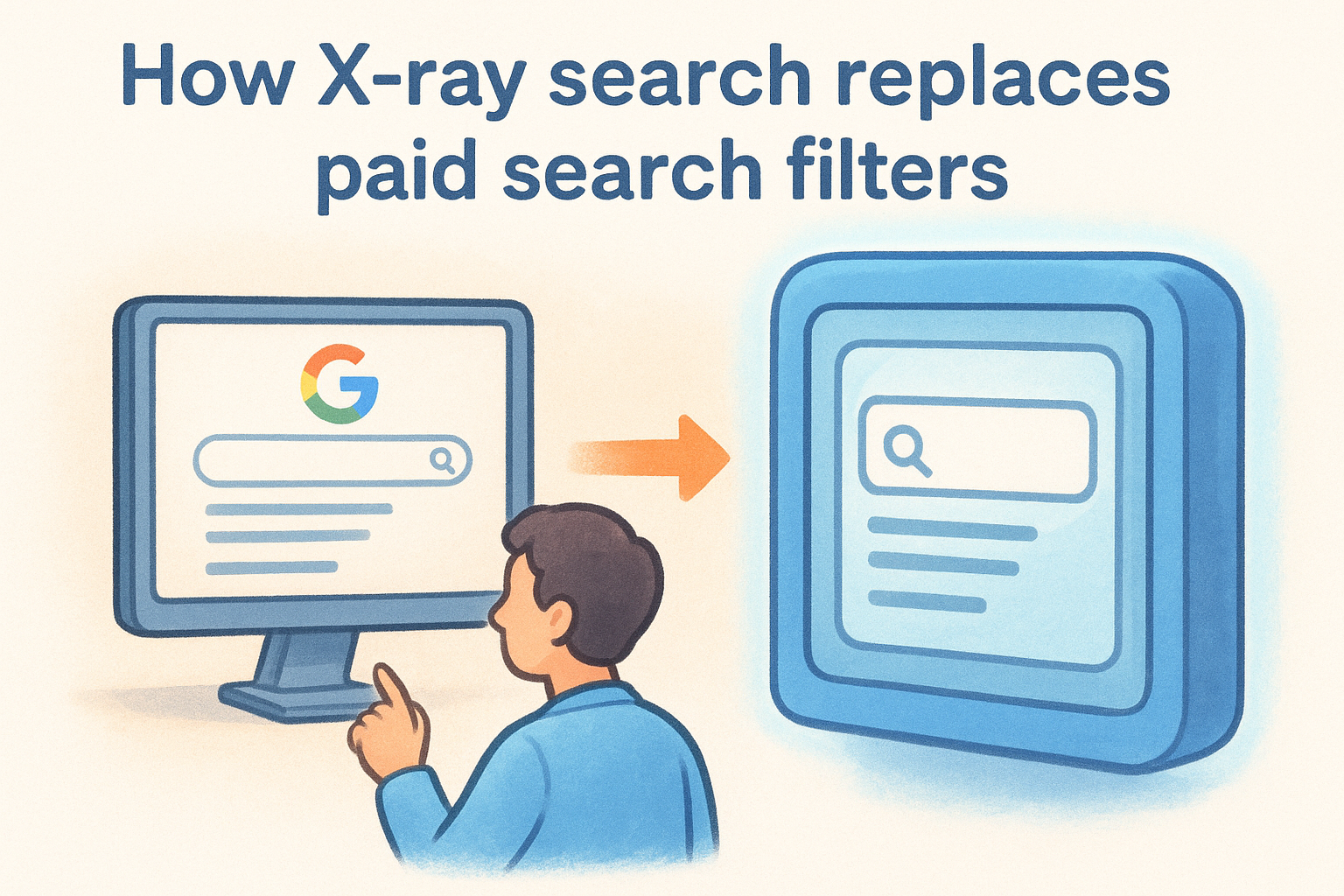
How X-ray search replaces paid search filters
You use Boolean operators and site: commands to search specific platforms like LinkedIn or GitHub through Google. A string like site:linkedin.com/in "software engineer" "Python" "Austin" returns public profiles matching those terms without a Recruiter license. This approach gives you direct access to publicly indexed candidate data at zero cost.
Copy-paste X-ray strings for LinkedIn, GitHub, and more
Three ready-to-use strings give you a starting point for the most common platforms:
- LinkedIn:
site:linkedin.com/in "job title" "skill" "city" - GitHub:
site:github.com "language" "location" - General resume search:
"resume" OR "CV" "job title" "skill" filetype:pdf
Swap in your own terms and run them directly in Google Search.
How to turn X-ray results into an outreach list
Once you identify relevant profiles, open each result, record names and contact details, and build a spreadsheet tracking source, profile URL, and outreach status. From there, you reach out via LinkedIn or email once you locate contact information.
X-ray search works best as a supplement to other linkedin recruiter alternatives, not as a standalone sourcing system.
Limits, compliance, and time cost to plan for
X-ray search is manual and slow at scale. Results depend on what candidates have made publicly indexable, so coverage for passive candidates with minimal web presence is thin. Budget two to three hours per role minimum if this is your primary sourcing method.
X-ray search pricing
X-ray search is completely free to use. Your only real investment is recruiter time, which makes it a practical backup option but a poor choice as a primary sourcing tool for high-volume hiring.
What to do next
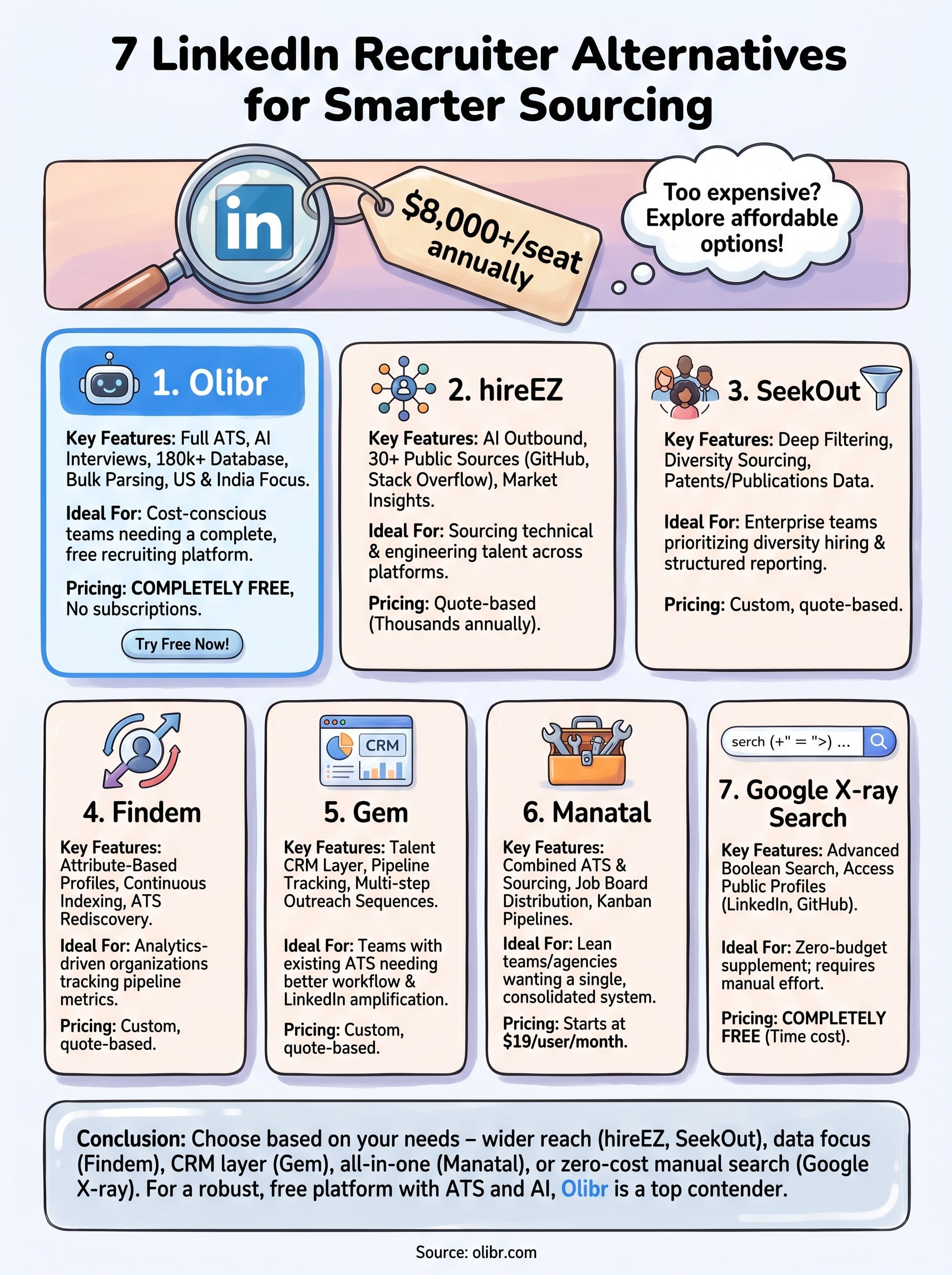
Each of the linkedin recruiter alternatives on this list solves a different problem. hireEZ and SeekOut give you broader candidate reach and deeper filtering. Findem helps data-driven teams tie sourcing to pipeline outcomes. Gem adds CRM structure on top of tools you already use. Manatal consolidates your ATS and job posting into one system. Google X-ray search costs nothing but trades speed for savings.
If your primary goal is eliminating recruiting costs without sacrificing features, Olibr removes that tradeoff entirely. You get a full ATS, AI-powered interviews, bulk resume parsing, and a searchable database of 180,000+ candidate profiles at no cost, covering both US and India hiring markets from day one.
The fastest way to see whether it fits your workflow is to try it yourself. Create your free Olibr account and start sourcing candidates today without spending a dollar.
For hiring teams
Search 180,000+ candidate profiles — free.
Olibr is a community-funded recruiting platform: full ATS, AI interviews, and a shared resume database. No per-seat fees.