What Is Talent Acquisition Strategy? Framework + Examples
Most recruiting teams operate in reaction mode, a role opens, a job gets posted, and the scramble begins. That cycle works until it doesn't. When critical positions sit unfilled for 45+ days, or you keep losing candidates to competitors who moved faster, the real issue isn't effort. It's the absence of a deliberate plan. Understanding what is talent acquisition strategy matters because it shifts hiring from a reactive task to a structured, long-term function that directly impacts business outcomes.
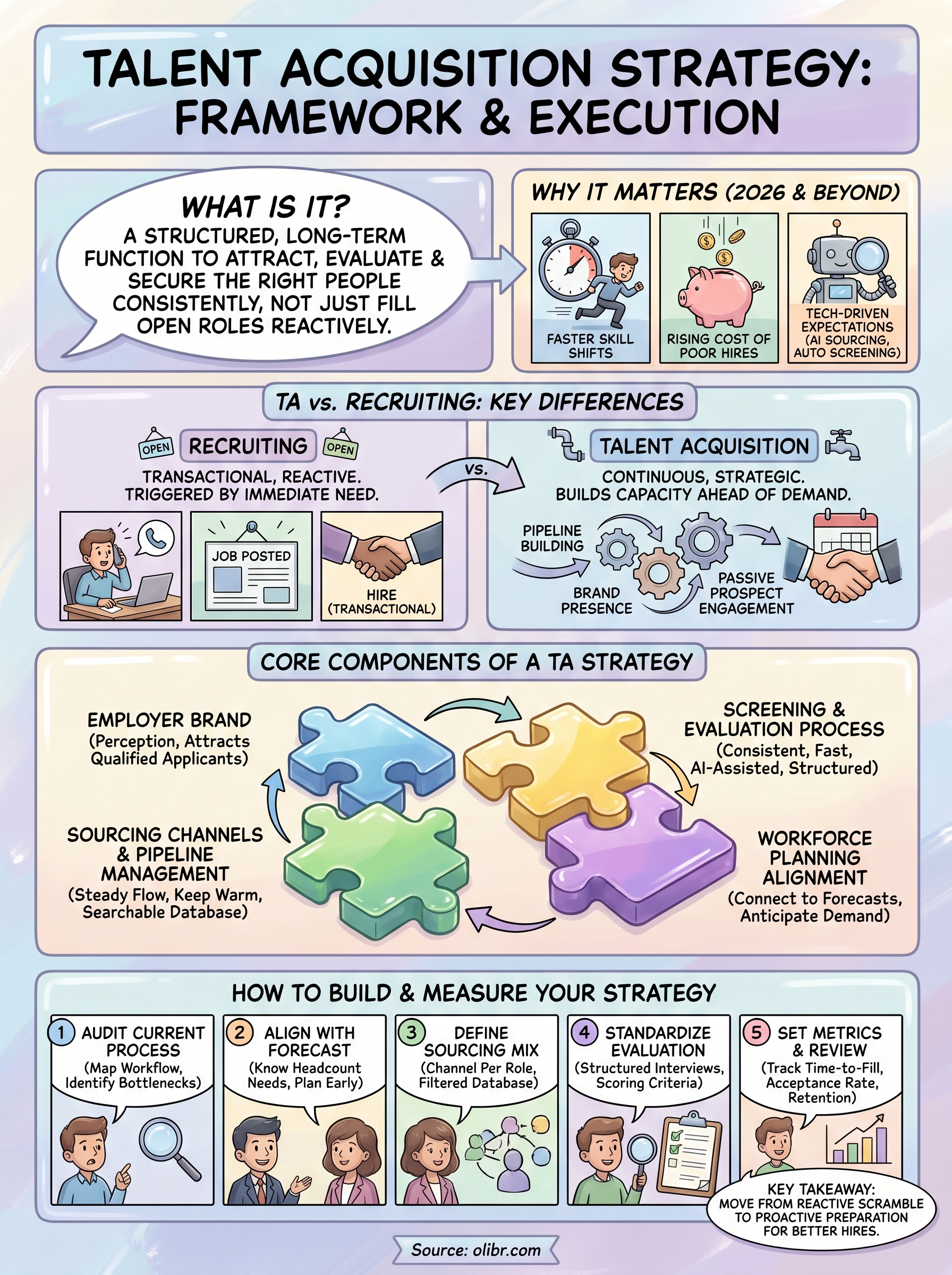
A talent acquisition strategy goes beyond filling today's open roles. It defines how your organization attracts, evaluates, and secures the right people, consistently and at scale. It accounts for employer branding, pipeline building, sourcing channels, and candidate experience, all aligned with where your company is headed. Without one, even large recruiting teams end up spending more while hiring slower.
This guide breaks down the core framework behind an effective talent acquisition strategy, walks through real examples, and shows how platforms like Olibr, which gives recruiting teams free access to AI-powered screening, a 180,000+ candidate database, and a full ATS, can serve as the operational backbone for executing that strategy. Whether you're building your first TA plan or overhauling an existing one, you'll walk away with a clear, actionable roadmap.
Why talent acquisition strategy matters in 2026
The hiring environment in 2026 looks nothing like it did five years ago. Skill requirements shift faster than most job descriptions can keep up with, and candidates with in-demand expertise have more options than ever. If you treat each hire as an isolated transaction, you're operating with a structural disadvantage. A clearly defined talent acquisition strategy gives your team a repeatable system to compete for the right people before a position even opens.
The labor market rewards preparation
Unemployment in technology, finance, and specialized trades remains tight despite broader economic volatility. The companies that fill critical roles in under 30 days aren't doing so because they got lucky. They built candidate pipelines well in advance, developed relationships with passive talent, and created processes that move quickly once a decision is made. Teams without that infrastructure spend weeks just identifying who to contact before any real evaluation begins.
The organizations winning the talent competition in 2026 aren't reacting faster. They're preparing earlier.
Passive candidates, people who aren't actively looking but would consider the right opportunity, make up a substantial portion of the best hires. Reaching them requires a consistent sourcing effort that doesn't stop between open roles. That kind of sustained activity only happens when talent acquisition is treated as a strategic function with dedicated processes, not a side task triggered by a resignation.
The cost of poor hiring decisions is rising
A bad hire at the mid-level costs organizations anywhere from 50% to 200% of that person's annual salary when you factor in recruiting fees, onboarding time, lost productivity, and the replacement search. Most hiring teams underestimate this figure because the costs are distributed across departments and rarely tracked in one place. When you understand what is talent acquisition strategy at its core, you see it's partly a risk management function, not just a sourcing exercise.
Speed also matters financially. Every day a revenue-generating role sits vacant is a day of lost output. For a sales position, that's measurable in pipeline. For an engineering role, it's delayed product work. Structured TA strategies compress time-to-hire by keeping talent pools warm, streamlining evaluation stages, and reducing the back-and-forth that drags out decisions by days or weeks.
Technology has raised the baseline expectations
AI-powered sourcing, automated screening, and predictive matching have shifted what a lean recruiting team can accomplish. Platforms now parse thousands of resumes in seconds, conduct preliminary interviews without human involvement, and surface candidates who match on dimensions beyond job titles and keywords. This technology doesn't replace judgment, but it does compress the manual work that used to consume most of a recruiter's day.
Teams gaining the most from these tools aren't using them as one-off shortcuts. They've integrated them into a coherent talent acquisition strategy that defines when and how each tool applies. Without that structure, even powerful technology produces inconsistent results, and the operational gains disappear into an unmanaged process.
Talent acquisition vs recruiting: key differences
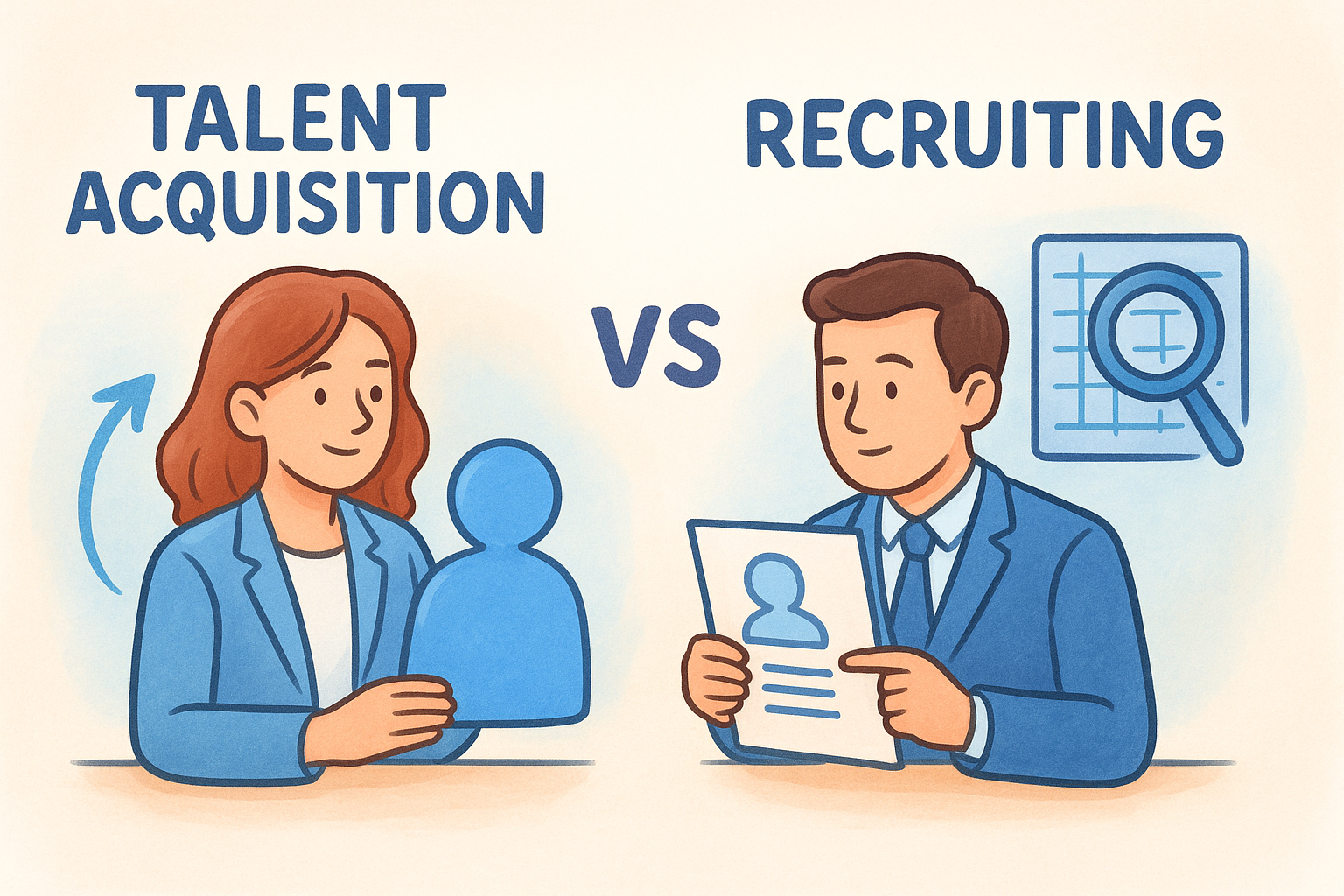
People use these two terms interchangeably, but they describe fundamentally different activities. Recruiting is a task. Talent acquisition is a function. Understanding that distinction helps you allocate resources correctly and stop expecting a short-term process to produce long-term results.
Recruiting is transactional by design
Recruiting starts when a vacancy exists and ends when the role is filled. Your team posts the job, reviews applications, screens candidates, and closes the hire. The entire workflow is triggered by an immediate need, and the goal is to move as efficiently as possible from opening to offer. That's not a criticism of recruiting. For predictable, high-volume roles where requirements stay consistent, a well-run recruiting process delivers exactly what you need.
The limitation shows up when the role is specialized, the market is competitive, or the hire has a long-term impact on team performance. In those situations, starting the search only after the position opens puts you weeks behind organizations that have already been building relevant pipelines. Recruiting, on its own, has no mechanism for that kind of advance work.
Talent acquisition operates on a longer timeline
When you think about what is talent acquisition strategy at the function level, the defining characteristic is continuous activity regardless of current headcount. Your team maps talent pools, tracks high-potential candidates, maintains relationships with passive prospects, and builds brand presence in communities where your target hires spend time. None of that work is tied to a specific open role.
Talent acquisition treats the next hire the same way a sales team treats the next deal: the pipeline starts filling before anyone asks for it.
This approach also connects hiring to business planning. When your organization knows it will need 20 engineers in Q3 to support a product launch, a TA strategy lets you start engaging candidates in Q1 rather than scrambling in June. Recruiting can't do that because it has no structure for prospective demand.
Where the two approaches overlap
The practical reality is that most teams run both simultaneously. You need recruiters closing current openings while TA strategy work builds future capacity. The distinction matters because these activities require different metrics, different timelines, and different skill sets. Conflating them leads to either neglected pipelines or unfilled roles. The clearest way to separate them: recruiting measures success by this quarter's hires, while talent acquisition measures success by how prepared your organization is for the next year of growth.
The core components of a TA strategy
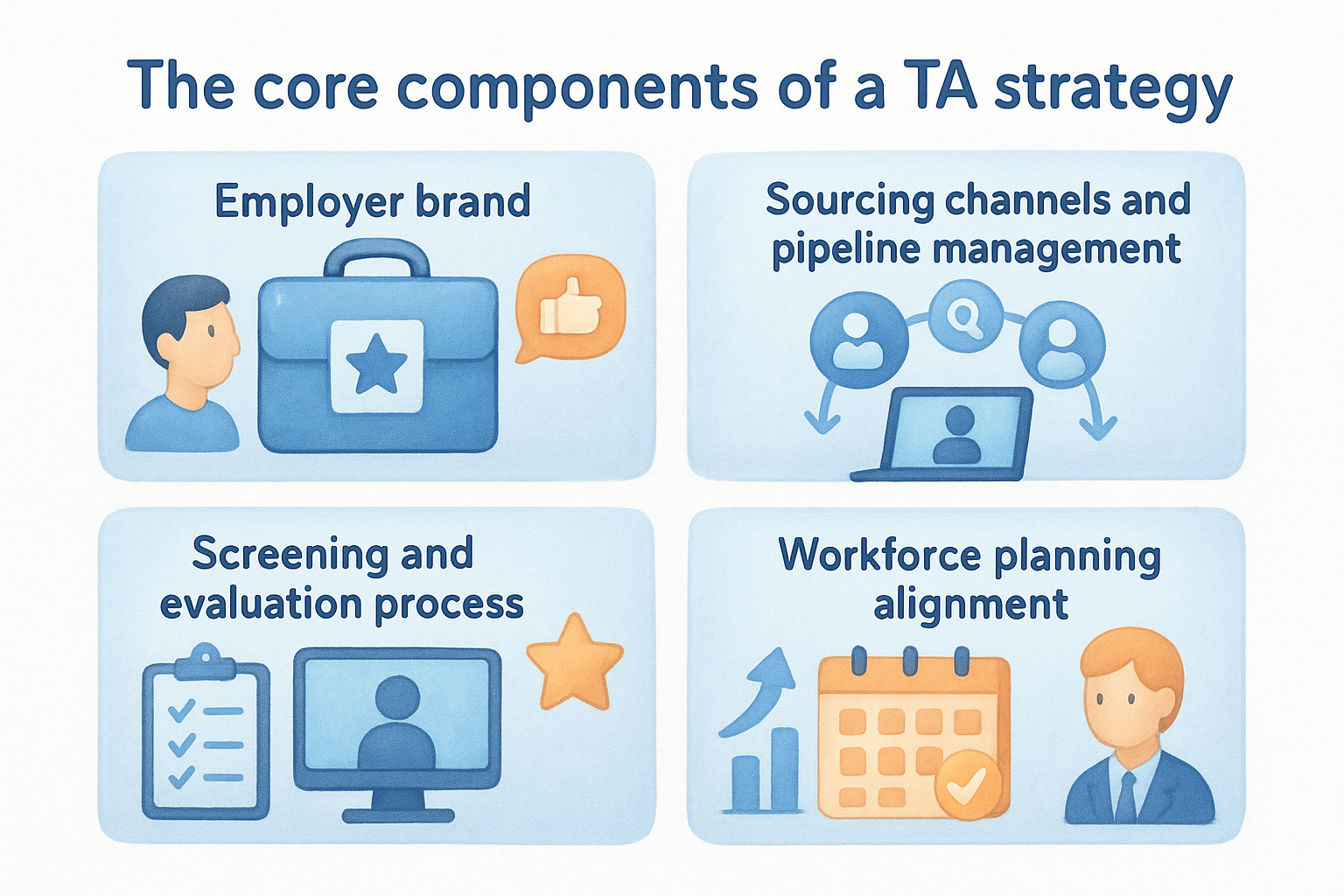
A talent acquisition strategy doesn't work as a single initiative. It's a system built from several connected components, each handling a distinct part of the hiring lifecycle. When you understand what is talent acquisition strategy at a structural level, you're really mapping out which components your team already handles well and which ones need deliberate investment.
Employer brand
Your employer brand is the perception candidates form about your organization before they ever speak to a recruiter. It shows up in job postings, Glassdoor reviews, LinkedIn presence, and how your employees talk about their work publicly. Strong employer brands attract higher volumes of qualified applicants, reduce the persuasion work your team has to do late in the process, and help candidates self-select in or out before a single interview is scheduled. Neglecting it doesn't make it disappear. It just means someone else is shaping it for you.
Sourcing channels and pipeline management
Sourcing is how you build a steady flow of qualified candidates rather than reacting to each new vacancy from scratch. Your strategy should define which channels produce the best candidates for each role type, whether that's a shared resume database, LinkedIn outreach, employee referrals, or community partnerships. The goal of active pipeline management is to keep those channels warm so that when a role opens, you already have people to contact. A searchable candidate database with advanced filtering cuts the time between identifying a need and engaging a shortlist from weeks to hours.
The best sourcing strategies don't chase candidates. They build systems that keep candidates close.
Screening and evaluation process
Even a strong candidate pool produces bad hires if your evaluation process is inconsistent or slow. This component covers how you assess candidates once they're in the pipeline, including screening criteria, interview formats, and scoring methods. AI-assisted interviews and structured scoring rubrics reduce the subjectivity that leads to poor hiring decisions, and they help you move through evaluation stages faster without cutting corners on quality.
Workforce planning alignment
Your TA strategy needs to connect directly to your organization's hiring forecast. This means working with leadership to understand headcount needs by quarter, mapping which roles require longer sourcing timelines, and building pipeline capacity before those roles officially open. Without this alignment, your team will always be operating on someone else's timeline. With it, you can anticipate demand and prepare accordingly, which is the defining advantage of a true talent acquisition function over a reactive recruiting process.
How to build a talent acquisition strategy step by step
Building a strategy sounds abstract until you break it into specific decisions your team can act on. Understanding what is talent acquisition strategy at the practical level means turning the framework into a clear sequence of steps that compounds over time. Each step below builds on the previous one, so skipping ahead creates gaps that show up later as inconsistent hiring results.
Step 1: Audit your current hiring process
Start by mapping every stage of your current recruiting workflow, from the moment a role opens to the moment an offer is accepted. Identify where candidates drop off, where delays accumulate, and which roles consistently take the longest to fill. This baseline tells you whether your biggest problem is sourcing, evaluation speed, or decision-making, and it keeps you from building a new strategy on top of a process that already has structural problems.
Step 2: Align with your business forecast
Talk to department heads and leadership to understand projected headcount needs for the next 12 months. Note which roles carry long sourcing timelines due to skill scarcity or seniority level. Once you know anticipated demand in advance, you can start building pipeline capacity before requests hit your desk rather than scrambling after they do.
Knowing your organization's hiring roadmap three months ahead fundamentally changes what your team can accomplish.
Step 3: Define your sourcing mix
Not every role fills through the same channel. Your strategy should specify which sourcing methods apply to each role type, whether that's a candidate database, referral programs, targeted outreach, or job boards. A searchable database with advanced filtering by skill, experience, and domain cuts the time between identifying a need and engaging a qualified shortlist from weeks to hours.
Step 4: Standardize your evaluation process
Decide in advance how you'll assess candidates at each stage. This includes structured interview formats, scoring criteria, and clear thresholds for each step in the funnel. Standardization removes the inconsistency that leads to drawn-out decisions and subjective outcomes. AI-assisted screening and automated scoring can handle early evaluation stages, freeing your team to focus on final-round judgment calls rather than manual resume reviews.
Step 5: Set metrics and schedule regular reviews
A strategy without measurement degrades into guesswork within a quarter. Track time-to-fill, source quality, offer acceptance rate, and 90-day retention as your starting baseline. Review these numbers quarterly and adjust your sourcing mix or evaluation process when the data shows a gap. Regular review cycles keep your strategy responsive to real hiring conditions rather than assumptions your team made at the beginning of the year.
Examples and templates you can copy
Abstract frameworks only go so far. Seeing what is talent acquisition strategy in concrete form helps you identify which pieces fit your organization's current scale and resources. The two templates below cover distinct stages of company growth. Use them as starting points and adjust the specifics to match your actual hiring volume, team size, and target roles.

Template 1: Small team or startup (1 to 3 recruiters)
When your team is lean, your TA strategy needs to focus energy rather than spread it thin. You can't maintain deep pipelines for every role type, so prioritize the two or three positions that are hardest to fill quickly and build proactive sourcing around those specifically.
Here's a practical structure to follow:
- Workforce planning: Meet with founders or department leads monthly to review the 90-day hiring forecast
- Sourcing: Maintain a filtered candidate shortlist for priority roles using a searchable database; refresh it every two weeks
- Employer brand: Keep a current company overview and culture content on your LinkedIn page; update it when major product or team milestones happen
- Evaluation: Use a standard three-stage process (screen call, skills assessment, final interview) with a shared scoring rubric for each role type
- Metrics: Track time-to-fill and offer acceptance rate quarterly; revisit your sourcing mix when either number moves in the wrong direction
The most effective small-team TA strategies don't try to do everything. They systematize the activities that prevent the most expensive delays.
Template 2: Mid-size or growing company (4 to 15 recruiters)
At this scale, you have enough capacity to run proactive pipeline work alongside active searches. The risk shifts from bandwidth to coordination. Without shared structure, different recruiters end up using different evaluation criteria, sourcing different channels for the same role type, and producing inconsistent candidate experiences that hurt your employer brand.
Your strategy at this level should define role tiers by sourcing complexity (standard versus specialist versus leadership), assign dedicated pipeline owners for each tier, and set clear handoff points between sourcing and evaluation stages. Build a shared candidate database your full team can access and filter, so no recruiter starts a search cold. Standardize your AI-assisted screening criteria by role family rather than configuring them from scratch each time a new position opens. Run a monthly pipeline review where each tier owner reports on active candidates, sourcing channel performance, and projected fill dates based on current demand. Connecting those updates to your workforce plan keeps your whole team moving toward the same quarterly targets.
Metrics to track and common mistakes to avoid
Executing on what is talent acquisition strategy means nothing if you can't tell whether it's working. Tracking the right numbers keeps your team honest about performance and gives you the data to justify process changes before small problems become expensive ones. Without consistent measurement, your strategy runs on assumptions rather than evidence.
The metrics that actually tell you how your strategy is performing
Start with time-to-fill, which measures how many days pass between a role opening and an offer being accepted. This number tells you whether your pipeline work is actually reducing sourcing delays. Pair it with source quality, which tracks what percentage of your hires came from each sourcing channel over a given period. When you know which channels produce hires and which ones produce volume without outcomes, you can reallocate sourcing effort instead of spreading it evenly across everything.
Tracking offer acceptance rate separately from time-to-fill reveals whether your speed gains are creating a different problem: rushing candidates who then decline.
Offer acceptance rate shows how well your process closes candidates once you've evaluated them. A low rate usually signals a gap in how your team communicates compensation, growth, or role expectations late in the funnel. Finally, track 90-day retention, meaning how many new hires are still in their role three months after starting. Early attrition points to a mismatch between what candidates were told during hiring and what they experienced after joining, which is a process problem, not a candidate quality problem.
Mistakes that quietly undermine TA strategy results
The most common mistake is treating strategy as a one-time document rather than a living system. Teams spend time building a plan, then file it while daily recruiting work takes over. Your strategy only compounds in value when you review it on a fixed schedule and update sourcing channels, evaluation criteria, and pipeline priorities based on actual hiring data.
Skipping workforce planning alignment is the second mistake. When your recruiting team operates without visibility into department-level headcount forecasts, you end up sourcing reactively regardless of how structured your process looks on paper. The result is the same 45-day scramble, just with better documentation around it.
A third mistake is measuring activity instead of outcomes. Tracking resumes reviewed or calls completed feels productive but tells you nothing about whether your strategy is generating better hires faster. Connect every metric you track directly to a hiring outcome, fill time, acceptance rate, or retention, and you'll have a much clearer signal of where your TA function actually needs work.
Next steps
Now that you understand what is talent acquisition strategy and how each component connects, the practical move is to pick one gap from your current process and close it before adding anything new. If your sourcing pipeline is empty, build it first. If your evaluation process is inconsistent, standardize it before optimizing speed. Trying to fix everything at once usually produces a strategy that looks complete on paper but doesn't hold up under real hiring pressure.
Your metrics will tell you where to focus next. Review time-to-fill, source quality, and offer acceptance rate on a fixed schedule, and let the numbers direct your adjustments rather than assumptions. Small, consistent improvements to each component compound into a hiring function that reliably fills roles faster and with better outcomes. If you want a platform that supports the full process without a monthly subscription, start hiring for free on Olibr and put your strategy into action today.
For hiring teams
Search 180,000+ candidate profiles — free.
Olibr is a community-funded recruiting platform: full ATS, AI interviews, and a shared resume database. No per-seat fees.