Candidate Experience in Recruitment: Definition & Practices
Every recruiter remembers a hire that almost didn't happen, a top candidate who nearly dropped out because of a clunky application, radio silence after an interview, or a process that dragged on for weeks. That's candidate experience in recruitment at work, and it shapes outcomes far more than most hiring teams realize. A single frustrating interaction can push qualified people toward your competitors, while a smooth, respectful process pulls them closer, even if they don't get the offer.
The problem is that most recruitment workflows weren't built with the candidate in mind. They were built around internal convenience: bulk postings, resume dumps, manual screening loops. The result? Hiring cycles that stretch past 45 days and candidates who ghost before you ever reach the offer stage. At Olibr, we've seen this firsthand across our platform's 180,000+ candidate profiles, the teams that hire faster and retain better are the ones that treat candidate experience as a core recruiting metric, not an afterthought. That's exactly why our AI-powered matching and interview tools are designed to reduce friction on both sides of the hiring table.
This article breaks down what candidate experience actually means, why it directly affects your hiring results, and the specific practices you can adopt to improve it. Whether you're running a lean HR team or managing recruitment at scale, you'll walk away with a clear framework for evaluating and upgrading how candidates move through your process, from first touchpoint to final decision.
What candidate experience means in recruitment
Candidate experience in recruitment refers to how a candidate perceives and feels about your hiring process from the moment they first encounter your company to the moment they receive a final decision. It covers every interaction along that path: the job listing, the application form, the automated confirmation email (or lack of one), the screening call, the interview, and the follow-up. None of these interactions exist in isolation. Together, they form a cumulative impression that determines whether a candidate accepts your offer, recommends your company to peers, or warns others to avoid applying altogether.
The full scope of the candidate journey
Most recruiters focus on the interview as the centerpiece of hiring, but the candidate's experience starts much earlier. It begins the moment someone reads a job description and decides whether the role is worth pursuing. That first impression is shaped by how clearly the role is written, how realistic the requirements look, and whether the application process seems proportionate to the position. From there, each step either builds or erodes the candidate's confidence in your organization.
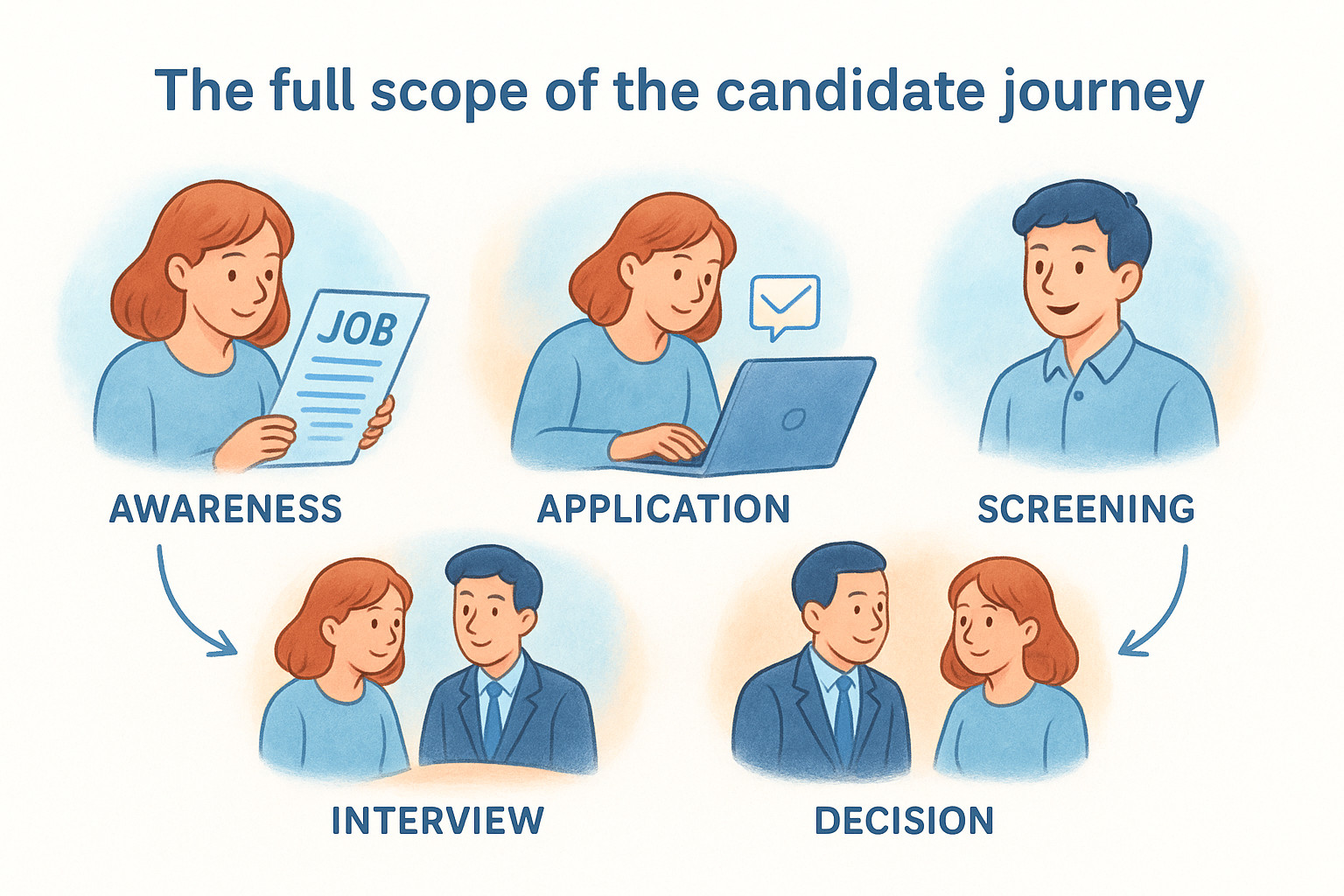
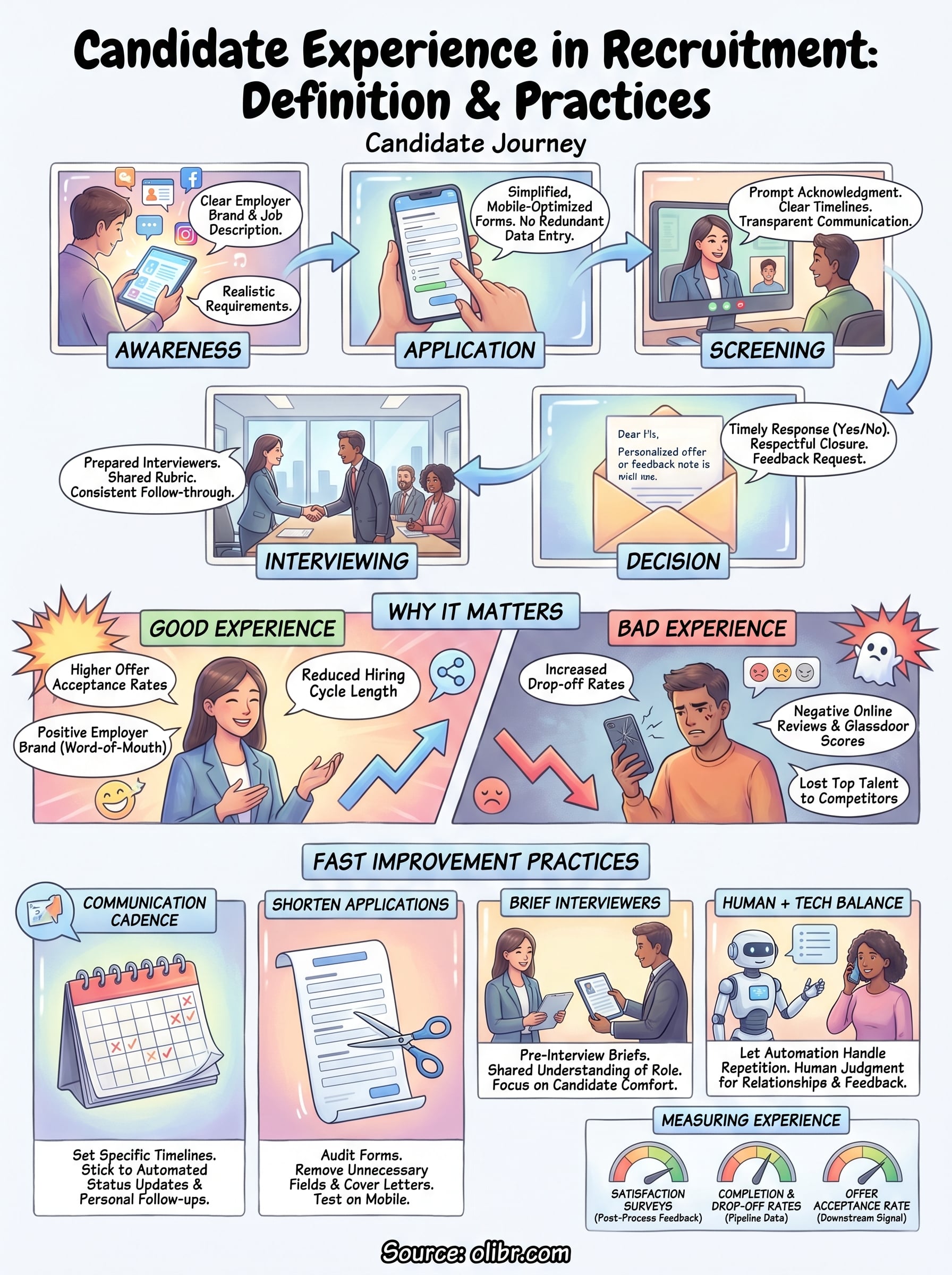
The journey typically moves through five broad phases: awareness, application, screening, interviewing, and decision. At every phase, candidates are making active judgments about you. During awareness, they're evaluating your employer brand. During application, they're assessing whether you respect their time. During screening, they're gauging your communication quality. During interviews, they're forming opinions about your culture and leadership. During the decision phase, they're measuring your transparency and speed. Missing the mark at any single stage can cost you a candidate who was ready to say yes.
The candidate experience isn't just about the steps in your process; it's about how those steps make people feel at each one.
What separates good from bad candidate experience
Good candidate experience doesn't require a large team or expensive infrastructure. It requires intentionality: clear job descriptions, prompt acknowledgment of applications, honest timelines, and consistent follow-through. Candidates don't expect a flawless process. They expect to be treated as people rather than as a resume sitting in a queue. When you give them straightforward information and respond without long delays, you signal that your company operates with the same respect on the inside that it projects publicly.
Bad candidate experience usually traces back to a few predictable failures that compound over time: application forms that take 40 minutes to complete for a junior role, weeks of silence after a final-round interview, vague or absent feedback, and processes that collapse because an internal decision was made without notifying the finalists. These aren't isolated inconveniences. They leave candidates with a concrete, shareable story about your company that travels through professional networks, lands on review platforms, and shapes how future candidates approach your open roles.
Your hiring process functions, in practice, as a public-facing product. Candidates treat it as direct evidence of how you run your business day-to-day. A disorganized, unresponsive process tells them far more than your careers page ever will. Conversely, a process that communicates clearly, moves at a reasonable pace, and treats every applicant with basic professionalism creates goodwill that extends well beyond the hire itself, whether or not that particular candidate gets the offer.
Why candidate experience matters
Candidate experience in recruitment isn't a soft metric you track when you have spare time. It directly affects whether your top choices accept offers, how quickly you fill roles, and what skilled professionals say about your company to their networks. If you treat it as secondary to sourcing or interviewing, you'll keep losing candidates at exactly the stages where you've already invested the most time.
It affects your offer acceptance rate
When candidates reach the offer stage, they've already formed a detailed opinion of your company based on every interaction they've had with your team. A slow, disorganized process signals risk, and risk makes candidates hesitate. Research consistently shows that candidates who had a positive hiring experience are far more likely to accept an offer, even when a competing offer is financially comparable. The process itself carries weight in the final decision.
Candidates who enjoyed the hiring process are significantly more likely to accept your offer, even if competing offers pay more.
A streamlined, respectful process communicates that your organization values people, and that impression shapes how confident a candidate feels about joining. Conversely, if they experienced long silences, unclear instructions, or contradictory feedback, they'll wonder whether that's how decisions get made internally too.
It shapes your employer brand over time
Every candidate who goes through your process has a network. The ones who felt ignored, misled, or disrespected will say so, in conversations with peers, on review platforms, and in professional communities. You don't need a large sample size for this to matter. A handful of negative experiences, shared across LinkedIn or Glassdoor, can quietly reduce the quality of your applicant pool over months.
Positive experiences do the opposite. Candidates who felt respected, even ones who didn't get the role, often refer qualified people from their own networks. Your hiring process becomes a word-of-mouth channel without any additional spend. That only happens when you're consistently treating every applicant as someone whose time and effort deserves acknowledgment.
It reduces hiring cycle length
When candidates get timely updates and clear next steps, they stay engaged instead of pursuing other options in parallel. Drop-off rates fall sharply when communication is consistent, because candidates aren't left guessing whether you've moved on without telling them. A process built around the candidate's experience doesn't just feel better; it closes faster.
Candidate experience touchpoints to get right
Candidate experience in recruitment breaks down into specific moments where your process either builds trust or erodes it. You don't need to overhaul everything at once, but you do need to identify the highest-impact touchpoints and make sure they're working. Getting these right creates a compounding effect: each positive interaction increases the likelihood that a candidate stays engaged through the next stage.
The job description and application
Your job description is the first real interaction a candidate has with your hiring process. If it's vague, inflated with requirements, or written in a way that reads like a wish list rather than a real role, you'll filter out strong candidates before they ever apply. Write descriptions that are specific, honest, and proportionate to the actual role, including realistic expectations around responsibilities and compensation where possible.
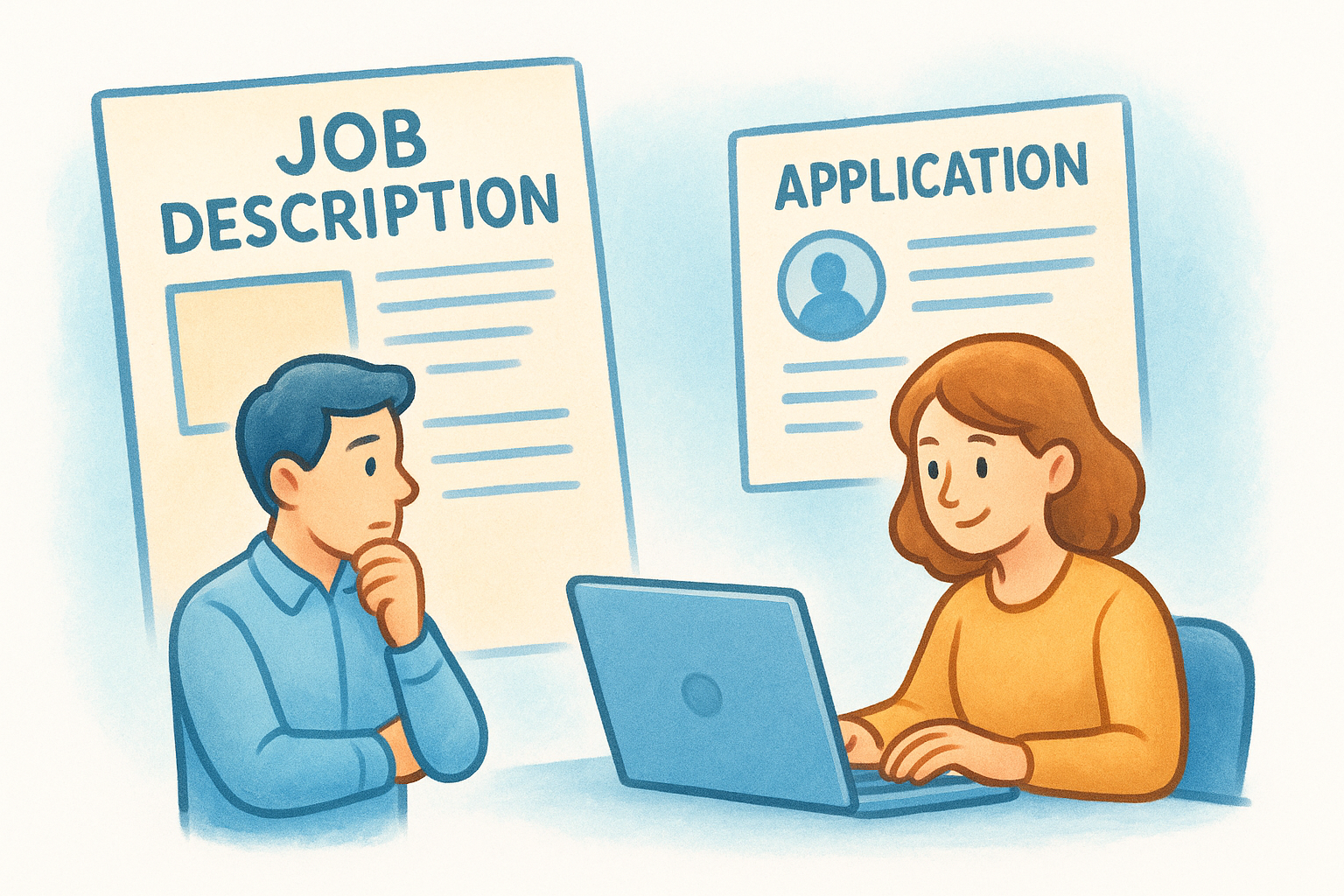
The application itself needs the same attention. A long, repetitive form that asks candidates to re-enter everything already on their resume signals that your process wasn't built with them in mind. Keep fields short, test the form on different devices, and make sure every question you ask directly informs a hiring decision.
Screening and early communication
The window between application submission and first contact is where most candidate drop-off happens, even before a single conversation takes place.
Prompt acknowledgment matters more than most recruiters assume. Sending an automated confirmation immediately after submission costs you nothing, but the absence of one creates immediate uncertainty about whether the application even landed. Beyond that, clearly stating the expected timeline in your first outreach removes the need for candidates to follow up repeatedly and reduces the chance they start disengaging.
When you do screen, treat the call as a two-way exchange. Candidates are actively evaluating your communication style and your team's clarity just as much as you're assessing their fit.
The interview and final decision
The interview stage carries more weight in the candidate's overall impression than any other single touchpoint. Show up prepared, brief your interviewers on the candidate's background before the session, and give the whole panel a clear, shared picture of what the role actually requires. Candidates notice immediately when interviewers haven't reviewed their materials.
Following up after the final interview is non-negotiable, whether the answer is yes, no, or not yet. A candidate who never hears back after a final-round conversation won't forget it, and neither will their network.
Practices that improve candidate experience fast
Improving candidate experience in recruitment doesn't require rebuilding your entire process from scratch. Most of the gains come from fixing a small number of high-friction points that candidates encounter repeatedly. Start with the areas that cause the most drop-off and work forward from there. Consistency matters more than perfection, so focus on changes you can apply to every candidate in every role, not just for senior hires or high-priority searches.
Set a communication cadence and stick to it
Silence is the single fastest way to lose a candidate who was otherwise committed to your process. Set a specific communication schedule before a role opens, decide in advance when candidates will hear from you after each stage, and assign someone on the team to own that follow-through. Even a short message that says you're still reviewing and will be in touch by a specific date keeps candidates engaged and prevents them from accepting other offers out of uncertainty.
Candidates who receive consistent updates are far less likely to drop out mid-process, even when timelines extend.
Automated status emails work well for early stages, but they need accurate timelines baked in. If you tell someone they'll hear back in five business days, you need to actually reach out within that window. Broken timelines signal that your process is unmanaged, and candidates carry that impression into every subsequent conversation.
Shorten and simplify your application
Every unnecessary field in your application form creates friction that costs you qualified applicants. Audit your current application and cut any question that doesn't directly influence a screening decision. If the role doesn't require a cover letter for practical reasons, remove that requirement. Testing your form on mobile before it goes live also catches usability problems that desktop-only reviews miss, since a large portion of candidates apply from their phones.
Brief your interviewers before every session
Poor interview preparation is one of the most visible failures in the process. Candidates notice immediately when interviewers haven't reviewed their materials, and it sends a clear message about how your team operates. Build a simple pre-interview brief that covers the candidate's background, the key competencies you're assessing, and any questions the team has already asked in prior stages. Keep it short enough that interviewers actually read it, and make distributing it a required step before any interview is confirmed.
How to measure candidate experience
Measuring candidate experience in recruitment gives you concrete data to work with instead of assumptions. Without a measurement system, you're making changes based on gut feeling and hoping they land. Two or three structured metrics tracked consistently across every open role will tell you exactly where your process is losing candidates and where it's earning their trust.
Candidate satisfaction surveys
Sending a short post-process survey is the most direct way to collect feedback. Keep it to five questions or fewer, and send it at two points: once after the first interview, and again after a final decision is made. Asking at both stages helps you separate feedback about your early-stage process from feedback about how you handle the final decision and communication.
Candidates who didn't get the offer are often your most honest source of process feedback, because they have no incentive to soften their responses.
Ask specific questions rather than broad ones. "How clearly did we communicate next steps?" tells you more than "How was your experience?" If a pattern shows up across multiple candidates, you have a real signal rather than a one-off complaint.
Tracking completion and drop-off rates
Your application completion rate shows you exactly how many candidates started the form and how many finished it. A low completion rate almost always points to a form that's too long, too repetitive, or broken on certain devices. Most applicant tracking systems track this automatically, so pull the numbers by role and look for patterns across positions.
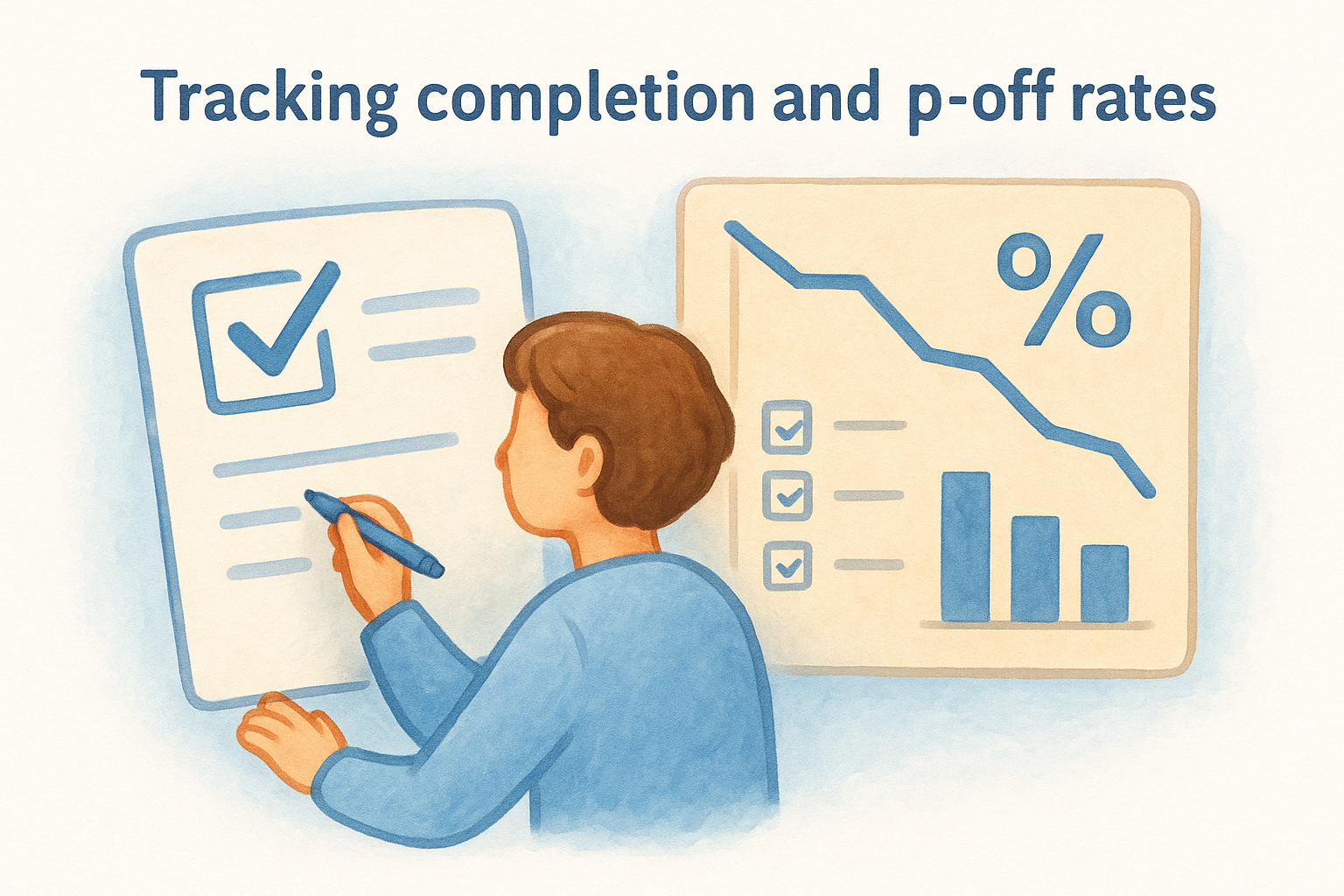
Drop-off rates by stage tell you where candidates are disengaging inside your pipeline. If a significant percentage of candidates disappear between the screening call and the first interview, that gap usually signals a communication or scheduling problem. Identifying the stage with the highest drop-off gives you a clear starting point for your next improvement.
Offer acceptance rate
Your offer acceptance rate is the clearest downstream signal of how well your process is working. A rate below 80 percent usually indicates a problem that starts well before the offer itself, whether that's misaligned expectations, slow communication, or an interview process that gave candidates reasons to doubt your organization. Track acceptance rate by role type and hiring manager, because patterns at that level reveal whether the problem is process-wide or localized to specific teams.
Using ATS and AI without losing the human touch
ATS platforms and AI tools have changed how recruiting teams manage volume, but they introduce a real risk if you deploy them without thinking through the candidate experience in recruitment. The recruiter's job shifts when you add AI to the mix: you spend less time on sorting and more time on the interactions that actually require judgment and care. That shift only improves outcomes if you stay deliberate about where automation ends and personal contact begins.
Let automation handle repetition, not relationships
The right boundary for automation is anywhere a task follows a predictable, rule-based pattern. Sending confirmation emails, advancing candidates between pipeline stages, and scheduling interviews are all strong candidates for automation because they don't require contextual judgment. Handling these manually creates delays and inconsistency, neither of which benefits your candidates. Your ATS should be doing this work so your team's attention is available for the conversations that carry actual weight.
Automation reduces friction for candidates when it runs invisible behind the scenes; it creates friction when it replaces communication that candidates expected to be personal.
Where automation breaks down is in anything that carries emotional weight. Rejection messages, feedback calls, offer conversations, and any communication following a final-round interview should come from a person. Candidates identify templated rejection emails immediately, and a generic message after a final-round interview leaves a lasting negative impression on your employer brand. A short, personal note costs you five minutes and earns you lasting goodwill from candidates who will remember how you handled the end of the process.
Where human judgment still wins
AI-powered matching and screening tools are strong at identifying patterns across large candidate pools, but they don't account for the full picture. A candidate's trajectory, career pivots, or unconventional background often look like noise to an algorithm. Human review at the shortlist stage catches the candidates worth a closer look that automated scoring would have passed over. Use AI to reduce the pile, then apply real judgment to the candidates it surfaces.
Your interviewers also need to understand that AI-assisted processes don't replace their role in shaping how candidates feel. Being present, prepared, and direct in every conversation is what candidates actually remember. Tools improve speed; people build trust. Keep both in balance and your process will close faster without losing the human signal that makes strong candidates say yes.
Next steps
Improving candidate experience in recruitment comes down to a handful of concrete decisions: clear job descriptions, consistent communication, structured interviews, and a measurement system that tells you where your process is breaking down. None of these require significant budget. They require deliberate design and follow-through at every stage of the hiring cycle.
Start by auditing the stage where you lose the most candidates. Pull your drop-off data, survey recent applicants, and review your offer acceptance rate. Those three numbers will point you directly at the problem worth solving first. Fix that, measure the result, then move to the next friction point.
If you want a platform that handles the operational side of recruiting without charging you a monthly fee, Olibr gives you a full ATS, AI-powered matching, and automated interviews in one place so your team can focus on the conversations that actually matter. Start hiring smarter with Olibr.
For hiring teams
Search 180,000+ candidate profiles — free.
Olibr is a community-funded recruiting platform: full ATS, AI interviews, and a shared resume database. No per-seat fees.