12 Best HR Hiring Software Platforms in 2026
Picking hr hiring software in 2026 feels harder than it should. Every vendor claims AI matching, every pricing page hides the real cost until you talk to sales, and most tools still charge per seat while your recruiters juggle five different logins just to move one candidate through a pipeline. If you manage hiring for a staffing agency or an in-house team, you already know the pain of paying for an ATS, a separate candidate database, and a job board that barely talk to each other.
This list cuts through that mess. We compared platforms on what actually matters for recruiters evaluating best hiring software in 2026: real candidate database size, AI screening that goes beyond keyword matching, pricing structure, and how fast a small team can get from job post to hire. Whether you're searching for recruiting database software to reach passive candidates or a full-stack ATS to replace three tools, you'll find it ranked here with honest tradeoffs.
We cover 12 platforms, from enterprise suites to lean, free alternatives built for agencies watching their cost per hire. Each entry includes standout features, pricing, and who it fits best, so you can shortlist in minutes instead of days.
1. Olibr: a free ATS with a community-powered candidate database
Most recruiters sit on an ATS full of candidates they sourced once and never touched again. Olibr flips that dead weight into working capital. Instead of charging a subscription, Olibr asks recruiters to contribute their dormant, no-longer-active candidate profiles to a shared network, and in return gives them free access to a searchable pool of over 180,000 verified profiles contributed by 500+ other recruiters, plus a complete hiring platform to run the whole process. If your team manages hiring for a staffing agency or an in-house desk and you're tired of paying separately for an ATS, a candidate database, and a job board, this is the rare hiring software built specifically around that frustration.

A recruiter's unused sourcing history is worth more traded than left sitting in a dead database.
Key features
Olibr bundles the tools recruiters usually buy piecemeal into one free platform:
- Shared candidate network: search 180,000+ profiles by skill, experience, and location, all contributed by other recruiters on the platform
- Full ATS included free: pipeline stages, kanban boards, team notes, and collaboration tools with no per-seat fee
- Unlimited job postings on an integrated job board with built-in applicant tracking
- AI matching that ranks candidates against a job description instead of relying on keyword search alone
- AI video interviews with scored transcripts and expression analysis, useful for screening at volume
- Bulk upload and parsing for PDF, DOCX, and CSV files, up to 10,000 profiles in one batch
- AI-powered sourcing that pulls candidates from 400+ job boards and a proprietary database of 400 million profiles
- One-click job distribution to major boards and social platforms
- Structured interview scorecards to keep hiring panels aligned
- Video interviewing and assessments built into the same workflow
- Reporting dashboards for pipeline health and time-to-hire tracking
- Dual-mode functionality for staffing agencies (client and candidate management) and in-house corporate hiring
- Resume parsing that extracts and organizes candidate data automatically
- Customizable pipelines with drag-and-drop stages
- Built-in job board posting to major boards and social channels
- Zia AI assistant for candidate matching and duplicate detection
- Structured interview kits with scorecards tied to each role's must-have competencies
- DEI-focused hiring tools, including anonymized resume review to reduce bias
- Deep integrations with over 500 HR tools, background check providers, and assessment platforms
- Custom reporting on pipeline conversion, source effectiveness, and interviewer load
- Onboarding handoff that carries candidate data into the new-hire process
- Applicant tracking with a visual pipeline and drag-and-drop stage changes
- Candidate-to-employee handoff that carries data straight into onboarding without re-entry
- Job posting to major boards from inside the same dashboard
- Mobile hiring app for approvals and candidate review on the go
- Compensation and reporting tools shared across HR and recruiting
- Customizable pipelines with templates for common roles
- One-click job board posting to major sites and social channels
- Collaborative hiring tools, including interview scorecards and team feedback threads
- E-signature offer letters built into the hiring workflow
- Compliance tracking for EEOC and OFCCP reporting requirements
- AI recommendation engine that scores and ranks candidates against open roles
- Candidate sourcing from 20+ channels including social media and job boards
- Enrichment tool that pulls public data to build out thin candidate profiles
- Customizable pipeline stages with kanban-style tracking
- DEI analytics to flag bias risk in shortlists
- On-demand video interviews candidates record on their own schedule
- Live video interviewing with multi-panelist scheduling automation
- Structured scorecards to standardize evaluation across interviewers
- Applicant tracking with customizable pipeline stages
- Automated reference checking built into the same workflow
- Automated candidate follow-ups triggered by pipeline stage changes
- Career page builder with no-code customization
- Interview scheduling synced to hiring manager calendars
- Candidate scorecards for consistent team feedback
- Job board syndication to free and paid boards from one posting
- No-code careers page builder with full branding control
- Programmatic job advertising that shifts budget toward boards driving actual applications
- DEI reporting built into candidate sourcing analytics
- Automated candidate communication with customizable email templates
- Structured interview scorecards shared across hiring panels
- Combined ATS and CRM tracking candidates and client accounts in one pipeline
- Resume parsing with a Chrome extension for sourcing straight from LinkedIn
- Kanban-style deal boards for tracking placements and revenue by client
- Automated email sequences for candidate and client outreach
- Custom fields and reporting built around agency KPIs like time-to-fill and placement fees
- AI chat and SMS screening that qualifies candidates against job-specific criteria
- Automated interview scheduling once a candidate clears the initial screen
- Bias-reduction tools that standardize screening questions across every applicant
- Integration with major ATS platforms rather than replacing one outright
- Candidate experience analytics tracking drop-off points in the application flow
- Database size and freshness: does the vendor's candidate pool grow, or does it sit static after signup, leaving you to grow your own talent pool from scratch?
- Pricing model: per seat, per job, or a free tier funded some other way?
- AI screening depth: keyword matching only, or scored ranking against the actual job description?
- Setup time: same-day usable, or a multi-week sales and onboarding cycle?
- Data privacy: can NDA-bound or retained search work run without exposing client candidates?
Best for
Olibr fits small to mid-sized recruiting agencies and in-house talent acquisition teams that already have a backlog of unused candidates and want to stop paying for tools that don't talk to each other. It also works well for teams trying to shorten time-to-hire, since access to a larger, pre-vetted pool cuts the sourcing step most recruiters spend the most time on. Access stays free as long as you contribute 50 candidate profiles from your own database per active user every 30 days.
Pricing
Olibr's core plan is free: no credit card, no trial period, and no per-seat licensing. Access is kept by contributing 50 candidate profiles per active user every 30 days from your own database. You can check current details on the Olibr pricing page.
2. Workable: AI-driven sourcing for growing teams
Workable built its name on sourcing automation, and it still leads there. The platform scans over 400 job boards and its own internal candidate pool automatically the moment you post a role, so recruiters spend less time hunting and more time talking to people who actually fit. For teams that outgrew spreadsheets but aren't ready for enterprise-grade complexity, Workable sits comfortably in the middle, offering a modern ATS with AI sourcing baked in rather than bolted on as an add-on.
Automated sourcing only pays off when the matches it surfaces are worth a recruiter's time.
Key features
Workable's toolkit leans heavily on speed and reach:
Best for
Growing mid-market companies hiring across multiple roles at once tend to get the most value here. Recruiters who need to fill several open reqs simultaneously benefit from the automated sourcing, since it removes the manual board-posting grind that eats up a junior recruiter's week.
Pricing
Workable charges per job slot rather than per seat, starting around $189/month billed annually for a small number of active jobs, scaling up for larger teams. There's a 15-day free trial, but no permanently free tier, which pushes cost-conscious agencies toward cheaper or free alternatives instead.
3. Zoho Recruit: budget-friendly ATS and CRM combo
Zoho Recruit built its reputation on stretching a small budget further than most competitors allow. Agencies that already run other Zoho products, like Zoho CRM or Zoho Books, get the added benefit of native integration across the whole suite, so candidate data flows into the same ecosystem finance and sales already use. Zoho Recruit works as both a staffing agency CRM and a corporate ATS, which makes it flexible for teams that split time between client-facing recruiting and internal hiring.
A tool that pays for itself in month one beats one that promises ROI in month twelve.
Key features
Zoho Recruit packs a wide feature set into its lower-tier plans compared to rivals at the same price point:
Best for
Small staffing agencies and lean in-house teams working with tight software budgets tend to get the best value from Zoho Recruit. Businesses already invested in the Zoho ecosystem gain the most, since candidate records sync directly with existing CRM and finance tools without extra setup work.
Pricing
Zoho Recruit offers a genuinely usable free tier for up to one user, then paid plans starting around $25/user/month for the Standard tier and climbing past $50/user/month for Enterprise features like advanced automation and custom reports. Per-seat pricing still adds up fast for growing teams, which is where free, seat-unlimited alternatives close the gap.
4. Greenhouse: structured hiring for enterprise teams
Greenhouse earned its reputation by forcing discipline into hiring decisions rather than leaving them to gut feel. The platform builds structured interview kits around every job requisition, so hiring managers score candidates against the same criteria instead of comparing vague impressions after the fact. Greenhouse shows up constantly in enterprise recruiting stacks precisely because it treats hiring like a repeatable, auditable process rather than a series of one-off decisions, which matters once you're hiring across dozens of teams and need consistency at scale.
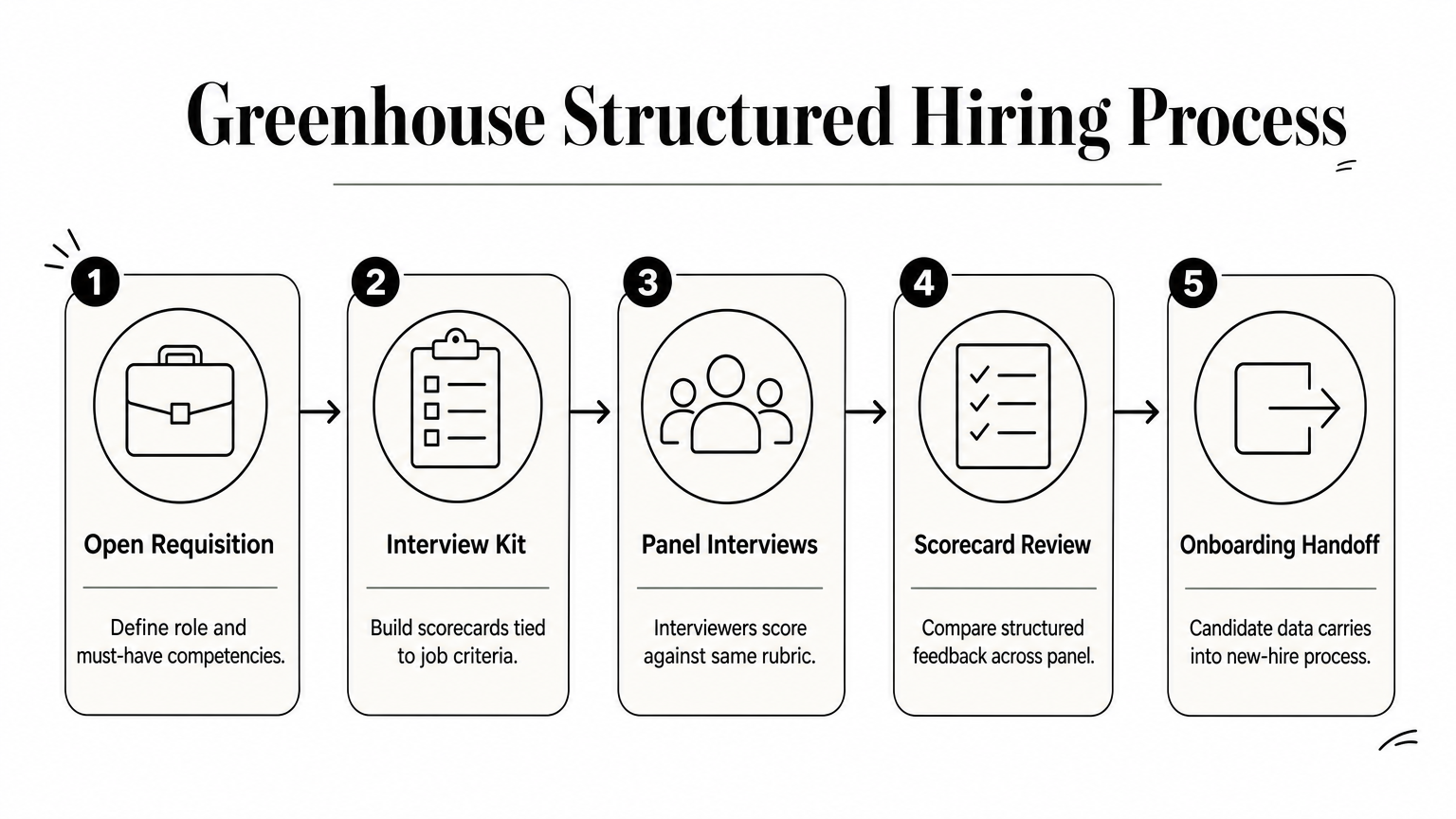
Structured hiring turns hundreds of individual gut calls into one decision process you can actually audit.
Key features
Greenhouse focuses on process rigor over flashy automation:
Best for
Enterprise talent acquisition teams with dedicated recruiting operations staff, the kind with defined recruiting roles and reporting lines, get the most out of Greenhouse. Companies that need consistent, compliant hiring processes across multiple departments or countries benefit from the structured scorecards, especially when legal or DEI reporting requirements demand a documented, repeatable process rather than ad hoc interviewing.
Pricing
Greenhouse doesn't publish pricing publicly, and every quote comes through a sales conversation, which typically starts in the low thousands per month depending on headcount and modules. There's no free tier and no self-serve signup, so smaller agencies without a recruiting ops budget usually find the sales cycle alone a barrier before they see a single candidate.
5. BambooHR: recruiting built into a full HR suite
BambooHR started as an HR information system and added recruiting later, and that history shows in how the product feels. Instead of buying a standalone ATS, you get hiring folded into the same platform that already handles onboarding, time-off tracking, and performance reviews. BambooHR suits companies that want one login for the entire employee lifecycle, from the first application to the exit interview, rather than stitching together separate hiring software and HR systems that never sync cleanly.
A hire that starts in one system and finishes in another loses data at every handoff.
Key features
BambooHR's recruiting module rides on top of its core HR platform:
Best for
Small and mid-sized companies without a dedicated recruiting team get the most value here, especially HR generalists who handle hiring alongside payroll and benefits administration, though it's worth weighing against other hiring software options for small businesses. Businesses that already run BambooHR for core HR functions gain the most, since adding recruiting costs less than bolting on a separate ATS and managing two vendor relationships.
Pricing
BambooHR doesn't publish flat pricing; it quotes based on employee count and module selection, and recruiting typically comes as a paid add-on to the core HR plan rather than a standalone product. Expect a sales call before you see a number, which slows down agencies that want to compare costs quickly against free alternatives.
6. JazzHR: simple ATS for small business hiring
JazzHR strips recruiting software down to what a small business actually needs, without the enterprise bloat that comes with tools built for thousand-person talent teams. The platform focuses on posting jobs fast, tracking applicants through a clean pipeline, and getting new hires signed off without a recruiting operations team managing the workflow. JazzHR works well as an entry point into structured hiring for companies that have outgrown email threads and spreadsheets but don't need the depth of an enterprise ATS.
Small teams don't need more features, they need fewer clicks between a resume and a decision.
Key features
JazzHR keeps its feature set tight and practical:
Best for
Small businesses and startups hiring under 50 roles a year get the most value from JazzHR, which shows up on most shortlists of the best ATS for a small business. Recruiters who need compliance reporting without paying for a full enterprise suite also find it a practical fit, since the compliance tools ship standard rather than as a premium add-on.
JazzHR prices by hiring volume rather than seat count, starting around $75/month for the Hero plan with a handful of open jobs, and scaling toward $420/month for unlimited jobs and users on the Plus plan. There's no permanently free tier, so agencies hiring at high volume without a dedicated budget line often outgrow the pricing faster than the platform itself.
7. Manatal: AI-driven recruitment automation
Manatal built its pitch around one idea: let AI handle the grunt work of sourcing and shortlisting so recruiters spend their time on conversations, not resume screening. The platform pulls candidate data from over 20 sources, including LinkedIn and major job boards, then scores and ranks applicants against a job description automatically, which saves the work of searching LinkedIn for candidates by hand. Manatal positions itself as an affordable, AI-first alternative to legacy ATS platforms, which makes it popular with smaller agencies that want automation without enterprise pricing.
Automation only saves time if it points a recruiter at the right five candidates instead of fifty.
Key features
Manatal leans on AI across nearly every stage of the pipeline:
Best for
Small to mid-sized recruiting agencies that want AI-assisted shortlisting without a big software budget tend to fit best here. Teams juggling high applicant volume per role also benefit, since the ranking engine cuts down manual resume review considerably.
Pricing
Manatal starts around $19/user/month for the Professional plan, with Enterprise pricing scaling up for larger teams needing custom integrations and dedicated support. There's a 14-day free trial, but no permanent free tier, so agencies evaluating recruiting database software on a zero-budget basis will still hit a paywall eventually.
8. VidCruiter: video interviewing at enterprise scale
VidCruiter built its entire product around one hiring bottleneck: getting hiring managers face-to-face with candidates without scheduling chaos or geographic limits. The platform specializes in structured, on-demand, and live video interviews, the format most teams default to when interviewing candidates remotely, backed by workflow automation that handles scheduling, panel coordination, and interview scoring across time zones. VidCruiter shows up most often in high-volume, multi-location hiring, where flying candidates in or coordinating a dozen calendars just isn't realistic.
Video interviewing only scales hiring when scheduling stops being the bottleneck.
Key features
VidCruiter's feature set centers on interview logistics and structure rather than sourcing:
Best for
Large organizations and government agencies hiring at high volume across multiple regions get the most value from VidCruiter. Teams that need to document a defensible, compliant interview process, particularly in public sector or unionized hiring, benefit from the structured scoring and audit trail built into every stage.
Pricing
VidCruiter doesn't publish pricing publicly; quotes come through a sales call and scale with interview volume and module selection, typically landing in enterprise-level budgets rather than small-agency territory. There's no free tier, and the sales process alone can take weeks, which rules it out for agencies wanting a hiring software platform they can start using the same day.
9. AvaHR: automated pipelines for lean hiring teams
AvaHR targets a specific problem: small teams without a dedicated recruiter still need to hire well, but they don't have hours to spend babysitting a pipeline. The platform automates candidate follow-ups, stage reminders, and interview scheduling so a hiring manager doing recruiting on the side doesn't let good candidates go cold. AvaHR trades enterprise depth for speed of setup, positioning itself as hiring software you can configure in an afternoon rather than a platform that needs a rollout plan.
Automation matters most for the teams with no one dedicated to chasing candidates.
Key features
AvaHR keeps its automation focused on the parts of hiring lean teams tend to drop:
Best for
Small businesses and startups without a dedicated recruiter get the most value from AvaHR, since the automation covers gaps that usually fall through when hiring is a part-time responsibility. Founders and office managers running hiring alongside other duties also benefit, given how little setup time the platform demands before it's usable.
Pricing
AvaHR prices around $59 to $199 per month depending on team size and job volume, with a free trial available but no permanent free tier, unlike the applicant tracking systems that stay genuinely free. Agencies managing multiple client searches at once will find the pricing better suited to a single internal hiring team than to high-volume recruiting work.
10. Pinpoint: branded careers pages for in-house teams
Pinpoint built its product around employer branding, betting that candidates decide whether to apply based on how a careers page looks and feels before they ever read a job description. The platform lets in-house talent teams design fully branded, no-code careers sites that match the company's visual identity, then routes every applicant through the same ATS without a jarring handoff to a generic job board template. Pinpoint shows up most in mid-market companies that treat their careers page as marketing, not just a form.
A careers page that looks like an afterthought tells candidates the job is one too.
Key features
Pinpoint's strengths sit at the front end of the funnel:
Best for
Mid-sized, in-house talent acquisition teams that care about employer brand consistency and improving candidate experience get the most out of Pinpoint. Companies running multiple simultaneous campaigns across regions also benefit, since the ad-spend optimization tools cut wasted budget on boards that rarely convert into hires.
Pricing
Pinpoint doesn't list public pricing; quotes come through a sales conversation and scale with company size and hiring volume, typically landing in the low thousands per month. There's no free tier, so agencies or lean teams evaluating hiring software on a tight budget will likely find the entry cost steeper than platforms built around a free or credit-based model.
11. Recruit CRM: built for staffing agencies
Recruit CRM was built specifically for staffing and executive search firms, not adapted from a corporate ATS after the fact. That distinction shows up everywhere in the product: it treats clients as first-class records alongside candidates, since agency recruiters need to track both a job order and the company that placed it. Recruit CRM combines a full applicant tracking system with a sales CRM, so a recruiter can move a candidate through interview stages while also tracking invoicing status and client communication in the same screen.

Agency recruiting fails when the client relationship and the candidate pipeline live in two different tools.
Key features
Recruit CRM leans hard into the dual client-and-candidate workflow agencies actually run:
Best for
Staffing agencies and executive search firms managing multiple client accounts at once get the clearest value from Recruit CRM, one of several applicant tracking systems built for agency desks. Recruiters who bill by placement rather than manage a single internal pipeline benefit most, since the client-tracking layer removes the need for a separate sales CRM running alongside the ATS.
Pricing
Recruit CRM starts around $85/user/month for its Pro plan, with higher tiers adding advanced automation and reporting for larger desks. There's a free trial but no permanent free tier, so agencies comparing recruiting database software on cost alone will still hit a per-seat bill every month regardless of placement volume.
12. Humanly: AI chatbot for candidate screening
Humanly automates the part of hiring most recruiters dread most: the initial screening call. Its chatbot texts or chats with applicants the moment they apply, asks qualifying questions built from the job description, and schedules interviews with candidates who pass, all without a recruiter lifting a phone, a similar goal to tools that screen and rank resumes automatically. Humanly targets high-volume, high-turnover hiring, where a recruiter screening hundreds of applicants for the same retail or hourly role simply can't get to everyone fast enough by hand.
A chatbot that screens candidates overnight beats a recruiter who gets to them three days later.
Key features
Humanly concentrates its automation on the screening and scheduling stage:
Best for
High-volume employers hiring for hourly, retail, or call-center roles get the clearest benefit from Humanly, since the chatbot handles the repetitive qualifying questions that eat a recruiter's day. In-house teams already running an ATS but drowning in applicant volume also fit well, since Humanly layers on top of existing systems instead of asking teams to migrate their whole pipeline.
Pricing
Humanly doesn't publish pricing publicly, and quotes depend on applicant volume and which ATS you're integrating with, typically landing in the low thousands per month for mid-sized employers. There's no free tier, which makes it a harder fit for smaller agencies or teams still evaluating hr hiring software without a committed screening budget.
13. How to choose the right hiring software for your team
Start by counting what you're actually paying for today. Most teams run an ATS, a separate candidate database, a job board subscription, and per-seat licensing on top, and each one bills separately even when they barely integrate. Hiring software worth switching to should collapse that stack into one login, not add a fifth tool to the pile.
Think about who's using it before you sign anything. A five-person agency filling contract roles has different needs than an enterprise team running compliance-heavy interviews across a dozen countries, and the wrong fit shows up fast in wasted seat licenses or missing DEI reporting. Match the platform to your hiring volume, not to whichever vendor has the flashiest demo.
The best hiring software fits how your team already works, not the workflow a sales deck assumes you have.
Use this checklist before you commit:
Vendors publishing clear pricing tend to respect your time more than ones hiding costs behind a sales call. Weigh that against how much of your recruiting database software budget goes toward tools your team barely opens each week, since trimming that stack is one of the fastest routes to lowering your cost per hire.
Finding the right fit for your hiring team
No single platform on this list wins every category. Enterprise suites like Greenhouse and VidCruiter buy you structure and scale, but they demand a sales cycle and a budget most small agencies don't have. Lean tools like AvaHR and JazzHR get you moving fast, but they don't solve the deeper problem: a database that stays thin no matter how many job boards you post to. That's the gap Olibr was built to close, turning your dormant candidate data into access to a shared pool of 180,000+ verified profiles, bundled with a free ATS instead of another line item.
If you're still paying for tools that don't talk to each other, or sourcing from scratch every time a role opens, stop comparing demos and just try the platform built around that exact frustration. Open your free Olibr recruiter account and see your first shortlist today, no credit card required.
For hiring teams
Search 180,000+ candidate profiles — free.
Olibr is a community-funded recruiting platform: full ATS, AI interviews, and a shared resume database. No per-seat fees.