
9 Best High-Volume Hiring Software Platforms in 2026
When you need to fill 50 or 200 positions in a quarter, spreadsheets and manual screening fall apart fast. High volume hiring software exists to solve exactly this problem: it automates resume screening, ranks candidates against job descriptions, and moves people through pipelines without your team drowning in applications. If you're staffing a seasonal warehouse ramp-up, a BPO expansion, or a multi-city sales hiring push, the right platform decides whether you hit your hiring targets or fall behind.
This article compares nine platforms built specifically for scale, looking at AI-powered screening, bulk resume parsing, interview automation, and pricing models that don't punish you for growth. We tested each one against real high-volume scenarios: thousands of applicants, tight timelines, and recruiters who need speed without losing candidate quality.
You'll see where traditional ATS platforms hit their limits and where purpose-built tools take over, including options that skip per-seat licensing entirely. Olibr is included because its shared candidate network and AI matching were built for teams tired of paying more every time headcount grows. By the end, you'll know which platform fits your hiring volume, your budget, and your timeline for 2026.
1. Olibr: free ATS and candidate database for volume hiring
Olibr takes a different approach to high volume hiring software by removing the cost barrier that usually scales with headcount. Instead of charging per seat or per job posting, it runs on a data-sharing model: you contribute dormant candidate profiles sitting unused in your ATS, and in return you get access to a shared network of 180,000+ verified profiles plus a full applicant tracking system at no cost. For teams hiring in bulk across warehouses, BPOs, or multi-city sales roles, that shared pool often means you're not starting your search from zero every time a new requisition opens.

How it works
Recruiters upload existing profiles in bulk into a searchable resume database that costs nothing to use, via PDF, DOCX, or CSV, and the platform parses and enriches them automatically. Access is kept by contributing 50 profiles per active user every 30 days. From there, Olibr's AI matching and interview tools rank candidates against your job description rather than relying on keyword search alone, and AI-powered video interviews with expression analysis and scored transcripts help you screen hundreds of applicants without scheduling hundreds of live calls. The built-in ATS handles pipeline stages, kanban boards, notes, and team collaboration, so you're not stitching together separate tools for sourcing and tracking.
The less time your team spends re-sourcing candidates you already had, the faster you fill volume roles.
Who it's for
Olibr suits recruiting agencies and in-house talent acquisition teams that already have large candidate databases going stale and want to convert that data into active hiring power. It's a strong fit for anyone running recurring high-volume campaigns who wants unlimited job postings, unlimited team seats, and role-based permissions without a growing invoice. Access is kept by contributing 50 candidate profiles per active user every 30 days, and the platform's ATS, CRM, job posting, candidate database, hiring-manager collaboration and candidate search are free to use.
Pricing
The core platform, including the ATS, job board, and shared candidate network, is free with no credit card or trial required, and it holds up well against other tracking systems that cost nothing to run; access is kept by contributing 50 candidate profiles per active user every 30 days.
2. Greenhouse: structured hiring at enterprise scale
Greenhouse built its name on structured hiring rather than raw speed, but its scorecards and workflow automation still hold up when volume spikes. Large enterprises use it to keep hundreds of open requisitions consistent across regions and hiring managers, which matters when volume hiring often means dozens of teams making similar decisions in parallel.
How it works
Greenhouse centers on customizable pipelines, structured interview kits, and scorecards that force every hiring manager to evaluate candidates against the same criteria. Its automation rules trigger next steps, like moving a candidate to the next stage or sending an assessment, once specific conditions are met, cutting down manual pipeline management. Integrations with job boards, background check vendors, and assessment tools let it act as the hub for a much larger recruiting stack rather than a standalone tool.
Consistency across hiring managers matters more than speed once you're filling roles across dozens of locations.
Who it's for
Greenhouse fits mid-market and enterprise companies with dedicated recruiting operations teams and the budget to configure a complex system properly. It suits organizations that need compliance-friendly, auditable hiring processes more than teams looking for the fastest, cheapest way to fill entry-level roles.
Pricing
Greenhouse doesn't publish public pricing; costs are quoted per plan tier and typically scale with headcount and feature access, which can push per-seat costs higher as your team grows, part of a broader story about what pushed recruiting software into four-figure invoices.
3. Paradox: conversational AI for candidate engagement
Paradox built its reputation around Olivia, a conversational AI assistant that texts and chats with candidates instead of pushing them through static application forms. For high volume hiring software, that shift matters because most drop-off happens before a human recruiter ever sees an application, and a chat-based flow keeps candidates moving instead of abandoning a long form on their phone.
How it works
Olivia handles the front end of hiring: answering FAQs, scheduling interviews, and screening candidates through natural conversation via SMS, WhatsApp, or web chat. It integrates with your existing ATS rather than replacing it outright, pulling candidates through automated scheduling and pre-screening before handing qualified applicants off to recruiters. Career sites can embed the assistant directly, letting candidates apply and book interview slots without ever touching a traditional application portal.
A candidate who can apply and book an interview by text is far less likely to ghost you mid-process.
Who it's for
Paradox suits large employers with high applicant volume and frequent hourly or frontline hiring, think retail chains, quick-service restaurants, and logistics companies filling hundreds of roles monthly. It fits teams that already run an ATS and need a conversational layer on top, rather than recruiters looking for a standalone system of record.
Pricing
Paradox doesn't list public pricing. Contracts are quoted per client based on hiring volume and features, and enterprise deployments typically require a sales conversation and implementation period before go-live.
4. Fountain: high-volume ATS built for hourly workforces
Fountain was designed from day one for hourly and frontline hiring, not as a general ATS with volume features bolted on. Companies hiring thousands of drivers, warehouse staff, or retail associates each month use it to move applicants from application to offer in days instead of weeks, which is the core promise behind most high volume recruiting software in this space.

How it works
Applicants move through configurable automated workflows that handle scheduling, background checks, and document collection without a recruiter touching every step. Fountain's mobile-first application flow reduces drop-off for candidates applying from a phone in a parking lot, and its bulk communication tools let recruiters text or email thousands of applicants at once about interview slots or offer status.
Hourly hiring lives or dies on how fast you respond to an applicant, and Fountain is built around that response time.
Who it's for
Fountain suits gig-economy platforms, retail chains, and logistics companies filling large numbers of hourly roles on tight, recurring timelines. It's a weaker fit for companies hiring mostly salaried, specialized roles where structured interviews matter more than speed.
Pricing
Fountain doesn't publish pricing publicly. Deals are quoted based on hiring volume and modules used, and most deployments involve a sales and onboarding process before launch.
5. HireVue: video interviews and skills assessments
HireVue built its platform around on-demand video interviews and skills-based assessments, much like an automated technical interview screen, letting recruiters evaluate thousands of candidates without booking a single live call. For companies running high volume hiring software searches specifically for screening speed, HireVue's pitch is that a candidate records answers on their own schedule, and your team reviews results in a fraction of the time a phone screen would take.
How it works
Candidates complete structured video interviews or job-simulation assessments at their own pace, and HireVue's AI-assisted scoring ranks responses against role-specific competencies to surface top performers first. Recruiters can layer in chat-based screening and automated scheduling for the interviews that do need a live conversation, keeping the whole funnel inside one system rather than juggling separate scheduling tools.
When you can't scale recruiter hours, scaling how candidates are evaluated is the next best option.
Who it's for
HireVue suits large employers hiring for customer service, retail, and call center roles where consistent, comparable assessment data matters more than a personal touch early in the process. It's less suited to small teams hiring a handful of specialized roles a year.
Pricing
HireVue doesn't publish pricing publicly. Plans are quoted per client based on assessment volume, video interview minutes, and integration needs, with enterprise contracts requiring a sales conversation.
6. iCIMS: enterprise workflows for global hiring
iCIMS positions itself as the backbone for enterprise recruiting software at global scale, built for organizations juggling thousands of open roles across multiple countries, languages, and compliance regimes. Multinationals use it less for speed and more for control, keeping every requisition, approval, and candidate record inside one system of record instead of scattered across regional tools.
How it works
Behind the interface sits a configurable workflow engine that routes requisitions through approval chains, assigns recruiters by region, and applies compliance rules specific to each country's labor laws. Its marketplace connects to background check vendors, job boards, and onboarding tools, and the platform's AI features surface qualified candidates from the talent pool you have already built before you post a new job externally.
Global volume hiring fails without consistent process, not without enough candidates.
Who it's for
iCIMS suits large enterprises with dedicated recruiting operations teams, multi-country hiring needs, and the internal resources to configure and maintain a complex global hiring platform. Smaller agencies or single-country employers usually find the setup heavier than what their volume actually requires.
Pricing
iCIMS doesn't publish pricing publicly. Contracts are quoted per client based on employee headcount, modules, and regions covered, and implementation typically involves a lengthy sales and configuration cycle before recruiters see any hiring benefit.
7. SmartRecruiters: flexible workflows with a large marketplace
SmartRecruiters positions itself as a talent acquisition suite that pairs a flexible ATS core with one of the largest vendor marketplaces in recruiting, letting you bolt on assessments, background checks, or sourcing tools without switching platforms. For companies running high volume hiring software searches alongside a longer-term recruiting stack, that marketplace approach avoids the lock-in that comes with an all-in-one enterprise suite.
How it works
Recruiters build configurable pipelines that adapt to different job families, so a warehouse role and a corporate hire can run through entirely different stages inside the same system, which is the stage-by-stage logic behind any ATS. The marketplace integrates dozens of third-party tools directly into the workflow, meaning volume-specific needs like SMS screening or video assessments plug in rather than requiring custom development. SmartRecruiters also layers in AI-driven candidate matching to surface strong fits from your existing pipeline before you pay to source externally.
A marketplace model only pays off if you actually use more than one or two of the integrations it offers.
Who it's for
SmartRecruiters suits mid-market and enterprise recruiting teams that want a strong ATS core but expect their tool needs to change as hiring volume and role types shift. It's a weaker fit for lean teams that want one system with everything built in, since marketplace integrations add setup time and often separate billing.
Pricing
SmartRecruiters offers a limited free tier, but volume hiring features require paid plans quoted per client based on headcount and modules, with most enterprise deployments needing a sales conversation before pricing is finalized.
8. Sapia.ai: interview-first, bias-free screening
Sapia.ai replaces the traditional resume screen, and the way parsing software reads a CV, with a text-based interview that every candidate answers on their own time, then scores the responses using a model trained to strip out signals tied to gender, ethnicity, or background. For teams under pressure to hire at scale without amplifying bias, this is the pitch behind Sapia's version of high volume hiring software: judge what candidates say, not where they went to school or what their name sounds like.
How it works
Candidates complete a chat-style interview answering the same structured questions, and Sapia's natural language scoring ranks responses against traits tied to job performance rather than keyword matches. Recruiters get a shortlist with explainable scoring behind each rank, plus adverse-impact reporting that shows whether the process is screening out protected groups at a higher rate. The system plugs into existing ATS platforms rather than replacing your system of record.
A hiring process only stays fast and fair if the scoring behind it is unbiased and can be shown to be.
Who it's for
Sapia.ai suits large employers hiring high volumes of frontline, retail, or call center staff who need defensible, auditable screening decisions, particularly in regulated markets where adverse impact reporting matters to legal and compliance teams. It's a weaker fit for niche technical hiring where skills assessments carry more weight than conversational responses.
Pricing
Sapia.ai doesn't publish pricing publicly. Contracts are quoted per client based on interview volume and reporting needs, with enterprise deals requiring a sales conversation before implementation.
9. Phenom: AI-driven candidate experience and career sites
Phenom treats the career site itself as the first screening tool, using AI to personalize job recommendations and content for every visitor before they even submit an application. For companies running high volume hiring software searches focused on top-of-funnel drop-off, Phenom's pitch is that a better experience upfront leads to faster, better hires and reduces the volume of unqualified applicants your recruiters have to sort through later.
How it works
A chatbot greets career site visitors, answers questions, and recommends open roles based on skills and location, cutting down the search time that causes candidates to abandon a job board. Behind the scenes, AI-driven matching scores applicants against open requisitions and can automatically surface strong fits from your existing talent pool, while employee referral tools and internal mobility features route candidates who never need to go through external sourcing at all.
A candidate who finds the right job in two clicks is a candidate you don't have to chase later.
Who it's for
Phenom suits large enterprises with high site traffic and frequent hiring across many locations, particularly employers who care about employer branding alongside raw fill speed. It's a heavier lift than smaller teams typically need if career site traffic is modest.
Pricing
Phenom doesn't publish pricing publicly. Plans are quoted per client based on site traffic, modules, and integration scope, with enterprise deployments requiring a sales conversation and implementation timeline before launch.
Which platform fits your hiring needs
Most of these nine platforms solve one piece of the volume hiring puzzle well: Fountain for hourly speed, HireVue for video screening, iCIMS for global compliance, Phenom for career site conversion. But enterprise pricing on these tools tends to climb with headcount, and stitching three or four of them together to cover sourcing, screening, and tracking adds cost and complexity most agencies don't need.
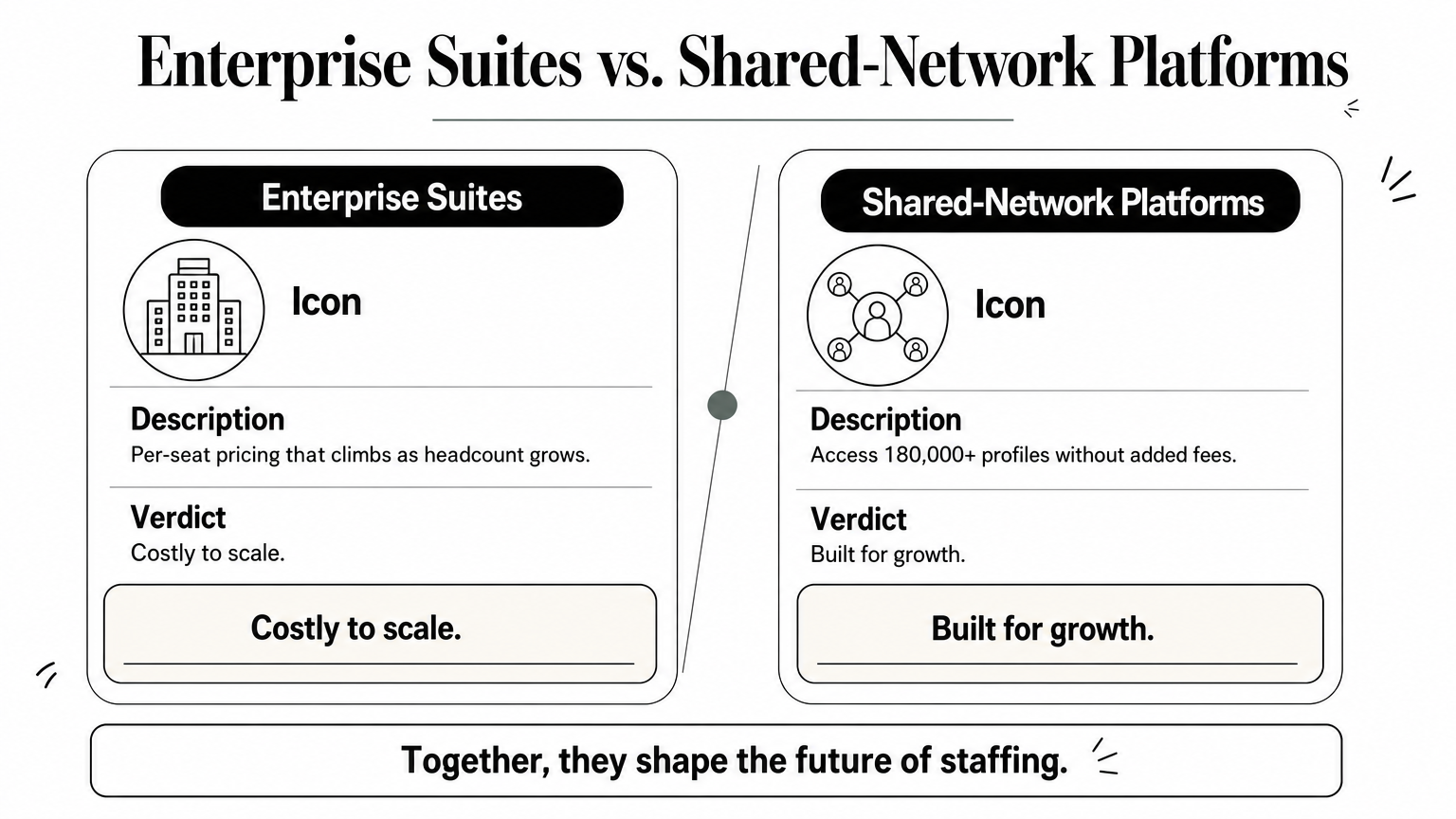
If your team is sitting on a stale candidate database and paying per seat for tools that don't talk to each other, that's the exact problem Olibr was built to fix. You get a free ATS, unlimited job postings, and a shared pool of 180,000+ verified profiles without a growing invoice tied to headcount. Recruiters who want to see the shared network before committing can filter verified profiles by skill, experience, and location and start shortlisting for your open roles today.
For hiring teams
Search 180,000+ candidate profiles — free.
Olibr is a community-funded recruiting platform: full ATS, AI interviews, and a shared resume database. No per-seat fees.