8 Best Resume Database Options for Recruiters in 2026
You need a resume database for recruiters that actually surfaces candidates who respond, not a search bar sitting on top of stale profiles from 2019. Most recruiters juggle two or three paid tools already, a job board, a CRM, and a separate database subscription, and still end up sourcing the same passive candidates everyone else is calling. That's expensive, and it rarely fixes the real problem: your own ATS is probably sitting on hundreds of qualified profiles that never get a second look.
The recruiters getting hires faster in 2026 aren't just buying access to more resumes. They're using platforms that combine searchable candidate pools with AI-based matching tools, so filtering by skill, location, or experience actually returns people worth calling, not keyword coincidences. Some tools also let you turn dormant sourcing history into new access instead of paying per seat or per unlock.
This list covers eight resume database options worth evaluating this year, from community-powered networks like Olibr to established paid platforms, so you can compare pricing models, candidate pool size, and screening features before you commit budget to another subscription.
1. Olibr: community-powered resume database and free ATS
Olibr flips the usual resume database model on its head. Instead of charging a subscription to search a fixed pool of profiles, it asks recruiters to contribute their own dormant candidate data in exchange for access to a shared network of 180,000+ verified profiles built by 500+ active recruiters. If your ATS is full of old sourcing work nobody's touching, you're sitting on currency you didn't know you had.
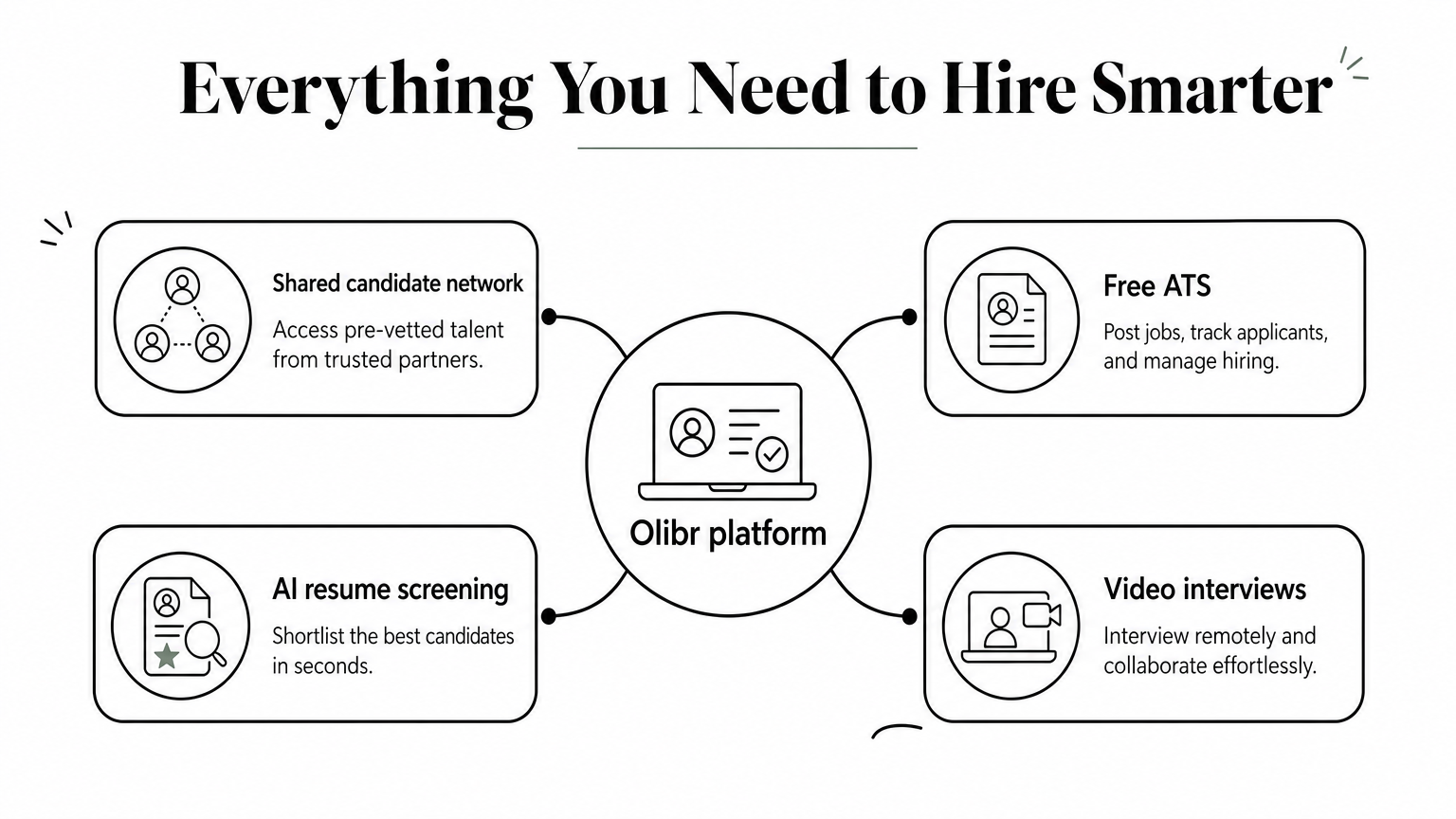
A resume database only works if the profiles inside it are alive; Olibr's model keeps replenishing itself because every recruiter who joins adds fresh, real candidates.
How it works
You upload your existing, no-longer-active candidate profiles in bulk, PDF, DOCX, or CSV, up to 10,000 at once, and the platform parses them automatically. Contributing 50 profiles per active user every 30 days keeps access free.
Key features
- Shared network of 180,000+ candidates, searchable by skill, experience, and location
- Free, full-featured ATS with pipeline stages, kanban boards, and team notes
- AI matching with resume screening that ranks candidates against a job description, not just keyword hits
- AI-powered video interviews with expression analysis and scored transcripts
- Unlimited job postings, unlimited team seats, and role-based permissions
- Bulk profile upload and parsing for fast database migration
Best for
Olibr suits small to mid-sized agencies and in-house teams tired of paying separately for an ATS, a database, and a job board, the same teams comparing free software for recruitment agencies. It's also a fit for anyone whose current database has gone quiet after the initial sourcing push, since contributing 50 profiles per active user every 30 days keeps access free.
Pricing
The core platform, ATS included, is free, and access is kept by contributing 50 candidate profiles per active user every 30 days. No credit card or trial period is required to start. Full details are on the Olibr pricing page.
2. Indeed Resume: largest resume search engine
Indeed built its resume search on the back of the world's most-visited job site, which means the sheer volume of profiles is hard to match. Millions of job seekers upload resumes directly to Indeed while applying to postings, so the pool refreshes constantly instead of aging into a static candidate database nobody updates. For recruiters who care about scale over curation, that volume alone is the pitch.
Scale wins the first search, but filtering skill still decides who actually gets called back.
How it works
Recruiters search by job title, skill, location, and years of experience, then contact candidates directly through Indeed's messaging system. Results are ranked by relevance and recency, and you can save searches to get alerted when new matching resumes appear.
Key features
- Access to a massive, constantly refreshed pool of active job seekers
- Filters for skills, education, salary expectations, and willingness to relocate
- Direct in-platform messaging to candidates
- Integration with Indeed job postings and sponsored listings
Best for
High-volume hiring, retail, hospitality, and other roles where speed and pool size matter more than deep candidate vetting.
Pricing
Indeed Resume is sold as a subscription with tiered plans based on how many resumes you unlock monthly, separate from Indeed's job posting fees.
3. LinkedIn Recruiter: professional network database
LinkedIn Recruiter taps into the professional network itself, not a resume upload pile. Every profile is self-maintained and tied to a real identity, so you're searching live career histories instead of static PDFs someone submitted years ago and forgot about. That accuracy comes at a premium, and it's the main tradeoff against cheaper LinkedIn Recruiter alternatives and other resume database for recruiters options.

A LinkedIn profile updates itself the moment someone changes jobs, which is exactly what a static resume never does.
How it works
You search LinkedIn's member base using Boolean search strings, filters for current title, industry, and location, then reach candidates through InMail credits included in your seat. Recruiter also surfaces "open to work" signals and lets you save searches with alerts for new matches.
Key features
- Advanced Boolean and filter-based search across LinkedIn's full member base
- InMail credits for direct outreach outside a candidate's existing network
- Talent pipelines and project folders for tracking candidates over time
- Spotlight filters showing who's actively open to opportunities
Best for
Recruiters filling mid-to-senior roles where passive candidate outreach and professional context matter more than raw applicant volume. It suits agencies and in-house teams with budget for per-seat licensing.
Pricing
LinkedIn Recruiter runs on annual per-seat licensing, typically well over $1,000 per seat per year depending on tier and region, with no public flat-rate pricing published. Costs stack quickly for teams needing multiple seats, which is worth weighing against free platforms bundling similar search and outreach tools.
4. ZipRecruiter resume database: AI-powered candidate matching
ZipRecruiter built its reputation on distributing job posts everywhere, but its resume database deserves attention on its own. The platform's matching engine actively pushes relevant candidates to recruiters instead of waiting for you to run a search, which flips the usual resume search workflow around. If you'd rather review a shortlist than dig through filters all day, this is the pitch.
Matching software that recommends candidates saves more sourcing hours than any filter combination ever will.
How it works
Recruiters post a job, and ZipRecruiter's algorithm scans its resume database to surface candidates it thinks fit, ranking them by predicted relevance. You can also run manual searches by title, skill, and location, then invite matched candidates to apply directly, which speeds up the funnel compared to waiting for inbound applications.
Key features
- AI-driven candidate recommendations pushed automatically after posting a job
- One-click invite-to-apply for matched profiles
- Resume search filters for skills, experience, and location
- Mobile app for reviewing and messaging candidates on the go
Best for
Small and mid-sized businesses hiring across multiple roles who want automated sourcing rather than manual searching every time.
Pricing
ZipRecruiter charges through subscription plans tied to job slots and candidate database access, with pricing quoted per business rather than published as a flat rate.
5. Monster: established resume database for bulk hiring
Monster has been around since the early days of online recruiting, and that longevity shows in the size of its resume database. Recruiters who need to fill dozens of similar roles at once, warehouse staff, drivers, call center agents, still turn to Monster because the volume of active profiles rarely runs dry. It's not flashy, but it's dependable for high-turnover hiring.
A database built for bulk hiring doesn't need to be elegant, it needs to never run out of candidates.
How it works
You search by job title, location, and experience level, then filter results using Monster's candidate search tools before reaching out through built-in messaging. Power Search lets you combine multiple criteria, including certifications and willingness to travel, to narrow a large pool down fast.
Key features
- Deep resume database built over two decades of job seeker traffic
- Power Search filters for certifications, education, and relocation
- Bulk messaging tools for contacting multiple candidates at once
- Integration with Monster job postings for combined sourcing
Best for
Staffing agencies and employers hiring at volume for repeatable, high-turnover roles where speed beats deep vetting.
Pricing
Monster sells resume database access through tiered subscription packages, usually bundled with job posting credits, quoted per business rather than published as a flat monthly rate.
6. CV-Library: resume database for UK recruiters
CV-Library focuses squarely on the UK job market, which makes it a strong pick if you're not hiring in India or the US at all. It's one of the older resume database platforms in Britain, built specifically around UK job seekers rather than a global pool diluted with candidates who can't legally work in the region you're recruiting for.
A resume database built for one country beats a global one when every candidate actually lives where you're hiring.
How it works
Recruiters search CV-Library's pool using filters for location, salary expectations, and job title, then contact candidates through the platform's messaging tools. You can also set up automated CV alerts that email you when new profiles match your saved search criteria, so sourcing continues even when you're not actively logged in.
Key features
- Large pool of UK-based candidate CVs updated regularly
- Saved search alerts delivered by email
- Filters for salary, location, and industry sector
- Bulk CV download and candidate shortlisting tools
Best for
UK-based recruiters and staffing agencies hiring locally, especially those who don't need international candidate reach and want a database built around British employment norms.
Pricing
CV-Library sells access through tiered subscription plans based on how many CVs you can view monthly, with custom quotes for agencies needing higher volume or multiple seats.
7. PostJobFree: free job posting and resume search
PostJobFree earns its name honestly. It's a free resume database built for small businesses and solo recruiters who can't justify a five-figure subscription just to post a handful of roles a year. The pool is smaller than Indeed or Monster, but the barrier to entry is basically zero, which matters if you're testing free resume database options for recruiters before committing budget.
Free access only matters if the candidates inside are real, and PostJobFree earns its keep by keeping both job posting and search genuinely no-cost.
How it works
You post a job listing at no charge, then search the site's resume bank using keywords, location, and job title. Candidates who've uploaded resumes to PostJobFree get emailed when a new posting matches their profile, so sourcing runs in both directions at once.
Key features
- Free job postings with no limit on how many you list
- Keyword and location-based resume search
- Automatic candidate-to-job email matching
- Simple resume database export for offline review
Best for
Solo recruiters, small businesses, and startups hiring occasionally who need a no-cost sourcing tool without long-term commitment.
Pricing
Core job posting and resume search are free. Paid upgrades exist for featured listings and expanded search visibility, priced per posting rather than as a recurring subscription.
8. Wellfound: resume database for startups and tech roles
Wellfound, formerly AngelList Talent, built its candidate pool around startup culture, so if you're recruiting engineers, designers, or product managers for early-stage companies, this is where they actually hang out. The platform skews heavily toward tech-specific roles, which narrows the pool compared to Indeed or Monster but raises the odds every profile you find actually fits a startup's pace and stack. Candidates here expect equity conversations and remote-first setups, not corporate ladders.

A smaller, focused resume database for recruiters beats a massive generic one when every candidate already wants the kind of company you're hiring for.
How it works
Recruiters create a company profile, post roles, and search Wellfound's candidate base using filters for role type, remote preference, and experience level. Candidates apply directly or get reached through the platform's messaging tools, and startup-specific details like funding stage and equity range show up right in the job listing to pre-qualify interest.
Key features
- Candidate pool concentrated in startup and tech-specific roles
- Filters for remote work, equity interest, and funding stage preference
- Company profile pages showing culture, team size, and funding
- Direct messaging without per-InMail credit costs
Best for
Startups and tech-focused agencies hiring engineers, designers, or early employees who want candidates already comfortable with startup risk.
Pricing
Wellfound offers free job postings with limited visibility, while paid plans unlock expanded candidate search and priority listing placement, billed per posting or as a monthly subscription.
Finding the right resume database for your team
Every option on this list solves the same problem differently. Indeed and Monster win on raw volume, LinkedIn wins on professional context, CV-Library and Wellfound win on niche focus, and PostJobFree wins on cost. But subscription-based access only makes sense if you're not already sitting on candidate data you paid to source once and never touched again. That's the gap Olibr closes: a free ATS, a shared network of 180,000+ verified profiles, and AI matching that ranks candidates against your job description instead of returning keyword coincidences.
Before renewing another paid database, check what's already dormant in your own system. Chances are it's worth more than another year of per-seat licensing. Set up your free Olibr recruiter account and see how far your existing sourcing history takes you when it's finally put back to work.
For hiring teams
Search 180,000+ candidate profiles — free.
Olibr is a community-funded recruiting platform: full ATS, AI interviews, and a shared resume database. No per-seat fees.