What Is an Applicant Tracking System? How It Works & Value
Every open role generates a pile of resumes. For a single job posting, recruiters can receive hundreds of applications within days, and sorting through them manually burns hours that could go toward actual hiring decisions. This is exactly the problem an applicant tracking system solves, and why it's become essential software for recruitment teams of every size.
An ATS is the operational backbone of modern hiring. It handles job postings, organizes candidate data, tracks where each applicant sits in your pipeline, and automates the repetitive work that slows recruiters down. But not every ATS works the same way, and understanding what separates a basic system from a genuinely useful one matters before you commit to a platform. The difference often comes down to whether the tool just stores resumes or actually helps you make better hiring decisions faster.
This article breaks down how applicant tracking systems work, what features to prioritize, and where they deliver real value for recruiters and hiring teams. It's also the kind of system we built Olibr around, a free ATS with AI-powered matching, pay-as-you-go AI interviews, and a searchable database of 180,000+ candidate profiles, so we'll share what we've learned about what actually moves the needle in recruitment software. Whether you're evaluating your first ATS or replacing one that isn't pulling its weight, this guide covers everything you need to make a smart choice.
What an ATS is and what it is not
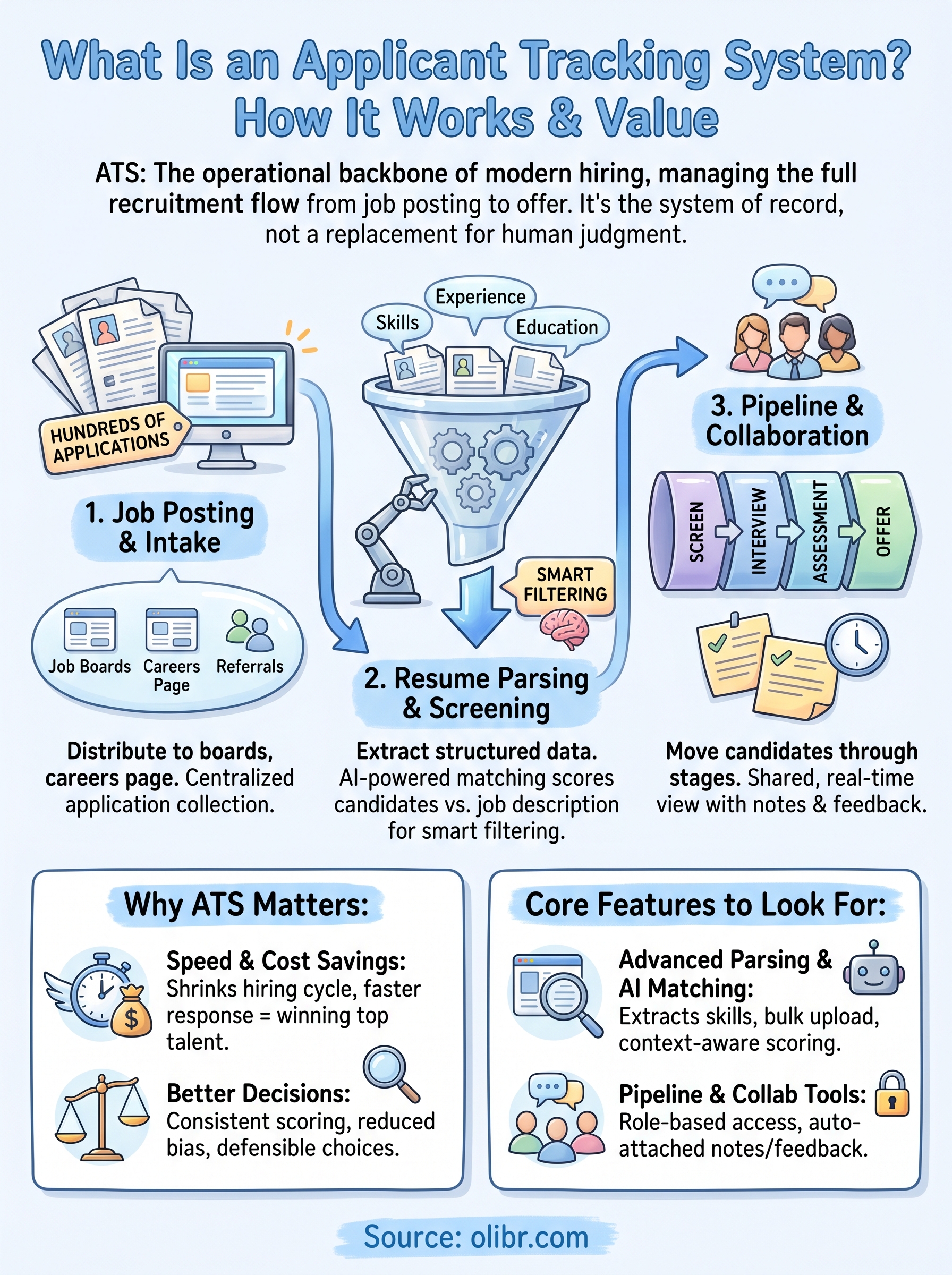
An applicant tracking system is software that manages the full flow of recruitment, from posting a job to making an offer. At its core, it gives you one place to collect, organize, and move candidates through your hiring pipeline without juggling spreadsheets, email threads, or disconnected tools. When people ask what is an applicant tracking system, the simplest answer is: it's the system of record for your entire hiring process.
What an ATS actually does
The system pulls in applications from every source you post to, job boards, your careers page, and referrals, then stores them in a searchable, structured database. You can filter candidates by skills, experience, location, or any criteria relevant to the role. Every action taken on a candidate, notes, status changes, interview feedback, gets logged automatically so your entire team works from the same live view of the pipeline instead of separate inboxes.
A well-built ATS doesn't just store resumes. It gives your team a shared, real-time view of every candidate at every stage so no one falls through the cracks.
Modern systems go further. Many now include AI-powered matching that scores candidates against your job description, automated interview tools, and analytics that show where your pipeline slows down. These additions reduce the time your team spends on manual triage and help you focus attention on the candidates most likely to move forward.
What an ATS is not
An ATS is not a replacement for recruiter judgment. It handles the administrative and organizational work so you can spend more time on decisions that actually require a human. The system surfaces candidates; you still evaluate fit, sell the role, and close the offer.
Your ATS is also not a magic sourcing tool on its own. A basic system only holds the candidates you already have. To get real sourcing value, you need a platform that combines the ATS with a live candidate database, which is exactly where most standalone tools fall short. Understanding this distinction helps you ask the right questions before you commit to any platform.
How an ATS works step by step
Understanding what is an applicant tracking system becomes clearer when you see it in motion. The process moves in a straight line from posting a job to making a hire, with the system handling the organizational work at each stage so you can focus on evaluating people.
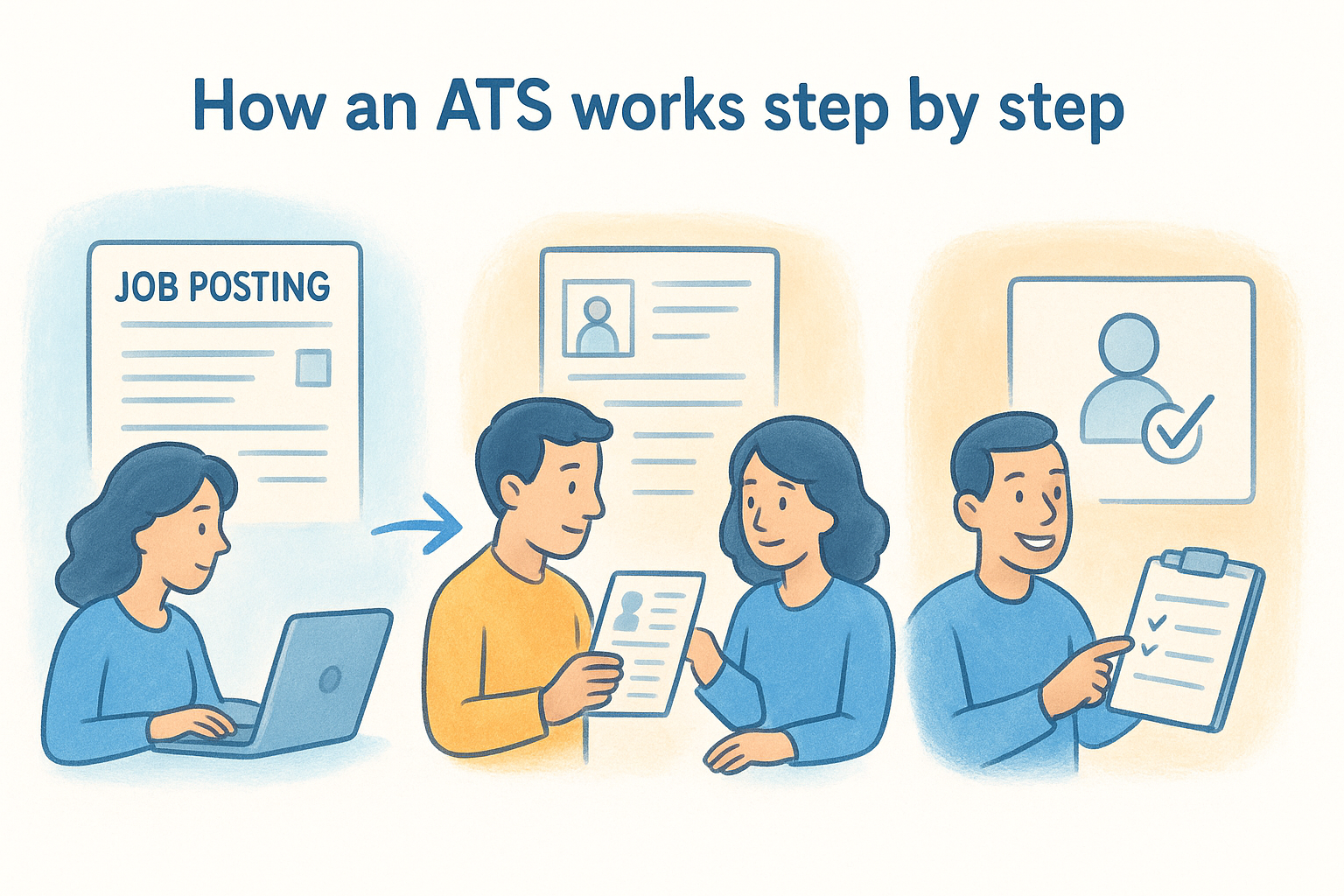
Job posting and application intake
When you create a job in your ATS, the system distributes it across job boards, your careers page, and any other channels you connect. Every application that comes back, regardless of source, lands in one central place. You never sort through separate inboxes or manually copy data from one spreadsheet to another.
The biggest time savings in recruitment don't come from working faster. They come from eliminating the steps that shouldn't need to happen at all.
Resume parsing and candidate screening
Once applications arrive, the system parses each resume automatically, pulling out structured data like skills, job titles, years of experience, and education. This turns an unstructured pile of documents into a searchable, filterable candidate database. Advanced platforms add AI matching here, scoring candidates against your job description so you know who deserves a first look before you read a single resume in full.
Pipeline management and team collaboration
From there, candidates move through stages you define: phone screen, interview, assessment, offer. Every status update, interview note, and feedback score attaches to the candidate profile automatically. Your whole team sees the same current picture of the pipeline, which cuts down on duplicate outreach and missed follow-ups.
Why ATS matters for recruiters and HR
The core reason to understand what is an applicant tracking system isn't academic. It comes down to where your time goes. Manual resume review and pipeline tracking eat a significant portion of every recruiter's day, and that's time you could spend on conversations that actually advance your hiring. An ATS removes that friction at scale, which is why adoption has grown steadily across teams of every size.
Speed and cost savings
When you stop sorting resumes by hand and chasing status updates over email, your hiring cycle shrinks. Teams using structured ATS workflows regularly cut time-to-hire from 45-plus days down to two or three weeks on competitive roles. That speed matters because top candidates move fast, and a slow process means losing people to employers who respond first.
The recruiter who responds to a strong candidate within 24 hours wins that candidate far more often than the one who responds in five days.
Better decisions with less effort
An ATS also changes the quality of decisions you make. When all candidate data sits in one place and your team shares a single view of the pipeline, you stop relying on gut feel driven by whoever happens to remember a name. Structured notes, consistent scoring, and searchable history mean you compare candidates on the same criteria every time. That consistency reduces bias and makes it easier to defend hiring decisions internally when someone asks why one candidate moved forward and another did not.
Core ATS features to look for
Not every platform that calls itself an ATS delivers the same value. When you understand what is an applicant tracking system at a feature level, you can cut through marketing claims and focus on capabilities that directly affect how fast you hire and how much manual work your team eliminates from the process.
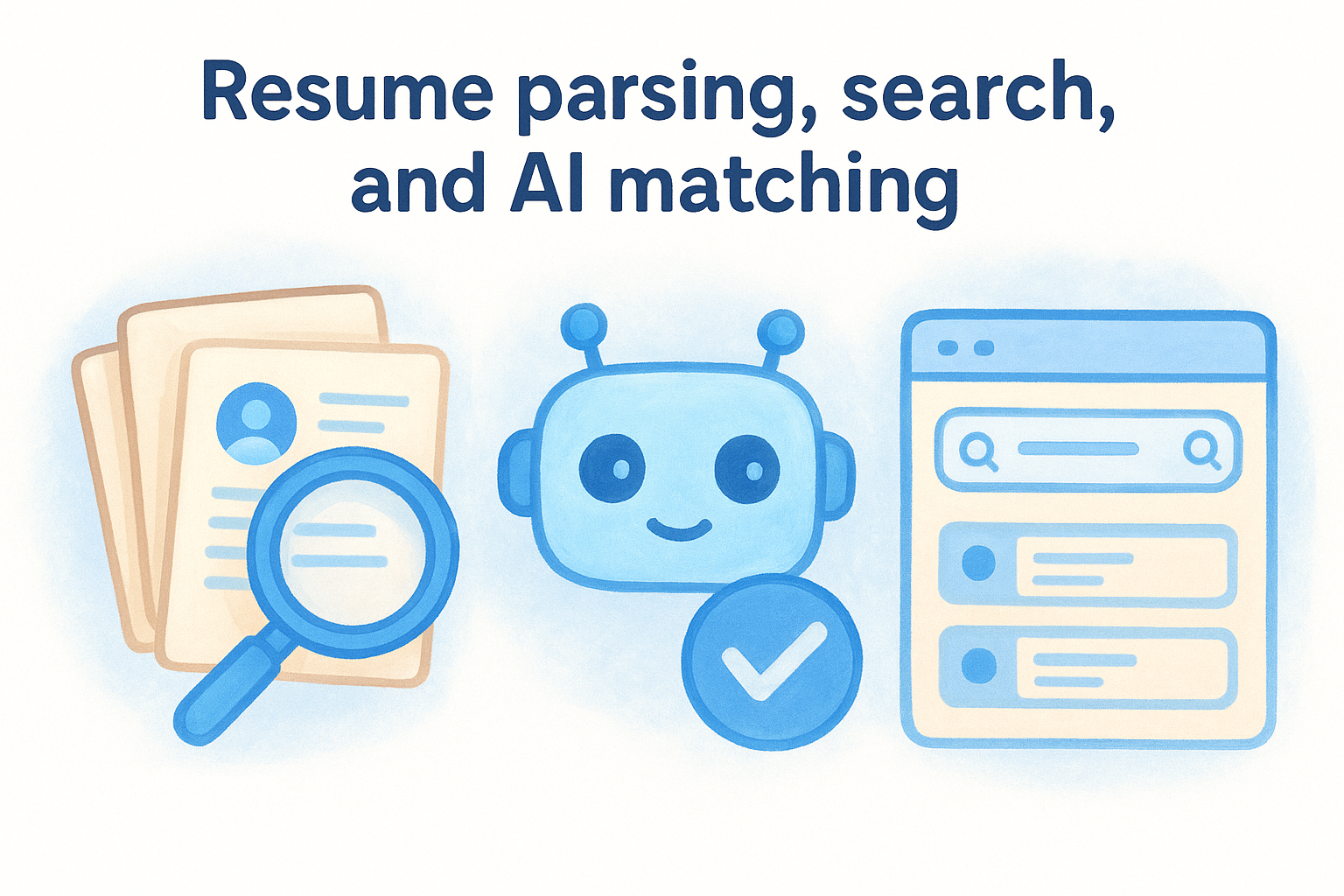
Resume parsing, search, and AI matching
Your ATS needs to extract structured data from resumes automatically so you can search candidates by skills, titles, experience level, or location without reading documents by hand. Weak parsing means your team spends time cleaning data instead of evaluating people.
The features that separate useful platforms from basic ones include:
- AI-powered matching that scores candidates against your job description using context, not just keywords
- Bulk resume upload with accurate parsing across multiple file formats
- A searchable candidate database you can filter by multiple criteria simultaneously
Pipeline management, interviews, and collaboration
Your whole hiring team needs to see the same live pipeline, with role-based permissions controlling who can view, edit, or advance candidates. Every interview note, status change, and feedback score should attach to the candidate profile automatically so nothing slips through.
If your team tracks hiring status over email threads, you are losing candidates to slower follow-ups and duplicate outreach.
Platforms that add automated AI interviews with consistent scoring take this further by removing an entire manual screening round and giving every candidate the same structured evaluation before a human gets involved.
How to choose and roll out an ATS
Knowing what is an applicant tracking system is only half the work. Choosing the right platform and deploying it without disrupting your current hiring process are where most teams either gain momentum or stall. A structured approach to both keeps the rollout fast and adoption high.
Evaluate based on your actual workflow
Before you compare platforms, map your current hiring steps from job posting to offer. This gives you a concrete checklist to test against any ATS demo. Focus on the features your team will use every day: resume parsing accuracy, pipeline customization, and collaboration tools. Skip features that sound impressive but do not solve a problem you actually have.
The recruiter who knows exactly what they need before a demo wastes zero time on irrelevant features.
Ask vendors for a free trial or sandbox environment so you can test real resumes against the parser and walk your actual pipeline stages through the system before you commit to anything.
Roll out in stages
Start with one team or one open role rather than switching your entire operation over on day one. A phased approach keeps disruption low and gives you space to train users properly.
A simple rollout follows three steps:
- Import existing candidate data and configure your pipeline stages
- Run one complete hiring cycle with a small group
- Collect feedback, adjust settings, then expand access to the full team
Next steps
Now you know what is an applicant tracking system, how it works, and which features separate platforms that save time from ones that just add complexity. The next move is applying that knowledge to your actual hiring operation. Start by auditing your current process to identify where candidates fall through the cracks and where your team loses the most time. That list becomes your evaluation criteria for any ATS you test.
If cost has kept you from adopting a full-featured platform, that barrier no longer applies. Olibr gives you a complete ATS, AI-powered candidate matching and access to 180,000+ candidate profiles at no cost in return for contributing profiles, with AI interviews at ₹99 each after the first 10 free, funded by a community model where uploading resumes earns you platform access. You get every feature from day one with no subscription fees and no locked tiers.
Start hiring smarter with Olibr's free ATS and see how much faster your pipeline moves when the administrative work handles itself.
For engineers
Find work worth your time.
Live engineering roles across India and the US, matched to your stack. Build a profile recruiters actually discover.