10 Best Free Applicant Tracking Systems in 2026
If you're scrolling through pricing pages trying to justify another software subscription to your manager, you already know the problem. Most paid recruiting tools charge per seat, per job post, or per candidate record, and costs climb fast once your team grows past two or three recruiters. Finding a genuine free applicant tracking system shouldn't mean settling for a stripped-down trial that locks you out after 14 days.
This list of the best free recruiting software cuts through the marketing noise and looks at what each platform actually gives you for free: real pipeline stages, resume parsing, job posting limits, and how long the free tier actually lasts before you hit a paywall. We tested each option against the needs of small agencies and in-house teams handling anywhere from 20 to 2,000 applications a month, so you can pick software that fits your hiring volume, not just your budget.
You'll find a mix of standalone free tools and platforms like Olibr that flip the usual model, giving you a full ATS plus access to a shared candidate pool at no cost in exchange for contributing dormant profiles you're not using anyway. Whether you want a simple resume ats parser or a complete hiring stack, the ten systems below cover every scenario a recruiter runs into in 2026.
1. Olibr, the free ATS with a shared candidate pool
Olibr flips the usual pricing model for a free applicant tracking system: instead of charging a subscription, it runs on a data-sharing exchange. You get the full hiring platform for free, and in return you contribute candidate profiles from your ATS that have gone dormant, the resumes sitting untouched after the first sourcing push. Most recruiters have thousands of these sitting idle, so the exchange costs you nothing you're actually using.

How it works
Uploading works through bulk parsing that reads PDF, DOCX, and CSV files, handling up to 10,000 profiles in one batch. Every profile you contribute earns credits, and those credits let you search 180,000+ verified candidate profiles sourced by 500+ other recruiters on the network. If you'd rather not share data at all, a private paid plan gives you the same platform with full data separation and encryption, which matters for retained search and NDA-bound work.
A free ATS that pays you back in candidates, not just software, changes the math on what "free" means for recruiters.
Key features
- Shared candidate network searchable by skill, experience, and location
- Full ATS software free of charge, with pipeline stages, kanban boards, notes, and team collaboration
- Unlimited job postings tied to an integrated job board
- AI matching that ranks candidates against job descriptions, not just keyword hits
- AI-powered video interviews with expression analysis and scored transcripts
- Role-based permissions and unlimited team seats
Who it's for
Agencies and in-house teams already using an ATS but ignoring most of what's stored in it fit here best. If your database is 90% dormant profiles, as it is for most recruiters, Olibr turns that dead weight into a working advantage instead of leaving it in cold storage.
Pricing and free plan limits
Olibr's shared plan costs nothing and requires no credit card, but access to the candidate pool is credit-based, meaning you unlock detail views by contributing profiles rather than paying cash. There's no artificial cap on job postings or team seats on the free tier. Recruiters who need complete data isolation, such as executive search firms, move to the private paid plan instead, which keeps every feature but removes the sharing requirement entirely.
2. Breezy HR, best for simple pipelines and career pages
Breezy HR built its reputation on a drag-and-drop pipeline that feels more like a visual planning board than traditional recruiting software. For teams that just want a clean, uncluttered way to move candidates from applied to hired, Breezy strips out the complexity that bogs down bigger platforms.
How it works
You create a job, publish a branded career page, and candidates flow straight into a free ats software online pipeline you customize with your own stages. Drag-and-drop cards replace spreadsheets, and the whole team sees the same view in real time.
Key features
- Customizable candidate pipeline with drag-and-drop stages
- Branded, hosted career pages included even on the free tier
- Basic resume parsing that pulls contact details and work history
- Email templates and scheduling tools for interview coordination
A pipeline you can actually see at a glance beats a spreadsheet every time.
Who it's for
Small teams hiring for a handful of roles at once, where visual simplicity matters more than deep automation, get the most value here. It suits recruiters who want something usable on day one without a training session.
Pricing and free plan limits
Breezy's free plan, called Bootstrap, caps you at one active job posting at a time, which is the main constraint compared to unlimited-posting tools. Paid tiers start once you need multiple concurrent jobs, advanced reporting, or deeper integrations with background check and assessment vendors.
3. Zoho Recruit, a truly free plan with no time limit
Zoho Recruit stands out because its free ats software tier doesn't expire after a trial window. Most competitors dangle a free plan for 14 or 30 days before pushing you toward a card entry screen, but Zoho's Free Forever plan stays free as long as you stay within its usage caps.
How it works
Setting up a job on Zoho Recruit runs through a standard workflow: create the posting, publish it to your career site, and candidates land in a pipeline you customize with stages that match your process. Resume parsing extracts contact details, skills, and work history automatically, so you're not retyping data from every PDF that lands in your inbox.
Key features
- Resume parsing built into the free tier, not gated behind a paid upgrade
- Career page hosting with basic branding options
- Candidate and client management for staffing-style workflows
- Email templates and interview scheduling tools
Free software that's actually free indefinitely is rarer than the marketing pages suggest, and Zoho earns that claim.
Who it's for
One-person recruiting operations and very small agencies fit this plan best, since the seat and record limits get tight once a team grows past a couple of recruiters. Owners testing whether an ATS is worth adopting at all, without committing budget upfront, get real functionality here rather than a watered-down demo.
Pricing and free plan limits
Zoho's free plan caps you at one active user and a limited number of job postings and candidate records monthly. Paid plans start once you add recruiters or need bulk resume parsing, advanced reporting, or client portals for agency work.
4. Loxo, best for candidate sourcing and CRM in one tool
Loxo blends a recruiting CRM with sourcing tools that pull candidate data straight from LinkedIn, GitHub, and other public profiles, so you're not switching between five browser tabs to build a list. Where most tools on this list focus on managing applicants who already came to you, Loxo leans toward finding people who haven't applied yet.
How it works
Setting up a search inside Loxo works more like a sourcing tool than a traditional posting workflow: you define criteria, the system surfaces matching profiles, and you push candidates into a pipeline once they're worth pursuing. Its browser extension captures profile data as you browse, which cuts down manual data entry considerably.
Sourcing and tracking in one tool saves the copy-paste work that eats up a recruiter's morning.
Key features
- Browser extension for one-click candidate capture
- Built-in resume ats parser that structures unstructured profile data
- CRM-style relationship tracking across multiple hiring cycles
- AI-assisted matching against open requisitions
Who it's for
Agencies and in-house teams doing heavy outbound sourcing, rather than relying on inbound applications, get the most value here, though it's worth comparing against free candidate sourcing platforms first. It suits recruiters filling niche or senior roles where passive candidates matter more than job board traffic.
Pricing and free plan limits
Loxo offers a free trial rather than a permanent free tier, so budget-conscious teams testing an ats with free plan long-term should look elsewhere once the trial ends. Paid plans scale by seat and unlock full sourcing volume and integrations.
5. MightyRecruiter, best for unlimited job postings
MightyRecruiter earns its spot on this list because it doesn't ration job slots the way most free ats software does. While Breezy caps you at one live posting and Zoho limits monthly volume, MightyRecruiter lets you publish as many openings as you need without hitting a wall mid-hiring-season. That makes it a fit for teams juggling seasonal spikes or multiple departments at once.
How it works
Creating a requisition inside MightyRecruiter pushes it out to a network of actually free job posting sites automatically, so you're not manually copying the listing to five different sites. Candidates land in a pipeline you customize, and a built-in free resume database lets you search past applicants without starting sourcing from scratch every time.
Unlimited postings mean you stop rationing which roles get real visibility.
Key features
- Unlimited job postings distributed to free job boards
- Searchable resume database of past applicants
- Basic candidate scoring and pipeline stages
- Email templates for outreach and scheduling
Who it's for
High-volume hiring teams, staffing agencies filling many roles simultaneously, and seasonal employers get the clearest benefit here. It suits recruiters who need breadth over deep automation or advanced AI matching.
Pricing and free plan limits
MightyRecruiter's free tier keeps job postings unlimited but restricts the number of resumes you can view in full detail each month. Upgrading unlocks unrestricted resume access, advanced search filters, and reporting tools that agencies managing dozens of open roles eventually need.
6. Jobsoid, best for multi-channel job distribution
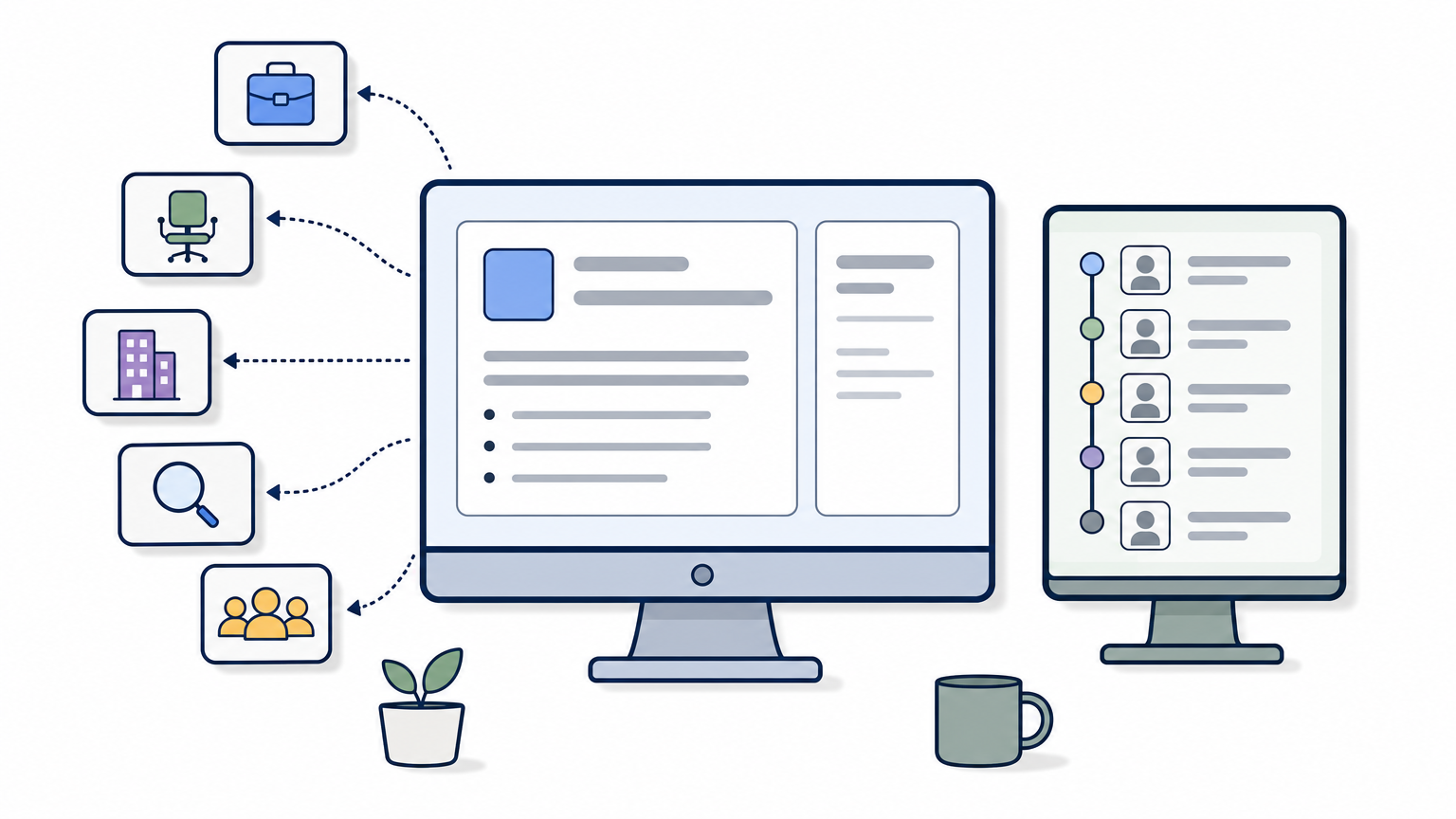
Jobsoid earns its place among the best free ats software picks because it pushes a single job posting to dozens of boards and social channels at once, without asking you to log into each one separately. Recruiters juggling LinkedIn, Indeed, and niche industry boards get one dashboard instead of five browser tabs open all day.
How it works
Creating a job inside Jobsoid triggers automatic distribution to its connected network of free and paid boards, and applications flow back into a single pipeline you customize by stage. Candidate profiles get parsed on arrival, so names, skills, and work history populate without manual entry.
Posting once and reaching every channel beats logging into five job boards before your coffee gets cold.
Key features
- Multi-channel job distribution from one posting
- Resume parsing on incoming applications
- Team collaboration with shared candidate notes and ratings
- Customizable pipeline stages by role or department
Who it's for
Smaller in-house teams and agencies that rely heavily on job board visibility, rather than sourcing outbound, benefit most here, especially if they already know how to post jobs for free across multiple sites. Jobsoid works well as a free ats for small business operations that need reach without paying for premium job board placements separately.
Pricing and free plan limits
Jobsoid's free tier caps the number of active jobs and users, typically suiting one or two recruiters posting a handful of roles at a time. Paid plans remove those caps and add advanced reporting, more integrations, and higher user seats as hiring volume grows.
7. Giig Hire, best for unlimited candidates and jobs
Giig Hire takes a different angle from the volume caps you see on Jobsoid or Zoho: it puts no ceiling on candidates or job postings, even on its free tier. Agencies that hit record limits on other platforms within a month or two often land here specifically because the numbers don't reset the clock on growth.
How it works
Candidates flow into Giig Hire from your career page or job board postings, and the system organizes them into a pipeline you build around your own hiring stages. Resume parsing runs automatically on intake, pulling contact details and work history so you're not retyping data from every application.
Free software that scales with you, instead of penalizing you for hiring more, is the exception rather than the rule.
Key features
- Unlimited candidates and job postings on the free tier
- Automatic resume parsing on every incoming application
- Customizable pipeline stages by role or team
- Collaboration tools for shared notes and candidate ratings
Who it's for
Staffing agencies and growing in-house teams that expect their hiring volume to climb, rather than stay flat, fit Giig Hire best. Recruiters burned by hitting a record cap mid-quarter on a different free ats for small business tool find the lack of ceilings here worth the switch.
Pricing and free plan limits
Giig Hire's free plan keeps candidates and jobs unlimited, but restricts team seats and some automation features to paid tiers. Upgrading unlocks advanced integrations, custom reporting, and additional user seats once a single recruiter account no longer covers the team.
8. Dover, a free ATS built for early-stage startups
Dover grew out of a recruiting agency's internal tooling, and that history shows in how tightly it's built around startup hiring rather than enterprise workflows. Founders and early hiring leads who don't have a dedicated recruiter often land here because Dover pairs its free ats software with sourcing support that feels closer to an outsourced recruiting team than a self-serve tool.
How it works
Getting a role live inside Dover starts with a short intake call or form where you describe the role, and the platform combines automated sourcing with its own team surfacing candidates into your pipeline. Applications and sourced profiles land in the same view, so you're not juggling two separate systems for inbound and outbound work.
Startups without a recruiter on staff get something closer to a hiring partner than a plain database.
Key features
- Automated candidate sourcing layered on top of standard ATS functions
- Resume parsing that structures both inbound applications and sourced profiles
- Slack integration for pipeline updates and team notifications
- Customizable pipeline stages built for fast-moving startup hiring
Who it's for
Early-stage startups hiring their first ten to fifty employees, often without a dedicated internal recruiter, get the clearest value, and they have plenty of other free ATS options built for startups to weigh too. Founders who need help finding candidates, not just tracking the ones who apply, fit Dover better than agencies managing high applicant volume across many clients.
Pricing and free plan limits
Dover's free tier covers core ATS functions and limited sourcing support, but its more active sourcing help and expanded seat counts sit behind paid plans. Growing teams that outgrow founder-led hiring typically move to a paid tier once they need dedicated sourcing bandwidth across multiple open roles at once.
9. Recruitee, best for collaborative hiring teams
Recruitee builds its whole workflow around getting hiring managers, not just recruiters, into the pipeline itself. Instead of exporting a shortlist to email and waiting for feedback, everyone with access comments and rates candidates inside the same board, which cuts the back-and-forth that stalls most hiring decisions.
How it works
Jobs get created and published to a branded career site, and applicants land in a customizable pipeline you build around your own stages. Team members tag each other on candidate cards, leave notes, and vote on whether someone advances through your recruiting pipeline stages, so decisions happen in one thread instead of scattered across Slack and email.
Collaboration built into the pipeline beats collaboration bolted on through email threads.
Key features
- Candidate cards with tagging, comments, and rating scales for team input
- Branded career page hosting
- Resume parsing on incoming applications
- Interview scheduling and email templates
Who it's for
Companies where hiring managers, not just recruiters, weigh in on every candidate fit this best. In-house teams running structured interview processes with multiple stakeholders get more value here than solo recruiters working alone.
Pricing and free plan limits
Recruitee offers a free trial rather than a permanent free tier, typically running around 18 days before requiring payment. Teams looking for an ats with free plan that lasts indefinitely should treat this as a test drive, not a long-term free option, and plan to budget for a paid seat once the trial closes.
10. Folk Flow, a free-forever ATS for agencies
Folk Flow markets itself as free forever rather than free for a trial window, aiming squarely at boutique agencies that don't want to relearn a new tool every time a discount expires. Like most recruitment agency software, it grew out of a relationship-management background, so it treats candidates less like line items and more like contacts you're actively nurturing across multiple client searches.
How it works
Running entirely in the browser, Folk Flow skips the setup headaches of an ats software download altogether. You build a pipeline per client or per role, tag candidates with custom fields, and move them through stages that mirror how a search firm actually works, sourcing, submitting, client feedback, offer. Onboarding materials are free to browse too, so teams can learn ats software free before committing any real workflow to it.
An agency-built ATS treats every candidate like a relationship worth tracking, not just a record to file.
Key features
- Client and candidate tagging built for search-firm workflows
- Free, unlimited pipeline boards per role or client
- Resume parsing on upload
- Shared notes and activity history across the team
Who it's for
Recruiting and search agencies managing multiple clients at once, rather than a single internal hiring queue, fit Folk Flow best. Solo recruiters juggling several retained searches simultaneously get more structure here than a generic pipeline tool offers.
Pricing and free plan limits
Staying genuinely free, Folk Flow limits seats and some reporting depth, but core pipeline and parsing features never sit behind a paywall. Larger agency teams needing more seats or deeper analytics eventually look at its paid tiers.
11. Free vs. paid ATS: what you really get for $0
Most recruiters assume free ats software means a crippled demo, but the ten tools above prove otherwise. The real gap between free and paid tiers isn't features like pipelines or resume parsing, those show up on nearly every free plan now. The gap shows up in volume caps, seat limits, and how much of your candidate history you can actually search once your database grows past a few hundred profiles, which is a big part of why ATS software got so expensive in the first place.
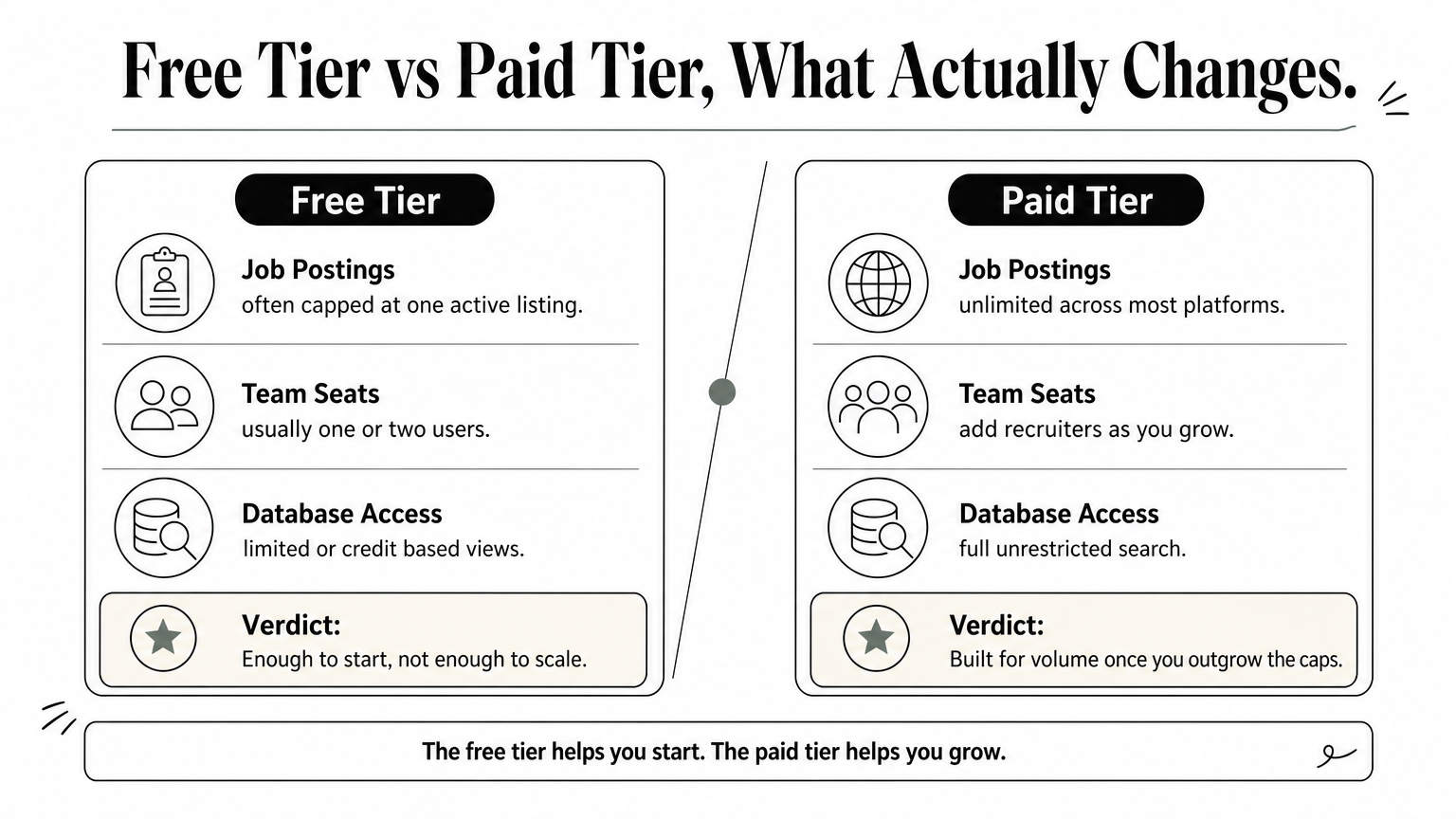
The real cost of a "free" ATS isn't the subscription, it's what happens once your candidate list outgrows the cap.
Here's what typically separates the two tiers across the platforms covered so far:
| What you get | Free tier | Paid tier |
|---|---|---|
| Job postings | Often capped (1 active job on Breezy, unlimited on Giig Hire and Olibr) | Unlimited across most platforms |
| Team seats | Usually 1-2 users | Add seats per recruiter |
| Resume parsing | Included on almost every list entry | Adds bulk parsing, more file formats |
| Candidate database access | Limited detail views (MightyRecruiter) or credit-based (Olibr) | Full unrestricted access |
| Reporting and analytics | Basic pipeline counts only | Custom dashboards, source tracking |
| Sourcing tools | Minimal or none | Outbound sourcing, browser extensions |
Understanding this table matters more than reading another feature list, because the caps decide whether a tool survives your actual hiring volume past month three. Olibr sidesteps the seat and record caps entirely by trading data contribution for access instead of charging by usage, which is worth weighing against tools that simply delay the paywall by a few weeks.
12. How to choose the right free ATS for your team
Picking a free applicant tracking system off a list isn't enough. You need to match the tool's caps and workflow to how you actually hire, not how the marketing page describes an ideal customer. Start by counting your monthly applicant volume and current team size, then cross those numbers against the caps in the table above before you commit a single job posting to a new pipeline.
The best free ATS for your team is the one whose limits you'll never actually hit.
Match the tool to your hiring volume
Agencies filling dozens of roles a month need unlimited postings and candidate records, which rules out tools like Breezy's single-job cap fast and points toward an ATS built for staffing agencies. Smaller in-house teams hiring for two or three roles at a time can live comfortably inside Zoho's or Jobsoid's tighter limits without ever feeling squeezed, and there are more ATS picks for small business worth comparing at that size.
Decide how you feel about sharing data
Teams bound by NDAs or working retained search should lean toward private, isolated plans rather than shared-pool models. Everyone else gets more value from a network approach, since learn ats software free trials rarely include a real candidate database to search on day one.
Run through this before signing up:
- How many active job postings do you run at once?
- How many recruiters need seats today, and in six months?
- Does your database sit mostly dormant, making a shared pool worth the trade?
- Do you need resume parsing on bulk uploads or just single files?
- Will the free tier still work once your candidate count doubles?
13. How ATS resume parsing actually works
Every ats resume parser on this list runs the same basic trick under the hood, and it's the core of how an applicant tracking system works: it reads unstructured text from a PDF or Word document and forces it into structured fields like name, email, skills, and work history. How AI reads resumes comes down to pattern scanning: headers like "Experience" or "Education," date ranges, and common skill keywords get mapped into your database so you're not typing candidate details by hand from every resume that lands in your inbox.
A parser that gets 90% of fields right still saves hours; the last 10% is why you double-check before an interview.
What a parser actually extracts
Most tools pull the same core fields, though accuracy varies by resume format and layout complexity:
- Contact details (name, email, phone, location)
- Work history with company names and date ranges
- Skills and keywords matched against your job requirements
- Education and certifications
- Sometimes a summary or objective statement
Where parsing breaks down
Heavily designed resumes with columns, graphics, or tables confuse most parsers, including the free tiers reviewed above, because the text extraction reads left to right and scrambles a two-column layout into nonsense. Non-standard section headers, like "Journey" instead of "Experience," also trip up simpler engines. Bulk uploads make this worse: parsing 500 resumes at once means a few hundred will need manual review, which is why tools supporting free ats software download-free, browser-based bulk parsing at scale, like Olibr's 10,000-profile batches, still flag low-confidence fields for you to fix rather than trusting the parser blindly.
Picking the ATS that fits how you actually hire
None of the ten tools above are wrong choices, they just fit different problems. A free applicant tracking system only earns its place in your stack if its caps match your hiring volume and its workflow matches how your team actually reviews candidates. Breezy and Zoho suit a single recruiter posting a few roles. Giig Hire and Olibr fit teams that expect volume to climb and don't want to hit a wall mid-quarter.
If you're already sitting on a database full of dormant profiles, the math tilts toward a free ats software option that pays you back in candidates rather than just saving you a subscription fee. That's the whole premise behind Olibr's exchange model, and it's worth testing against your own numbers before you commit to anything paid.
Create your free recruiter account and see what your dormant profiles are worth in access.
For engineers
Find work worth your time.
Live engineering roles across India and the US, matched to your stack. Build a profile recruiters actually discover.