
How To Build a Candidate Pipeline That Fills Roles Faster
Most recruiters spend their days reacting, scrambling to fill roles after they open, screening hundreds of unqualified applicants, and watching hiring cycles stretch past 45 days. The fix isn't working harder or posting on more job boards. It's learning how to build a candidate pipeline before you actually need one.
A candidate pipeline is a pre-vetted pool of talent you've already identified, engaged, and qualified, ready to move forward the moment a role opens. Recruiters who maintain one consistently cut their time-to-hire in half and stop competing in the same desperate talent grab as everyone else. The difference between a pipeline and a prayer is a repeatable system, and that's exactly what this guide breaks down.
Below, you'll get a step-by-step framework for sourcing, engaging, and nurturing candidates proactively, plus practical ways to use tools like Olibr's searchable database of 180,000+ candidate profiles and AI-powered matching to keep your pipeline full without burning hours on manual work. Whether you're an in-house recruiter or running an agency, this approach will help you stop hiring from zero every single time.
What a candidate pipeline is and what it is not
A candidate pipeline is a structured, ongoing process of identifying, engaging, and organizing potential hires before you have an open role. Think of it as a living pool of people you've already vetted, sorted by role type, skill set, and readiness to move. Rather than starting from scratch every time a position opens, you pull from a group you've already built relationships with. This distinction matters because it completely changes how fast and how well you hire.
What a candidate pipeline actually is
A true pipeline is an active system, not a static spreadsheet. At any given moment, it holds candidates at different stages: some you've sourced but haven't contacted yet, others you've spoken with and found strong but didn't have a role for at the time, and a few who are warm and ready to interview. The key is that every candidate in your pipeline carries a status, a skill tag, and a last-contact date attached to them.
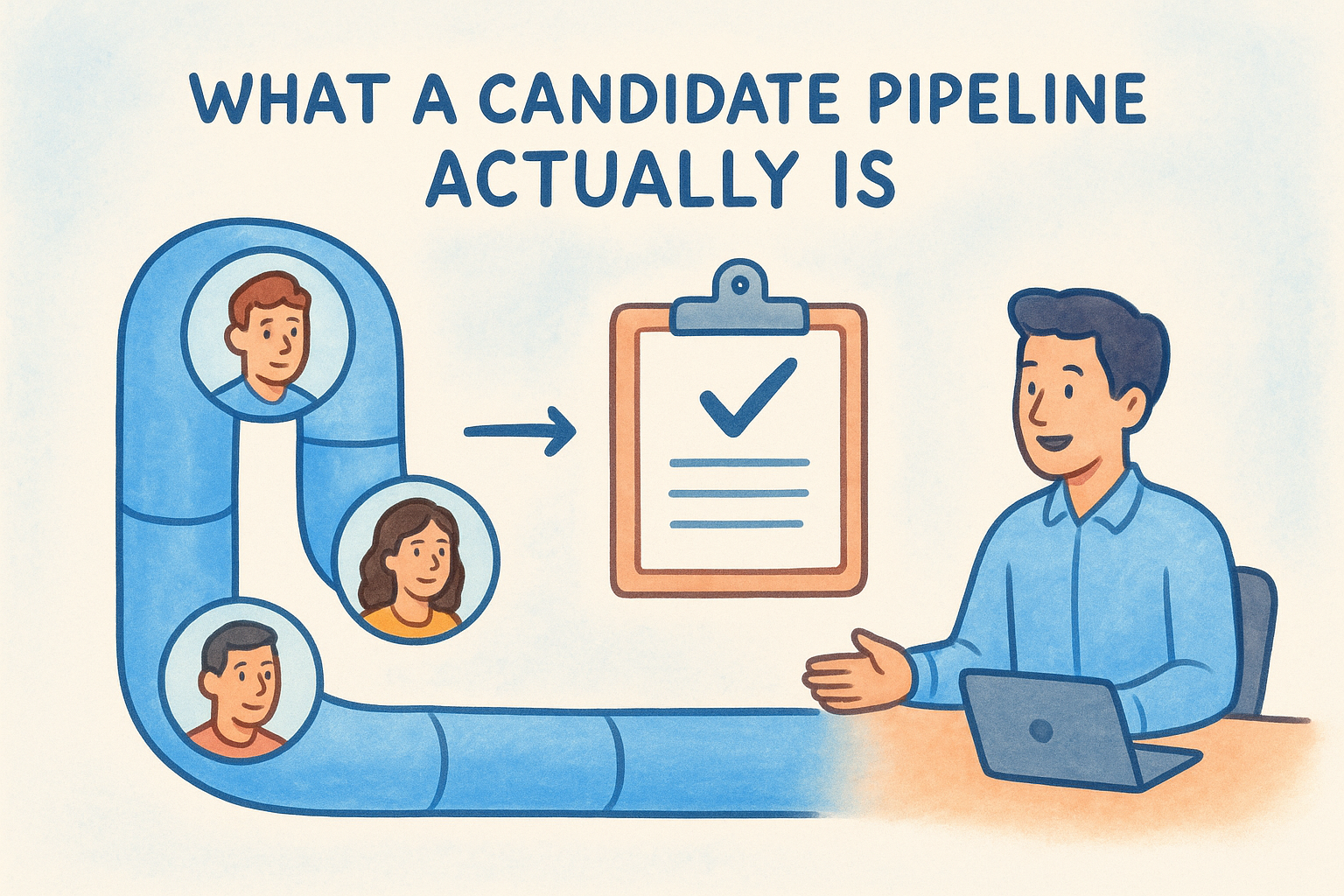
A pipeline only works if it moves. If you're not updating statuses and re-engaging candidates regularly, you have a list, not a pipeline.
When you think about how to build a candidate pipeline that actually functions, the core components are: a sourcing routine that adds new candidates consistently, a way to qualify and segment them by fit, and a nurturing process that keeps your best prospects warm. Platforms like Olibr provide AI-powered candidate matching across 180,000+ profiles, which means you can skip cold sourcing entirely for many roles and jump straight to candidates who already match your criteria.
What a candidate pipeline is not
Plenty of recruiters confuse a pipeline with a few things it simply is not. Understanding where that line sits saves you from building something that looks organized but produces no results when you actually need to hire. The two most common mistakes are treating it like a resume folder and treating it like a more organized version of posting a job.
Dumping applications into a shared drive with no tagging, no outreach history, and no follow-up plan gives you a storage problem, not a hiring advantage. Posting a role and collecting applicants is reactive hiring. A pipeline is what you build so that when a role opens, you already know three or four people who could fill it. Here's a quick breakdown of the difference:
| Pipeline behavior | Reactive behavior |
|---|---|
| You reach out before a role opens | You post and wait for applicants |
| Candidates are pre-screened and tagged | Resumes sit unreviewed in a folder |
| You know each candidate's readiness level | You start qualification from zero |
| Time-to-hire drops significantly | Hiring cycles stretch to 45+ days |
| Relationships exist before urgency hits | First contact happens under pressure |
Finally, a pipeline is not a one-time project. Recruiters who build a list in January and never touch it again find that candidates have moved on, accepted other roles, or changed their availability entirely. Consistent upkeep is what separates a pipeline that delivers from one that looks good on paper but collapses under pressure.
Step 1. Pick pipeline roles and success profiles
You can't build an effective pipeline around every role in your organization. Trying to source proactively for 30 different positions at once spreads your effort thin and produces a cluttered, unmanageable list. Start by identifying the roles that cause the most disruption when they're vacant and the ones you hire for on a recurring basis. Those are the positions that belong in your pipeline first.
Identify your high-priority pipeline roles
Not every open seat is worth proactive sourcing effort. Focus on roles with high hiring frequency, long time-to-fill, or significant business impact when left unfilled. A frontend engineer role you hire for three times a year makes far more sense in a pipeline than a one-off search you run once a decade.
If a role consistently takes more than 30 days to fill or appears on your hiring plan more than twice a year, it belongs in your pipeline.
To identify your pipeline roles, ask yourself:
- Which positions stay open the longest when they open?
- Which roles, when vacant, directly block revenue or operations?
- Which skill sets are consistently hard to find in your market?
- Which roles do you hire for on a recurring or seasonal basis?
Start with three to five roles maximum. You can expand your pipeline later once you have a consistent sourcing and nurturing rhythm in place.
Build a success profile for each role
Once you know which roles to prioritize, you need to define what a strong hire actually looks like for each one. A success profile goes beyond a job description and captures the specific skills, experience patterns, and signals that separate a strong candidate from someone who looks good on paper but underdelivers.
Use this template when building a success profile for each pipeline role:
| Attribute | What to define |
|---|---|
| Core skills | The 3-5 non-negotiable technical or functional abilities |
| Experience range | Years of relevant experience and domain context |
| Career signals | Patterns that suggest growth (promotions, expanding scope) |
| Red flags | Common resume patterns that predict poor fit |
| Screening question | One question that quickly separates strong from weak |
When you understand how to build a candidate pipeline that actually performs, a clear success profile makes every downstream step faster. It turns sourcing from guesswork into a targeted search and ensures the candidates you store are genuinely worth keeping.
Step 2. Build repeatable sourcing channels
Once you have your priority roles and success profiles locked in, you need a consistent way to bring new candidates into your pipeline without reinventing your process every week. Repeatable sourcing channels are the specific places and methods you return to on a defined schedule to find qualified people for each role type. The goal is to build habits, not heroics. When each channel has a clear owner, a defined frequency, and a target output, sourcing stops feeling like a scramble and starts producing predictable results.
Choose your channels by role type
Not every channel works equally well for every position. Technical roles often respond well to direct outreach through professional networks and internal candidate databases, while sales or operations roles may surface faster through employee referrals or niche job communities. Pick two or three channels per role and run them consistently rather than checking ten platforms occasionally.
A single channel you work every week will outperform five channels you visit whenever you remember.
Here are the most effective sourcing channels to build into your pipeline routine:
| Channel | Best for | Recommended frequency |
|---|---|---|
| Internal candidate database | All roles, especially recurring ones | Weekly search |
| Employee referrals | Culture-fit roles, niche skill sets | Ongoing, monthly reminders |
| LinkedIn outreach | Mid-to-senior professional roles | 10-15 messages per week |
| Niche job communities | Technical and specialized roles | Bi-weekly |
| Past applicants | All roles | Review every time a role reopens |
Use a searchable database to cut sourcing time
One of the fastest ways to understand how to build a candidate pipeline that actually scales is to stop starting from zero on every search. Olibr's database of 180,000+ candidate profiles lets you filter by skill, experience level, location, domain, and career trajectory so you can pull a targeted shortlist in minutes instead of posting and waiting. AI-powered matching analyzes your job description and ranks candidates by fit, going beyond keyword overlap to surface people whose actual experience aligns with your success profile.
Set a weekly block of 30 to 45 minutes dedicated to running two or three targeted database searches per priority role. Adding five to ten qualified candidates per week compounds fast. Within a month, you have a meaningful pool to draw from before a single urgent role lands on your desk.
Step 3. Screen, segment, and store candidates
Sourcing candidates without a clear system for evaluating and organizing them creates a different problem: a messy, unmanageable list that's impossible to act on quickly. This step is where you turn raw leads into a structured pool your team can actually work from. Screening, segmenting, and storing candidates properly is what makes the difference between a pipeline that delivers results under pressure and one that only looks organized.
Define your screening criteria upfront
Before you start evaluating anyone, write down the two or three questions that quickly separate a strong candidate from a weak one for each priority role. These should come directly from the success profile you built in Step 1. Without a consistent screening standard, two recruiters on the same team will qualify candidates differently, and your pipeline fills with inconsistent quality.
Your screening criteria should be tight enough to filter out weak fits but broad enough that you're not eliminating people who could grow into the role.
Use this quick screening template for each candidate you evaluate:
| Screening check | Pass / Fail / Maybe |
|---|---|
| Meets core skill requirements | |
| Experience range matches success profile | |
| Career trajectory shows relevant growth | |
| No obvious red flags from success profile | |
| Available or open to new roles within 90 days |
Run every candidate through this before they enter your pipeline. Anyone who scores all "Fail" ratings gets archived rather than stored as an active lead.
Create a segmentation system that sticks
Once a candidate passes your screening check, you need to tag them by role type and readiness level so you can pull the right people instantly when a position opens. A simple three-tier labeling system works for most teams and fits inside any ATS or candidate tracking tool without requiring custom configuration.
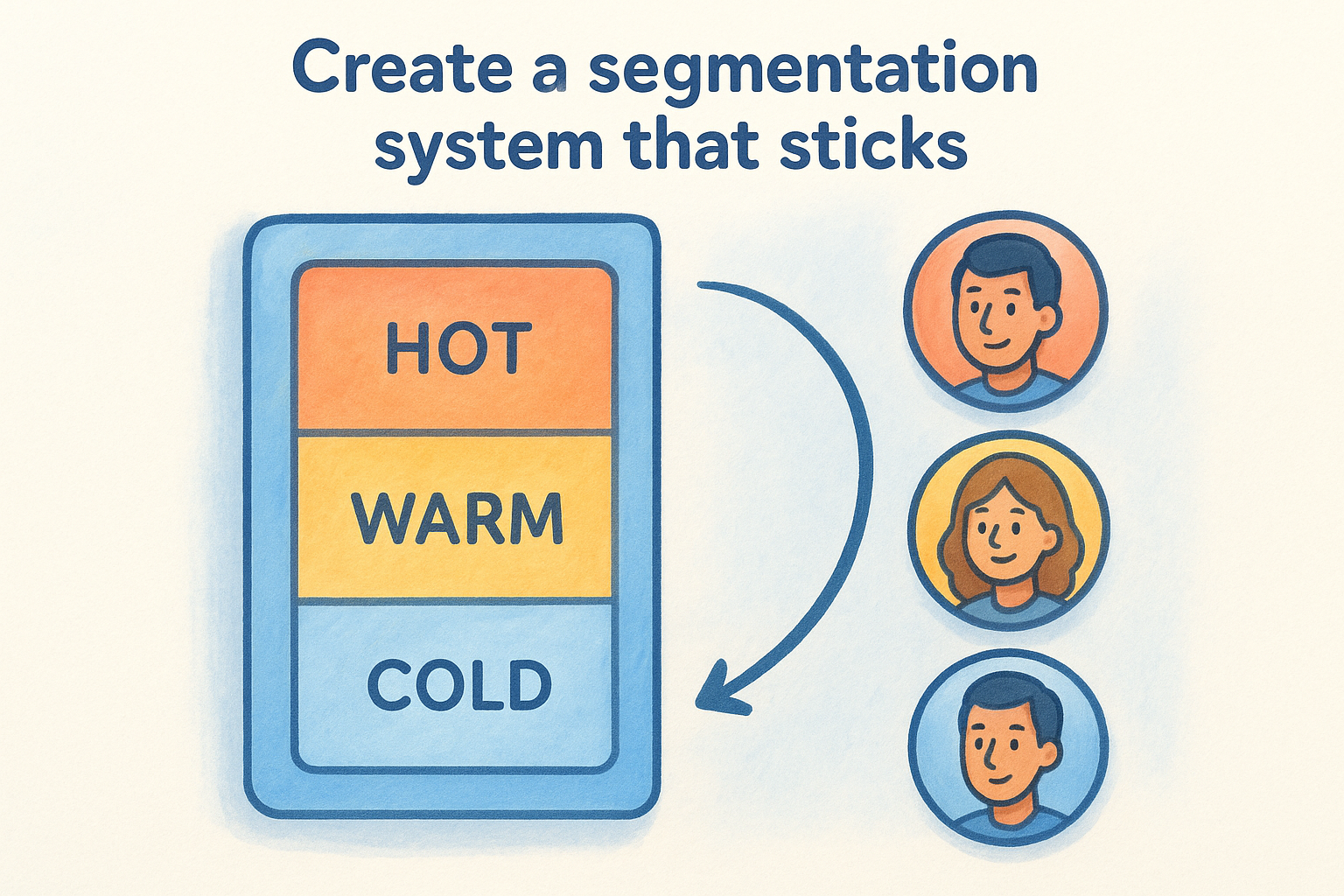
Apply one of these three labels to every candidate in your pipeline:
- Hot: Actively looking, available within 30 days, strong fit
- Warm: Open to opportunities, not actively searching, strong fit
- Cold: Not currently looking but worth re-engaging in 60 to 90 days
Understanding how to build a candidate pipeline that performs means treating storage as an active decision, not a filing task. Review your segmentation labels every 30 days and update them based on any new contact you've had, so your pipeline reflects reality rather than the moment you first spoke with someone.
Step 4. Nurture, re-engage, and measure results
A candidate pipeline that no one contacts is just a list with labels. The work of step four is keeping your best prospects engaged so that when a role opens, they already know who you are, trust your outreach, and are ready to move. Nurturing doesn't require hours of manual effort. It requires a consistent, lightweight cadence that keeps the relationship warm without being intrusive.
Build a contact cadence for each pipeline tier
Your nurturing schedule should match the readiness level you assigned in step three. Hot candidates need contact every two to three weeks. Warm candidates respond well to a monthly check-in or a relevant article, job market update, or role preview. Cold candidates need a re-engagement message every 60 to 90 days to confirm they're still worth keeping active.
Silence is how you lose your best candidates to competitors who were paying attention.
Use this contact cadence template as your baseline:
| Tier | Contact frequency | Message type |
|---|---|---|
| Hot | Every 2-3 weeks | Role update, interview invite, check-in |
| Warm | Monthly | Relevant insight, upcoming role preview |
| Cold | Every 60-90 days | Re-engagement, availability check |
Keep each message short and specific. Reference something from your previous conversation or their background to show you actually know who they are.
Re-engage candidates who have gone quiet
Candidates go quiet for a reason, usually timing. Re-engagement messages work best when they acknowledge the gap and lead with something new: a role that fits them specifically, a salary range update, or a change in team structure. Avoid generic "just checking in" messages. Instead, reference the role type they expressed interest in and ask one direct question about their current availability.
Measure the metrics that show your pipeline is working
Knowing how to build a candidate pipeline is only half the job. Tracking the right numbers tells you whether your pipeline is actually healthy or just full. Review these four metrics monthly:
- Pipeline coverage ratio: Active pipeline candidates per open role (target: 5:1 minimum)
- Time-to-fill from pipeline: Days from role opening to offer accepted using pipeline candidates
- Candidate decay rate: Percentage of candidates who go stale or unresponsive each month
- Re-engagement response rate: Percentage of cold candidates who reply to outreach
These numbers tell you where to invest more sourcing effort and which nurturing messages are working.
Wrap-up and next steps
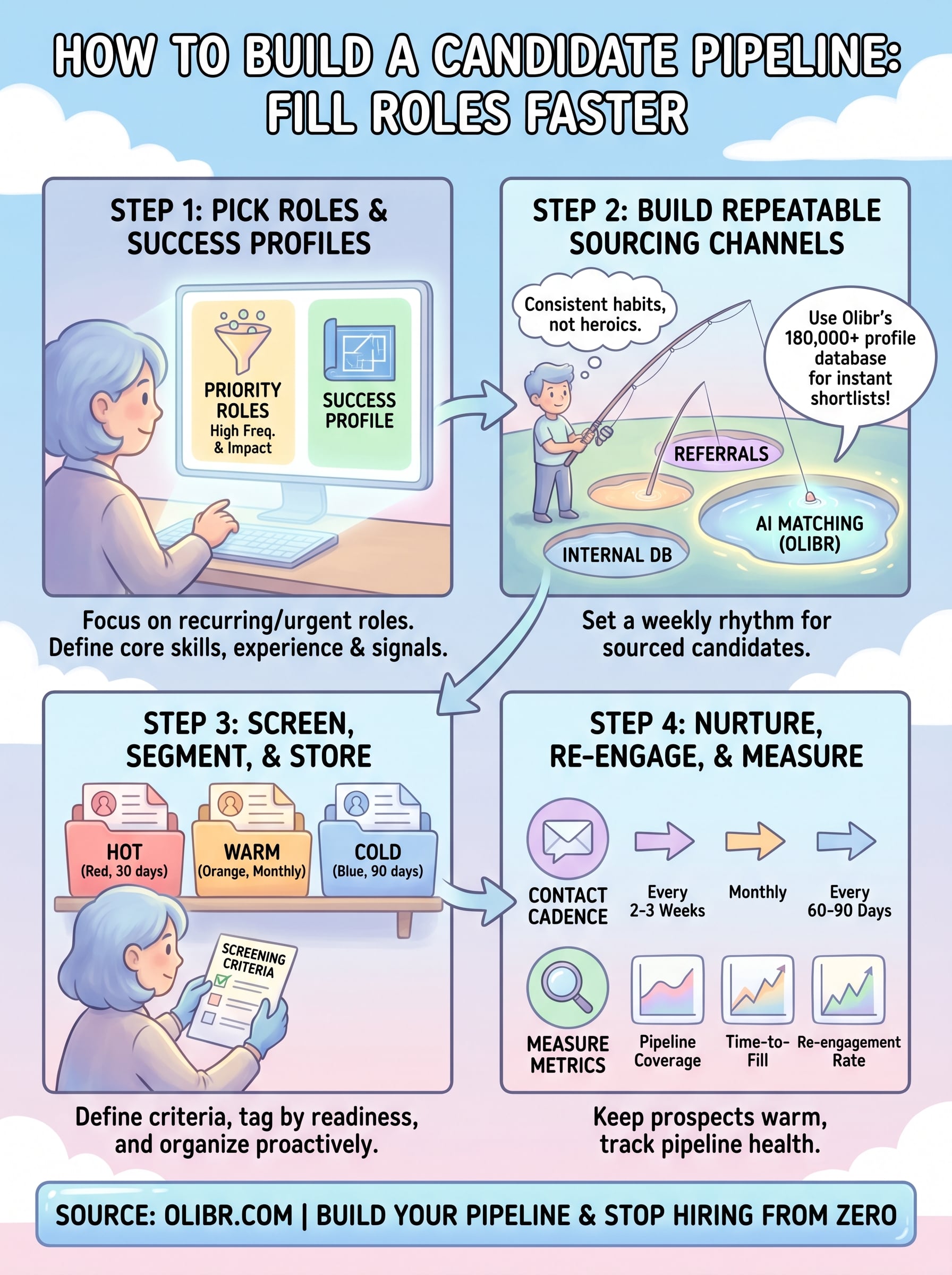
You now have a complete framework for how to build a candidate pipeline that produces results before urgency hits. The process comes down to four repeatable steps: pick your priority roles and define success profiles, build consistent sourcing channels, screen and segment every candidate you bring in, and maintain a contact cadence that keeps your best prospects warm. None of these steps require a massive time investment. They require consistency.
Start small. Choose two or three roles this week, run a targeted search, and add ten qualified candidates to a segmented list. Build the habit before you try to scale it. Every week you run the process, your pipeline gets stronger and your next hire gets faster.
If you want to cut sourcing time significantly, search Olibr's shared candidate database to find pre-filtered profiles matched to your open roles without paying a monthly subscription fee.
For hiring teams
Search 180,000+ candidate profiles — free.
Olibr is a community-funded recruiting platform: full ATS, AI interviews, and a shared resume database. No per-seat fees.