10 Candidate Pre Screening Questions (With Sample Answers)
A bad hire costs time, money, and momentum, and most of them slip through because the right questions weren't asked early enough. Candidate pre screening questions are the filter between a flood of applications and a shortlist worth interviewing. Get them right, and you cut your time-to-hire significantly while improving the quality of every candidate who reaches the next round.
The challenge is knowing which questions actually reveal fit versus the ones that just eat up everyone's time. You need questions that uncover deal-breakers fast, salary expectations, availability, role alignment, without turning the process into a full interview. That's the balance this article helps you strike, whether you're screening candidates manually or using AI-powered tools like Olibr to automate and score early-stage interviews.
Below, you'll find 10 pre screening questions that work across roles and industries, each paired with sample answers to benchmark responses against. Use them to build a screening process that's faster, more consistent, and harder to game.
1. What drew you to this role and why now?
This question does two things at once: it tests motivation and reveals timing. A candidate who can clearly explain why this specific role at this specific company interests them is showing you they connected the position to a real career goal, not just a need for income.
Learn what this question reveals
The answer tells you whether the candidate applied with intent or impulse. Strong candidates tie their interest to something concrete about the company, the team, or the scope of work. The "why now" piece is equally important because it surfaces context, a desire for growth, a career pivot, a recent move, that shapes how committed they're likely to be once they're in the seat.
A candidate who understands where your company is headed is far more likely to stay engaged through a longer hiring cycle and beyond.
Use a strong sample answer
A strong answer sounds something like: "I've spent four years in backend engineering, and I've been actively looking to move into a role closer to data pipelines. Your job description mentioned direct ownership of the ETL architecture, which is exactly the direction I want to grow. The timing works because I just shipped a major product at my current company and I'm ready for a new challenge."
Notice how this answer names a specific technical area and ties it to a real milestone. That level of specificity is your benchmark when scoring this question.
Spot weak answers and red flags
Watch for candidates who describe the role in generic terms or offer vague reasons like "it seemed like a good opportunity." That signals they applied broadly. Red flags to watch for:
- No specifics about the company or the actual role requirements
- "Why now" answers that are entirely reactive with no mention of the work itself
- Candidates who can't name anything distinct about your company versus a competitor
Ask smart follow-ups
Push deeper with: "What specifically about this company made you apply here rather than a similar role elsewhere?" or "Where do you see this role fitting into your next three years?" These follow-ups separate rehearsed answers from genuine ones and give you real signal fast.
Score answers fast in Olibr
Olibr's AI interview feature lets you set this question as part of your screening flow and scores responses automatically based on criteria you define. Instead of listening to ten variations of the same answer, you get a ranked summary, making it easy to run these candidate pre screening questions at scale without adding time to your day.
2. Can you walk me through your resume with an emphasis on relevant work?
This question puts the candidate in control of the narrative and shows you how self-aware they are. The direction to focus on relevant work is intentional; it tests whether they understand what actually matters for this role.
Learn what this question reveals
Strong candidates filter and prioritize. They don't recite every job title chronologically; they connect past experience directly to your open role. This tells you how well they read the job description and how clearly they can communicate value.
A candidate who knows which experience matters most to you has already done the work of qualifying themselves.
Use a strong sample answer
A solid response sounds like: "In my last two roles, I led frontend development for SaaS products with 50,000+ users. I'll skip my early retail work since it's less relevant, but the last three years map closely to what you're hiring for, particularly the React and performance optimization experience."
Spot weak answers and red flags
Watch for candidates who walk through every job in equal detail regardless of relevance. That signals poor self-awareness or a copy-paste application. Also flag candidates who can't connect any past work to your specific requirements even loosely.
Ask smart follow-ups
Push with: "Which part of your background do you think prepares you best for the hardest parts of this role?" This surfaces both confidence and role comprehension.
Score answers fast in Olibr
Olibr scores this and other candidate pre screening questions automatically, flagging responses that lack role-specific detail so you spend time only on candidates who demonstrate genuine fit.
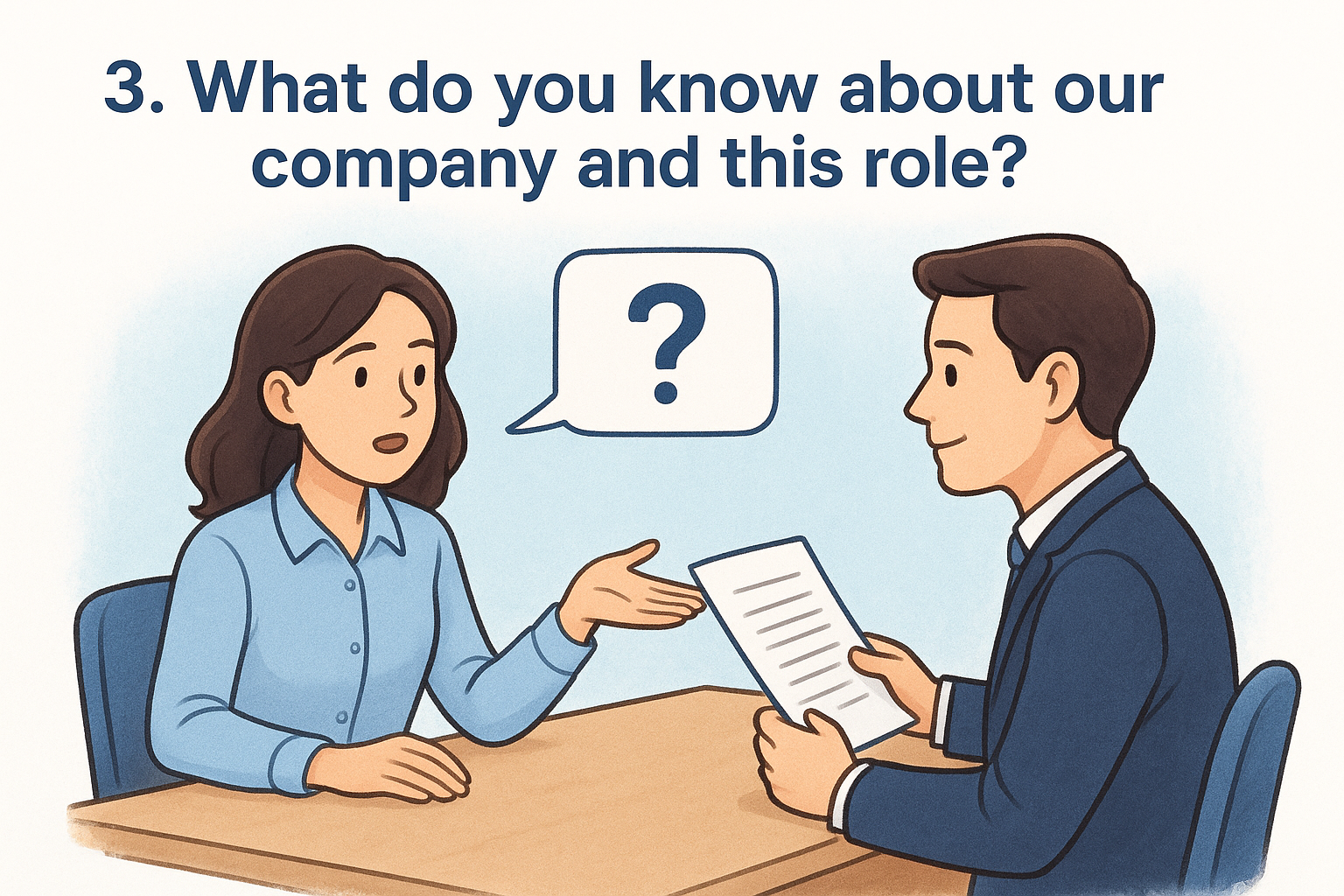
3. What do you know about our company and this role?
This question is a basic preparation check, and it cuts a surprising number of candidates from the list fast. Someone who researched your company before applying is signaling effort, genuine interest, and the kind of professional habits that carry into the job.
Learn what this question reveals
You're testing whether the candidate treated your posting as one of many or as a real target. A prepared candidate can speak to your product, your market position, or a recent company milestone. That tells you they're serious. Candidates who can't answer this question haven't done the minimum work required to earn your time.
Preparation before a screening call is the clearest early signal of how a candidate will approach the job itself.
Use a strong sample answer
A strong answer looks like: "I read through your product pages and saw that you focus on AI-powered hiring tools. I also noticed you recently expanded into the US market. The role itself maps well to my background because you need someone to own end-to-end sourcing, which is exactly what I've been doing for the past three years."
Spot weak answers and red flags
Watch for answers that are entirely generic ("you seem like a great company") or candidates who only reference the job title. Flag anyone who confuses basic facts like your industry or company size, as that signals either low interest or poor attention to detail.
Ask smart follow-ups
Push with: "What part of what we're building interests you most?" This forces specifics and confirms they didn't just skim the homepage.
Score answers fast in Olibr
Olibr automates this and other candidate pre screening questions in a structured flow, scoring preparation depth so you never spend a full call discovering someone applied without reading the job description.
4. Which must-have skills do you bring, and how have you used them?
This question bridges the gap between a resume that lists skills and a candidate who can actually demonstrate them. Asking for proof of use, not just possession, separates real competency from keyword stuffing.
Learn what this question reveals
The answer tells you whether the candidate understands what the role actually requires or just mirrored your job description back to you. Strong candidates name skills with context, not in a vacuum. They explain the situation where the skill mattered and the outcome it produced, which gives you concrete evidence rather than a claim you can't verify.
A candidate who can describe exactly how they applied a skill is far more useful to you than one who simply asserts they have it.
Use a strong sample answer
A strong answer looks like: "You listed Python and data pipeline work as core requirements. I've been using Python daily for three years, primarily to build and maintain ETL pipelines processing over two million records per day. Last year, I reduced processing time by 40% by rewriting a legacy script in a more efficient framework."
Spot weak answers and red flags
Watch for candidates who list skills without connecting them to real work. "I'm proficient in SQL" with no supporting example tells you almost nothing. Also flag candidates who only mention skills from your job description without adding anything that reflects genuine depth or range.
Ask smart follow-ups
Push with: "Which of those skills do you feel you still have room to grow in?" This surfaces self-awareness and honesty.
Score answers fast in Olibr
Olibr evaluates these candidate pre screening questions automatically, scoring technical responses against role-specific criteria so you can compare candidates objectively without sitting through repetitive calls.
5. What accomplishment are you most proud of that relates to this job?
This question forces candidates to make a direct connection between their best work and your open role. It's one of the most useful candidate pre screening questions because it reveals both what a candidate values and how well they understand what success looks like in the position they're applying for.
Learn what this question reveals
A candidate's proudest achievement tells you a lot about what they care about and how they measure their own impact. You want someone who picks an example that's genuinely relevant, not the biggest thing they ever did, but the thing most aligned with the challenges your role carries.
The specificity and relevance of this answer tells you whether the candidate mapped their experience to your job description or just submitted a generic application.
Use a strong sample answer
A strong response sounds like: "I led the migration of our entire customer database to a new CRM system with zero downtime across 80,000 records. It took six months, required cross-team coordination, and cut our reporting time by 30%. That project is closest to what your role requires."
Spot weak answers and red flags
Watch for candidates who pick an accomplishment with no connection to your role at all. Also flag vague answers where the candidate describes team output without clarifying their personal contribution to the result.
Ask smart follow-ups
Push with: "What would you do differently if you tackled that same project today?" This tests both reflection and growth.
Score answers fast in Olibr
Olibr scores responses against role-specific benchmarks you define, so you compare accomplishments objectively rather than relying on memory across a stack of calls.
6. Tell me about a time you solved a hard problem at work
This question is a behavioral screen that asks candidates to show their thinking under pressure, not just describe the outcome. The goal is to understand how they approach obstacles, who they involve, and what judgment they apply when the path forward isn't obvious.

Learn what this question reveals
Strong candidates use this question to walk you through a real structured problem-solving process. You want to hear how they defined the problem, what they tried, and how they measured success. Candidates who can describe failure points along the way demonstrate honest self-awareness, which is far more useful than a polished story with no friction.
Problem-solving answers reveal how a candidate thinks, not just what they've done.
Use a strong sample answer
A strong response sounds like: "Our payment processing system started failing intermittently during peak hours and no one could reproduce it consistently. I mapped the failure pattern against server logs, identified a race condition in our queue handler, and patched it within 48 hours with no additional downtime."
Spot weak answers and red flags
Watch for candidates who describe team efforts without naming their individual role in solving the problem. Also flag anyone who can't recall a specific hard problem because that signals either limited scope in previous roles or poor situational awareness.
Ask smart follow-ups
Push with: "What was the first thing you ruled out, and why?" This tests whether their process was structured or reactive.
Score answers fast in Olibr
Olibr scores these candidate pre screening questions automatically, flagging vague problem-solving answers so you only advance candidates who demonstrate real analytical depth.
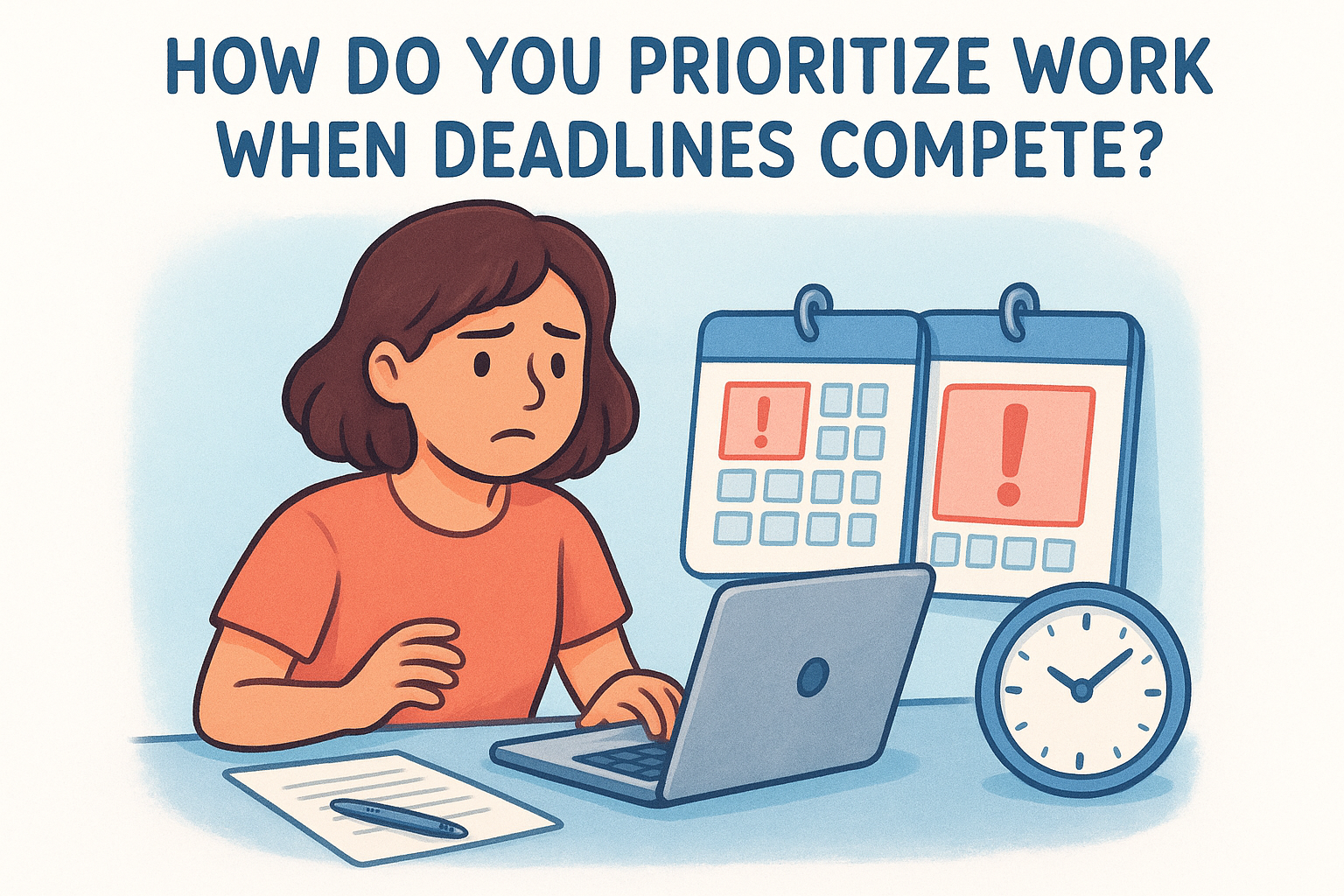
7. How do you prioritize work when deadlines compete?
Prioritization under pressure shows up in every role, but it's rarely tested until someone is already hired. This question reveals how a candidate manages competing demands and whether they have a real system for making smart trade-offs when everything feels urgent at once.
Learn what this question reveals
You're testing decision-making structure, not just time management. Strong candidates describe a real method: triage by impact, communicate early with stakeholders, or break large tasks into smaller phases. The best answers show that the candidate controls their workload actively rather than reacting to whoever is loudest.
A candidate with no prioritization framework will create the same bottleneck inside your team that they experienced at their last job.
Use a strong sample answer
A strong response sounds like: "When two deadlines compete, I first clarify the downstream impact of each. If delaying one blocks another team, that takes priority. I also communicate early with stakeholders so no one gets a last-minute surprise. Last quarter, I managed three simultaneous launches by breaking each into daily milestones and flagging risks a week out."
Spot weak answers and red flags
Watch for candidates who say they just work harder or stay later with no actual strategy behind it. That signals burnout risk, not capability. Also flag answers where the candidate relies entirely on their manager to sort competing priorities, because that signals a lack of independent judgment you'll end up compensating for.
Ask smart follow-ups
Push with: "Give me a specific example where you got the prioritization wrong and what you learned from it." This tests self-awareness directly.
Score answers fast in Olibr
Olibr automates this and other candidate pre screening questions in a structured interview flow, scoring each response against criteria you define so you can compare prioritization skills across candidates without scheduling ten separate calls.
8. Are you authorized to work here, and will you need sponsorship?
This question is one of the most practical candidate pre screening questions you can ask because it surfaces a hard constraint early, before you invest time in interviews, hiring panels, and offer negotiations. Getting this answer upfront saves everyone from a frustrating dead end.
Learn what this question reveals
The answer tells you whether moving forward is logistically viable from day one. If your company doesn't offer sponsorship and a candidate needs it, the conversation ends there. Knowing this early protects your hiring timeline and keeps your pipeline focused on actionable candidates.
Skipping this question and discovering the constraint at the offer stage is one of the most avoidable delays in any hiring process.
Use a strong sample answer
A strong answer is direct: "I'm fully authorized to work in the US and I don't require any sponsorship now or in the future." That's it. Clarity and brevity here signal that the candidate understands the practical stakes of the question.
Spot weak answers and red flags
Watch for candidates who hedge or deflect with answers like "it depends" or "I'd need to check." That signals either a sponsorship need they're avoiding disclosing or genuine uncertainty about their own status, neither of which helps you move forward. Flag any answer that lacks a clear yes or no.
Ask smart follow-ups
Push with: "Has your authorization status changed in the last year, and do you anticipate any changes in the next twelve months?" This surfaces expiring visas or pending applications before they derail an offer.
Score answers fast in Olibr
Olibr flags authorization responses automatically during screening, so this critical checkpoint never gets buried in notes or forgotten between calls.
9. What salary range do you expect, and when can you start?
Asking about compensation and availability together is efficient because both answers directly determine whether you can move forward. Salary misalignment and long notice periods are the two most common reasons promising candidates fall out late in the process, and asking this as one of your candidate pre screening questions eliminates that surprise entirely.
Learn what this question reveals
This question surfaces two hard constraints in one exchange. The salary answer tells you whether your budget and their expectations overlap before you spend hours on interviews. The start date answer tells you whether their timeline matches your hiring urgency, which matters especially when you're backfilling a critical open seat.
Discovering a salary gap after a final-round interview wastes more time than any other mistake in the hiring process.
Use a strong sample answer
A strong response is specific and direct: "My target range is $95,000 to $110,000 depending on the full compensation package. I'm currently giving two weeks' notice at my current company, so I can start within three weeks of accepting an offer."
Spot weak answers and red flags
Watch for candidates who refuse to name a number or respond only with "it depends on the offer." That forces you to do work they should be doing. Also flag candidates whose start date is four or more months out without a concrete explanation, as that signals competing offers or low urgency to make a move.
Ask smart follow-ups
Push with: "Is your salary range flexible if the total compensation package includes strong equity or benefits?" This reveals how fixed their number actually is.
Score answers fast in Olibr
Olibr flags salary and availability answers automatically against the parameters you set for each role, so mismatched candidates never make it to a live interview.
Next steps
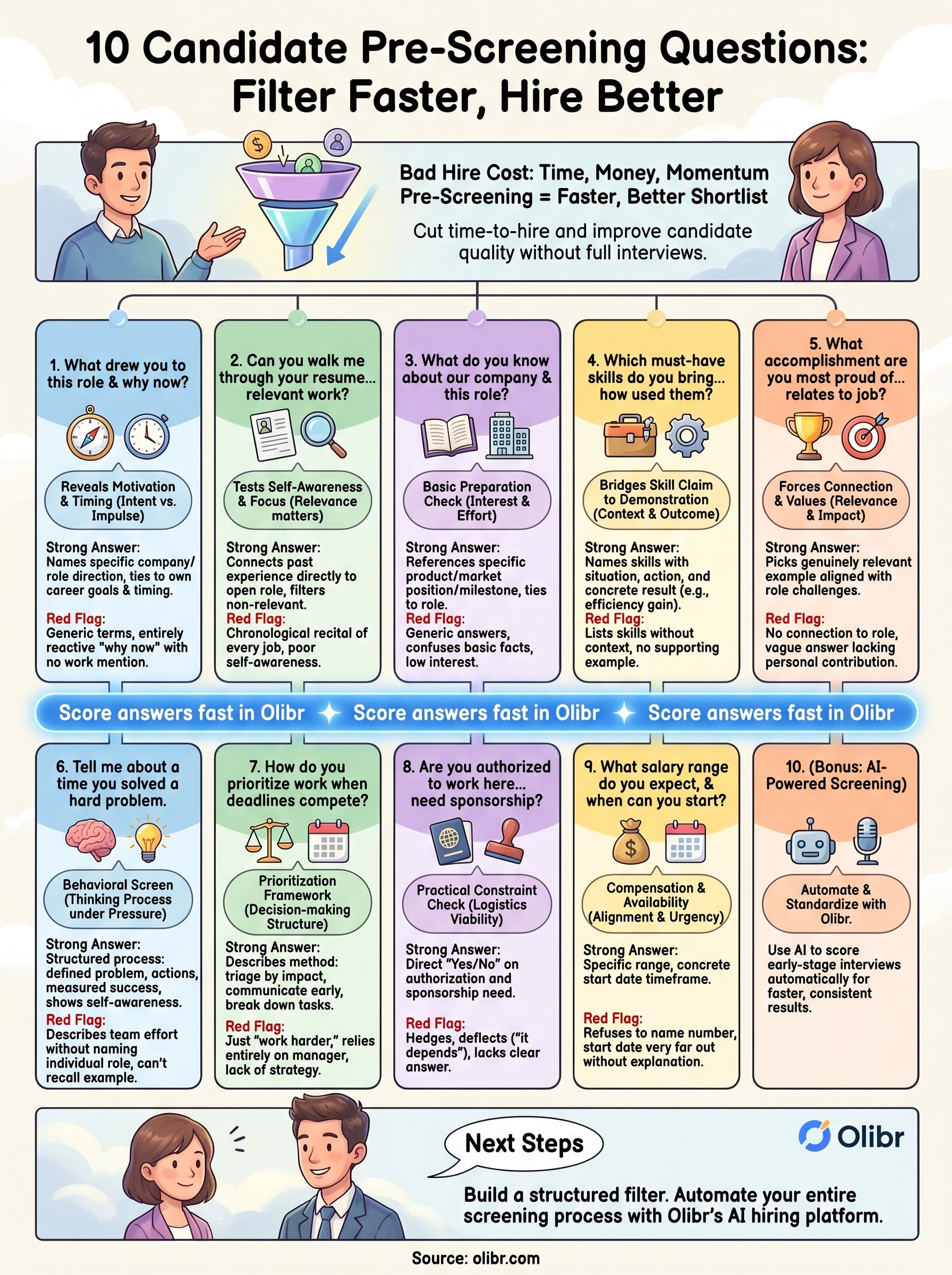
These nine candidate pre screening questions give you a structured filter you can apply consistently across every role you're hiring for. Each question targets a real signal, motivation, preparation, skill depth, problem-solving, or logistics, so you build a shortlist based on actual fit rather than gut instinct and guesswork.
The next step is putting these questions into a repeatable system. Running screens manually works for one or two roles, but it breaks down fast when you're managing multiple open positions at once. Inconsistent screening leads to inconsistent hiring, and that costs you far more than the time you saved by winging it.
Olibr automates your entire screening process, from AI-conducted interviews to automatic scoring against the criteria you set, so every candidate gets evaluated the same way. Start running smarter screens today with Olibr's free AI hiring platform and cut your time-to-hire without adding headcount to your recruiting team.
For hiring teams
Search 180,000+ candidate profiles — free.
Olibr is a community-funded recruiting platform: full ATS, AI interviews, and a shared resume database. No per-seat fees.