How To Measure Candidate Experience: 12 Metrics + KPIs
Most recruiting teams say they care about candidate experience. Far fewer can tell you exactly how theirs performs. That gap between intention and measurement is where top talent quietly slips away. Learning how to measure candidate experience isn't just a nice-to-have, it's the difference between a hiring process that attracts great people and one that drives them straight to competitors.
The challenge? Candidate experience is subjective. It spans every touchpoint from the first job listing to the final offer (or rejection). Without concrete metrics, you're guessing. With the right KPIs, things like candidate Net Promoter Score, offer acceptance rate, and time-to-feedback, you get a clear, data-backed picture of what's working and what's broken. That clarity lets you fix problems before they cost you hires. At Olibr, our AI-powered recruiting platform gives hiring teams built-in tools to track these signals, from automated interview scoring to candidate intelligence dashboards that surface friction points across your pipeline.
This guide breaks down 12 specific metrics and KPIs you can start tracking now. You'll learn what each one measures, how to collect the data, and what benchmarks actually matter, so you can turn candidate experience from a vague goal into a measurable advantage.
What candidate experience covers and why it matters
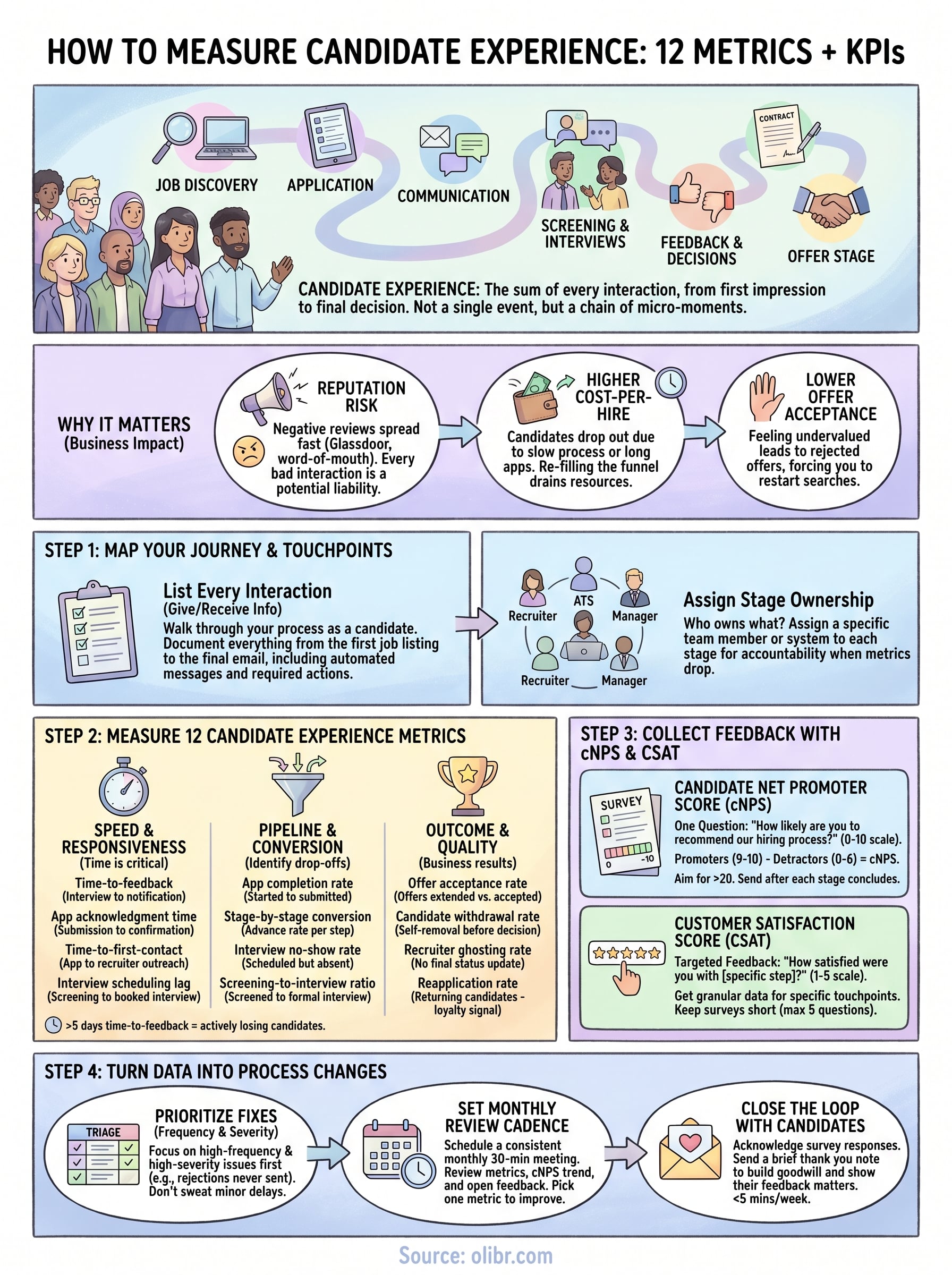
Candidate experience is the sum of every interaction a person has with your organization during the hiring process. It starts the moment someone reads your job posting and ends long after you've made a hire or sent a rejection. Most teams treat it as a single event, like how the interview went, but it's actually a chain of micro-moments that shape how candidates feel about your brand, your team, and your role.
What candidate experience actually includes
The scope is broader than most recruiters expect. A candidate forms an opinion about your organization based on how long your application takes to complete, whether they hear back after applying, how interviewers show up, and how clearly you communicate next steps. Each of these moments carries weight. A smooth application followed by two weeks of silence still leaves a bad impression.
Here's a breakdown of the major touchpoints that make up candidate experience:
- Job discovery: How clear and accurate is your job listing? Does it reflect the actual role?
- Application process: How long does it take? Is it mobile-friendly? Does it require redundant information?
- Communication: Do candidates receive confirmation emails? Are they kept informed of timelines?
- Screening and interviews: Are interviewers prepared? Do they respect candidates' time?
- Feedback and decisions: Do rejected candidates receive a response? Is the timeline reasonable?
- Offer stage: Is the offer process clear, timely, and professional?
Each touchpoint is a data point. When you understand which stages are causing friction, you can fix them systematically rather than guessing.
Why poor candidate experience costs you more than you think
The business case for measuring candidate experience is straightforward: bad experiences have direct financial consequences. According to research, a significant share of candidates who have a poor experience will actively discourage others from applying to your company. In a competitive hiring market, word-of-mouth reaches further and faster than any employer branding campaign you run.
A single frustrated candidate can share their experience with hundreds of people through reviews on platforms like Glassdoor, making every negative interaction a potential hiring liability.
Beyond reputation, poor candidate experience drives up your cost-per-hire. When candidates drop out mid-process because your application is too long or your response times are slow, you spend more resources re-filling the top of your funnel. Offer acceptance rates fall when candidates feel undervalued during the process, forcing you to restart searches that could have closed weeks earlier.
Strong candidate experience, on the other hand, gives you a measurable edge. Candidates who feel respected during the process accept offers at higher rates, refer other strong candidates, and remain engaged customers or brand advocates even if they don't get the role. Learning how to measure candidate experience is how you identify where your process creates that respect and where it erodes it.
Understanding what candidate experience covers gives you a foundation. The next step is mapping your specific journey so you know exactly where your data needs to come from and which moments carry the most weight in your pipeline.
Step 1. Map your candidate journey and touchpoints
Before you can measure anything, you need to know what you're measuring. Most hiring teams have a rough sense of their process, but a rough sense won't give you clean data. Mapping your candidate journey means laying out every interaction a candidate has with your organization, from the first job listing they read to the final communication they receive. This is the foundation for learning how to measure candidate experience with any real precision.
List every touchpoint your candidates encounter
Start by walking through your process as if you were the candidate. Open your job posting, submit a test application, and note every form, automated message, and required action along the way. You are looking for all the moments where a candidate gives or receives information, not just the ones your team considers significant.
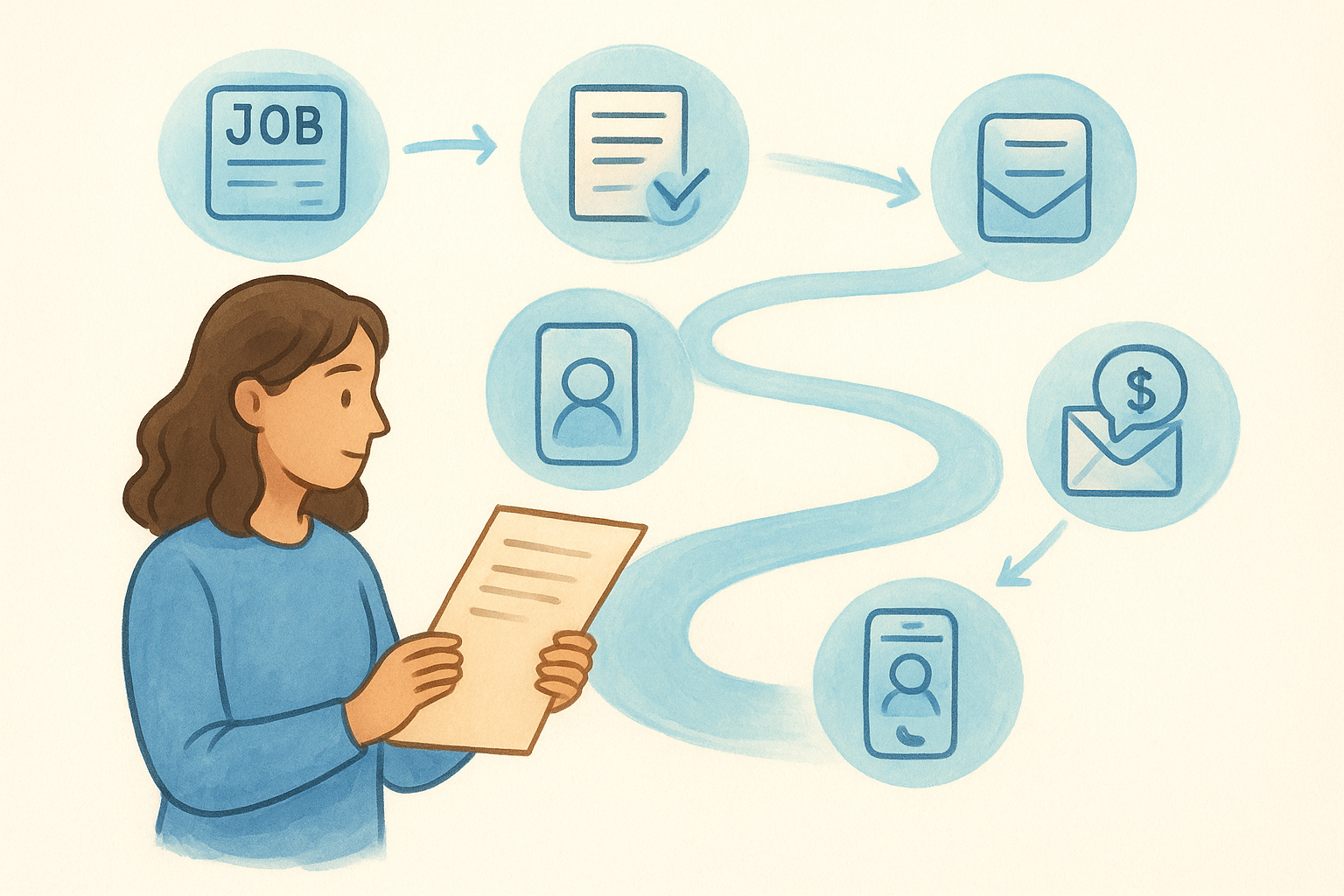
Here are the core touchpoints most pipelines include:
| Stage | Touchpoints to document |
|---|---|
| Discovery | Job board listing, career page, employer branding content |
| Application | Form length, login requirements, mobile experience |
| Screening | Confirmation email, wait time, screening call format |
| Interview | Scheduling process, interviewer preparation, format |
| Decision | Feedback timing, rejection communication, offer delivery |
| Post-hire | Onboarding handoff, first-day communication |
The goal isn't to list every touchpoint you think matters. It's to list every touchpoint a candidate actually encounters, including the ones that feel routine to your team but create real friction for applicants.
Assign ownership to each stage
Once you have your full list, assign a specific team member or system as the owner of each stage. This matters because measurement only works when someone is accountable for acting on the data. Your ATS handles application confirmations, your recruiter owns screening call timing, and your hiring manager controls interview preparation.
Identifying who owns what tells you exactly where to collect feedback and who needs to change behavior when a metric drops. Without clear ownership, the data you gather has nowhere to land and no one to act on it.
Step 2. Measure 12 candidate experience metrics
With your journey mapped, you can start collecting real data on how your process performs at each stage. Understanding how to measure candidate experience comes down to tracking the right numbers consistently, not just the ones that are easy to pull from your ATS. The 12 metrics below give you full coverage across speed, conversion, and satisfaction.
Speed and responsiveness metrics
Candidates form strong opinions about your organization based on how quickly you move. Slow response times are one of the top reasons candidates withdraw or accept competing offers. Track these four metrics to surface lag in your process:
| Metric | What it measures |
|---|---|
| Time-to-feedback | Days between interview and candidate notification |
| Application acknowledgment time | Hours between submission and confirmation email |
| Time-to-first-contact | Days between application and first recruiter outreach |
| Interview scheduling lag | Days between screening completion and interview booked |
If your time-to-feedback exceeds five business days, you are actively losing candidates to faster-moving competitors.
Pipeline and conversion metrics
These four metrics show you where candidates are dropping out and how efficient your funnel is at each stage. Review them weekly to spot sudden drops that signal a broken step.
- Application completion rate: percentage of started applications that are submitted
- Stage-by-stage conversion rate: percentage of candidates who advance from each pipeline step
- Interview no-show rate: percentage of scheduled interviews where the candidate does not appear
- Screening-to-interview ratio: how many screened candidates reach a formal interview
Outcome and quality metrics
The final four metrics tie candidate experience directly to business results. A strong process produces high offer acceptance and low ghosting. A broken one shows up clearly in these numbers:
- Offer acceptance rate: percentage of offers extended that candidates accept
- Candidate withdrawal rate: percentage who remove themselves before a decision is made
- Recruiter ghosting rate: percentage of candidates who never receive a final status update
- Reapplication rate: percentage of past candidates who apply again in a future cycle
Track reapplication rate as a loyalty signal. Candidates who return despite not being hired the first time tell you your process left them with a positive impression worth acting on.
Step 3. Collect feedback with cNPS, CSAT, and surveys
The metrics from Step 2 tell you what is happening in your pipeline. Candidate surveys tell you why it is happening. Combining quantitative data with direct feedback is the core of how to measure candidate experience accurately. Without asking candidates directly, you miss the context behind every drop in your conversion rates and every spike in withdrawals.
Candidate Net Promoter Score (cNPS)
cNPS asks one question: "How likely are you to recommend our hiring process to a friend or colleague?" Candidates respond on a scale of 0 to 10. Scores of 9-10 are Promoters, 7-8 are Passives, and 0-6 are Detractors. Calculate your cNPS by subtracting the percentage of Detractors from the percentage of Promoters.
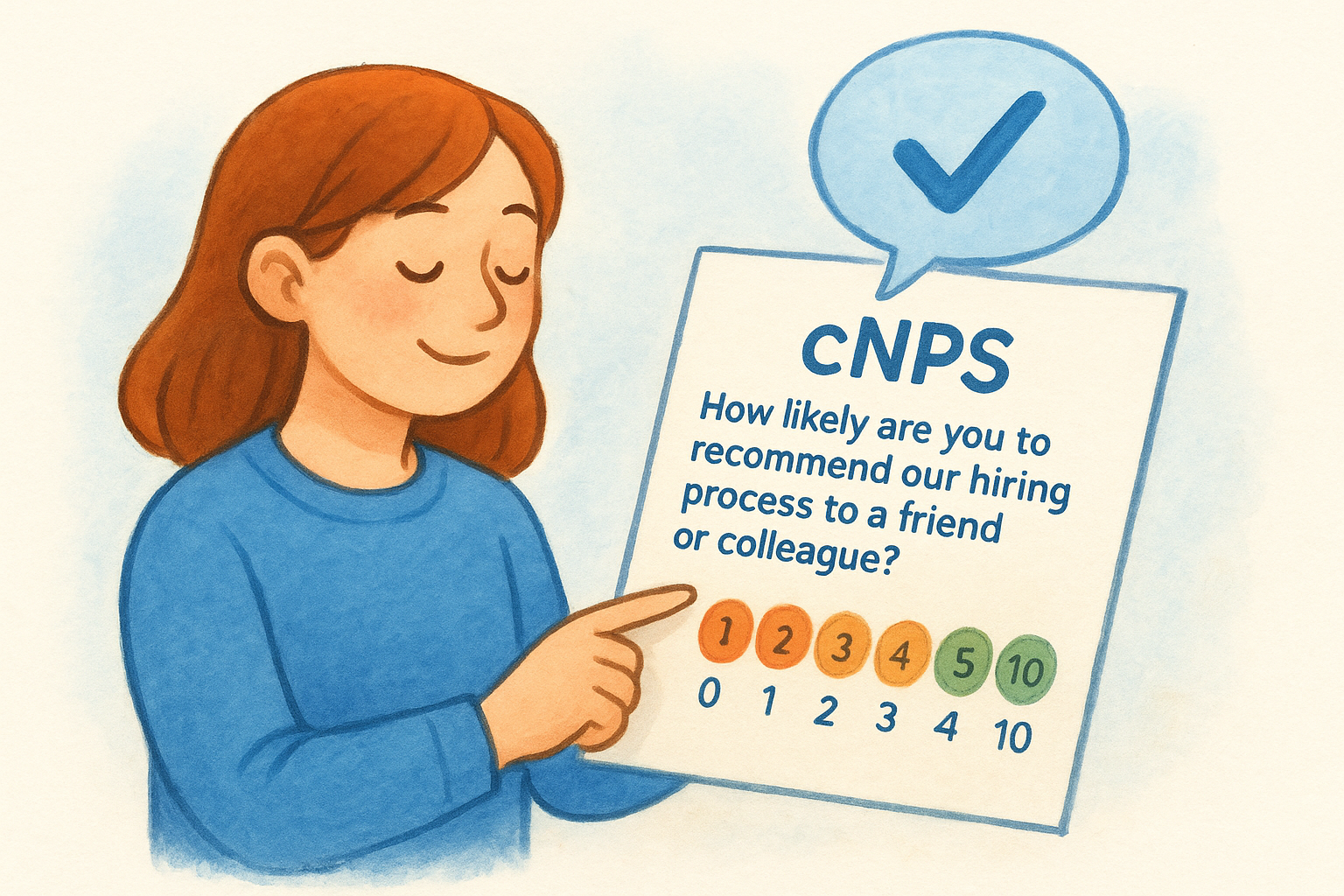
A cNPS above 20 indicates a strong candidate experience; below 0 means more candidates are actively warning others away than recommending you.
Send the cNPS survey immediately after each pipeline stage concludes, not just at the very end of the process. Stage-level cNPS shows you exactly where your score breaks down, rather than giving you one blended number that hides the real problem.
CSAT for specific touchpoints
Customer Satisfaction Score (CSAT) measures how satisfied candidates are with a specific interaction, such as the scheduling process or the interview itself. Ask one targeted question after each touchpoint: "How satisfied were you with [specific step]?" and use a 1-5 scale. This produces granular data tied directly to the stages you mapped in Step 1, so you know which part of the process needs work.
Building a short survey candidates actually complete
Long surveys get abandoned. Keep your follow-up survey to five questions or fewer and send it within 24 hours of the relevant interaction. Here is a template you can adapt:
| Question | Format |
|---|---|
| How likely are you to recommend our hiring process? (0-10) | cNPS scale |
| How satisfied were you with the scheduling experience? (1-5) | CSAT scale |
| Did our job description accurately reflect the role? | Yes / No |
| What one thing would have improved your experience? | Open text |
| Would you apply to our company again in the future? | Yes / No |
Deliver this survey through email or SMS and keep the subject line direct: "Quick question about your interview experience."
Step 4. Turn the data into process changes
Data without action is just overhead. Once you have your cNPS scores, CSAT ratings, and pipeline metrics in place, the real work of how to measure candidate experience shifts from collection to interpretation. You need a repeatable review process for identifying the highest-impact problems and assigning fixes to the people who own each stage.
Prioritize fixes by frequency and severity
Not every metric that drops demands immediate attention. Start by sorting your issues into two categories: high-frequency problems that affect most candidates and high-severity problems that cause candidates to withdraw or reject offers. A 30-second delay in a confirmation email is minor. A 10-day gap between interview and feedback is a pipeline killer.
Use this triage table to categorize what you find:
| Issue | Frequency | Severity | Priority |
|---|---|---|---|
| No acknowledgment email after application | High | Medium | Fix first |
| Interview scheduling takes 5+ days | Medium | High | Fix first |
| Rejection emails never sent | High | High | Fix immediately |
| Career page loads slowly on mobile | Low | Low | Fix later |
Fix high-frequency, high-severity issues before anything else. These are costing you the most candidates and doing the most damage to your employer brand.
Set a monthly review cadence
Your metrics need a consistent review cycle to stay useful. Schedule a monthly 30-minute meeting with your recruiting team to go through your 12 metrics, your cNPS trend, and any open-text survey responses from the past 30 days. This keeps improvements on the agenda rather than buried in a dashboard no one checks.
During each review, pick one metric to improve and set a specific, time-bound target. For example: reduce time-to-feedback from eight days to four days within the next 30 days. Assigning a single owner to that target and checking progress the following month builds accountability without overwhelming your team.
Close the loop with candidates who gave feedback
Candidates who complete your survey took time to help you improve. Sending a brief acknowledgment message builds goodwill and signals that your process changes are real, not performative.
A simple template you can use:
| Element | Example text |
|---|---|
| Subject line | "Thanks for sharing your experience" |
| Body | "Thank you for completing our survey. Your feedback directly shapes how we improve our hiring process, and we appreciate you taking the time." |
| Closing | "We hope to stay in touch and welcome your application again in the future." |
Sending that message to every survey respondent costs your team less than five minutes per week and turns a routine data collection step into a genuine brand-building moment.
Next steps
You now have a complete system for how to measure candidate experience: map your touchpoints, track 12 specific metrics, collect cNPS and CSAT feedback at each stage, and run a monthly review that turns data into fixes. The method works because it ties every improvement to a specific owner and a measurable target, not to a vague commitment to "do better."
Start small. Pick three metrics from Step 2 that you can pull from your existing ATS today. Set your first cNPS survey for the next candidate who completes an interview this week. Add a 30-minute monthly review to your team calendar before you close this tab.
Your hiring process is already generating the signals you need. The gap is in collecting and acting on them consistently. If you want a platform that makes tracking these metrics easier from day one, explore Olibr's free recruiting platform and see how it fits your team's workflow.
For hiring teams
Search 180,000+ candidate profiles — free.
Olibr is a community-funded recruiting platform: full ATS, AI interviews, and a shared resume database. No per-seat fees.