Why Candidate Experience Matters for Faster, Better Hires
Every recruiter remembers a hire that fell apart at the last minute, not because of salary, not because of a better offer, but because the process itself drove the candidate away. Understanding why candidate experience matters is no longer optional if you want to consistently land top talent. A clunky application, radio silence after interviews, or a disorganized screening process doesn't just lose you one person. It damages your employer brand with every candidate who walks away frustrated and tells others about it.
The numbers back this up. Candidates who have a negative hiring experience are far less likely to apply again, refer peers, or even buy from that company as a customer. On the flip side, organizations that invest in a smooth, respectful hiring journey fill roles faster and see higher offer acceptance rates. The ROI is real and measurable, not just a feel-good HR metric.
That's exactly why we built Olibr around removing friction from recruiting. With AI-powered interviews, intelligent candidate matching, and a full ATS that keeps communication flowing, the platform is designed to make hiring feel human again, for recruiters and candidates alike.
This article breaks down what candidate experience actually means in practice, why it directly affects your hiring outcomes, and specific steps you can take to improve it across every stage of your recruitment process.
What candidate experience means in real life
Candidate experience is the sum of everything a person feels, sees, and does from the moment they first encounter your job posting to the moment they accept or decline your offer. It covers every interaction a candidate has with your organization during the hiring process, including how easy your application is to complete, how quickly you respond after interviews, and how clearly you communicate each next step. Most companies think about candidate experience narrowly, as if it only means how the final interview went. In reality, it's the entire arc of the hiring journey, and each stage either builds or erodes a candidate's confidence in your organization.
The touchpoints that define the experience
The candidate journey moves through several distinct stages, and each one carries real weight. When someone first finds your job posting, the clarity of that description shapes whether they trust your company enough to apply. The application process itself is often the first filter candidates use to judge your organization's culture. A form that takes 45 minutes to fill out, or one that forces candidates to re-enter information already on their resume, signals that you don't value their time.
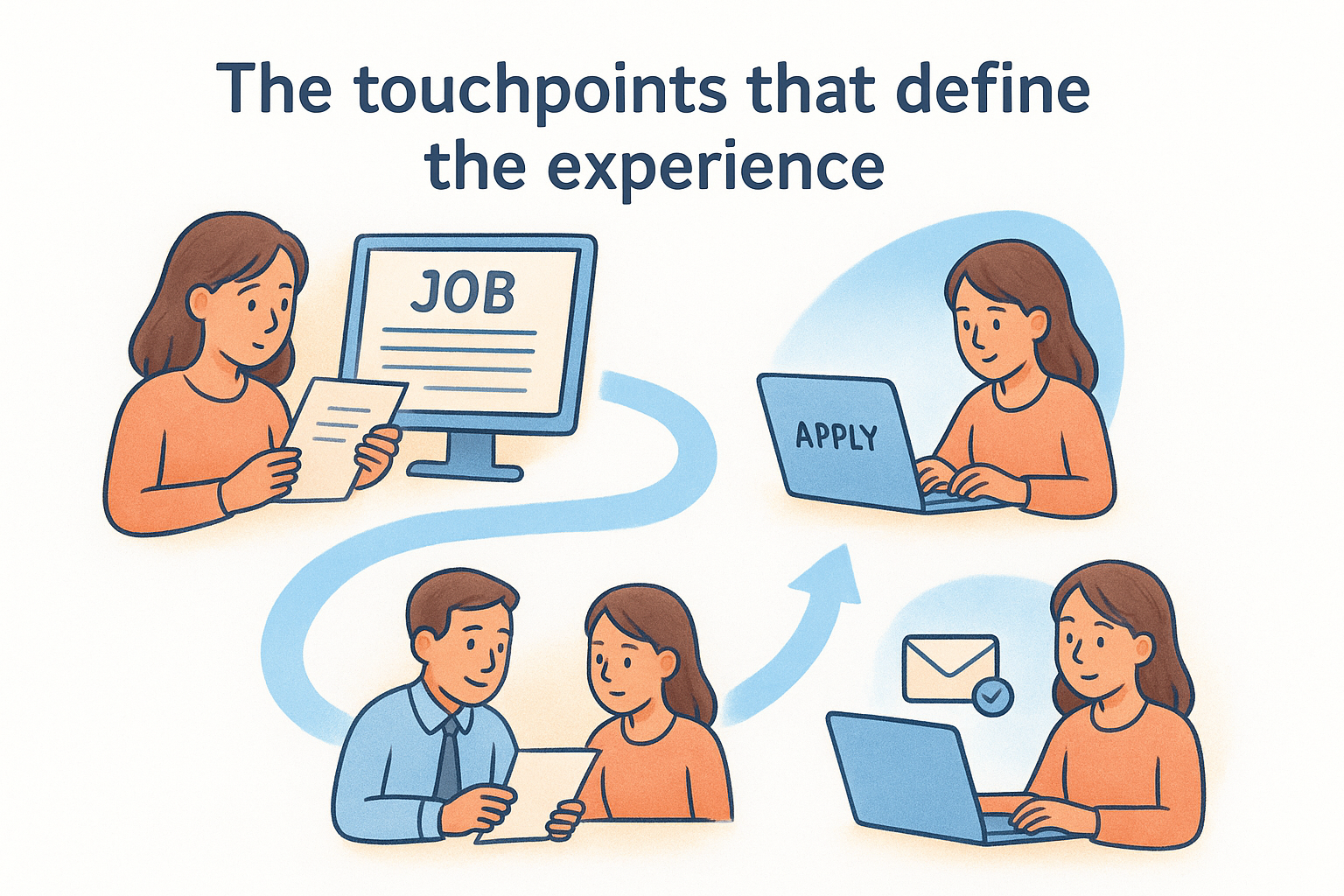
Once candidates submit applications, the wait begins. Silence at this stage is one of the most damaging things a recruiter can allow. Candidates who hear nothing for two weeks often apply elsewhere and mentally disengage from your role entirely. Even an automated acknowledgment that sets clear timeline expectations keeps candidates in the process and maintains goodwill. Small gestures like this cost very little but protect a lot of the trust you worked to build with the job posting.
A candidate sitting in silence for two weeks has already started updating their profile on a competitor's platform.
What the interview stage actually communicates
Interviews are where candidate experience becomes the most visible and personal. The logistics of scheduling tell candidates a lot about how your team operates: if booking a single interview requires five back-and-forth emails, that friction reflects poorly on your process. How interviewers show up matters just as much. Candidates pay close attention to whether interviewers are prepared, whether the questions feel relevant to the actual role, and whether the conversation feels like a genuine two-way exchange or a one-sided interrogation.
After the interview, the follow-up either reinforces a strong impression or damages it. Candidates who receive timely, honest communication, even a rejection with a brief reason, walk away with a better perception of your company than those left completely in the dark. That perception doesn't disappear when the hiring process ends. It follows your employer brand into forums, LinkedIn posts, and word-of-mouth conversations. Understanding why candidate experience matters starts with accepting that every touchpoint reflects how your organization treats people, not just in hiring, but at every level.
Why candidate experience matters for hiring outcomes
The connection between candidate experience and your actual hiring results is direct and measurable. When candidates move through a process that feels organized and respectful, they arrive at the offer stage with higher confidence in your organization. That confidence translates into faster decisions and higher acceptance rates. When the process feels chaotic or dismissive, you lose candidates before they even reach the offer, which forces you to restart searches that cost time and budget.
Offer acceptance rates go up when candidates feel valued
Strong candidate experience compresses your time-to-fill because fewer candidates drop out mid-process. Research from IBM shows that candidates who have a positive experience are 38% more likely to accept a job offer. That single metric should shift how seriously you treat every communication, every scheduling interaction, and every piece of feedback you deliver. You can have the strongest compensation package in your market and still lose candidates to a competitor whose process simply felt more human.
When a candidate has a positive hiring experience, they are significantly more likely to accept your offer, refer others, and speak well of your company publicly.
Your employer brand reaches further than your job postings
Every candidate who goes through your hiring process becomes a carrier of your employer brand, whether you intend that or not. Candidates who feel respected share that experience with their networks. Candidates who feel ignored do the same, usually more loudly. Understanding why candidate experience matters means recognizing that your reputation as an employer is shaped as much by rejected candidates as by current employees.
A recruiter who communicates clearly throughout the process, even when delivering a rejection, builds more goodwill than one who goes silent after a final-round interview. That goodwill feeds future applicant pipelines and reduces your cost-per-hire over time, making candidate experience one of the most financially sound investments a recruiting team can make.
Where candidate experience breaks down most often
Most recruiting teams don't intentionally create a poor process. The breakdowns happen in places that feel routine and low-risk, like application forms, scheduling systems, and post-interview follow-ups. Identifying where your process fails candidates is the first step toward fixing it, and the failure points tend to cluster in the same stages across most organizations.
The application stage creates unnecessary friction
The application form is often where you lose strong candidates before they even enter your pipeline. Long forms that require candidates to manually enter every line of their resume, or systems that time out and delete progress, push qualified people toward employers with simpler processes. Research from the U.S. Bureau of Labor Statistics consistently shows that job seekers apply to multiple roles simultaneously, which means your process competes directly with every other application a candidate fills out that day. If yours takes longer than ten minutes with no clear reason why, many candidates won't finish.
The best candidate in your pipeline may never complete your application if the form treats their time as irrelevant.
Communication gaps damage trust at every stage
Silence after an application, silence after a phone screen, and silence after a final interview are three of the most common complaints candidates raise when describing a poor hiring experience. Each gap signals that your team doesn't consider the candidate's time valuable enough to warrant a brief update. Understanding why candidate experience matters means recognizing that candidates interpret silence as disorganization, not busyness. They don't assume you're overwhelmed. They assume you've moved on and didn't bother to say so.
The interview scheduling process is another consistent failure point. Requiring candidates to email back and forth multiple times to confirm a single time slot adds friction and creates the impression that your internal processes aren't built to respect external stakeholders. Automated scheduling tools and clear communication templates solve this quickly and remove a common source of candidate frustration before it starts.
How to improve candidate experience at every stage
Improving candidate experience doesn't require a complete overhaul of your recruiting process. Most of the gains come from fixing the gaps that already exist in your current workflow, specifically around application design, communication, and interview structure. When you address each stage deliberately, you reduce drop-off, shorten your time-to-hire, and leave candidates with a stronger impression of your organization regardless of the outcome.
Simplify your application and screening process
Your application form should take no more than ten minutes to complete for a standard role. Remove fields that duplicate information already on a resume, cut mandatory free-text questions that don't filter effectively, and make sure your system saves progress automatically. If you use AI-powered tools to parse resumes, you can pre-populate candidate details and reduce the manual effort on both sides. That alone removes one of the most common friction points that sends qualified candidates to a competitor's form instead.
Reducing your application to the essential fields can increase completion rates significantly without sacrificing the quality of your candidate pool.
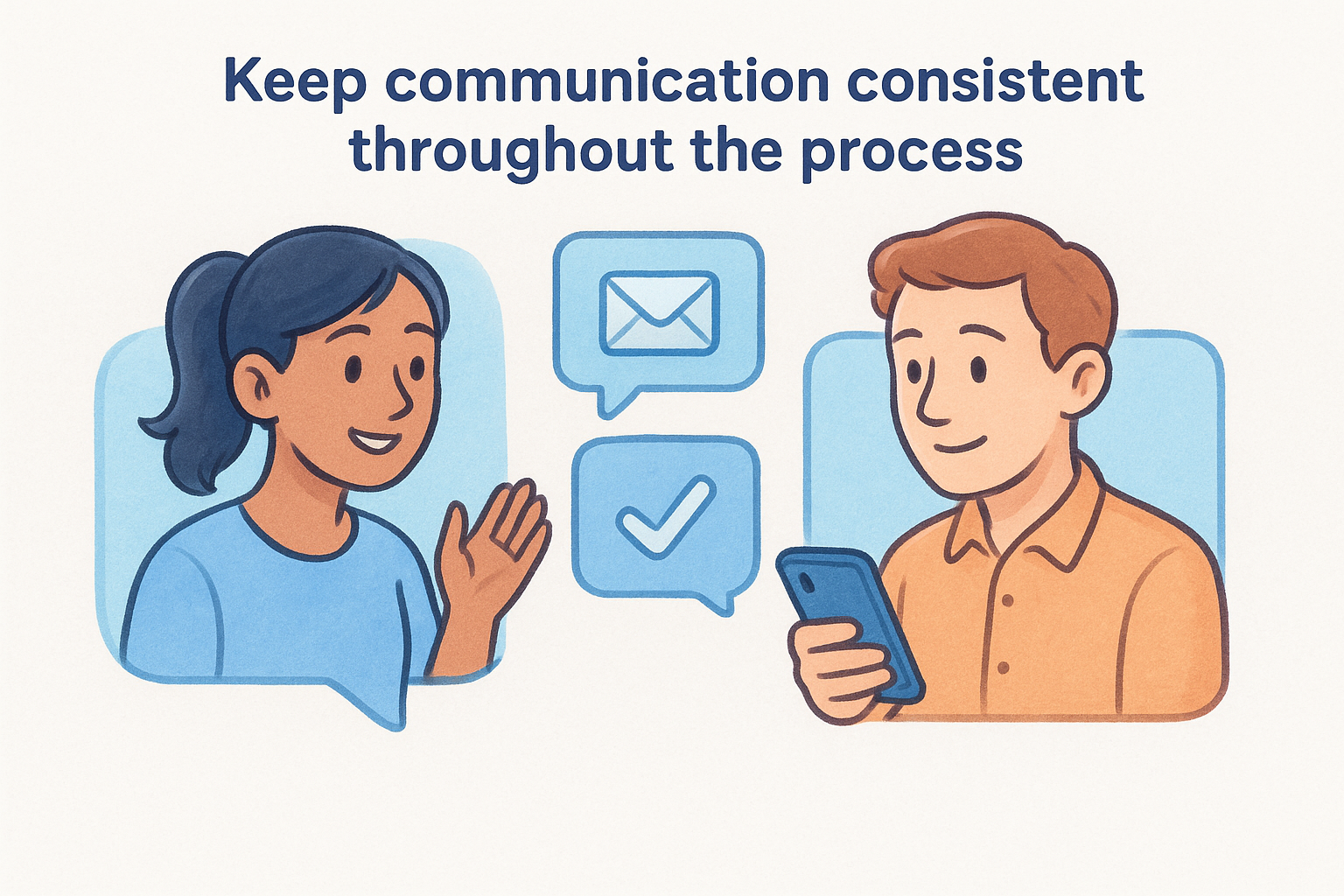
Keep communication consistent throughout the process
Set a clear response timeline at the start of every stage and stick to it. When candidates submit applications, send an automated confirmation that tells them exactly when they can expect to hear back. After interviews, follow up within 48 hours with either next steps or a respectful rejection. You don't need lengthy feedback in every case, but a brief, honest message does more to protect your employer brand than silence ever will.
Standardize your interview scheduling process so candidates can book time without back-and-forth email chains. Prepare your interviewers with consistent question sets and role context before each session, so every candidate receives the same quality of conversation. Understanding why candidate experience matters is easier when you see how these small, repeatable actions build the kind of trust that turns strong candidates into accepted offers.
How to measure candidate experience and ROI
Improving candidate experience requires knowing where you currently stand. Without concrete data, you're making changes based on assumptions rather than evidence, and you risk fixing things that aren't broken while missing the gaps that actually cost you candidates. The measurement approach doesn't need to be complicated, but it does need to be consistent and tied to real hiring outcomes rather than treated as a one-time survey exercise.
Track candidate satisfaction directly
The most direct way to understand how candidates perceive your process is to ask them. Send a short post-process survey to every candidate who reaches the interview stage, whether they received an offer or not. Keep it to three to five focused questions covering communication clarity, scheduling ease, and how respected they felt throughout the process. Response rates stay higher when the survey is brief and arrives within 24 hours of the process ending.
Asking rejected candidates for feedback often surfaces your most honest and actionable data, since they have no incentive to soften their answers.
Connect experience metrics to hiring performance
Candidate satisfaction scores only become meaningful when you link them to outcomes they directly influence. Track your offer acceptance rate alongside satisfaction data to see whether improvements in experience correlate with more candidates saying yes. Monitor your time-to-fill per role and compare it against stages where you've added communication checkpoints or simplified scheduling. These connections show you ROI in concrete terms that go beyond survey percentages.
Understanding why candidate experience matters becomes far easier when you can show leadership that a measurable improvement in satisfaction scores reduced time-to-fill by a week and lifted offer acceptance by a visible margin. Tie those figures to average recruiter hours saved and cost-per-hire reduction, and you build a business case that justifies continued investment in your hiring process rather than treating it as a fixed overhead cost you can't influence.

Next steps
Candidate experience is not a soft metric you can defer until hiring gets harder. Every stage of your hiring process either builds trust with candidates or destroys it, and the cumulative effect shapes how quickly you fill roles and how often candidates accept your offers when you finally extend them.
Start with the friction points that cost you the most: a lengthy application form, slow follow-up after interviews, and scheduling processes that waste everyone's time. Fix those first, then layer in consistent measurement so you can track progress against real outcomes. Understanding why candidate experience matters gives you the foundation, but results come from acting on it every time you open a new role.
Olibr gives your team the tools to eliminate that friction from day one, with AI-powered candidate matching, automated interview scheduling, and a full ATS that keeps communication and pipeline management on track without a subscription fee.
For hiring teams
Search 180,000+ candidate profiles — free.
Olibr is a community-funded recruiting platform: full ATS, AI interviews, and a shared resume database. No per-seat fees.