7 Candidate Experience Survey Template Options + Questions
Most recruiters ask candidates how the interview went. Few actually structure that question well enough to get useful answers. A solid candidate experience survey template gives you a repeatable way to collect honest feedback at every stage of your hiring process, from application to offer (or rejection). Without one, you're guessing at what's working and what's driving qualified candidates away before they even reach your pipeline.
At Olibr, we help recruiters hire faster with AI-powered screening, matching, and interviews, but even the best tools fall flat if your candidate experience has blind spots. Surveys close that gap. They tell you where friction lives and what candidates actually think about your process, not just what your ATS metrics suggest.
This article breaks down seven candidate experience survey templates you can grab and customize right now, along with specific questions mapped to different hiring stages. Whether you need a quick post-interview pulse check or a full end-to-end feedback form, you'll find a starting point below that fits.
1. Olibr
Olibr's built-in feedback tools let you send a candidate experience survey template directly from your ATS at any stage of the hiring process. Because Olibr tracks candidate data, interview scores, and pipeline movement in one place, your survey responses tie directly back to the candidate record, so you get context alongside raw feedback.
What this template helps you measure
This template captures overall process satisfaction, communication clarity, interview fairness, and the candidate's likelihood to reapply or refer others. It gives you a structured read on how your process feels from the candidate's side, not just how it performs on your internal dashboard.
Who it fits best
In-house recruiting teams and agencies using Olibr as their primary ATS will get the most from this template. It works especially well when multiple interviewers are involved, since you can cross-reference candidate feedback against individual interviewer scores already logged in the system.
Copy-paste questions to include
These five questions cover the core feedback areas most recruiters overlook, and you can add or remove items based on role type. Start here and keep your survey under ten questions total to protect your response rate.
- How clearly did we communicate next steps throughout the process?
- How would you rate the professionalism of your interviewers?
- Did the job description accurately reflect what was discussed in interviews?
- How likely are you to recommend our company to another candidate? (0-10)
- What one thing would you change about our hiring process?
Recommended question types and scales
Mix Likert scales (1-5) with NPS-style ratings (0-10) for closed questions, and add one open-ended field per section. Keep closed questions grouped together so candidates can move through the form quickly without switching mental modes between question formats.
Surveys with fewer than ten questions consistently return higher completion rates than longer forms.
When to send it and how to deliver it
Send the survey within 24 hours of the final decision, whether that is an offer or a rejection. Olibr lets you trigger automated survey delivery from pipeline stage changes, so you do not need to remember to send it manually each time.
How to tag, track, and act on feedback in your ATS
Tag responses by hiring stage, role type, and interviewer inside Olibr so you can filter patterns over time. When a trend surfaces, flag the relevant pipeline stage for review and assign a specific team member to investigate before the next hiring cycle opens.
2. Application experience survey template
The application stage is where most candidates drop off without telling you why. This candidate experience survey template targets the very first touchpoint in your process, capturing how candidates felt completing your form and what friction may have stopped others from finishing.
What this template helps you measure
This template identifies problems in your application flow, including form length, confusing instructions, and technical issues. It also tells you whether your job descriptions set accurate expectations before candidates invest time applying.
Who it fits best
High-volume hiring teams posting multiple roles at once will get the most from this template. It is especially useful if you recently changed your application platform or added new screening questions.
Copy-paste questions to include
Use these five questions to gather direct input from every applicant:
- How long did the application take to complete?
- Were the instructions clear throughout?
- Did you encounter any technical issues?
- Did the job description match what the application asked for?
- What, if anything, almost stopped you from finishing?
Recommended question types and scales
Multiple choice and short-answer fields work best here. Avoid rating scales since candidates have limited context to benchmark against at this early stage.
When to send it and how to deliver it
Send this survey immediately after the submission confirmation screen. A short automated email with a single-click link keeps response rates high while the experience is still fresh.
Capturing application feedback in real time gives you data you cannot reverse-engineer from drop-off metrics alone.
How to spot and fix drop-off points
Review completion time data and open-ended answers together to pinpoint friction. If multiple candidates flag the same step, simplify or remove it before your next role opens.
3. Interview scheduling and logistics template
Scheduling friction is one of the most common reasons candidates disengage before a single interview question gets asked. This candidate experience survey template focuses on the coordination layer, covering how easy it was to book time, receive confirmations, and show up prepared.
What this template helps you measure
This template surfaces issues with your scheduling tools, communication gaps, and logistical blind spots like unclear location instructions or missing dial-in details. It tells you whether your coordination process respects candidates' time.
Who it fits best
Companies running multi-round interview processes or hiring across multiple time zones will benefit most here. It is also useful if your team uses several tools to coordinate interviews and hand-offs between schedulers and hiring managers are common.
Copy-paste questions to include
- How easy was it to schedule your interview?
- Did you receive a confirmation with all necessary details?
- Were there any delays or last-minute changes?
- Did you feel well-informed about the format before your interview began?
- What would have made scheduling easier for you?
Recommended question types and scales
Use yes/no questions paired with one open-ended follow-up for each area. This keeps the form short while giving candidates room to explain what went wrong.
When to send it and how to deliver it
Send this survey within two hours of the interview ending, while logistics details are still clear in the candidate's memory. A short SMS or email link works better than an embedded form here.
Candidates who struggle to schedule interviews are less likely to show up engaged, even if they do show up at all.
How to reduce delays and no-shows
Review responses weekly and look for recurring patterns around specific interviewers or time slots. If candidates consistently flag last-minute changes, audit your internal calendar management process and assign a single point of contact for each interview round.
4. Interview quality and fairness template
Candidates form strong opinions about your company based on how your interviewers behave, not just what they ask. This candidate experience survey template focuses on the quality and consistency of your interviews, giving you data to improve how your team shows up in the room.
What this template helps you measure
This template captures whether interviewers arrived prepared, asked relevant questions, and treated candidates respectfully. It also surfaces bias concerns before they become legal or reputational problems.
Who it fits best
Hiring teams with multiple interviewers across different departments benefit most here. It is especially valuable if you have senior leaders conducting interviews without formal training on structured questioning techniques.
Copy-paste questions to include
- Did your interviewer appear familiar with your background before the conversation started?
- Were the questions relevant to the role you applied for?
- Did you feel you had a fair opportunity to demonstrate your skills?
- How would you rate the professionalism of your interviewer?
- Was there anything about the interview that felt unclear or uncomfortable?
Recommended question types and scales
Use a 1-5 Likert scale for professionalism and fairness questions, then close with one open-ended field. Short scales reduce cognitive load and produce more consistent, comparable data across candidates.
Candidates who feel heard during interviews are significantly more likely to accept offers, even after tough rounds.
When to send it and how to deliver it
Send this survey within four hours of the interview ending. Email delivery with a direct link works well since candidates are often near their inbox immediately after a session.
How to turn feedback into interviewer coaching
Review flagged responses monthly and share anonymized feedback directly with each interviewer involved. Pair low scores with specific questions to give interviewers concrete areas to improve rather than vague critiques they cannot act on.
5. Rejected after interview template
Rejection is the moment when candidate experience either holds or breaks. How you handle this stage determines whether rejected candidates leave with goodwill or write a negative review. This candidate experience survey template captures honest feedback from candidates who made it through at least one interview round before receiving a no.
What this template helps you measure
This template tells you whether your rejection communication felt respectful and timely, and whether candidates understood enough about the process to leave with a positive impression of your company.
Who it fits best
Any team that interviews a high volume of candidates and advances multiple finalists per role will benefit most here. It is also useful if your brand relies on referrals, since rejected candidates talk.
Copy-paste questions to include
- Did you receive a timely response after your final interview?
- Did the rejection feel respectful and clear?
- How likely are you to apply to our company again in the future? (0-10)
- Would you recommend our hiring process to someone else?
- Is there anything we could have communicated better?
Recommended question types and scales
Use an NPS-style scale (0-10) for the reapplication question and yes/no options for communication questions. One short open-ended field at the end is enough.
When to send it and how to deliver it
Send this survey within 48 hours of the rejection notice, not before. Candidates need a small buffer before they respond honestly.
Candidates who receive respectful rejections are far more likely to reapply or refer others than those who receive no follow-up at all.
How to protect your employer brand without over-explaining
Keep your rejection survey short and neutral in tone. Avoid survey language that sounds defensive or like you are justifying the decision. Your goal is to listen, not to explain yourself. When responses flag cold or abrupt messaging, revise your rejection email template before the next round opens.
6. Offer and decision experience template
The offer stage is where your process should feel like a win, but many candidates reach it with unresolved doubts about timeline, compensation clarity, and how the decision was communicated. This candidate experience survey template focuses on that final stretch, helping you understand whether your offer process gave candidates the information and confidence they needed to say yes.
What this template helps you measure
This template captures how candidates experienced the offer delivery, negotiation process, and overall decision timeline. It tells you whether your team communicated compensation and role details clearly enough for candidates to make an informed choice.
Who it fits best
Teams with long offer cycles or frequent offer declines will benefit most from this template. It is also useful if you regularly hire for senior roles where candidates are weighing multiple offers simultaneously.
Copy-paste questions to include
- Was the offer presented clearly and in full detail?
- Did you feel you had enough time to consider the offer?
- How satisfied were you with how compensation was communicated?
- Was there anything about the offer process that felt rushed or unclear?
- How likely are you to recommend our company based on this experience? (0-10)
Recommended question types and scales
Use a 1-5 satisfaction scale for process questions and a single NPS question at the end. Keep the form to five questions maximum.
When to send it and how to deliver it
Send this survey within 24 hours of the candidate accepting or declining. Email delivery works well at this stage since the conversation is already happening there.
Candidates who decline offers but had a strong offer experience are more likely to refer qualified peers your way.
How to improve acceptance rate and speed
Review open-ended responses for patterns around unclear compensation details or pressure to decide quickly. When those themes repeat, shorten your offer window, simplify your compensation breakdown, and brief your hiring managers on how to present offers with fewer ambiguities.
7. New hire recruiting handoff template
Most recruiting teams celebrate when a candidate accepts the offer and then move on. That gap between offer accepted and day one is where valuable feedback gets lost. This candidate experience survey template captures how the new hire experienced the full recruiting cycle before their first day shapes it in memory.
What this template helps you measure
This template reveals whether your recruiting process set accurate expectations about the role, the team, and the culture. It also tells you whether the transition from recruiter to hiring manager felt smooth or left the new hire with unanswered questions.
Who it fits best
Teams with a clear hand-off between recruiting and HR onboarding benefit most here. It is particularly useful when recruiters and hiring managers operate in separate systems and communication gaps are common.
Copy-paste questions to include
- Did what we described during recruiting match your experience so far?
- How prepared did you feel on your first day?
- Was the hand-off from your recruiter to your manager clear and organized?
- What could we have communicated better during the hiring process?
- Would you recommend our company to someone in your network?
Recommended question types and scales
Use a 1-5 satisfaction scale for process questions and one open-ended field at the end for specific suggestions.
When to send it and how to deliver it
Send this survey during the first two weeks on the job, after the new hire has enough context to compare expectations with reality.
New hires who feel the recruiting process was honest are significantly more likely to stay past the 90-day mark.
How to close the loop between recruiting and onboarding
Share responses with both your recruiter and the hiring manager so both sides understand where expectations broke down. When multiple new hires flag the same gap, update your role briefing materials before the next search opens.
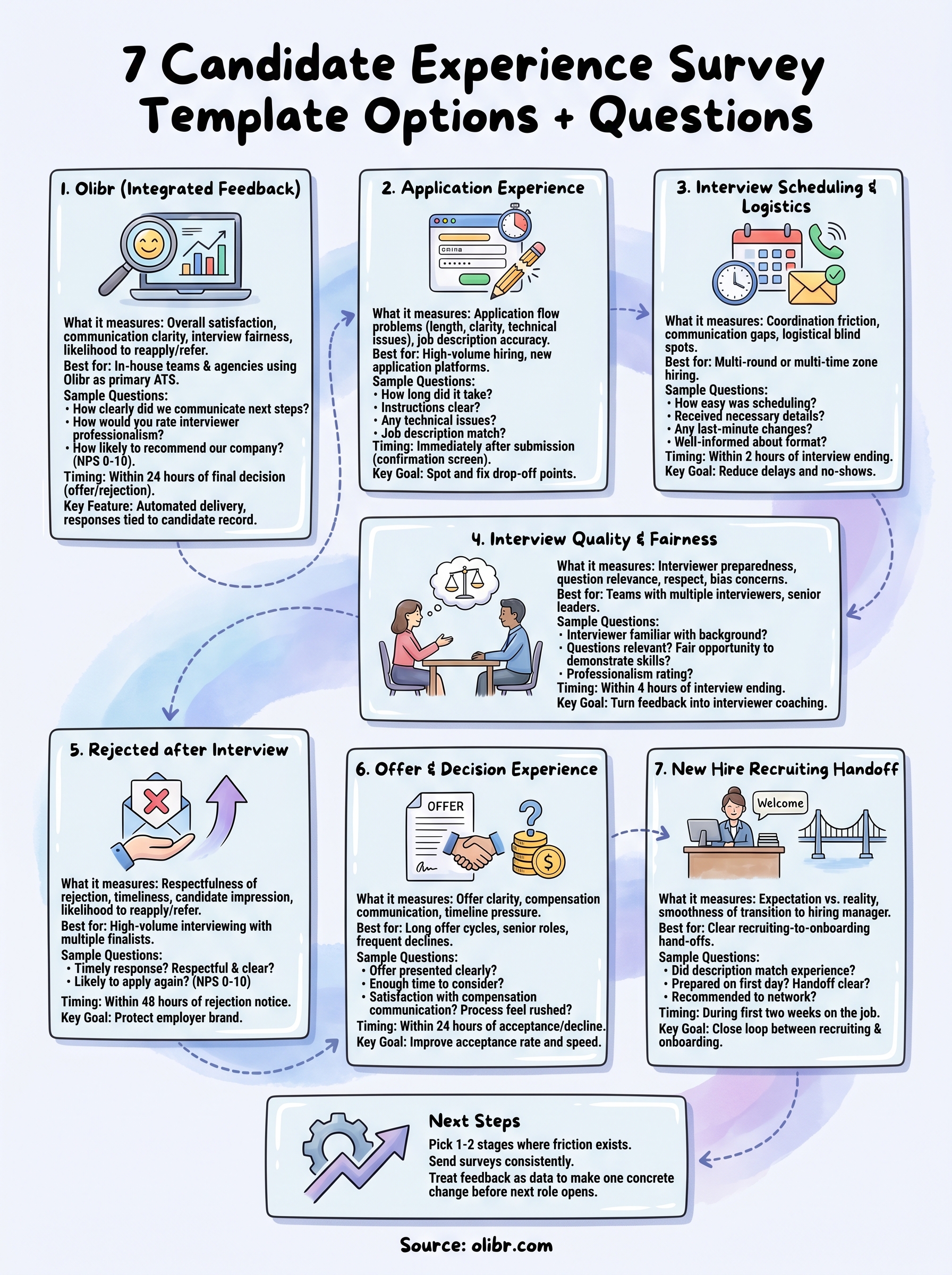
Next steps
You now have seven ways to collect structured feedback at every stage of your hiring process. The goal is not to run all seven at once. Pick the one or two stages where you already know friction exists, build the habit of sending surveys consistently, and use what you learn to make one concrete change before your next role opens. A single well-timed candidate experience survey template beats a complicated feedback system you never actually send.
Your recruiting process is always a work in progress, and the candidates moving through it are your best source of signal. Treat their feedback as data, not just sentiment, and you will make faster decisions about what to fix and what to keep.
If you want a platform that helps you track candidate feedback alongside interview scores and pipeline data in one place, start hiring for free on Olibr and see how it connects your feedback loop to your full recruiting workflow.
For hiring teams
Search 180,000+ candidate profiles — free.
Olibr is a community-funded recruiting platform: full ATS, AI interviews, and a shared resume database. No per-seat fees.