What Is Candidate Experience? Definition + Best Practices
Every interaction a job seeker has with your company, from the moment they spot your listing to the day they accept (or decline) your offer, shapes how they perceive you as an employer. That full arc of interactions is what is candidate experience, and it directly affects whether top talent says yes or ghosts you mid-process. For recruiters spending hours sourcing, screening, and interviewing, a poor experience doesn't just lose one hire, it damages your reputation with every person that candidate talks to.
The stakes are real. Candidates who feel ignored, confused, or disrespected during hiring share those stories publicly. They leave reviews. They warn their networks. On the flip side, a strong candidate experience builds your employer brand organically, turning even rejected applicants into advocates. That's why platforms like Olibr build AI-powered interviews, automated screening, and transparent pipeline management directly into the recruiting workflow, to remove the friction that creates bad experiences in the first place.
This article breaks down the full definition of candidate experience, explains why it matters more than most recruiters realize, and walks through practical best practices you can implement at every stage of your hiring process. Whether you're an in-house recruiter or running a staffing agency, you'll walk away with a clear framework for making your process one candidates actually respect.
What candidate experience includes
When you ask what is candidate experience, the answer spans far more touchpoints than most recruiters account for. It is not just the interview itself. Every step, from a job posting to a rejection email, contributes to how a candidate feels about your company. Missing even one of those touchpoints can unravel an otherwise solid process.
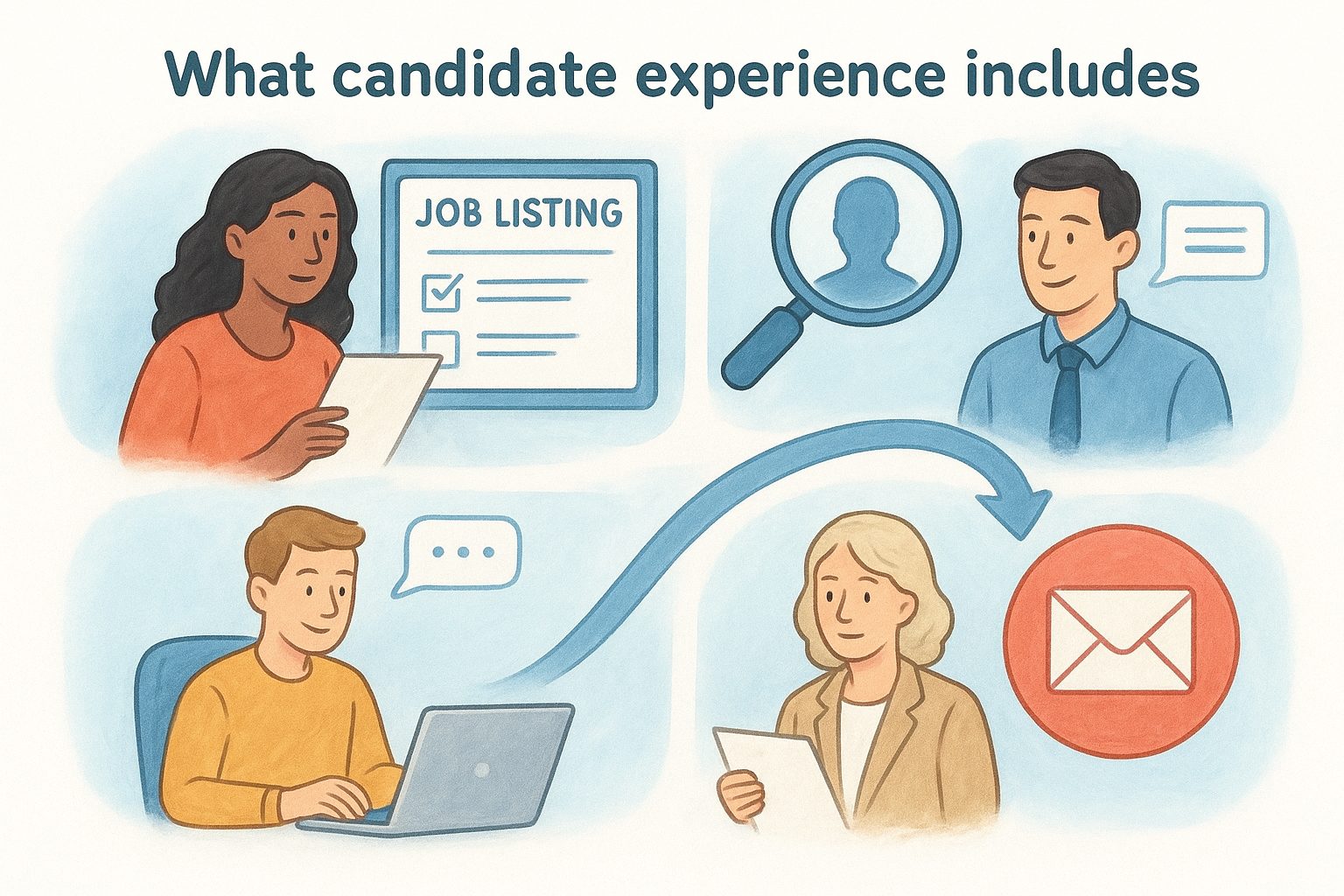
Candidate experience is not a single moment. It is the sum of every interaction across the entire hiring journey.
The pre-application stage
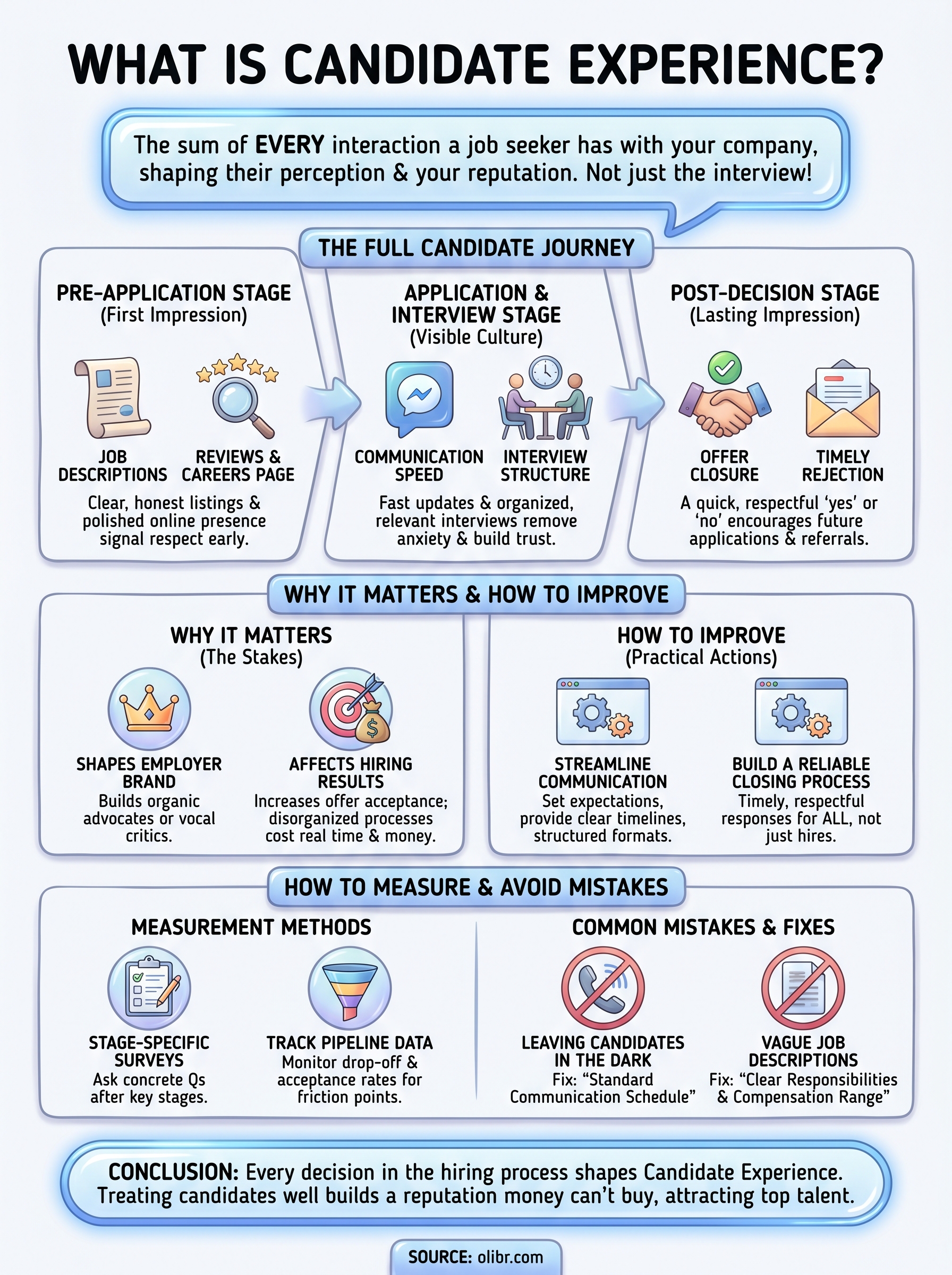
Your candidate experience starts before anyone submits a resume. How your job description reads, how easy your careers page is to navigate, and how your company appears on review sites all shape a candidate's first impression. If your listing is vague, your application portal crashes on mobile, or your company page looks neglected, candidates draw conclusions immediately. A clear, honest job description with defined requirements and compensation signals respect for the applicant's time right from the start.
Candidates also check employer reviews and your company's presence online before they apply. What they find there either builds confidence or raises doubts. Your employer brand, which you largely control through communication and transparency, sets the tone before any formal contact happens.
The application and interview stage
Once a candidate enters your pipeline, the speed and clarity of your communication become the most visible indicator of your company culture. Acknowledging applications, setting clear timelines, and explaining each step removes the anxiety that makes candidates drop out or lose interest. Every unreturned email and every unexplained delay chips away at their confidence in you.
The interview itself carries the most weight in shaping overall perception. Whether you run a structured interview, a panel format, or an AI-powered screening, candidates pay close attention to how prepared your team appears, whether questions feel relevant, and whether the conversation feels two-sided. Disorganized interviews or repetitive questions send a clear signal that your process needs work.
The post-decision stage
The experience does not end when you make a hiring decision. How you deliver rejections and how quickly you close the loop matter just as much as anything that came before. A brief, respectful rejection note leaves candidates with a positive impression of your brand. Silence, on the other hand, is one of the most common complaints candidates raise publicly.
Candidates who receive timely, honest closure are far more likely to reapply in the future, refer others, and speak positively about your company to their networks.
Why candidate experience matters
Understanding what is candidate experience helps you see why it deserves serious attention in your recruiting process. Every candidate who moves through your hiring pipeline forms a concrete opinion about your company, and that opinion rarely stays private. With review platforms giving candidates a public stage, a single poor experience can reach dozens of future applicants before you even open your next role.
The way you treat candidates during hiring signals to everyone how you treat employees after.
It shapes your employer brand
Your employer brand is built by every interaction a candidate has with your team, not by job ads alone. Candidates who feel respected and kept informed share that experience with their networks. Ones who feel ignored or dismissed share that experience too, often more loudly and to a wider audience. Even rejected applicants carry an impression of your company, and how you close that loop determines whether they leave as quiet supporters or vocal critics.
It directly affects your hiring results
A strong candidate experience increases the likelihood that top candidates actually accept your offer. When someone moves through a well-organized, communicative process, they arrive at the offer stage already feeling confident about joining your team. Long silences, disorganized interviews, and unclear next steps, on the other hand, create doubt that is hard to reverse. Losing a qualified hire at the offer stage because your process felt chaotic costs you real time and money. Treating every stage of the process with the same care you apply to sourcing dramatically reduces that risk.
How to improve candidate experience
Knowing what is candidate experience sets the foundation. Acting on it is where recruiting teams actually make a difference. You do not need to rebuild your entire hiring process to see improvement. Targeting the touchpoints that frustrate candidates most produces fast, visible results.
The fastest gains come from fixing what candidates complain about most: silence and confusion.
Streamline communication at every stage
Set clear expectations from the moment a candidate applies, starting with an acknowledgment email within 24 hours. Candidates who know what to expect next are far less likely to drop out or accept competing offers while waiting on you. A brief timeline update before each interview stage signals that you respect their time and keeps your pipeline from losing qualified people unnecessarily.
Your interview format matters as much as your timing. Train every interviewer to arrive prepared, ask role-relevant questions, and leave room for candidate questions at the end. A structured, consistent interview reduces confusion and gives candidates the clarity they need to stay engaged through your process.
Build a reliable closing process
Every candidate who moves through your pipeline deserves a clear response, whether they move forward or not. A short, respectful rejection note sent within a defined window after your decision leaves a far better impression than silence. Candidates who receive timely closure are more likely to reapply, refer others, and speak positively about your company to their networks.
Speed matters here. The longer you wait to communicate a decision, the more candidates conclude your process lacks organization. Build a standard rejection template your team can send quickly, and make closing the loop a defined step in your recruiting workflow, not an optional follow-up.
How to measure candidate experience
Knowing what is candidate experience is only useful if you can track whether yours is actually working. Measurement turns vague impressions into specific data you can act on, and it tells you exactly which stages in your process need attention rather than forcing you to guess.
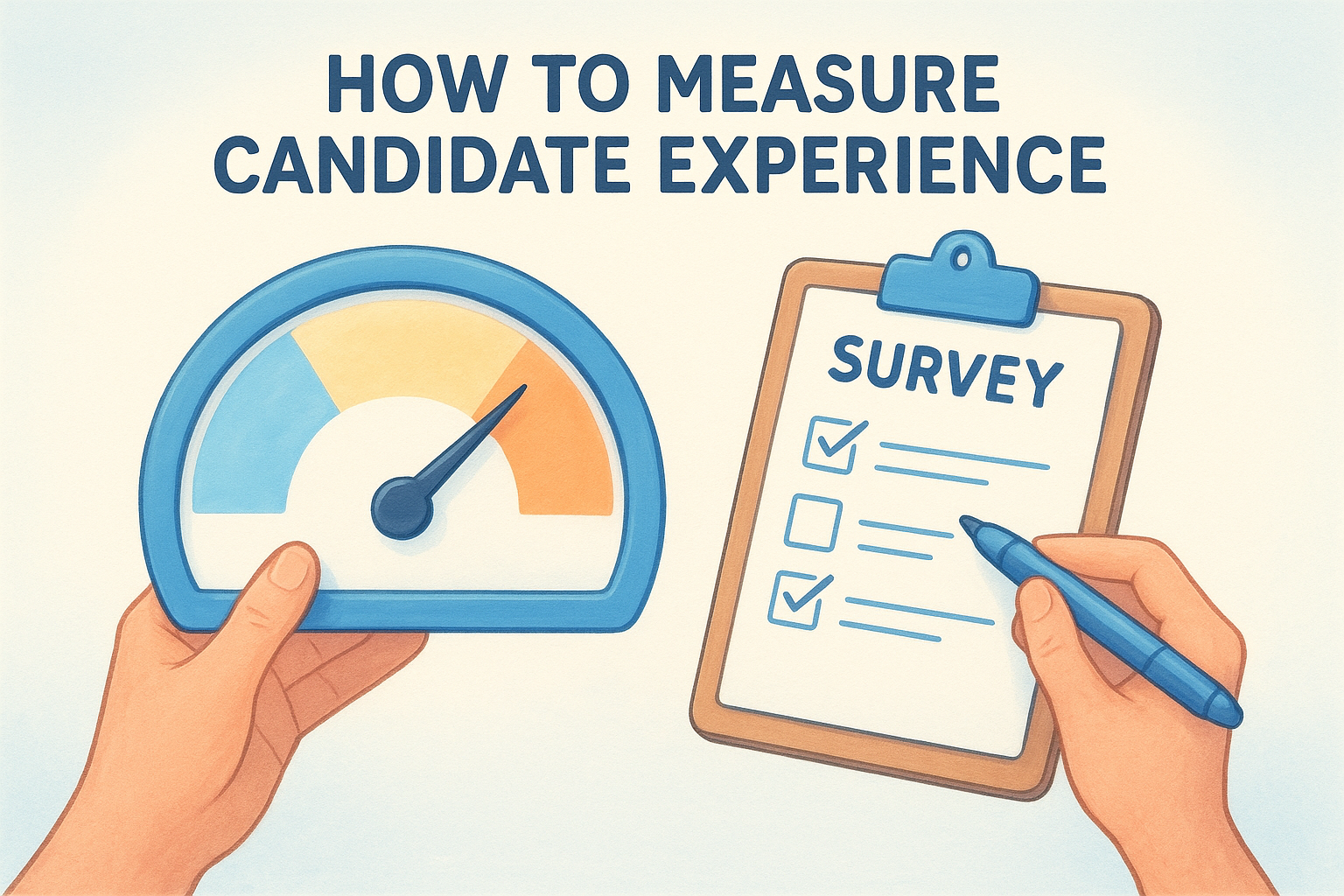
Send surveys after each hiring stage
Candidate surveys are the most direct way to collect feedback on how your process feels from the outside. Send a short, three-to-five question survey after key milestones, such as the first interview and the final decision, rather than only at the very end. Shorter surveys get higher response rates, and stage-specific questions surface problems at the exact point where they occur instead of blending them together.
Asking candidates for feedback signals that you take the experience seriously, which itself improves perception.
Ask questions that focus on specific behaviors: Did you receive timely updates? Did the interviewer seem prepared? Candidates give more useful answers when questions are concrete rather than broad.
Track drop-off and offer acceptance rates
Your pipeline data tells a story that surveys alone cannot. If candidates consistently drop out after the second interview round, something about that stage is creating friction. If your offer acceptance rate is declining, candidates may be arriving at the finish line with doubts your process created.
Review these metrics on a monthly basis alongside your survey results to build a complete picture. Pairing quantitative drop-off data with direct candidate feedback helps you prioritize fixes by their actual impact, so you spend time solving the problems that cost you the most qualified hires.
Common mistakes and quick fixes
Even recruiters who understand what is candidate experience still fall into patterns that quietly damage their process. The most damaging mistakes are often the most avoidable, and most have a direct fix that takes less than a day to implement.
Leaving candidates in the dark
Silence is the single most common complaint candidates raise about hiring processes. After an interview, candidates want to know what happens next and when. Leaving them without a timeline, or missing the one you gave, signals disorganization and erodes trust fast.
A two-sentence status update sent on time does more for your employer brand than a polished careers page.
Fix this by building a standard communication schedule into your workflow. Decide in advance when each update goes out, assign ownership to a specific team member, and treat that schedule as a non-negotiable step in your process, not a courtesy.
Writing job descriptions that waste everyone's time
Vague listings attract unqualified applicants and push qualified ones away. When candidates cannot tell what the role actually requires, what the team looks like, or what the compensation range is, they either skip your posting or enter your pipeline underprepared.
Fix this by reviewing every active job listing for three things: a clear summary of day-to-day responsibilities, defined experience requirements with no inflated wish lists, and a stated or estimated compensation range. This single change reduces the volume of mismatched applications and gives serious candidates the information they need to self-select accurately before they apply, which shortens your screening time and improves the quality of your pipeline from the first step.
Conclusion
Candidate experience is not a buzzword, it is the practical result of every decision your team makes during the hiring process. Once you understand what is candidate experience and where it breaks down, the path forward becomes clear: communicate early, close the loop on every decision, and treat each candidate as a person whose time and attention matter.
The recruiters who get this right build something money cannot buy, a reputation that brings qualified candidates to them rather than away from them. You do not need to overhaul everything at once. Fix the silence, sharpen your job descriptions, and start tracking the data your pipeline already generates.
If you want a recruiting process that makes all of this easier, explore Olibr's free hiring platform. AI-powered interviews, automated candidate matching, and a full ATS give your team the tools to run a faster, more transparent process without paying the fees that competing platforms charge.
For hiring teams
Search 180,000+ candidate profiles — free.
Olibr is a community-funded recruiting platform: full ATS, AI interviews, and a shared resume database. No per-seat fees.