11 Best Free Recruiting Software Options in 2026
If you're hiring on a shoestring budget, you've probably typed free recruiting software into Google more than once, hoping to find a tool that doesn't quietly turn into a paid plan after 14 days. Most "free" tiers cap you at three job posts, hide the candidate database behind a paywall, or charge per seat the moment you add a second recruiter. That gets frustrating fast when you're a small agency or a lean in-house team trying to keep cost per hire down.
This list answers the question directly: which tools actually let you post jobs, track candidates, and manage your pipeline without a credit card. We've included options ranging from lightweight applicant trackers to full recruitment CRM software with built-in sourcing, and we've flagged which ones work well as free recruiting software for small business teams versus larger staffing operations.
You'll find 11 platforms here, including Olibr, which skips subscription fees entirely by letting recruiters trade dormant candidate profiles for access to a shared pool of 180,000+ verified candidates plus a full ATS. Whether you need a free hiring software for one-off postings or a long-term candidate database to replace your paid stack, you'll know exactly which option fits by the end of this article.
1. Olibr: turn dormant ATS data into free hiring power
Olibr flips the usual free-tier model on its head. Instead of capping features until you upgrade, it asks recruiters to contribute the candidate profiles already sitting dead in their ATS, the ones sourced months ago and never touched again, in exchange for full access to a shared network and a complete hiring platform. Founded in 2021, Olibr built this exchange specifically for recruiters in India and the US who are tired of paying for candidate database software they barely use.
How it works
Signing up starts with a bulk profile upload, where you can parse resumes from PDF, DOCX, or CSV files pulled straight from your existing ATS export. Contributing candidate profiles from your own database keeps your access free: 50 profiles per active user every 30 days. From there, AI matching ranks candidates against your job description based on actual skill and experience fit, not just keyword overlap, and you can use the AI interview suite to run video interviews with expression analysis and scored transcripts when you need to screen at volume.
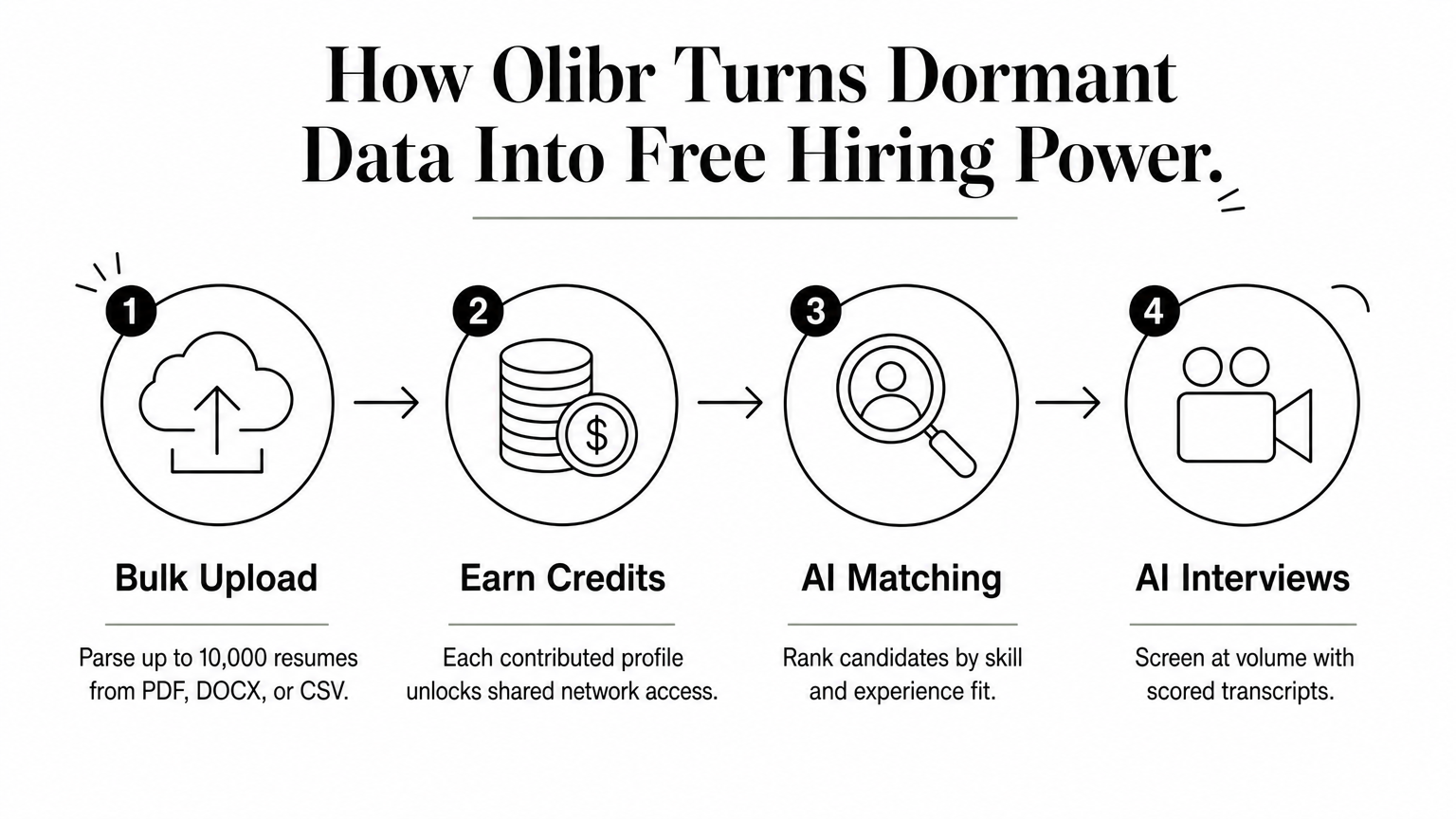
The more dormant data you contribute, the more active hiring power you unlock, without ever entering a credit card.
Who it's for
This setup suits recruiters and staffing agencies who already have years of sourcing history clogging up their database and would rather trade that dead weight for a bigger, live pool. It also works well for in-house talent acquisition teams juggling multiple open roles who want a single free ATS instead of stitching together separate tools for sourcing, tracking, and interviewing, and it holds up well against other no-cost ATS picks for Indian startups.
What's free
The core platform costs nothing to use. You get:
- A full ATS with pipeline stages, kanban boards, notes, and team collaboration
- Unlimited job postings on an integrated job board
- Unlimited team seats with role-based permissions
- AI matching and AI video interview scoring
- Access to the shared candidate network, where you can search verified profiles by skill, experience, and location, scaled to how much you contribute
Pricing beyond the free plan
Most recruiters never need to pay, since contributing 50 profiles per active user every 30 days keeps access free. The ATS, CRM, job posting, candidate database and candidate search are all free to use.
2. Zoho Recruit: an all-in-one free ATS for global teams
Zoho Recruit has been around long enough to become a default answer whenever someone asks for recruiting software free of per-seat traps. It's built by Zoho, the same company behind dozens of business apps, so it plugs into a wider suite if you ever need CRM or HR tools down the line. The free plan isn't a stripped-down demo either, it's a genuinely usable ATS for small teams running a handful of open roles at once.
How it works
Zoho Recruit lets you post jobs, collect applications, and move candidates through a customizable pipeline, all from one dashboard. Resume parsing pulls structured data from uploaded files automatically, and you can tag, rate, and search candidates using boolean-style filters once your database grows.
A free ATS only earns its keep if it scales with your hiring, and Zoho Recruit does that without forcing an upgrade at month two.
Who it's for
Small staffing agencies and in-house recruiters with straightforward hiring needs get the most out of this plan. Teams that need deep automation or heavy customization will eventually outgrow it, but for a first ATS, it's a solid starting point, and worth weighing against other applicant tracking systems that stay free.
What's free
The free tier covers:
- Up to 1 active job posting and 1 user
- Resume parsing and candidate tagging
- Basic reporting and email templates
- Career site integration
Pricing beyond the free plan
Once you need more than one job open or more than one recruiter logged in, paid plans start around $30 per user per month, scaling up with automation and analytics features. Compare that against Zoho's own pricing page before committing, since the jump from free to paid happens quickly.
3. Loxo: a free ATS backed by an 800M-profile database
Loxo built its reputation on sourcing power before it ever touched recruiting workflows, and that history shows in what its free plan actually gives you. Instead of gating candidate search behind a paywall, Loxo lets free users tap into a database of over 800 million profiles, pulled from public web sources and enriched with contact details. That's a rare feature to find in any best free recruiting software comparison, since most competitors charge separately for sourcing access.

How it works
Recruiters search Loxo's database using filters like title, location, and skill, then pull matching candidates directly into a pipeline. AI-powered search ranks results by relevance rather than exact keyword matches, and you can track outreach, notes, and interview stages from the same dashboard.
A free ATS that includes an 800M-profile database changes the sourcing math entirely, since you're not paying extra just to find people.
Who it's for
Independent recruiters and small agencies that rely heavily on outbound sourcing benefit most here, especially alongside no-cost platforms for sourcing candidates. Loxo suits teams who spend more time hunting for passive candidates than managing inbound applicants.
What's free
The free tier includes:
- Access to the 800M-profile sourcing database
- Basic pipeline tracking
- One active job requisition
- Email outreach tools
Pricing beyond the free plan
Loxo's paid plans unlock unlimited job requisitions, team collaboration, and deeper automation, with pricing quoted directly through sales rather than published upfront. If your hiring volume grows past one role at a time, budget for a custom quote before you commit long-term.
4. Breezy HR: a free-forever plan built for team hiring
Breezy HR markets its free tier as exactly that, free forever, not a trial that quietly expires. It's built around collaborative hiring, so if you've got a founder, a hiring manager, and a recruiter all weighing in on the same candidate, Breezy keeps everyone on one visual pipeline instead of scattered email threads. That focus on team hiring makes it a genuine contender in any best recruiting software free shortlist for small companies scaling their first few hires.
How it works
Jobs get posted through a drag-and-drop visual pipeline builder, where candidates move through custom stages as your team leaves comments, ratings, and scorecards directly on their profile. Video interviewing and automated candidate scoring come built into the workflow, so screening doesn't require a separate tool bolted on top.
Team hiring only works when everyone can see the same pipeline, and Breezy's free plan makes that visibility the default, not an upsell.
Who it's for
Small businesses hiring for a handful of roles with more than one decision-maker involved get the most value here, and it sits comfortably among the top ATS choices for small business hiring. Solo recruiters managing high volume on their own will likely find the collaboration features go unused.
What's free
The free-forever plan includes:
- One active job posting at a time
- Visual pipeline with unlimited team members
- Candidate scorecards and interview scheduling
- Basic job board syndication
Pricing beyond the free plan
Paid tiers start once you need more than one open role simultaneously, with pricing structured around job volume rather than per-seat fees, a detail worth checking on Breezy's pricing page since it differs from most competitors on this list. Higher tiers add advanced reporting, custom branding, and SMS candidate communication for teams running multiple searches at once.
5. WebHR: free recruiting inside a full HR platform
WebHR takes a different angle than most tools on this list, since recruiting is just one module inside a broader HR system covering onboarding, payroll, and performance tracking. If you're an in-house team that eventually wants free recruiting software to grow into a full HR suite without switching vendors, WebHR positions itself as the tool you never have to migrate away from. It's not built for agencies chasing external clients, but for companies managing their own hiring pipeline from first application to first paycheck.
How it works
Recruiters post jobs, collect applications, and move candidates through configurable pipeline stages, the same as any standard applicant tracking system does. What sets WebHR apart is that once a candidate gets hired, their profile carries straight into onboarding and employee records without re-entering data. Resume parsing handles bulk uploads, and a built-in career page lets you publish openings without a separate job board subscription.
The real value of WebHR isn't the ATS alone, it's not having to export candidate data into a separate HR system once someone gets hired.
Who it's for
Small and mid-sized companies hiring for internal roles, rather than staffing agencies placing candidates elsewhere, get the most out of this setup. Teams that want one login covering recruiting, HR, and basic payroll tasks will appreciate the continuity more than the recruiting features themselves.
What's free
The free tier covers:
- Job posting and a basic career page
- Applicant tracking with pipeline stages
- Resume parsing for bulk uploads
- Limited employee records for up to 5 users
Pricing beyond the free plan
Paid plans scale by employee count rather than job postings, starting once your team grows past five users, with pricing quoted through WebHR's official site based on module selection. Larger HR modules like payroll and performance reviews sit behind these paid tiers, so budget accordingly if recruiting is only your starting point.
6. Snaphunt: free global sourcing with AI shortlisting
Snaphunt built its reputation on sourcing across borders, pulling candidates from over 40 countries and running them through AI-powered shortlisting before a recruiter even opens the pipeline. For teams hiring remote talent or building distributed teams, this cross-border reach makes Snaphunt stand out among options marketed as free recruitment software india recruiters actually use for global roles, not just local postings.
How it works
Jobs get posted once, then Snaphunt's algorithm scans its candidate pool and surfaces matches ranked by skill fit, availability, and salary expectations. Automated screening questions filter out mismatched applicants before they reach your inbox, and the platform layers in video screening tools so you can review shortlisted candidates without scheduling a separate call for every early-stage interview.
Sourcing globally only works if the shortlist stays relevant, and Snaphunt's AI filtering keeps recruiters from wading through hundreds of unqualified applications.
Who it's for
Remote-first companies and recruiters filling roles across multiple countries get the most value here. Agencies hiring exclusively for local, in-office positions will find the global reach mostly wasted.
What's free
The free plan includes:
- One active job posting with global distribution
- AI-shortlisted candidate matches
- Basic applicant tracking pipeline
- Automated screening questions
Pricing beyond the free plan
Paid tiers unlock multiple simultaneous job postings, deeper candidate filters, and team collaboration features, with pricing published directly on Snaphunt's pricing page. Recruiters running more than one search at a time should expect to upgrade fairly quickly, since the free tier caps out at a single active role.
7. Wellfound: unlimited free job postings for startups
Wellfound, formerly AngelList Talent, built its name as the place startups go when they need candidates who already want to work at a startup. Instead of charging per job posting, Wellfound lets you publish unlimited free job postings and puts them in front of a candidate pool that's actively browsing startup roles, not passively scrolling a generic job board. If your hiring pitch includes equity, remote flexibility, or an early-stage mission, this audience already speaks that language.

How it works
You create a company profile, list your funding stage and team size, then post as many open roles as you need without hitting a paywall. Candidates apply directly through Wellfound, and you manage responses through a basic applicant tracker with simple pipeline stages. Salary and equity transparency is baked into the listing format, which follows what makes a job posting attract stronger candidates and cuts down on candidates applying without knowing your compensation range.
Startups don't need more applicants, they need applicants who already understand the startup trade-offs, and that's exactly the pool Wellfound filters for.
Who it's for
Early-stage startups and small tech teams hiring for engineering, product, or design roles get the most out of this platform. Agencies placing candidates for established corporations will find the applicant pool mismatched to their typical client.
What's free
The free tier includes:
- Unlimited job postings
- A public company profile with funding and team details
- Basic applicant tracking
- Direct messaging with candidates
Pricing beyond the free plan
Wellfound layers in paid promoted listings and premium sourcing tools for companies that want more visibility than the free tier provides, with details available on Wellfound's own site. Most early-stage teams never need to pay, since the free posting volume alone covers typical startup hiring needs.
8. TalentHR: a free-friendly ATS with built-in onboarding
TalentHR, built by the team behind Factorial, targets small businesses that want an ATS without the enterprise price tag attached to most onboarding suites. Unlike tools that treat onboarding as a paid add-on, TalentHR bundles it into the same platform as recruiting, so a candidate's profile carries straight through from applicant to new hire. That continuity makes it a practical pick for anyone comparing free hiring software options that need to do more than just post jobs.
How it works
Recruiters build job postings through customizable templates, then track applicants across a visual pipeline with stages you define yourself. Once someone gets hired, their data flows directly into onboarding workflows, covering document collection, task checklists, and welcome emails, without re-entering anything into a separate system.
An ATS that hands candidates off cleanly into onboarding saves more admin time than any single recruiting feature ever will.
Who it's for
Small businesses and startups hiring a steady trickle of new employees benefit most from this setup, particularly once their talent acquisition roles and reporting lines start to formalize. Staffing agencies placing candidates elsewhere won't use the onboarding side at all, so the value shrinks considerably for that audience.
What's free
TalentHR's free plan includes:
- Unlimited job postings and applicant tracking
- Customizable hiring pipeline stages
- Basic onboarding workflows for new hires
- Career site with company branding
Pricing beyond the free plan
Paid tiers add advanced onboarding automation, performance tracking, and deeper HR reporting, with pricing listed on TalentHR's official pricing page. Teams that only need recruiting and basic onboarding rarely need to upgrade, since the free plan already covers the full hiring-to-onboarding handoff without a seat limit.
9. Recruit CRM: a never-expiring free trial for agencies
Recruit CRM built its reputation among staffing agencies that need a combined ATS and CRM in one place, and its free plan works more like a permanent starter tier than a countdown clock. Instead of cutting off access after 14 or 30 days, Recruit CRM lets small teams keep using core features indefinitely, which makes it a strong pick if you're comparing recruiting crm software free options built specifically for agency workflows rather than in-house hiring.
How it works
Recruiters manage both candidates and client accounts from the same dashboard, since Recruit CRM treats placements as a two-sided relationship rather than a one-way pipeline. Kanban-style boards track candidates through custom stages, while a separate CRM layer logs client contacts, deal stages, and commission notes tied to each open requisition. Chrome extension sourcing pulls candidate profiles from LinkedIn directly into your database without manual data entry.
An agency ATS only earns its keep when it tracks the client relationship as closely as the candidate pipeline, and that dual view is where Recruit CRM stands apart.
Who it's for
Staffing and executive search agencies placing candidates for outside clients get the most value here, since the CRM layer has no real use for in-house recruiting teams, and it's worth comparing against other tracking systems built for staffing firms. Small agencies running two or three recruiters at once fit the free tier's limits comfortably.
What's free
The free plan includes:
- Up to 2 team members
- Basic candidate and client pipeline tracking
- Chrome sourcing extension
- Limited email templates
Pricing beyond the free plan
Paid tiers add resume parsing at scale, invoicing, and unlimited team seats, priced per recruiter per month once your agency grows past two users. Budget for that jump early if you're planning to add recruiters within the first year.
10. Odoo Recruitment: open-source and self-hosted for free
Odoo Recruitment sits inside Odoo's broader open-source business suite, which means you can download the community edition and run it on your own server without paying a licensing fee at all. That distinction matters if you're wary of vendor lock-in or want full control over where candidate data physically lives. Among tools claiming to be free recruiting software download options rather than hosted SaaS, Odoo is one of the few that's genuinely self-hostable, not just free to sign up for.
How it works
You install the community edition on your own infrastructure, then configure recruitment as one module alongside HR, payroll, or inventory if you ever expand into Odoo's other apps. Job postings publish to a career page, applicants move through a customizable kanban pipeline, and interview feedback gets logged directly on each candidate's card. Since it's open source ATS software, developers can modify the underlying code to fit workflows that off-the-shelf ATS tools won't accommodate.
Self-hosting trades convenience for control, and Odoo is one of the rare recruiting tools that actually lets you make that trade for free.
Who it's for
This setup suits technically comfortable teams, often ones with an in-house developer or IT resource, who want a recruiting tool without ongoing subscription costs and don't mind managing their own server. Agencies or recruiters without technical support will find the setup overhead outweighs the savings.
What's free
The community edition includes:
- Self-hosted recruitment module with source code access
- Kanban pipeline and career page publishing
- Basic interview scheduling and candidate notes
- Integration with other Odoo apps if installed
Pricing beyond the free plan
Odoo's hosted Odoo Online and Odoo.sh plans start at a per-user monthly rate, detailed on Odoo's own pricing page, and remove the self-hosting burden in exchange for a subscription. Most teams that outgrow self-hosting move to these tiers rather than switching platforms entirely.
11. Jobin.cloud: free sourcing and outreach at scale
Jobin.cloud built its name around LinkedIn sourcing before it added applicant tracking, and that origin still shows in how the platform works today. Rather than treating candidate search as a paid add-on, Jobin.cloud gives free users a browser extension that pulls profiles directly from LinkedIn, GitHub, and other public sources into a searchable database, which makes it one of the cheaper ways to source without a LinkedIn Recruiter seat. If you're comparing free recruiting software download options that focus on outreach volume rather than polished pipeline design, this is one of the few built specifically for high-volume sourcing.
How it works
Recruiters install the extension, browse LinkedIn or niche talent sites, and save profiles into Jobin.cloud with a single click. Automated outreach sequences then send connection requests, follow-up messages, and email campaigns without manual repetition, tracking open rates and replies from the same dashboard. Candidates move into a basic pipeline once they respond, though the tool leans harder into sourcing than into managing later-stage interviews.
Sourcing at scale only pays off if outreach follows automatically, and that's the gap Jobin.cloud closes for free.
Who it's for
Independent recruiters and small agencies running heavy outbound campaigns get the most value here. Teams that need deep pipeline customization or client-side CRM features will find those areas thinner than the sourcing tools.
What's free
The free tier includes:
- LinkedIn and web sourcing extension
- Automated outreach sequences with tracking
- Basic candidate database and tagging
- Limited monthly outreach volume
Pricing beyond the free plan
Paid tiers raise the outreach volume cap and add team collaboration features, priced per user per month on Jobin.cloud's pricing page. Recruiters running large campaigns monthly should expect to hit that cap and upgrade within their first few weeks.
12. How to choose the right free recruiting software
Matching a tool to your hiring volume matters more than chasing the longest feature list. A solo recruiter posting two roles a year needs something different than an agency running twelve searches at once, which is why tools built for recruitment agencies at no cost are worth a separate look, and the wrong fit shows up fast once you hit a free-tier cap on job postings or seats. Start by counting how many active roles you typically manage and how many people need login access, since those two limits knock out more options than any feature comparison ever will.
Next, decide whether finding candidates in the first place or tracking them matters more to your day-to-day work. Some platforms, like Loxo or Jobin.cloud, put their free-tier value into finding candidates, while others, like Breezy HR or TalentHR, focus on managing the pipeline once applicants already exist. Recruiting software free of cost still varies wildly in what it's actually free for, so read the feature list against your actual bottleneck, not the marketing page.
The best free recruiting software is the one that's free where you actually spend your time, not just free on the pricing page.
A few practical checks before you commit:
- Job posting limits: does the free tier cap you at one active role, or scale with your hiring, and do you have somewhere else to list roles at no cost if it doesn't?
- Seat limits: can your whole team log in, or does adding a second recruiter trigger a paywall?
- Data ownership: can you export candidate records if you switch tools later?
- Sourcing access: does the free plan include a candidate database, or only applicant tracking?
Finally, weigh how a tool's business model funds its free tier. Subscription-based platforms eventually ask you to upgrade; exchange-based models like Olibr's fund access through data contribution instead, which changes what you're actually trading for the free plan.
13. Frequently asked questions about free recruiting software
Is free recruiting software actually free, or does it expire? It depends on the model, and Olibr's own step-by-step guides to posting jobs and managing candidates spell out how its version works. Subscription-based tools like Zoho Recruit or Breezy HR offer a free-forever plan but cap job postings or seats until you upgrade. Exchange-based platforms like Olibr work differently: you contribute dormant candidate profiles instead of paying, so the free tier doesn't expire as long as you keep contributing.
Can free recruiting software handle a full hiring pipeline, or just job posting? Most tools on this list include some form of applicant tracking, not just a job board. Olibr, TalentHR, and Breezy HR bundle a complete free ATS with pipeline stages and team collaboration, while options like Wellfound lean more toward posting and basic response tracking.
The real test of any free recruiting software isn't whether it's free to sign up, it's whether it's still free once your hiring volume grows.
What's the best free recruitment software for small business teams specifically? Look at seat limits first. Tools capped at one user, like Recruit CRM's free tier, work fine solo but break down the moment you add a second recruiter. Platforms with unlimited seats, including Olibr and Wellfound, scale better for small teams adding people mid-year.
Does free recruiting software include a candidate database, or only applicant tracking? Rarely both at full strength. Loxo and Jobin.cloud prioritize sourcing access, giving free users a searchable database upfront. Others, like WebHR, focus on tracking applicants who've already applied and leave sourcing as a paid add-on or separate tool entirely.
Is free recruitment software in India different from US options? Not structurally, though Olibr specifically built its shared candidate network around recruiters active in both India and US hiring markets, which matters if your sourcing pool needs regional depth on both sides.
Finding the right free tool for your hiring goals
Every tool on this list solves a different piece of the hiring puzzle. Zoho and Breezy work well if you just need a lightweight tracker for one or two open roles. Loxo and Jobin.cloud fit teams whose real bottleneck is sourcing, not pipeline management. Odoo suits anyone comfortable running their own server. But if you're carrying years of dormant candidate data that's never done anything for you, none of those subscription-capped plans actually solve that problem.
Olibr does. Instead of asking you to pay once your team or job postings outgrow a free tier, it asks you to put unused sourcing history to work, and hands back a full ATS plus access to 180,000+ verified profiles in return. There's no card required and no countdown clock. If that trade sounds better than another monthly bill, open a recruiter account free and start hiring to see what your dormant data is actually worth.
For hiring teams
Search 180,000+ candidate profiles — free.
Olibr is a community-funded recruiting platform: full ATS, AI interviews, and a shared resume database. No per-seat fees.