9 Best Open Source ATS Software Options in 2026
If your team is staring down another software renewal invoice, and wondering how recruiting software got this pricey, you've probably typed open source ats software into Google looking for a way out. Self-hosted tools promise no license fees, full control over your data, and the freedom to customize pipelines however your agency actually works. But "free" often hides real costs: server setup, plugin maintenance, and a developer on standby when something breaks.
This list answers the practical question every recruiter asks before committing: which open source ATS actually holds up for day-to-day sourcing, screening, and pipeline management, and which ones are abandoned projects with a nice GitHub README. We looked at active development, community support, and how well each tool handles real candidate volume, not just a demo login.
Below you'll find nine options, from lightweight single-recruiter tools to platforms for agencies running multiple job orders at once. Each entry covers setup effort, standout features, and who it's actually built for. If you'd rather skip the server maintenance entirely, we'll also point out where a hosted alternative like Olibr gives you a full ATS plus a shared candidate pool at no cost, no data hosting required.
1. Olibr: free ATS with a shared candidate network
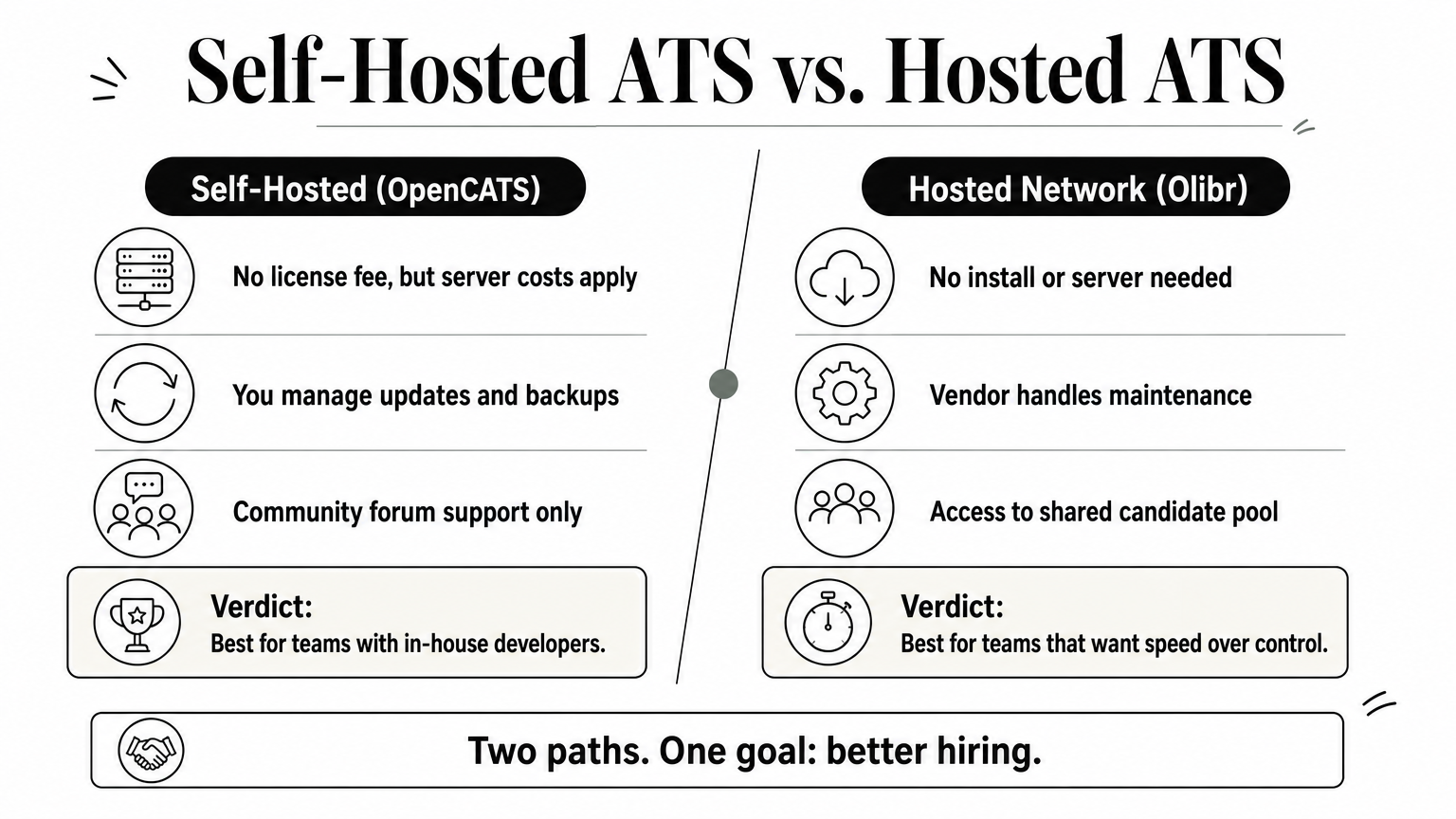
Before you spin up a server for a self-hosted tool, it's worth understanding why we're including Olibr in a list of open source options at all. Olibr isn't open source code you install and modify. It's a free, hosted ATS built on a different idea: instead of paying license fees or maintaining your own infrastructure, you contribute your dormant, no-longer-active candidate profiles to a shared network and get to search a shared pool of 180,000+ verified profiles in return. For recruiters who want the freedom that draws people to open source (no cost, no vendor lock-in) without the maintenance burden that comes with it, Olibr is worth comparing against every self-hosted tool on this list.

How it works
Signing up gets you a full applicant tracking system with pipeline stages, kanban boards, notes, and team collaboration, all included at no cost. You post unlimited jobs through the integrated job board, one of several places recruiters can post roles at no cost, and applicants flow straight into your pipeline. The differentiator is the contribution-based data exchange: contributing 50 profiles per active user every 30 days from your own candidate database keeps access free, and contributed profiles join the shared pool after a 30-day private window. AI matching then ranks candidates against your job descriptions using more than keyword search, and AI interviews with expression analysis and scored transcripts help you screen at scale without adding headcount, paid from a wallet you top up.
A shared candidate network turns your unused ATS data into a bigger hiring pool, without a single line of code to maintain.
Best for
Olibr fits recruiters and staffing agencies who are less interested in tinkering with server configs and more interested in filling roles faster. It suits teams sitting on large, underused databases where most sourced profiles never get a second look after the initial search. It's also a strong match if you're currently juggling separate subscriptions for an ATS, a no-cost resume database, and a job board, since Olibr folds all three into one platform. If your recruiting team values speed (the platform cites an average time-to-hire of 15 days) over full source-code control, this is the more practical starting point.
Setup, hosting, and real cost
There's no server to provision and no database to back up. You sign up, and the platform is live immediately with unlimited team seats and role-based permissions built in. There's no credit card required and no trial period to track. The only real cost is contributory: you share 50 dormant candidate profiles per active user every 30 days to keep access free.
| Factor | Olibr |
|---|---|
| License model | Free, hosted (data-exchange based) |
| Hosting | Fully managed, no install |
| Candidate pool | 180,000+ shared profiles |
| Bulk upload | Up to 10,000 profiles at once |
| Private option | Yes, paid plan with data separation |
2. OpenCATS: the veteran self-hosted ATS
OpenCATS has been around since 2005, making it one of the oldest open source ATS software projects still in active use. It's a PHP and MySQL application you install on your own server, and it covers the fundamentals: candidate database, job orders, pipeline stages, and resume parsing. Agencies that want a genuinely self-hosted applicant tracking system with no monthly fee often land here first, since the codebase is stable and the feature set hasn't drifted far from what staffing firms actually use day to day.
How it works
Underneath, OpenCATS runs on a standard LAMP stack (Linux, Apache, MySQL, PHP), so any developer familiar with that combination can get it running in an afternoon. Resumes get parsed automatically into candidate records, job orders link to pipelines with configurable statuses, and built-in reporting shows submissions, placements, and recruiter activity. There's no AI matching or video screening here; it's a straightforward, form-based system built for manual sourcing workflows rather than automated ranking.
OpenCATS proves that a fifteen-year-old codebase can still outlast plenty of newer, better-marketed tools.
Best for
Small staffing agencies with an in-house developer, or a technical founder comfortable maintaining a server, get the most out of OpenCATS. It suits teams that want full source-code control and don't need AI features, video interviews, or a shared candidate network. If your hiring volume is modest and your priority is a no-cost, no-vendor system you fully own, this fits better than a heavier ERP-style tool.
Setup, hosting, and real cost
Installation itself is free, but you'll need a VPS or dedicated server, which typically runs $10 to $40 a month depending on your provider and traffic. Budget time for initial configuration, periodic PHP and MySQL updates, and backups, since there's no vendor handling any of that for you. Community support comes through forums and documentation rather than a help desk, so if something breaks at 11 p.m. before a client deadline, you're troubleshooting it yourself or paying a developer to do it.
| Factor | OpenCATS |
|---|---|
| License model | Free, open source (self-hosted) |
| Hosting | You provide (VPS/dedicated) |
| AI features | None |
| Support | Community forums only |
| Ideal user | Small agency with in-house dev |
3. CandidATS: a modernized OpenCATS fork
CandidATS started as a direct fork of OpenCATS, built by developers who liked the core recruiting logic but wanted a cleaner interface and more active maintenance. If OpenCATS feels like it's stuck in 2008, CandidATS is the answer for teams who want the same open source ATS software foundation with a modern coat of paint. It's still self-hosted, still free, and still built on the same PHP and MySQL base, but the fork has trimmed some of the clutter and updated the UI to feel less like a legacy enterprise tool.
How it works
CandidATS keeps the candidate database, job order pipelines, and resume parsing that made OpenCATS useful, then layers in a refreshed dashboard and slightly improved search filters. Data migration from an existing OpenCATS install is straightforward since the underlying schema hasn't changed much, which matters if you're already running the older tool and just want a better front end. There's still no AI matching or automated candidate ranking; you're getting a more usable version of a proven workflow, not a next-generation platform.
A fork only earns its place when it fixes what the original left broken, and CandidATS mostly does exactly that.
Best for
CandidATS suits agencies already comfortable with OpenCATS's data model but tired of its dated interface. It's a good fit for teams that tested OpenCATS, liked the core recruiting logic, but found the UI too clunky for daily use by non-technical recruiters. If your staff spends hours a day inside the ATS, the interface improvements alone can justify switching, especially for smaller agency recruiting and CRM setups where every extra click adds friction across dozens of candidate records.
Setup, hosting, and real cost
Hosting requirements mirror OpenCATS almost exactly: a LAMP-stack server, whether that's a cheap VPS or an existing box you already run other tools on. Expect similar monthly hosting costs, roughly $10 to $40, plus the same ongoing responsibility for security patches and backups. Community support is smaller than OpenCATS's, simply because the project has fewer active contributors, so documentation gaps are more common and you may end up reading source code to solve edge cases.
| Factor | CandidATS |
|---|---|
| License model | Free, open source (self-hosted) |
| Hosting | You provide (VPS/dedicated) |
| Base codebase | OpenCATS fork |
| AI features | None |
| Ideal user | Existing OpenCATS users wanting a UI refresh |
4. OrangeHRM Community Edition: HR suite with an ATS
OrangeHRM built its name as a full human resources platform, and recruitment is just one module inside a much bigger suite that covers payroll, leave, performance, and time tracking. If you're searching for open source ATS software but actually need broader HR functionality down the line, OrangeHRM Community Edition gives you both in one install, unlike the recruiting-only tools earlier on this list. It's free, PHP-based, and has a large enough user base that documentation and plugins are easy to find.
How it works
Recruitment inside OrangeHRM covers job vacancy postings, candidate records, and a hiring pipeline that moves applicants through stages like screening, interview, and offer. Because it sits inside the same database as the rest of the HR suite, a hired candidate converts directly into an employee record without re-entering data, which is a real time-saver for in-house talent acquisition teams who also handle onboarding. Reporting ties recruitment metrics into the same dashboards used for headcount and attrition, so you get hiring data alongside broader workforce numbers rather than in a separate silo.
When recruitment lives inside a full HR suite, you stop re-typing the same candidate details into a second system after every hire.
Best for
OrangeHRM Community Edition suits in-house HR departments more than staffing agencies, since agencies rarely need payroll or leave management bundled with their ATS. It's a strong fit if you're a growing company hiring occasionally rather than running dozens of concurrent job orders, and you want one system to manage the entire employee lifecycle from application to exit. Recruiting agencies focused purely on placements will likely find the extra HR modules unnecessary weight.
Setup, hosting, and real cost
Self-hosting requires a LAMP-stack server, similar to OpenCATS, with PHP and MySQL as the core dependencies, and setup guides are thorough given the project's larger user base. Monthly hosting typically runs $15 to $50, a bit higher than the lighter recruiting-only tools since the full suite carries a heavier resource footprint. OrangeHRM also sells a paid, professionally hosted version if you want the same software without server maintenance, which is worth comparing before you commit to self-hosting the community edition.
| Factor | OrangeHRM Community Edition |
|---|---|
| License model | Free, open source (self-hosted) |
| Hosting | You provide, or paid hosted tier available |
| Scope | Full HR suite with recruitment module |
| AI features | None |
| Ideal user | In-house HR teams, not staffing agencies |
5. Odoo Recruitment: open source ATS for ERP users
Odoo built its reputation as a modular ERP, and recruitment is one of dozens of apps you can bolt onto the same install alongside sales, inventory, and accounting. If your company already runs Odoo for another department, adding its open source ATS software module costs nothing extra and shares the same login, database, and user permissions as the rest of your business tools. It's a different pitch from the recruiting-only platforms earlier in this list: you're not choosing an ATS first, you're choosing an ERP that happens to include one.
How it works
Each job opening becomes a Kanban-style pipeline in Odoo Recruitment, with drag-and-drop stages you customize per role, from initial review through offer. Candidates apply through an integrated careers page, and their resumes get parsed and attached directly to their record. Because recruitment sits inside the same platform as HR and payroll apps, a hired candidate can convert into an employee profile with a couple of clicks, carrying over contact details and documents instead of forcing a re-entry. Odoo's interview scorecards let hiring managers rate candidates on set criteria, giving you a lightweight scoring layer without any AI matching behind it.
Recruitment inside an ERP only pays off once you're already running other Odoo apps; bolted onto nothing else, it's just extra overhead.
Best for
Odoo Recruitment suits companies already committed to the Odoo ecosystem for accounting, inventory, or project management, where adding recruitment is a marginal decision rather than a standalone platform choice. It's a weaker fit for staffing agencies whose entire business is recruiting, since you'd be adopting a full ERP just to get an ATS module. In-house teams at mid-sized companies hiring across departments tend to get the most value here, particularly when they want hiring data sitting next to employee records long-term.
Setup, hosting, and real cost
Odoo offers both a free Community edition you self-host and a paid Enterprise edition with more modules and official support. Self-hosting the Community edition needs a Python and PostgreSQL server, and monthly VPS costs typically run $15 to $40 depending on how many other Odoo apps you run alongside recruitment. Odoo also sells managed cloud hosting starting around $25 to $30 per user per month if you'd rather skip server maintenance, which quickly changes the total cost calculation compared to a purely open source deployment.
6. ERPNext HRMS: recruiting module for ERP teams
ERPNext takes the same approach as Odoo: it's a full open source ERP with modules for accounting, manufacturing, and HR, and recruitment lives inside the HRMS module rather than as a standalone product. Built by Frappe, an Indian company, ERPNext has a particularly strong footprint in the India recruitment market, which matters if you want documentation and community support that already understands local payroll and compliance quirks. Like Odoo, you're not picking ERPNext for the ATS alone; you're picking it because the rest of your business already runs there.
How it works
Job openings in ERPNext HRMS create a structured pipeline with stages for application, interview, and offer, and each candidate record links back to the job requisition that generated it. Resume attachments, interview feedback, and offer letters all sit inside the same document, so nothing gets scattered across email threads. Once a candidate is hired, ERPNext converts the record into an employee profile, carrying details straight into payroll and attendance modules without manual re-entry. The Frappe framework underneath also supports custom fields and workflows, so technical teams can adjust the hiring pipeline to match unusual approval chains.
An ERP-based ATS only earns its keep when recruitment data actually needs to flow into payroll and employee records afterward.
Best for
ERPNext HRMS suits mid-sized companies in India already using, or planning to use, ERPNext for finance or operations, where recruitment becomes one more module rather than a separate purchase decision. It's a poor match for staffing agencies since the recruitment features are built around internal hiring, not managing external clients or multiple job orders for different companies. In-house talent teams at growing businesses that want hiring, onboarding, and payroll under one login get the clearest benefit here.
Setup, hosting, and real cost
Self-hosting ERPNext requires a server running Python, MariaDB, and the Frappe framework, and setup is more involved than a simple PHP install, often needing Docker or a bench-based deployment. Monthly VPS costs typically land between $20 and $50 depending on company size and how many other ERPNext modules you run. Frappe Cloud also offers managed hosting with support plans if you'd rather not maintain the framework yourself, which is worth pricing out before committing your team to self-hosted upkeep.
| Factor | ERPNext HRMS |
|---|---|
| License model | Free, open source (self-hosted) |
| Hosting | You provide, or Frappe Cloud managed option |
| Scope | Full ERP with HR/recruitment module |
| Ideal user | India-based companies already on ERPNext |
7. Horilla: free HRMS with built-in recruitment
Horilla is a newer entrant compared to the others on this list, built as a full open source HRMS with recruitment as one of its core modules rather than an afterthought bolted onto payroll software. Python and Django power the backend, which gives it a cleaner, more modern feel than the older PHP tools further up this list. Growing companies comparing free ATS tools that don't feel like a relic from 2010 tend to land on Horilla once they discover it, since the project has picked up momentum fast on GitHub.
How it works
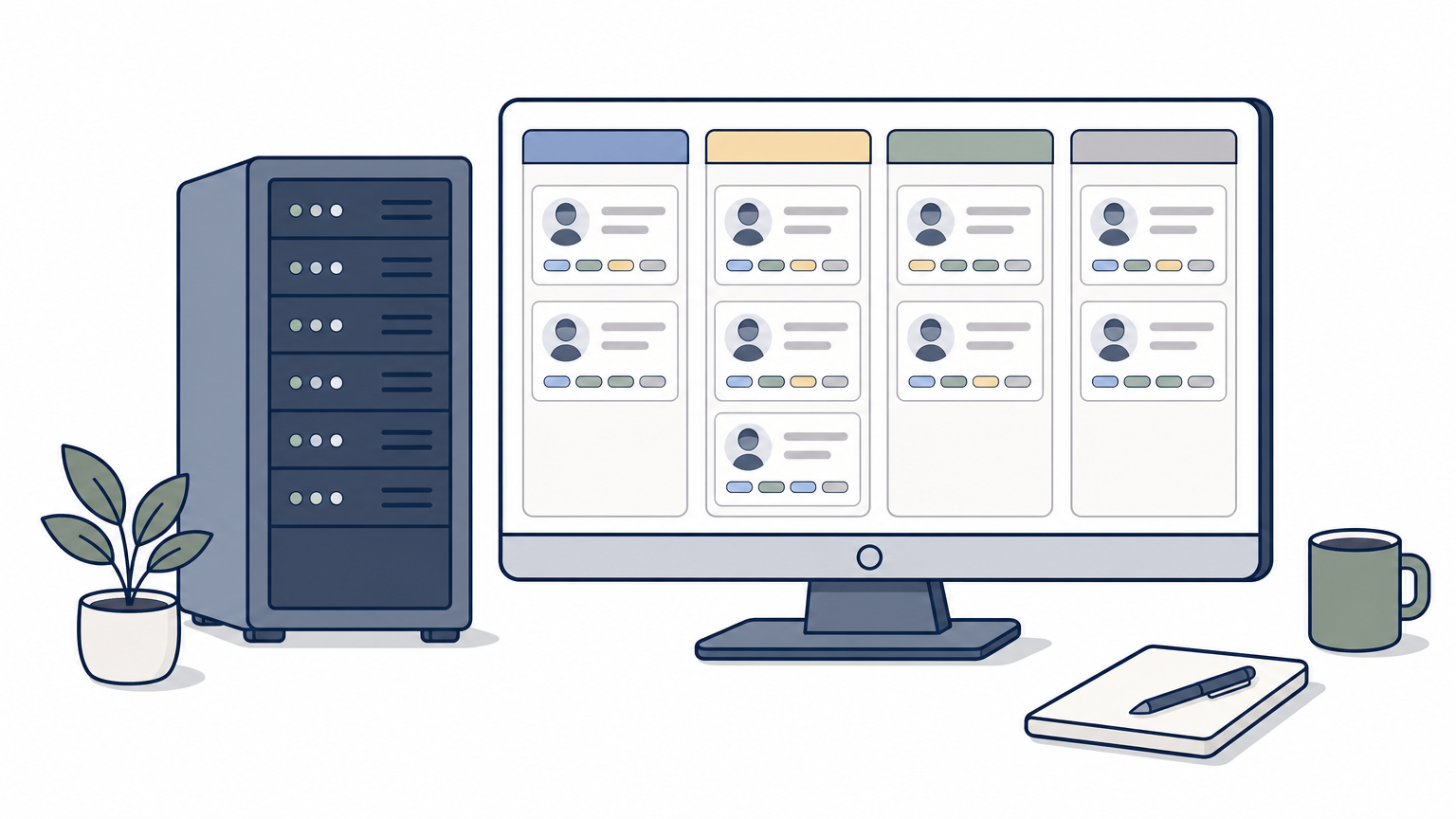
Recruitment in Horilla runs through a pipeline view where you create job postings, track applicants through stages like screening and interview, and collect feedback from hiring managers directly on each candidate profile. The module connects to the broader HRMS, so a hired applicant moves into onboarding and employee records without a second data entry step. Horilla also includes skill zone tracking, a feature that tags candidates by skill set so you can pull up a shortlist for a future role even after a job closes, something most of the older self-hosted tools on this list don't offer out of the box.
A recruitment module built on a modern framework ages better than one bolted onto a decade-old codebase.
Best for
Horilla suits small to mid-sized companies that want a modern, self-hosted HRMS and are comfortable running a Python and PostgreSQL stack instead of the more common LAMP setup. It's a better fit for in-house HR teams managing occasional hiring than for staffing agencies juggling dozens of concurrent job orders for different clients. Teams that value active development and a responsive open source community will appreciate how frequently Horilla ships updates compared to older, slower-moving projects.
Setup, hosting, and real cost
Self-hosting Horilla needs a server running Python, Django, and PostgreSQL, typically deployed with Docker for a smoother install. Monthly VPS costs usually run $15 to $35, similar to the other self-hosted options here, though you'll want a provider comfortable with Python-based stacks rather than the PHP-heavy shared hosting common for older tools.
| Factor | Horilla |
|---|---|
| License model | Free, open source (self-hosted) |
| Hosting | You provide (Python/PostgreSQL stack) |
| Scope | Full HRMS with recruitment module |
| Standout feature | Skill zone candidate tagging |
| Ideal user | Modern in-house HR teams comfortable with Django deployments |
8. Sentrifugo: lightweight open source HR tool
Sentrifugo has been around since 2013 and built its reputation on being lighter than the ERP-style tools earlier on this list. It's a standalone HR management system with a recruitment module included, aimed at companies that want basic hiring functionality without the weight of a full ERP behind it. Development has slowed compared to newer projects like Horilla, but the core codebase is stable enough that plenty of small businesses still run it in production, especially teams that found OrangeHRM or Odoo too heavy for what they actually needed.
How it works
Recruitment inside Sentrifugo covers job posting, candidate application tracking, and a basic interview scheduling tool, all wrapped in a simpler interface than the ERP suites further up this list. You post vacancies, candidates apply through a portal, and their records move through configurable pipeline stages that mirror your hiring workflow. The module also includes basic reporting on open positions and applicant counts, though it lacks the resume parsing sophistication or automated resume screening you'd find in a purpose-built recruiting platform. Sentrifugo trades depth for simplicity, which is exactly the point for teams that found other tools overbuilt.
A lightweight tool only wins when your hiring volume is genuinely light too; past a certain scale, the missing automation starts to hurt.
Best for
Sentrifugo suits small businesses and startups running occasional hiring who want a no-frills, self-hosted HR tool without committing to a full ERP install. It's a reasonable fit if your team hires a handful of roles a quarter and doesn't need advanced candidate scoring or bulk resume parsing. Staffing agencies handling higher volume, or any team juggling multiple concurrent job orders, will likely outgrow Sentrifugo's feature set faster than the other tools on this list, since the recruitment module was never built with agency-scale sourcing in mind.
Setup, hosting, and real cost
Sentrifugo runs on a standard LAMP stack, similar to OpenCATS, so hosting costs land in the same range: roughly $10 to $30 a month for a basic VPS. Setup is generally straightforward given the project's age and available documentation, though community activity has cooled in recent years, so newer PHP versions occasionally cause compatibility friction during installation. Budget extra time for troubleshooting if you're deploying on a recent server stack, since official support has thinned considerably compared to when the project was actively maintained.
| Factor | Sentrifugo |
|---|---|
| License model | Free, open source (self-hosted) |
| Hosting | You provide (LAMP stack) |
| Scope | Standalone HR tool with recruitment module |
| Development activity | Slower than newer alternatives |
| Ideal user | Small businesses with occasional, low-volume hiring |
9. Open HRMS: Odoo-based recruitment platform
Open HRMS takes Odoo's Community edition and repackages it as a dedicated open source HR platform, stripping away the generic ERP framing and focusing the pitch squarely on human resources and recruitment. It's built and maintained by Cybrosys, a Kerala-based development firm, which gives it a more India-focused support ecosystem than vanilla Odoo. If you want Odoo's recruitment engine without wading through inventory and manufacturing modules you'll never touch, Open HRMS is the more direct route to the same underlying open source ATS software.
How it works
Underneath the rebrand, Open HRMS runs on the same Kanban-style recruitment pipeline as Odoo, with drag-and-drop stages, resume parsing on application, and a careers page you can embed on your own site. Candidates convert into employee records on hire, carrying documents and contact details straight into onboarding without re-entry. Cybrosys layers on additional modules over time, including expense tracking and appraisal tools, so the recruitment piece sits inside a broader employee lifecycle suite rather than standing alone.
Rebranding an ERP module as HR-first software only helps if the support and documentation actually follow that focus, and Open HRMS mostly delivers on that promise.
Best for
Open HRMS suits small and mid-sized companies in India that want Odoo's recruitment functionality without setting up the full ERP themselves, or that prefer working with a regional implementation partner over generic community forums. It's a better match for in-house HR teams handling internal hiring than staffing agencies managing external client job orders, since the workflow still assumes you're hiring for your own company. Teams already comfortable with Odoo's interface but wanting a narrower, HR-specific installation get the clearest benefit.
Setup, hosting, and real cost
Self-hosting needs the same Python and PostgreSQL stack as Odoo, with monthly VPS costs typically running $15 to $40. Cybrosys also sells implementation and support packages if you'd rather pay for setup help than DIY the install, which pushes total cost meaningfully above a purely free deployment once you factor in that support.
| Factor | Open HRMS |
|---|---|
| License model | Free, open source (self-hosted) |
| Hosting | You provide (Python/PostgreSQL) |
| Base codebase | Odoo Community fork |
| Support | Cybrosys paid implementation available |
| Ideal user | India-based SMBs wanting HR-focused Odoo |
Picking the right ATS for your team
Every tool on this list trades something for that zero-dollar price tag. Self-hosted options like OpenCATS or Horilla hand you full control, but you own the server, the patches, and the 2 a.m. troubleshooting when something breaks. ERP-based platforms like Odoo or ERPNext only pay off if you're already running other modules from the same vendor. If your priority is filling roles fast rather than managing infrastructure, that's where the calculation shifts.
Ask yourself one honest question before you commit: do you actually want to maintain a codebase, or do you want candidates moving through your pipeline by next week? If it's the second one, skip the server setup entirely. Set up a free recruiter account and get a working ATS, unlimited job postings, and access to the shared candidate network live today, no credit card, no install.
For hiring teams
Search 180,000+ candidate profiles — free.
Olibr is a community-funded recruiting platform: full ATS, AI interviews, and a shared resume database. No per-seat fees.