15 Applicant Tracking System Reviews: Best ATS Picks 2026
Picking the wrong ATS can cost you months of migration headaches and thousands in wasted budget. With dozens of platforms competing for your attention, reading applicant tracking system reviews from actual users and hiring professionals is the smartest move before you commit. The difference between a good and bad choice here directly affects how fast you fill roles and how much manual work your team absorbs daily.
We built Olibr as a recruiting and hiring platform with a free full ATS, a searchable database of over 180,000 candidate profiles and pay-as-you-go AI interviews, so we know exactly what separates a capable tracking system from one that just looks good on a demo call. That hands-on experience across thousands of hiring workflows informs how we evaluate every platform on this list, including our own. No tool is perfect for every team, and we'd rather help you find the right fit than pretend otherwise.
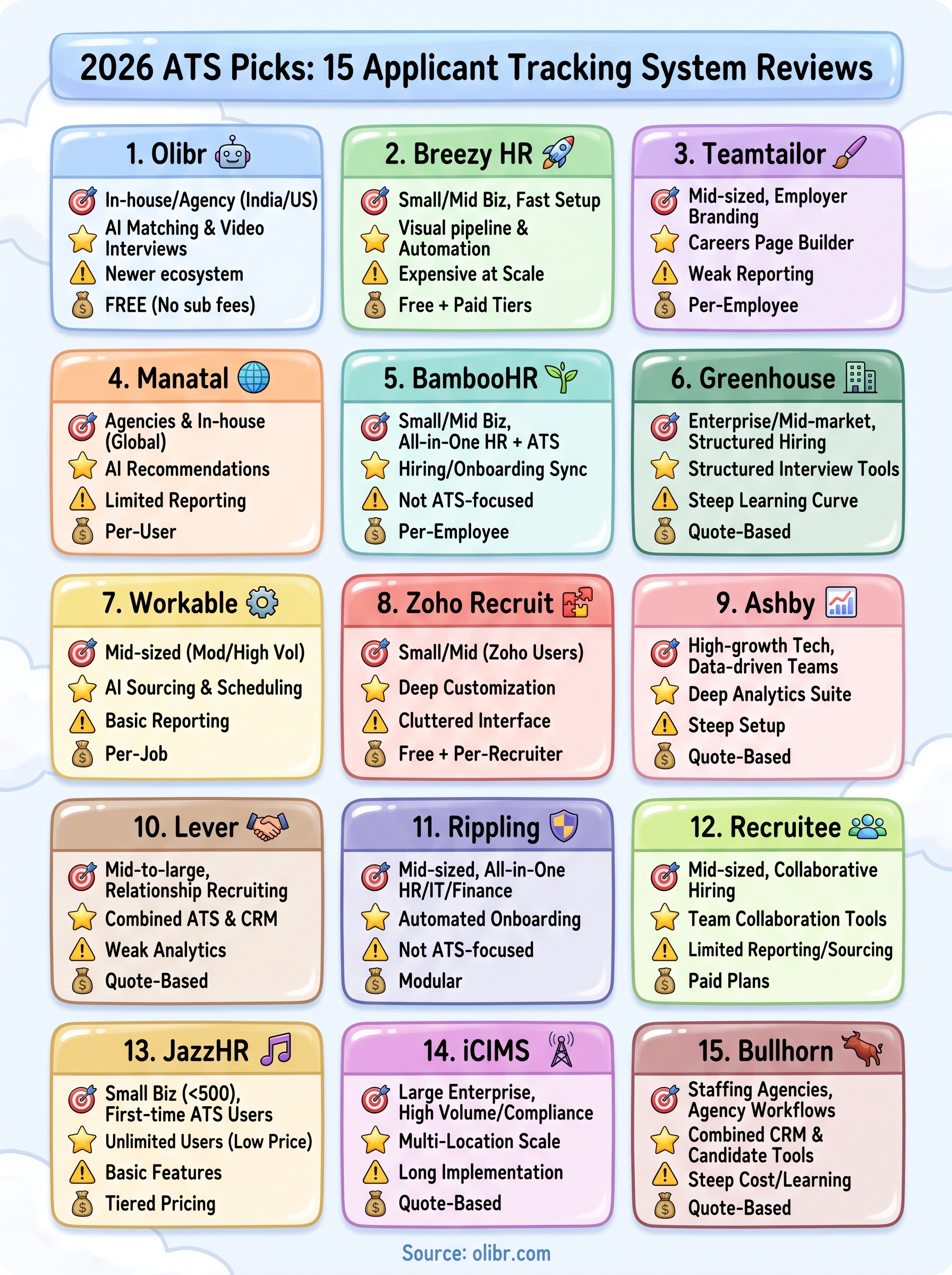
This guide breaks down 15 applicant tracking systems with honest reviews covering features, pricing, pros, cons, and the specific use cases where each one shines. Whether you're an in-house recruiter tired of overpaying for basic functionality or a growing agency that needs collaborative hiring tools, you'll walk away with a clear picture of which platforms are worth your time in 2026, and which ones you can skip.
1. Olibr
Olibr is a free ATS and recruiting platform built for hiring teams that want AI-powered tools without paying monthly subscription fees. The platform serves recruiters in both India and the United States and operates on a community contribution model where uploading resumes earns you credits to access the full feature set.

What it is
The platform combines a full applicant tracking system with an AI interview engine, a searchable candidate database of over 180,000 profiles, and a Chrome extension for capturing profiles directly from LinkedIn and Naukri. Unlike platforms that lock features behind paid tiers, you get access to everything from day one, including bulk resume uploads, AI parsing, pipeline management, and team collaboration tools. Contributing resumes to the shared candidate pool is what keeps the ATS free.
Best for
Olibr works best for in-house recruiters and talent acquisition teams that hire across multiple roles and need to cut cost per hire without sacrificing capability. It's also a strong fit for recruiting agencies in the India or US markets that already hold large resume databases sitting unused in spreadsheets or hard drives.
Key strengths
The standout capability is AI-powered candidate matching, which goes beyond keyword scanning to analyze job descriptions and resumes together, predicting fit more accurately than traditional filters. You also get AI-conducted video interviews that score candidates using facial expression analysis and automated assessments, which cuts screening time significantly. The candidate intelligence dashboard gives you context on career trajectory, experience type, and portfolio strength rather than just a flat list of job titles.
When reading applicant tracking system reviews, total cost of ownership matters as much as features. Olibr's free model changes the math on what's possible for budget-conscious teams entirely.
Trade-offs to know
Olibr is newer than most competitors on this list, so the integration ecosystem is smaller than what you'd find with Greenhouse or Workable. Teams whose hiring stack relies heavily on third-party HRIS tools may run into gaps that require workarounds until the integration library expands further.
Pricing
Olibr's ATS is free; AI features are paid per use. There are no paid tiers and no per-seat charges. You keep access by contributing resumes to the shared database, so the ATS costs you participation rather than budget; AI features are paid per use. For teams currently paying anywhere from $500 to $15,000+ monthly on competing platforms, this model eliminates a significant line item immediately.
2. Breezy HR
Breezy HR is a recruiting and ATS platform designed primarily for small and mid-sized businesses that want a clean interface and fast setup. Most applicant tracking system reviews highlight its drag-and-drop pipeline and built-in video interviewing as the features that make it stand out from similarly priced tools.
What it is
Breezy HR gives you a visual hiring pipeline you can customize per role, along with job posting to 50+ job boards, automated candidate communication, and structured interview scorecards. The platform integrates with common HR and productivity tools and offers a branded careers page that teams can launch without developer help.
Best for
Breezy HR fits small businesses and growing startups that need to get a structured hiring process in place quickly without spending weeks on configuration. It works particularly well for teams that handle low-to-moderate hiring volume and want something simpler than enterprise-grade platforms.
Key strengths
The biggest draw is how fast you can get a job live and start receiving applications, often within minutes of signing up. The candidate communication tools, including automated email sequences and SMS, reduce the manual back-and-forth that slows down early-stage screening.
If your team currently manages candidates through shared spreadsheets, Breezy HR's visual pipeline alone will feel like a significant upgrade.
Trade-offs to know
Breezy HR becomes expensive at scale, and the reporting features are limited compared to platforms like Greenhouse or Ashby. Teams that need deep analytics or complex hiring workflows will likely outgrow it faster than expected.
Pricing
Breezy HR offers a free plan for one active job. Paid plans start at $157 per month (Bootstrap), with higher tiers reaching $307 to $679 per month depending on features and seat count.
3. Teamtailor
Teamtailor is a recruiting platform built around employer branding, giving you a fully customizable careers site alongside a functional ATS. It's popular with companies that treat the candidate experience as part of their hiring strategy rather than an afterthought.
What it is
The platform combines ATS functionality with a built-in careers page builder, letting you create job listings and a branded hiring experience without needing a separate website tool. It handles pipeline management, candidate communication, and team collaboration, while making employer brand presentation the centerpiece of the experience.
Best for
Teamtailor works best for mid-sized companies that actively compete for talent and want their careers page to reflect their brand quality. It fits teams that prioritize candidate experience at every touchpoint in the hiring funnel.
Key strengths
The careers page builder is genuinely strong, giving you drag-and-drop customization without developer involvement. The platform also offers solid team collaboration features, including internal notes, candidate ratings, and automated triggers that keep your pipeline moving with minimal manual effort.
Among applicant tracking system reviews that highlight employer branding, Teamtailor consistently earns mentions for building careers pages that actually convert visitors into applicants.
Trade-offs to know
Teamtailor's reporting and analytics tools are less developed than what you'd get from platforms built specifically around hiring data. Teams that need granular pipeline metrics or custom reports may find the built-in dashboards too limited for serious analysis work.
Pricing
The platform uses per-employee pricing rather than per-seat or per-job pricing. Exact costs depend on your company size and are available on request through their website. Most companies find that mid-market pricing aligns reasonably with the employer branding value they receive.
4. Manatal
Manatal is a cloud-based ATS and recruitment platform that combines pipeline management with AI-powered candidate scoring and social media enrichment. It targets recruiting agencies and in-house teams across Southeast Asia and broader global markets, though its pricing makes it accessible to teams well outside that region too.
What it is
Manatal gives you a drag-and-drop recruitment pipeline, job posting to 2,500+ channels, and candidate profiles that automatically pull data from LinkedIn and other social platforms. The platform includes built-in AI recommendations that score candidates against open roles and highlight the strongest matches at the top of your pipeline without requiring manual filtering.
Best for
Manatal fits small-to-mid-sized recruiting agencies and internal HR teams that want AI-assisted screening without committing to an enterprise-level contract. It works particularly well for teams that hire across multiple regions and need multi-currency, multi-language support built in from the start.
Key strengths
The social media enrichment feature stands out because it automatically populates candidate profiles with publicly available information, reducing the time you spend on manual data entry. Several applicant tracking system reviews note that the AI scoring accuracy improves as you use the platform more, since it learns from your hiring decisions over time.
Manatal's combination of affordable pricing and AI-driven scoring gives smaller teams access to matching capabilities that typically show up only in enterprise platforms.
Trade-offs to know
Manatal's reporting and analytics suite is more limited than what you'd find in platforms like Ashby or Greenhouse. Teams that need deep pipeline visibility or custom report exports will likely feel constrained by the current dashboard options.
Pricing
Manatal charges $15 per user per month on the Professional plan, with the Enterprise plan starting at $35 per user per month. A 14-day free trial is available without requiring a credit card.
5. BambooHR
BambooHR is an HR software platform that bundles ATS functionality into a broader suite covering onboarding, payroll, performance management, and employee records. Most applicant tracking system reviews position it as an all-in-one HR tool rather than a dedicated recruiting platform.
What it is
The platform gives you a centralized HR system where recruiting connects to the rest of your employee lifecycle management. Its ATS component handles job postings, pipeline management, offer letters, and new hire onboarding, all within the same employee database you use after someone gets hired.
Best for
BambooHR works best for small and mid-sized businesses that want recruiting and HR management under one roof. It fits teams that already need HR software and prefer the ATS included rather than paying for two separate tools.
Key strengths
The tightest integration between hiring and onboarding is where BambooHR earns its reputation. When you move a candidate to hired, their information flows directly into your employee records and onboarding workflows without manual re-entry, which saves time and reduces data errors at the handoff point.
For growing companies that care about the new hire experience, having recruiting and onboarding in the same system removes a friction point that standalone ATS tools cannot solve on their own.
Trade-offs to know
Dedicated recruiting teams will notice that ATS functionality is not BambooHR's primary focus, and the gaps show. Pipeline customization and advanced candidate sourcing tools are more limited compared to platforms built specifically around hiring volume and recruiter workflows.
Pricing
BambooHR uses per-employee monthly pricing with custom quotes based on company size. Exact pricing is available on request through their website, with no publicly listed flat-rate plans.
6. Greenhouse
Greenhouse is an enterprise-grade ATS and recruiting platform that has become a standard tool for fast-growing tech companies and larger organizations that need structured, repeatable hiring at scale. Most applicant tracking system reviews from enterprise hiring teams rank Greenhouse near the top for its depth of customization and reporting capabilities.

What it is
Greenhouse gives you a structured hiring framework built around scorecards, interview kits, and defined approval workflows. The platform connects to hundreds of integrations, including HRIS systems, background check providers, and sourcing tools, making it a central hub for your entire recruiting operation rather than just a pipeline tracker.
Best for
Greenhouse fits mid-market and enterprise companies that run high-volume, cross-functional hiring and need every stakeholder, from recruiter to hiring manager to executive, working from the same structured process. It also suits teams that take data-driven hiring seriously and want reporting that holds up to scrutiny.
Key strengths
The structured interview process tools are where Greenhouse pulls ahead of most competitors. You can build custom scorecards and interview kits per role, ensuring every interviewer evaluates candidates against the same criteria. The analytics dashboard gives your team detailed pipeline metrics covering source effectiveness, time-to-hire, and offer acceptance rates that actually drive better decisions.
For teams that care about reducing hiring bias and improving consistency across interviewers, Greenhouse's structured interview framework is one of the strongest implementations available.
Trade-offs to know
Greenhouse has a steeper learning curve than most platforms on this list, and smaller teams often find the setup process time-consuming. The platform's cost is also significant, which puts it out of reach for startups or teams that don't have a dedicated recruiting operations function to manage it.
Pricing
Greenhouse does not publish pricing publicly. Costs are quote-based and typically scale with company size and seat count. Most teams report that annual contracts start in the thousands, making it a meaningful budget commitment before you sign.
7. Workable
Workable is a full-featured ATS and hiring platform that covers the entire recruiting process from job posting to offer letter. It sits in the middle of the market, offering more recruiting capability than lightweight tools like Breezy HR while staying more accessible than enterprise platforms like Greenhouse. Many applicant tracking system reviews for mid-market teams point to Workable as a practical default choice when you need breadth without complexity.
What it is
Workable gives you job posting to 200+ job boards, AI-powered candidate sourcing, interview scheduling, collaborative scorecards, and an automated pipeline that handles much of the routine communication for you. The platform also includes a passive candidate database you can tap through its People Search feature, which surfaces profiles beyond your active applicant pool.
Best for
Workable fits growing mid-sized companies that handle moderate-to-high hiring volume across multiple departments. It works well for teams that need one platform covering sourcing, screening, and coordination without requiring dedicated recruiting operations support to maintain it.
Key strengths
The AI sourcing tool actively identifies candidates that match your open roles and surfaces them inside the platform, reducing the time your team spends manually searching job boards. Interview scheduling and automated reminders are polished and reliable, which cuts the back-and-forth that kills hiring momentum.
Workable's combination of sourcing tools and pipeline management removes two of the biggest time drains in mid-market recruiting.
Trade-offs to know
Workable's reporting capabilities are adequate but not deep, and teams that need granular custom analytics will hit limits quickly. Advanced workflow automation is also less flexible than what Greenhouse or Ashby offer.
Pricing
Workable charges based on active job slots. The Starter plan runs $149 per month for up to two active jobs, Standard starts at $299 per month, and Premier starts at $599 per month with added sourcing and analytics features.
8. Zoho Recruit
Zoho Recruit is a cloud-based ATS and recruiting platform that sits inside the broader Zoho software ecosystem, covering everything from candidate sourcing to offer management. It serves both in-house HR teams and staffing agencies, with separate product interfaces tailored to each use case.
What it is
Zoho Recruit gives you a full recruiting pipeline with job board posting, resume parsing, candidate management, and interview scheduling built into one platform. It connects natively with other Zoho products like Zoho CRM and Zoho People, making it a practical choice if your team already runs on the Zoho software stack.
Best for
Zoho Recruit fits small to mid-sized businesses and recruiting agencies that want affordable ATS functionality with room to grow. Teams already using other Zoho products will find the native integrations cut setup time significantly compared to stitching together separate tools.
Key strengths
The platform handles multi-channel job posting and resume sourcing from a single dashboard, which reduces the tab-switching that slows active sourcing. Several applicant tracking system reviews highlight Zoho Recruit's deep customization options, where you can build custom fields, hiring stages, and automation rules to match your specific process rather than adapting to a rigid default workflow.
Zoho Recruit's position inside a broader software ecosystem gives it integration advantages that standalone ATS tools cannot replicate at the same price point.
Trade-offs to know
The interface can feel cluttered and outdated compared to newer platforms, and the learning curve is steeper than most tools in this price range. Teams that need clean, modern UX from day one may find the initial setup friction genuinely frustrating.
Pricing
Zoho Recruit offers a free plan covering one active job. Paid plans start at $30 per recruiter per month on the Standard plan, with higher tiers available for larger teams and agencies.
9. Ashby
Ashby is a recruiting platform built specifically for data-driven hiring teams that want analytics depth and workflow automation in the same tool. It has gained traction quickly among high-growth tech companies that run structured hiring processes and want reporting that matches the rigor of their engineering or finance operations.
What it is
Ashby combines a full ATS with built-in CRM functionality and analytics, giving you sourcing, pipeline management, interview scheduling, and reporting without relying on third-party add-ons for each piece. The platform is built around the idea that recruiting should be as measurable as any other business function, so every stage of your pipeline produces data you can act on.
Best for
Ashby fits scaling tech companies and recruiting operations teams that treat hiring metrics as seriously as revenue metrics. It works particularly well for teams running high-volume, structured hiring where consistency across interviewers and reliable funnel data directly impact how fast the company grows.
Key strengths
The analytics suite is where Ashby genuinely separates itself from most platforms covered in applicant tracking system reviews. You get customizable dashboards and funnel reports that give your team real-time visibility into where candidates drop off, which sources convert best, and how individual interviewers affect outcomes.
For recruiting teams that want to present hiring data in the same format as business performance data, Ashby's reporting depth is difficult to match at any price point.
Trade-offs to know
Ashby has a steeper setup and learning curve than most mid-market tools, and smaller teams without a dedicated recruiting operations role may struggle to use it to its full potential. The pricing also reflects its enterprise positioning, which rules it out for budget-conscious teams.
Pricing
Ashby does not publish pricing publicly. Costs are quote-based and scale with company size and seat count, with most teams reporting that it sits in the mid-to-high end of the market.
10. Lever
Lever is a recruiting platform that merges ATS and CRM functionality into a single tool, giving you a unified system for managing both active applicants and passive candidates you're nurturing over time. It's used across mid-market and enterprise companies that want relationship-based recruiting built into their core workflow rather than bolted on as a separate tool.
What it is
Lever positions itself as a talent relationship management platform, meaning every candidate interaction, from the first email to the final offer, lives in one place. The platform handles pipeline management, nurture sequences, interview scheduling, and analytics without requiring you to switch between an ATS for active candidates and a separate CRM for passive sourcing.
Best for
Lever fits mid-to-large companies that run both high-volume hiring and long-cycle relationship building for specialized or senior roles. Teams that invest heavily in pipeline nurturing and talent community development will find the CRM layer genuinely useful rather than just a checkbox feature.
Key strengths
Most applicant tracking system reviews that highlight Lever focus on its two-sided approach to talent management, where passive and active candidates coexist in the same system. The visual pipeline and collaborative interview tools make it easy for hiring managers to stay engaged throughout the process without being trained on a complex tool.
Lever's combined ATS and CRM design removes the friction of managing two separate databases for the same candidate at different stages of your pipeline.
Trade-offs to know
Lever's analytics capabilities fall behind what Ashby or Greenhouse offer for data-heavy recruiting teams. The platform has also gone through ownership changes, which some users report has affected support responsiveness and product development pace.
Pricing
Lever does not publish pricing publicly. Costs are quote-based and scale with company size and seat count.
11. Rippling
Rippling is a workforce management platform that combines HR, IT, and finance operations into one system, with an ATS included as part of the broader suite. It targets companies that want hiring connected directly to provisioning, payroll, and device management from the moment someone accepts an offer.
What it is
Rippling handles recruiting pipeline management, job posting, and offer letter workflows alongside the rest of your employee lifecycle. When a candidate converts to a new hire, the platform automatically triggers onboarding tasks, payroll enrollment, and software access without any manual handoff required between your recruiting and HR systems.
Best for
Rippling works best for mid-sized companies that want a single platform covering the entire employee journey from first application to last paycheck. Teams looking to reduce the number of tools their HR function manages will find the all-in-one approach genuinely cuts administrative overhead across departments.
Key strengths
The strongest advantage Rippling offers is automated cross-system onboarding, where a single hire action kicks off payroll, IT provisioning, and benefits enrollment simultaneously. Several applicant tracking system reviews note that this automation alone justifies the platform for teams previously managing new hire setup across three or four separate systems.
If your team spends hours manually setting up new hire accounts after every offer acceptance, Rippling's automated provisioning removes that work entirely.
Trade-offs to know
The ATS functionality is not Rippling's core product, and dedicated recruiting teams will notice gaps in sourcing tools and pipeline customization compared to platforms built specifically for talent acquisition workflows.
Pricing
Rippling uses modular pricing where each product component is billed separately. The ATS is available as part of broader packages, with custom quotes based on company size and the specific modules your team selects.
12. Recruitee
Recruitee is a collaborative ATS and hiring platform designed for companies that want their entire team involved in recruiting decisions. The platform focuses on bringing structure to team-based hiring, giving recruiters, hiring managers, and department leads a shared workspace where every stakeholder contributes feedback in one place rather than across scattered email threads.
What it is
Your team gets pipeline management, job board distribution, and built-in collaboration tools that let everyone leave structured notes, ratings, and candidate evaluations directly inside the platform. Recruitee also includes a careers page builder and handles automated candidate communication throughout each stage of your hiring funnel without requiring manual follow-up from your team.
Best for
The platform fits growing mid-sized companies that struggle with hiring decisions happening in side conversations and disconnected tools. Teams that want to bring clear structure and shared visibility to a process currently spread across email, spreadsheets, and messaging apps will get the most practical value from Recruitee.
Key strengths
Recruitee's team collaboration features are genuinely well-built, giving each team member a defined role in candidate evaluation without forcing them through a steep learning curve. The platform also manages multi-channel job distribution from a single dashboard, which removes the manual posting work that slows down the early stage of each search.
When reading applicant tracking system reviews focused on collaborative hiring, Recruitee consistently earns recognition for making structured team feedback practical rather than burdensome.
Trade-offs to know
Your reporting and candidate sourcing tools will feel limited compared to what dedicated recruiting platforms like Greenhouse or Ashby provide. Teams running high-volume, data-driven hiring programs will hit the ceiling of what Recruitee supports faster than expected.
Pricing
Recruitee offers a free 18-day trial with no credit card required. Paid plans start at $199 per month on the Launch plan, with the Scale plan beginning at $299 per month.
13. JazzHR
JazzHR is a recruiting and ATS platform built specifically for small businesses that need structured hiring tools without the complexity or cost of enterprise software. It targets teams that are moving away from spreadsheets and email chains for the first time and want a functional hiring process they can set up quickly.
What it is
JazzHR gives you pipeline management, job posting to major job boards, and collaborative candidate evaluation in a straightforward interface designed for teams without dedicated recruiting operations support. The platform handles resume collection, automated candidate communication, and hiring stage tracking without requiring significant technical expertise or lengthy implementation.
Best for
JazzHR fits small businesses with under 500 employees that need to replace informal hiring habits with a repeatable process. It works particularly well for teams making a modest number of hires each year who want basic ATS functionality without paying mid-market prices.
Key strengths
The platform's low price point and fast onboarding make it one of the most accessible ATS options for small business owners handling their own recruiting. Several applicant tracking system reviews highlight JazzHR's unlimited user seats across all paid plans as a genuine advantage, since you can involve hiring managers, department leads, and HR contacts without incurring additional per-seat costs.
For small teams that need multiple stakeholders involved in every hire without watching the bill climb, JazzHR's flat-rate seat pricing removes a recurring friction point.
Trade-offs to know
JazzHR's feature depth falls short compared to mid-market tools. The reporting suite is basic, and candidate sourcing capabilities are limited enough that your team will handle most outbound sourcing entirely outside the platform.
Pricing
JazzHR offers three plans. The Hero plan starts at $75 per month, Plus starts at $269 per month, and Pro starts at $420 per month, with unlimited users included across all tiers.
14. iCIMS
iCIMS is an enterprise talent acquisition platform used by large organizations that need a scalable, compliant hiring system built to handle thousands of open roles simultaneously. It consistently appears in applicant tracking system reviews for enterprise hiring teams as one of the most established players in the large-employer segment.
What it is
iCIMS gives you a full talent acquisition suite covering career site management, candidate relationship management, application tracking, video interviewing, and offer management within a single enterprise-grade platform. The system integrates with major HRIS and payroll platforms, making it a common choice for companies that already run Oracle, Workday, or SAP environments.
Best for
iCIMS works best for large enterprises and Fortune 500 companies that hire at significant volume across multiple locations, business units, or countries. Teams that require strong compliance controls and audit trails for regulated industries will find the platform built with those requirements in mind from the start.
Key strengths
The platform handles high-volume, multi-location hiring at a scale that most tools on this list cannot match without performance issues. iCIMS also provides strong career site customization that lets enterprise talent teams build candidate-facing experiences that reflect their brand across every job family and region.
For organizations hiring hundreds of people per year across multiple countries, iCIMS provides compliance and scalability infrastructure that mid-market tools simply cannot support.
Trade-offs to know
The implementation timeline is long and typically requires dedicated project management resources before your team sees day-to-day value. Smaller organizations that test iCIMS frequently find the platform significantly over-built for their actual hiring volume.
Pricing
iCIMS uses custom, quote-based pricing that scales with employee count and feature set. Most organizations report significant annual contract values that reflect its enterprise positioning.
15. Bullhorn
Bullhorn is a cloud-based ATS and CRM platform built exclusively for staffing and recruiting agencies. It focuses on the relationship-heavy workflows that define agency recruiting, where managing client accounts and candidate pipelines happen inside the same system at the same time.
What it is
Bullhorn gives you end-to-end staffing automation covering candidate sourcing, client relationship management, job order tracking, and placement reporting within a single platform. The system is built around high-volume, agency-specific workflows, where you need to manage multiple client accounts alongside thousands of active candidates simultaneously.
Best for
The platform fits staffing agencies and executive search firms that run high-volume placements across permanent and contract roles. If your business model centers on filling roles for multiple client companies at once rather than hiring for a single internal employer, Bullhorn is designed with your exact workflow in mind.
Key strengths
Most applicant tracking system reviews covering the staffing agency segment rank Bullhorn highly for its combined CRM and candidate relationship tools, which let your team track every client interaction alongside every candidate touchpoint in one place. The platform also handles contract staffing workflows including timesheets and placement records, which most standard ATS tools do not support at all.
For staffing agencies managing hundreds of open client requisitions simultaneously, Bullhorn's combined CRM and ATS design removes the context-switching that kills placement speed.
Trade-offs to know
Bullhorn carries a steep implementation cost and learning curve that smaller agencies often struggle to absorb. The platform is not designed for internal corporate hiring teams that run standard employer-side recruitment rather than agency-style workflows.
Pricing
Bullhorn uses custom, quote-based pricing that scales with agency size and feature requirements, available directly through their sales team.
Next steps
Reading through these applicant tracking system reviews gives you a practical starting point, but the real decision comes down to what your team actually needs day to day. If you run a staffing agency, Bullhorn or Lever fit the workflow. If you need enterprise compliance infrastructure, iCIMS or Greenhouse make sense. If you want a full-featured ATS without paying a monthly subscription, Olibr removes that cost entirely while still giving you AI-powered matching, video interviews, and a searchable candidate database.
Most teams pick the wrong platform by optimizing for features they rarely use while ignoring total cost of ownership over 12 to 24 months. Start by listing your three biggest hiring bottlenecks, then match the platform that solves those first. If budget is one of those bottlenecks, there is no reason to delay. Try Olibr for free today and see how much your hiring process changes when the platform cost drops to zero.
For hiring teams
Search 180,000+ candidate profiles — free.
Olibr is a community-funded recruiting platform: full ATS, AI interviews, and a shared resume database. No per-seat fees.