10 Best Hiring Manager Software Platforms in 2026
Every recruiter knows the friction: a hiring manager wants updates, feedback, and visibility, but your ATS was built for sourcing, not collaboration. That gap lengthens your time-to-hire on every requisition and turns hiring managers into a bottleneck instead of a partner. If you're evaluating hiring manager software to fix this, you're likely comparing tools on pipeline visibility, interview scheduling, and how easily a non-recruiter can actually use them.
This article answers that comparison directly. We've ranked the 10 best platforms for 2026 based on collaboration features, ease of adoption for hiring managers, pricing transparency, and how well each tool actually reduces back-and-forth email threads. You'll see where free and freemium options hold up against enterprise suites, and which platforms bake in AI matching or scoring instead of just offering a shared inbox.
We built this list from a recruiter's perspective, because that's who typically owns the buying decision even when hiring managers are the daily users. Olibr made this comparison because we built our own shared ATS and hiring platform around solving exactly this handoff problem, so we know firsthand what separates genuinely useful collaboration tools from ones that just add another login to manage.
1. Olibr
Olibr sits at the top of this list because it was built to solve the exact handoff problem this article opened with: hiring managers stuck outside the recruiter's workflow. Instead of bolting a feedback portal onto a traditional ATS, Olibr gives recruiters and hiring managers the same live view of every pipeline, so a hiring manager can leave feedback, rate a candidate, or approve a move to the next stage without asking for a status update. That shared visibility is what most hiring manager software promises but few actually deliver without extra licensing tiers.
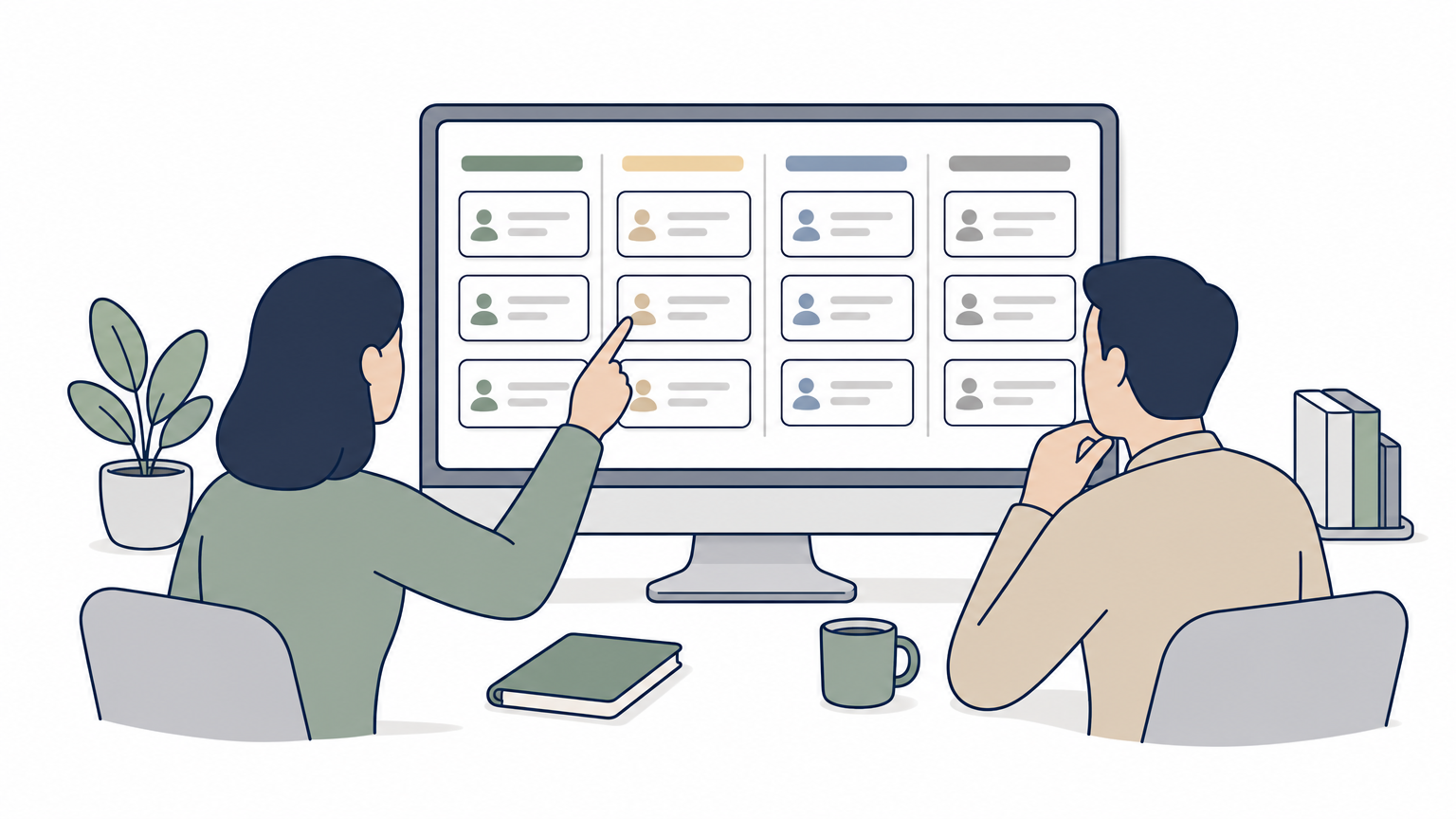
When a hiring manager can see the pipeline without emailing for it, you've already cut your time-to-hire.
Key features
What separates Olibr from a standard recruitment software option for staffing agencies is the combination of a free full platform with a community-powered candidate pool. Recruiters who contribute dormant profiles from their own database get access to a shared network of over 180,000 verified candidates, searchable by skill, experience, and location, alongside the collaboration tools hiring managers actually use day to day.
- Shared ATS with kanban pipeline stages, notes, and role-based permissions so hiring managers see only what's relevant to their req
- AI matching that ranks candidates against a job description instead of relying on keyword search alone
- AI-powered video interviews with scored transcripts and expression analysis, letting hiring managers review screened shortlists instead of raw resumes
- Bulk resume parsing for PDF, DOCX, and CSV files, up to 10,000 profiles at once
- Unlimited job postings and unlimited team seats, so adding hiring managers doesn't trigger a per-seat bill
Who it's for
Olibr fits recruiting teams and in-house talent acquisition groups that want hiring managers actively involved in candidate evaluation without paying for a separate collaboration license. It's a strong match for agencies and internal recruiters in India and the US sitting on ATS databases where most sourced profiles never get reused, since the platform turns that dormant data into two-way value. Retained search firms and NDA-bound recruiters who can't share candidate data still get full access through a private plan with complete data separation, so the collaboration features remain available even when the shared network isn't.
Pricing
Olibr's core model runs on data contribution rather than subscription fees: recruiters upload their existing, no-longer-active candidate profiles and earn credits to unlock candidates from the shared pool and use AI tools, with no credit card or trial required to get started. This makes Olibr one of the few genuinely free recruitment CRM and hiring platforms that doesn't cap seats or hide collaboration features behind a paid tier. For recruiters who prefer not to contribute candidate data, private plans offer the same full platform, including hiring manager collaboration, ATS, and job posting, on a paid basis with encrypted, separated data.
2. Greenhouse
Greenhouse built its reputation as one of the best ATS software platforms for recruiting, and its hiring manager tools reflect that structured-interview DNA. Instead of a shared pipeline view, Greenhouse leans on scorecards: hiring managers fill out standardized evaluation forms tied to each interview stage, which keeps feedback consistent across a large hiring team but adds a step recruiters have to manage. Companies that already run formal interview kits and want every hiring manager scored against the same rubric tend to get the most out of this approach.
Structured scorecards work well when your interview process is mature enough to need standardization.
Key features
Greenhouse centers its hiring manager collaboration around interview kits, scorecards, and a candidate-facing survey tool that captures feedback on the interview experience itself. Key capabilities include:
- Structured interview kits with pre-built questions and scorecards for each stage
- Automated scheduling that syncs with hiring manager calendars
- Custom reporting on pipeline velocity and interviewer feedback turnaround
- Integrations with over 450 third-party HR and assessment tools
Who it's for
Greenhouse suits mid-market and enterprise talent acquisition teams that already have a defined interview process and want software to enforce it. It works less well for lean agencies or startups that need hiring managers onboarded fast without training on scorecard workflows, since the learning curve is real for occasional users who only log in a few times a month.
Pricing
Greenhouse doesn't publish pricing publicly. Quotes are custom based on headcount and modules, and most reviews put annual contracts well into five figures once you add the Onboarding or Recruiting Automation add-ons. There's no free tier, which matters if you're comparing it against free recruiting software tools that include hiring manager access by default rather than as a paid seat.
3. Pinpoint
Pinpoint markets itself as recruitment software built for in-house talent teams, and its hiring manager tools reflect that focus on internal collaboration rather than agency-style sourcing. Hiring managers get a dedicated portal where they can review candidates, leave comments, and approve next steps without ever touching the recruiter's side of the ATS. That separation keeps the interface simple for occasional users, which is exactly the problem this article opened with: a hiring manager who only logs in a few times a month shouldn't need training first.
A hiring manager portal only works if it hides complexity, not just moves it somewhere else.
Key features
Pinpoint's hiring manager collaboration tools sit on top of a fairly standard ATS core, with a few features built specifically for non-recruiter users:
- Dedicated hiring manager portal with simplified candidate review and comment threads
- DEI-focused reporting that flags demographic drop-off across pipeline stages
- Branded career sites built into the platform without extra design work
- Automated referral tracking so internal hires route through the same pipeline
Who it's for
Pinpoint fits mid-sized in-house talent acquisition teams, particularly ones with a compliance or DEI reporting requirement, more than it fits agencies or staffing firms managing multiple client pipelines at once. If your hiring managers are internal department heads rather than external clients, the portal model translates well.
Pricing
Pinpoint doesn't list public pricing, and quotes are based on company size and modules selected. Buyers report annual contracts starting in the low five figures, with DEI reporting and career site features often bundled into higher tiers. There's no free plan, so teams comparing it against free applicant tracking systems that include hiring manager access at no cost will find Pinpoint a heavier commitment upfront, one better justified by a larger, ongoing hiring volume rather than occasional or seasonal roles.
4. Workable
Workable positions itself as an all-in-one recruiting platform that hiring managers can actually navigate without recruiter hand-holding, which is a fair claim once you see the mobile app in action. A hiring manager can review resumes, rate candidates, and approve next steps from a phone during a commute instead of waiting to open a laptop, and that mobile-first design is Workable's biggest differentiator from heavier enterprise suites. Mobile candidate review removes one of the most common excuses for slow feedback: the hiring manager simply wasn't at a desk.

Feedback that fits in a phone notification gets answered faster than feedback buried in an email thread.
Key features
Workable pairs its mobile app with AI sourcing tools that pull candidates from over 400 job boards automatically, reducing the manual sourcing load recruiters carry before a hiring manager ever sees a shortlist:
- Mobile app for hiring managers to review, rate, and comment on candidates
- AI-powered sourcing that auto-suggests candidates from Workable's own database
- One-click interview scheduling synced to hiring manager calendars
- Structured evaluation forms attached to each interview stage
Who it's for
Small and mid-sized businesses hiring across multiple departments tend to get the most value from Workable, and it sits alongside other hiring software options for small businesses, especially for teams where hiring managers are busy operators who won't log into a desktop ATS regularly. Companies with distributed or field-based hiring managers, retail, healthcare, or logistics roles, benefit most from the mobile-first approach.
Pricing
Workable publishes tiered pricing starting around $189 per month for its Starter plan, billed annually, with higher tiers unlocking AI sourcing credits and advanced reporting. A 15-day free trial lets you test hiring manager adoption before committing, but there's no permanent free tier, so ongoing costs scale with job volume rather than staying flat like a free recruitment CRM model.
5. BambooHR
BambooHR started as an HR information system, and its hiring manager tools still carry that HR-first DNA rather than a recruiter-first one. Hiring managers who already use BambooHR for time off, org charts, or performance reviews find the hiring module familiar on day one, since it lives inside the same login they check weekly for other tasks. That single-login convenience is BambooHR's real pitch: you're not asking a hiring manager to adopt a new tool just for recruiting, you're extending one they already trust, even if it covers less than what a full applicant tracking system does.
A hiring manager who already logs in weekly for HR tasks needs zero onboarding to start reviewing candidates.
Key features
BambooHR's hiring tools sit inside its broader HR suite, so the collaboration features lean on data the system already holds about the company and its managers:
- Applicant tracking built directly into the core HRIS, no separate login required
- Self-service offer letters with e-signature built in
- Candidate comparison views that let hiring managers rank shortlists side by side
- Reporting dashboards that connect hiring data to headcount and turnover metrics
Who it's for
Companies that already run BambooHR for HR functions and want to add lightweight hiring without buying separate recruitment CRM software get the most value here. It suits small and mid-sized businesses with occasional hiring needs more than high-volume agencies running dozens of concurrent requisitions, since the ATS features stay fairly basic compared to dedicated recruiting platforms.
Pricing
BambooHR doesn't publish flat pricing; quotes depend on employee headcount and whether you add the hiring module to an existing HR subscription. Expect the hiring add-on to run several hundred dollars a month for a mid-sized company, on top of the base HRIS fee, which puts it well above free ATS software alternatives if hiring is your only requirement.
6. Manatal
Manatal built its name on affordability and AI, packaging recruitment automation that usually sits behind enterprise pricing into a plan small teams can actually justify. Hiring managers get a simplified view of candidates ranked by an AI scoring engine, so instead of scrolling a full pipeline, they see a shortlist already sorted by fit. That AI candidate scoring is Manatal's real hook: it turns hiring manager review into a quick approve-or-reject decision rather than a research project.
When a hiring manager only has to review a ranked shortlist, feedback turnaround stops being the bottleneck.
Key features
Manatal leans on automation to compress the recruiter's workload before a hiring manager ever opens a profile, which keeps the collaboration layer light:
- AI-powered candidate scoring that ranks applicants against the job description automatically
- Social media enrichment that pulls LinkedIn and other public data into candidate profiles
- Kanban-style pipeline with hiring manager comment threads on each card
- Built-in career page builder and job board distribution to 2,500+ channels
Who it's for
Manatal fits small and mid-sized recruiting agencies and lean in-house teams that want AI matching without paying enterprise rates for it. Startups running their first structured hiring process, where the hiring manager is often the founder or a department head with no time for a heavy tool, tend to adopt Manatal fastest because the interface stays uncluttered. Agencies juggling multiple clients also like that pipelines stay visually separated by requisition.
Pricing
Manatal publishes transparent tiers starting at $19 per seat per month for its Professional plan, with a $39 per seat Enterprise tier adding AI recommendations and custom permissions. A 14-day free trial is available, but there's no permanent free plan, so per-seat costs climb as you add hiring managers, a contrast to platforms built around a free recruitment CRM model where extra logins don't add to the bill.
7. Ashby
Ashby built its platform for high-growth companies that need recruiting analytics and hiring manager collaboration to scale together, not as an afterthought bolted onto a basic ATS. Hiring managers get a real-time view of pipeline health alongside custom scorecards, but what sets Ashby apart is how deeply its recruiting analytics feed back into the collaboration layer, so a hiring manager isn't just approving candidates, they're seeing conversion rates and stage velocity for their own req in the same screen.
Analytics only help hiring managers when they show up next to the decision, not in a separate report nobody opens.
Key features
Ashby pairs its ATS core with a reporting engine built for recruiting leaders who need to defend headcount decisions with data, which trickles down into how hiring managers interact with candidates:
- Customizable scorecards tied to each interview stage, with hiring manager feedback logged automatically into reporting
- Built-in sourcing extension that lets recruiters pull candidate data from LinkedIn directly into the pipeline
- Advanced analytics dashboards covering pipeline velocity, offer acceptance, and interviewer load
- Automated scheduling with hiring manager availability synced across calendars
Who it's for
Scaling startups and mid-market companies with a dedicated recruiting operations function tend to get the most from Ashby, especially teams already treating hiring as a measurable, forecastable process rather than a reactive one. It suits organizations where hiring managers are comfortable with data dashboards, less so teams looking for the simplest possible portal for occasional hiring managers.
Pricing
Ashby doesn't publish flat public pricing, and quotes scale with headcount and the analytics modules you select. Buyers typically report contracts starting in the low five figures annually, positioning Ashby well above free ATS software alternatives and closer to Greenhouse's enterprise tier than to lightweight, per-seat tools built for smaller teams.
8. Zoho Recruit
Zoho Recruit comes from the same ecosystem as Zoho CRM and Zoho Books, and that lineage shows up in how deeply hiring manager collaboration ties into a broader business suite. Hiring managers who already work inside Zoho for sales or finance find the recruiting module familiar within minutes, since permissions, dashboards, and even the notification style match what they use elsewhere. That ecosystem integration is the real draw here, more than any single standout recruiting feature, and it makes Zoho Recruit one of the more practical choices for companies that don't want yet another isolated hiring manager software login floating outside their existing tools.
Software a hiring manager already recognizes gets adopted faster than software they have to learn from scratch.
Key features
Zoho Recruit blends standard ATS functionality with the automation and customization Zoho is known for across its other products:
- Blueprint workflows that automate approval steps and route candidates to the right hiring manager automatically
- Resume parsing and AI scoring that ranks applicants against job criteria before a hiring manager reviews them
- Native integration with Zoho CRM, Zoho Books, and other apps in the Zoho suite
- Client and vendor portals for staffing agencies managing external hiring managers, not just internal ones
Who it's for
Companies already invested in the Zoho ecosystem get outsized value here, since adding recruiting doesn't mean managing a separate vendor relationship or a new set of logins. Staffing agencies that need external client portals also do well with Zoho Recruit, because the vendor and client access model was built with agency workflows in mind rather than purely internal hiring.
Pricing
Zoho Recruit offers a genuinely usable free plan for a single user, plus paid tiers starting around $25 per user per month for its Standard plan, scaling up to $75 for Enterprise features like advanced automation and portals. Compared to platforms with no free option at all, Zoho gives smaller teams a real entry point before committing to per-seat costs.
9. Phenom
Phenom built its platform around the "talent experience" idea, treating hiring manager collaboration as one piece of a much larger automation engine that also runs career sites, chatbots, and candidate relationship management. Hiring managers interact with this system mostly through AI-driven recommendations rather than raw pipelines, since Phenom's matching engine surfaces candidates and internal mobility options before a hiring manager ever opens a full profile list. This makes Phenom's hiring manager software feel less like a portal and more like a recommendation feed layered on top of the ATS.
A hiring manager who reviews an AI shortlist instead of a stack of resumes cuts search time immediately.
Key features
Phenom's collaboration tools are wrapped around a broader suite of AI recruiting tools compared on features and pricing, built for enterprise-scale hiring:
- AI matching engine that recommends candidates and internal talent for open reqs
- Career site personalization that adapts content based on visitor behavior
- Chatbot-driven scheduling that lets candidates and hiring managers book interviews without back-and-forth emails
- Internal mobility tools that surface existing employees as candidates for hiring managers to consider
Who it's for
Large enterprises with dedicated talent acquisition and employer branding teams get the most from Phenom, particularly organizations already investing in internal mobility programs. Smaller agencies or lean in-house teams without a full TA function will find much of Phenom's automation overbuilt for their actual hiring volume, and the learning curve alone can outweigh the benefit for a team hiring a handful of roles a year.
Pricing
Phenom doesn't publish public pricing, and quotes depend on the modules selected plus overall company size. Enterprise contracts typically start well into six figures annually, positioning Phenom far above free ATS software alternatives and squarely in the enterprise talent-experience category rather than a lightweight hiring manager collaboration tool.
10. JazzHR
JazzHR built its reputation on being the straightforward, no-frills alternative to bloated enterprise ATS platforms, and its hiring manager tools follow that same philosophy. Hiring managers get a simple, guest-style login where they can view candidates assigned to their req, leave star ratings, and add comments without ever touching the recruiter's sourcing tools. That simplicity is JazzHR's real selling point: it's hiring manager software stripped down to exactly what a busy department head needs, nothing more.
A tool a hiring manager can use without a walkthrough is worth more than one packed with features nobody opens.
Key features
JazzHR keeps its feature set focused on core recruiting workflows rather than adjacent HR or analytics modules, which is exactly why smaller teams adopt it quickly:
- Guest hiring manager logins for candidate review, rating, and commenting without a full paid seat
- Customizable workflows that route candidates to the right approver automatically
- One-click job board posting to major boards including Indeed and ZipRecruiter
- Automated background check integration for post-offer steps
Who it's for
Small businesses and lean recruiting teams hiring under 50 roles a year tend to fit JazzHR best, especially companies that tried a heavier ATS built for a small business first and found the setup time not worth it for their hiring volume. It's a reasonable pick for a first structured hiring tool, though growing teams often outgrow its reporting depth within a year or two.
Pricing
JazzHR publishes tiered pricing starting around $75 per month for its Hero plan, scaling to $269 for Plus with unlimited jobs and users. There's no permanent free tier, and unlike a free recruitment CRM model, costs rise as your open job count grows, which matters for agencies with seasonal hiring spikes rather than steady, predictable volume.
11. How to choose hiring manager software for your team
Most buying decisions on hiring manager software go wrong because recruiters shop for their own needs first and treat the hiring manager experience as an afterthought. Start from the opposite direction: watch how a hiring manager actually reviews candidates today, whether that's a forwarded email thread, a shared spreadsheet, or a login they never bother opening. If the tool you're evaluating adds a step to that existing habit instead of removing one, adoption will stall no matter how many features it has.
The best hiring manager software is the one your hiring managers actually open without being reminded.
Cost structure matters as much as feature depth here, since per-seat pricing punishes exactly the behavior you want, which is adding more hiring managers to the process. A platform that charges per login discourages recruiters from inviting every stakeholder, which quietly recreates the bottleneck this article opened with. Weigh that against tools built on a free recruitment CRM or shared-network model, where extra seats don't change your monthly bill.
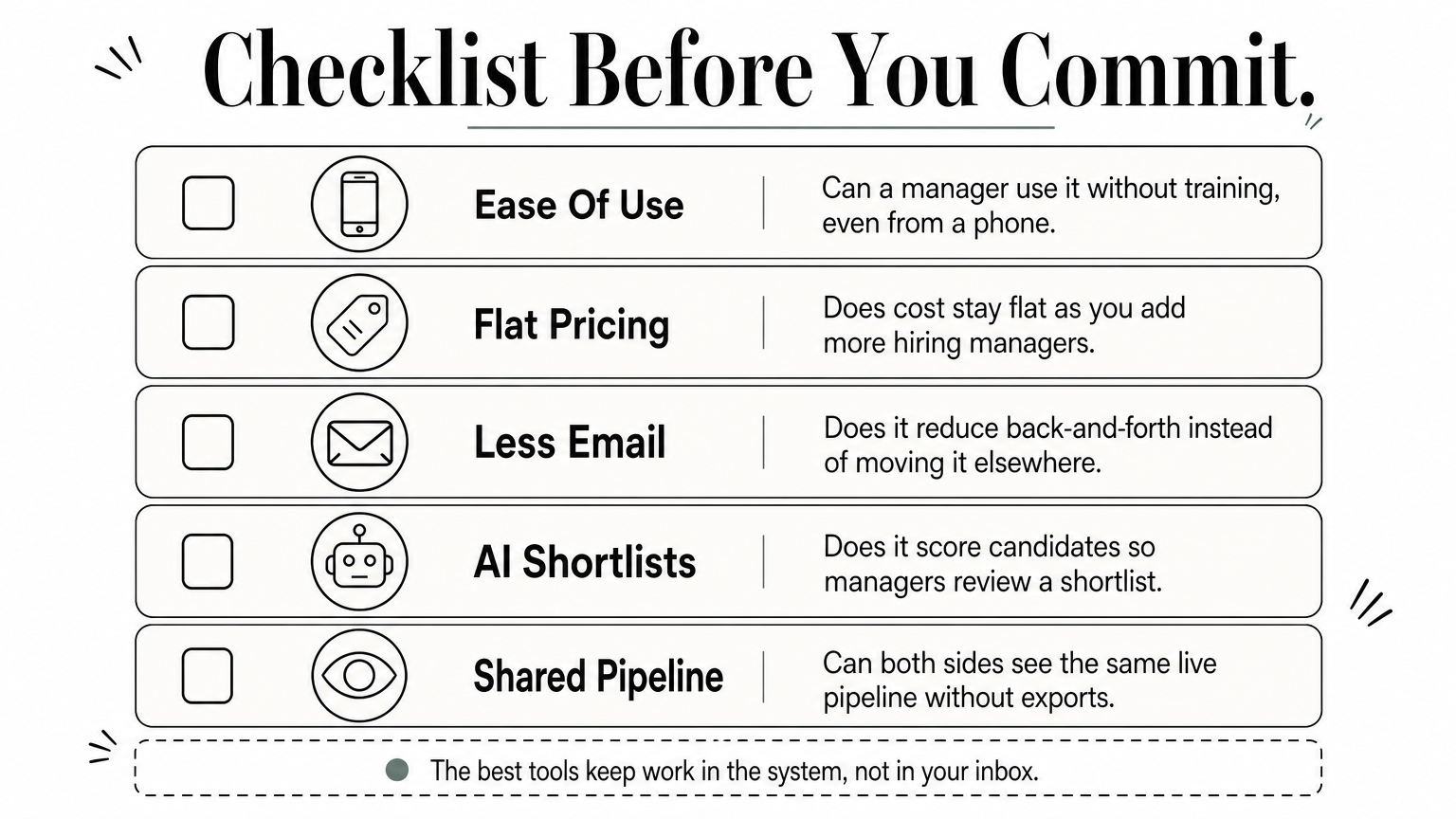
Before you commit, run each finalist through a short checklist:
- Can a hiring manager use it without training, on the first try, from a phone if needed?
- Does pricing stay flat as you add more hiring managers, or does every new login cost extra?
- Does it reduce email back-and-forth, or just move the same conversation into a new inbox?
- Does it include AI matching or scoring, so hiring managers review a shortlist instead of a raw pipeline?
- Can recruiters and hiring managers see the same live pipeline, or does feedback require a separate export?
Run a two-week pilot with one real requisition before rolling a tool out company-wide. Adoption problems show up fast when a hiring manager has an actual req riding on the software, not a demo account.
Choosing the right fit for your hiring team
The right hiring manager software is the one that disappears into your existing workflow instead of adding another login nobody opens. Enterprise suites like Greenhouse, Ashby, and Phenom deliver real depth if you've got the budget and a mature interview process to match. Lighter tools like JazzHR, Manatal, and Zoho Recruit fit smaller teams that need speed over analytics. But if you're weighing cost against collaboration, free platforms that don't charge per seat remove the biggest adoption barrier: pricing that punishes you for inviting more hiring managers in.
Olibr built its whole model around that problem, pairing a free shared ATS with a community-powered candidate pool so recruiters and hiring managers work off the same live pipeline from day one. If you're ready to test that firsthand, open a free Olibr recruiter account and run your next requisition through it before you sign anything else.
For hiring teams
Search 180,000+ candidate profiles — free.
Olibr is a community-funded recruiting platform: full ATS, AI interviews, and a shared resume database. No per-seat fees.