12 Best ATS Software for Recruiting in 2026
Every recruiter has the same folder problem: hundreds of resumes in email, dozens more in spreadsheets, and a database that nobody trusts. Picking the best ats software fixes that mess, but with dozens of vendors pitching nearly identical feature lists, the choice gets confusing fast. If you're comparing tools for staffing agencies or an in-house TA team, you need more than a features page, you need to know what actually works at your hiring volume.
This guide is built for recruiters and hiring managers who want a straight answer, not a sales pitch. We've compared top ats software on pricing, candidate database size, resume parsing accuracy, and how well each handles bulk sourcing versus one-off requisitions, so you can match the tool to your actual workflow instead of guessing.
Below you'll find 12 options worth considering for 2026, from enterprise platforms to leaner, budget-friendly picks. We'll cover what each does well, where it falls short, and who it fits best, including where a community-powered talent network with a free ATS included changes the cost equation entirely for agencies tired of paying per seat.
1. Olibr: the free ATS with a shared candidate database
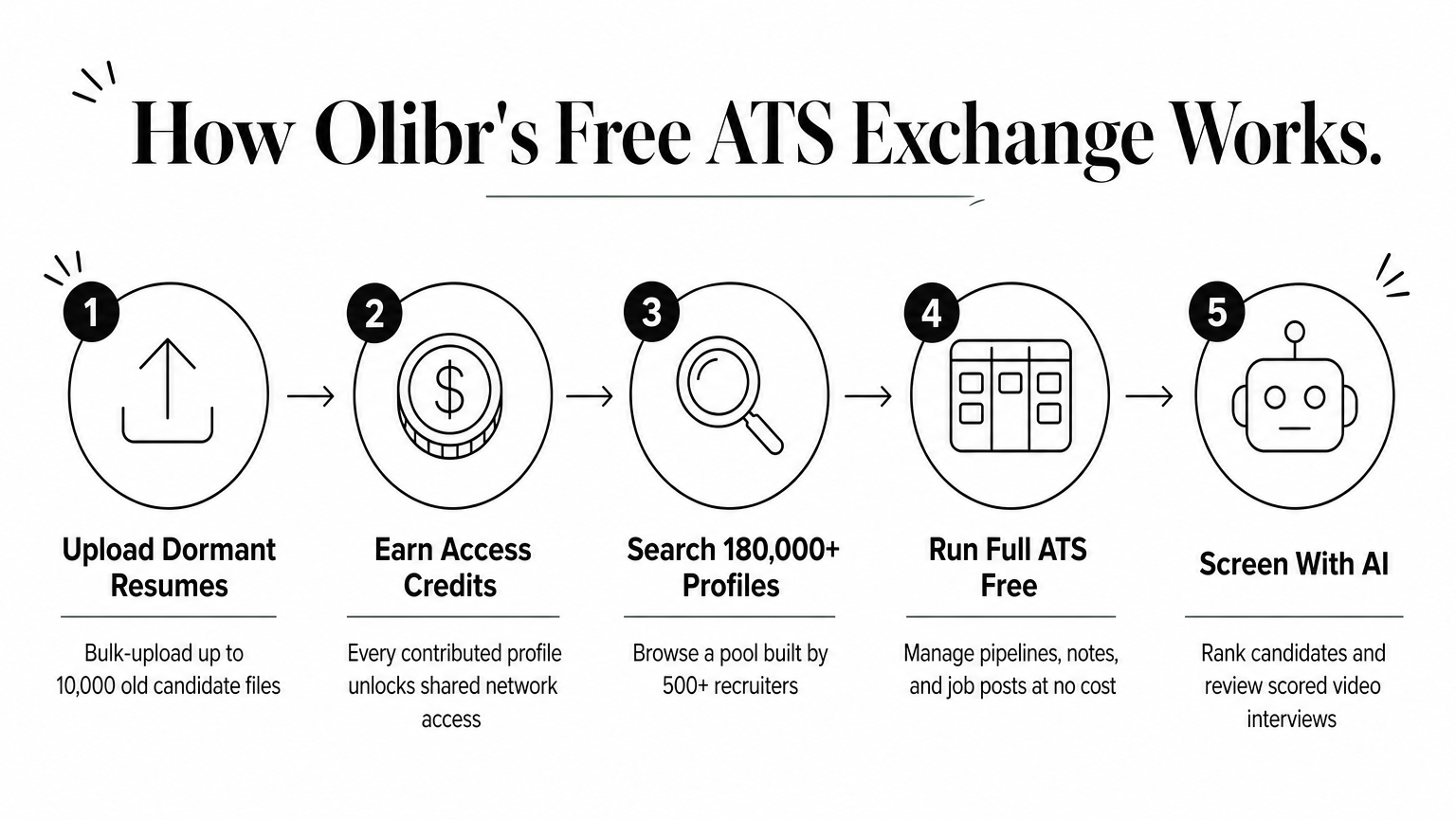
Olibr flips the usual ATS pricing model on its head. Instead of charging per seat or per job post, it runs on a data-sharing exchange: you upload the dormant, no-longer-active candidate profiles sitting in your existing database, and in return you unlock access to a shared pool of 180,000+ verified profiles you can search by skill and location, contributed by 500+ other recruiters. The ATS itself, the job board, and the AI tools all come free with that exchange. For agencies that have spent years sourcing candidates who never got placed, this turns wasted data into working inventory.
How it works
Getting started means bulk-uploading your existing candidate files (PDF, DOCX, or CSV), and Olibr's parser handles up to 10,000 profiles in one batch, tagging skills, experience, and location automatically. Contributing profiles keeps your access to the shared network open; contact reveals and AI tools are paid per use from a wallet. Once you're in, the full ATS takes over: kanban pipeline stages, team notes, role-based permissions, and unlimited job postings, all standard. Olibr's AI matching ranks candidates against your job description instead of just keyword-matching, and AI-powered video interviews add expression analysis and scored transcripts so you can screen at scale without sitting through every call live.
A dormant resume in your ATS is worth nothing until someone can search it. Olibr turns that dead weight into a bigger, shared talent pool for everyone who contributes.
Who it's for
Olibr fits recruiters and staffing agencies who are tired of paying separately for an ATS, a candidate database subscription, and job board credits, and who have an existing database with unused profiles worth contributing, the same case made by other no-cost tools built for recruitment agencies. It's a strong match for:
- Small to mid-sized agencies juggling multiple paid tools
- In-house TA teams wanting to cut cost-per-hire without losing functionality
- Recruiters comfortable pooling anonymized, dormant profile data for a bigger search radius
- Teams that want unlimited seats without per-user licensing fees
Retained search firms or NDA-bound recruiters who can't share candidate data at all still have a path in, covered below.
Pricing
Olibr's core plan costs nothing: no credit card, no trial period, no seat limits. Access is earned by contributing profiles rather than by paying a subscription. For recruiters who need the platform's full functionality but can't share candidate records due to client contracts or confidentiality agreements, Olibr is not the right fit, since there is no paid plan that replaces contribution. These keep your data fully separated and encrypted while still giving you the ATS, job board, and AI screening tools. You can see current plan details and sign up directly on the Olibr pricing page, where the exchange terms and private-plan rates are listed side by side.
2. Breezy HR: budget-friendly ATS for small teams
Breezy HR built its name on being the friendliest ATS for teams that don't have a dedicated recruiting ops person. It trades some of the deep customization found in enterprise tools for a drag-and-drop pipeline that anyone on a five-person hiring team can pick up in an afternoon. If you're scanning a list of ats software and want something that won't require a training session, Breezy usually lands near the top of that shortlist.
How it works
Jobs post to Breezy's own career page plus a handful of free job boards, and candidates flow into a visual pipeline you drag between stages. Automated actions handle the busywork: rejection emails, interview reminders, and offer letter templates all trigger without you touching them manually. Breezy also bundles one-way video screening, so candidates record answers to preset questions before a recruiter ever schedules a live call.
Breezy earns its reputation by being usable, not by being the most powerful ATS on the market.
Who it's for
Small businesses and startups hiring under 20 roles a year get the most value here, since Breezy's simplicity starts to feel limiting once you're running complex, multi-department requisitions. Staffing agencies with light candidate volume also do fine on it, though the shared-database size and AI matching depth won't match what a community-powered talent network like Olibr offers at zero cost.
Pricing
Breezy runs on a tiered monthly subscription with per-active-job limits rather than per-seat fees.
| Plan | Monthly cost (approx.) | Active jobs |
|---|---|---|
| Bootstrap | Free | 1 |
| Startup | ~$189 | 3 |
| Growth | ~$329 | 6 |
| Business | ~$529 | Unlimited |
Pricing scales quickly once you outgrow the free tier, which is worth factoring in before committing.
3. Greenhouse: structured hiring and DEI-focused ATS
Greenhouse built its reputation on structured hiring, a methodology that forces every interviewer to score candidates against the same rubric instead of going on gut feel. If your team has ever argued about why one candidate got an offer and another didn't, Greenhouse's scorecards are designed to remove that ambiguity. It's a common answer when recruiters ask peers for ats software names worth trusting at enterprise scale, especially in companies where hiring decisions get audited.
How it works
Every requisition in Greenhouse starts with a defined scorecard, interview kit, and hiring plan before a single candidate applies. Interviewers submit structured feedback tied to specific competencies, and hiring managers see aggregated scores instead of scattered opinions. Greenhouse also layers in DEI tools: anonymized resume review, diverse interviewer panel tracking, and reporting that flags where bias might be creeping into your funnel. Integrations run deep, connecting to over 400 third-party tools including background check providers and assessment platforms.
Structured scorecards don't just speed up decisions, they make hiring defensible when someone asks why.
Who it's for
Greenhouse suits mid-size to large companies with dedicated recruiting operations teams who need consistency across dozens of hiring managers. It's a strong fit for organizations under pressure to show fair, auditable hiring practices, including those tracking diversity metrics for compliance or investor reporting. Smaller agencies without the headcount to build out scorecards for every role often find the setup overhead heavier than what they need, and the candidate sourcing side still relies on your own outreach rather than a shared pool like Olibr's 180,000+ profile network.
Pricing
Greenhouse doesn't publish flat rates; pricing is quoted per company based on employee count and hiring volume, typically starting in the low four figures annually for smaller teams and climbing well past that for enterprise contracts. Expect a sales call before you see real numbers, and factor in implementation time since structured hiring setup isn't instant.
4. BambooHR: all-in-one HR platform with built-in ATS
BambooHR started as core HR software, payroll, PTO tracking, employee records, and added recruiting later, which shows in how it's built. The ATS lives inside a bigger HR suite rather than standing alone, so the appeal isn't sourcing power, it's not juggling separate systems once a candidate signs an offer letter. If your team already runs BambooHR for HR and wants hiring in the same login, it's worth a look before shopping standalone ats software providers.
How it works
Requisitions post to a handful of job boards and a branded careers page, and applicants land in a simple pipeline with customizable stages. Once you make an offer, the same candidate record converts into an employee file, no re-entering names, contact details, or documents into a second system. Automated emails handle interview scheduling and rejection notices, and hiring managers can leave feedback directly on candidate profiles without a separate tool.
BambooHR's real value isn't the ATS itself, it's not needing a second system once someone gets hired.
Who it's for
Small and mid-sized companies with under 500 employees who want HR and hiring under one roof fit BambooHR best, particularly ones without a dedicated recruiting team running high-volume searches. It's a weaker match for staffing agencies placing candidates for other companies, since the onboarding-to-employee-record handoff assumes you're hiring for yourself, not a client. Agencies needing a bigger sourcing pool should look at options built specifically for recruiting volume instead.
Pricing
BambooHR prices per employee per month, bundled into HR platform tiers rather than sold as a standalone ATS. The ATS module (called Hiring) is an add-on to the core HR plan, and exact rates require a quote based on headcount, typically landing in the mid-to-high single digits per employee monthly once you add recruiting features. There's a free trial, but no permanent free tier for the ATS itself.
5. Teamtailor: automated workflows and employer branding
Teamtailor treats your careers page like a marketing asset, not an afterthought bolted onto an ATS. The platform is built around the idea that employer branding wins candidates before a job description ever gets read, so it puts as much engineering effort into your public-facing pages as it does into the pipeline behind them. If you're comparing ats software providers and your team already struggles to get candidates to apply at all, Teamtailor addresses that gap directly instead of assuming applicants will show up on their own.
How it works
You build a custom careers site inside Teamtailor using drag-and-drop blocks, no developer needed, and it publishes with your own branding, employee stories, and video content baked in. Automated triggers move candidates through stages, send scheduled emails, and nudge hiring managers when feedback is overdue, so nothing sits untouched for a week. Teamtailor also includes a built-in candidate nurture feature that keeps a database of past applicants warm with automated newsletters, useful when you want to refill a pipeline without starting sourcing from zero.
A careers page that looks like an afterthought tells candidates your hiring process is one too.
Who it's for
Teamtailor fits companies that treat recruiting as a branding function, consumer brands, scale-ups, and agencies pitching employer branding services to clients. It suits teams with someone dedicated to content and design, since the platform rewards effort put into the careers page. Recruiters more focused on raw sourcing volume than brand polish, or agencies without a shared candidate pool to draw from, will find the database side thinner than what a network like Olibr's 180,000+ profiles provides.
Pricing
Teamtailor prices per active job opening on a subscription basis, with tiers scaling by job volume and added features like video interviews or advanced analytics. Rates aren't published in full and typically require a quote, though the entry tier starts in the low hundreds of dollars monthly for smaller teams running a handful of open roles at once.
6. Manatal: AI-powered candidate sourcing and scoring
Manatal built its pitch around one idea: recruiters spend too much time searching and too little time talking to candidates. The platform leans hard into AI, pulling in social media and public profile data to enrich candidate records automatically, then scoring each applicant against your job requirements. For recruiters comparing ats software providers on how much manual sourcing they can offload, Manatal is one of the more aggressive AI recruiting platforms on this list.
How it works
Once a job goes live, Manatal's AI scans its own database plus connected sources like LinkedIn to surface candidates who match the role, ranking them by fit score before a recruiter even opens the requisition. Candidate profiles get auto-enriched with social data, skills, and career history pulled from public sources, cutting down the manual research recruiters usually do before an outreach message. The pipeline itself is standard kanban, but Manatal layers in a recommendation engine that resurfaces candidates from past searches when a similar role opens later.
Letting the software rank candidates before you touch a resume saves the most time on high-volume, generic roles.
Who it's for
Manatal suits recruiters running high-volume, repetitive searches, think contact center staffing or retail hiring, where sourcing similar profiles over and over eats up hours every week. Agencies placing candidates across many similar roles benefit more than teams hiring for niche or highly specialized positions, where AI scoring has less signal to work with. It's a reasonable fit for lean teams without a dedicated sourcer, though the candidate pool still depends on what you and your team have sourced, unlike Olibr's shared 180,000+ profile network.
Pricing
Manatal prices per seat on monthly or annual subscriptions, starting around $15 per user monthly on the entry tier and climbing past $50 per user for enterprise features like custom integrations and advanced AI scoring. A 14-day free trial is available, but there's no permanent free tier once it ends.
7. JazzHR: simple ATS for small and mid-sized businesses
JazzHR keeps things deliberately basic, and that's the point. Where Greenhouse or Ashby pile on workflow logic, JazzHR strips recruiting down to job posting, applicant tracking, and interview scheduling, then stops. Recruiters scanning ats software names for something a five-person HR team can run without a training budget usually land here, since the learning curve is closer to a spreadsheet than an enterprise platform.
How it works
Posting a job pushes it out to free job posting sites plus premium ones like ZipRecruiter and Indeed with a paid add-on, and applicants land in a customizable pipeline you build once and reuse across roles. Interview scheduling syncs with your calendar, and JazzHR auto-generates offer letters from templates, cutting down repetitive drafting. Custom application questions and knockout filters let you screen out unqualified applicants before a recruiter opens a single resume, which matters when volume gets high on entry-level roles.
A tool built to do fewer things well still beats one that does everything poorly.
Who it's for
JazzHR fits small and mid-sized businesses hiring under a few dozen roles a year without a dedicated recruiting operations function. Startups and small agencies that want structure without configuration overhead do well here, though top ats for recruiting at scale usually means outgrowing JazzHR's reporting depth within a year or two. Teams needing a shared candidate pool beyond their own sourcing history won't find one, unlike Olibr's contribution-based network of 180,000+ profiles.
Pricing
JazzHR runs three subscription tiers based on open job limits: Hero starts around $75 monthly for 3 open jobs, Plus adds unlimited jobs and reporting around $269 monthly, and Pro adds advanced permissions and support near $420 monthly. A free trial is available, but no permanent free tier exists once it ends.
8. Workable: advanced candidate search and AI screening
Workable has been around long enough to build one of the largest built-in sourcing networks on this list, and it shows in how confidently it markets itself against pricier enterprise tools. The platform pairs a deep candidate search engine with AI screening that flags top applicants automatically, aiming to save recruiters the manual triage step most ATS tools leave entirely to humans. For teams weighing best ats for recruiting based on raw sourcing reach, Workable's database access is a real differentiator.

How it works
Jobs post to 200+ job boards with a single click, and Workable's own sourcing tool searches over 400 million candidate profiles pulled from public sources, letting you find passive candidates without leaving the platform. AI screening scores incoming applicants against the job requirements and surfaces the strongest matches at the top of the pipeline, cutting down time spent scrolling through unqualified resumes. Workable also includes one-way and live video interviewing, plus automated reference checks that send questionnaires directly to a candidate's references without a recruiter chasing responses by email.
A bigger built-in search index only helps if the AI ranking behind it actually surfaces the right people first.
Who it's for
Workable suits mid-sized companies and agencies that want strong sourcing tools without building a scorecard-heavy process like Greenhouse requires. It fits teams hiring across multiple departments who need one system flexible enough for both technical and non-technical roles. Recruiters relying purely on Workable's own database still pay for that reach through subscription tiers, unlike Olibr's model where access to 180,000+ shared profiles comes from contributing data instead of a monthly fee.
Pricing
Workable prices per job slot rather than per seat, with a Starter tier around $169 monthly for limited job slots, scaling to custom enterprise pricing for unlimited postings and advanced AI features. A 15-day free trial is available, but no free tier persists afterward.
9. Zoho Recruit: affordable ATS with built-in AI assistant
Zoho Recruit rides on the back of the larger Zoho ecosystem, and that's exactly why it's cheap. If your team already runs Zoho CRM, Books, or Desk, adding Recruit costs less and integrates faster than bolting on a separate vendor. For agencies comparing best ats recruitment software purely on cost per seat, Zoho consistently undercuts the bigger names on this list while still shipping AI hiring features most competitors charge extra for.
How it works
Jobs post to major boards and your careers site, and applicants flow into a pipeline you customize per client or department, useful for staffing firms running multiple requisitions at once. Zia, Zoho's built-in AI assistant, scores resumes against job criteria, flags top matches, and even suggests interview questions based on the role. Resume parsing pulls structured data from PDFs and DOCX files automatically, and a built-in career site builder lets you launch a branded page without a developer.
Cheap software only wins if the AI features inside it actually work, and Zoho's do most of the heavy lifting other platforms charge extra for.
Who it's for
Zoho Recruit suits staffing agencies and in-house teams already inside the Zoho ecosystem, since the pricing advantage shrinks if you're not using other Zoho products. Budget-conscious small agencies without a dedicated recruiting ops person do well here too. Teams wanting a shared candidate pool beyond their own sourcing still won't find one, unlike Olibr's 180,000+ profile network built from recruiter contributions.
Pricing
Zoho Recruit offers a free tier for a single user with limited job postings, then scales through Standard, Professional, and Enterprise plans priced per recruiter monthly, roughly $25 to $75 depending on tier. A 15-day free trial covers paid plans before committing.
10. Lever: nurturing passive candidates with CRM tools
Lever built its name on treating recruiting as a relationship problem, not just a pipeline problem. Most ATS platforms drop rejected or not-yet-ready candidates into a dead-end status. Lever keeps them warm inside a built-in recruitment CRM, so a strong candidate who wasn't right for one role stays reachable for the next one. For teams comparing best ats recruitment software on how well it handles long-term talent relationships instead of one-off requisitions, Lever is built specifically around that gap.
How it works
Every candidate record in Lever lives inside a searchable talent pool tagged by skills, past interactions, and interest level, so recruiters can pull up warm leads before opening a new sourcing project. Automated nurture campaigns send scheduled emails to candidates in that pool, keeping them engaged without a recruiter manually tracking who to follow up with and when. LeverTRM (its combined ATS and CRM product) also includes visual analytics dashboards showing pipeline health, source effectiveness, and diversity metrics across every open requisition at once.
Treating candidates as a renewable resource, not a one-time applicant, is what separates a CRM-backed ATS from a plain pipeline tool.
Who it's for
Lever suits mid-size to large companies with high hiring volume and repeat roles, where the same skill sets get hired for again and again across quarters. In-house talent acquisition teams running employer branding and long-term sourcing strategies get the most value from the nurture features. Agencies without a steady stream of repeat requisitions, or those wanting a shared external candidate pool rather than just their own warmed-up database, should also weigh Olibr's 180,000+ profile network alongside Lever's internal CRM.
Pricing
Lever doesn't publish flat rates publicly; pricing is quoted per company based on headcount and hiring volume, typically landing in enterprise territory and requiring a sales conversation before you see real numbers. There's no permanent free tier, and implementation usually involves onboarding support given the CRM's added complexity.
11. Ashby: all-in-one recruiting for high-growth teams
Ashby was built for companies that scale fast and outgrow spreadsheets within a single funding round. It packages sourcing, scheduling, analytics, and a built-in CRM into one system, aiming to replace the patchwork of tools most Series B and C startups end up stitching together. Recruiters comparing top ats for recruiting at high-growth companies often land here because Ashby's reporting depth matches what a data-driven VP of Talent expects from day one.
How it works
Jobs move through customizable pipelines while Ashby's analytics engine tracks funnel conversion, time-to-fill, and interviewer scorecard consistency in real time. A built-in sourcing extension pulls candidate data from LinkedIn directly into Ashby, and its scheduling tool handles complex, multi-interviewer panels without the usual back-and-forth. Custom dashboards let recruiting leaders slice data by department, source, or hiring manager, which matters once a company is running dozens of open requisitions simultaneously.
Ashby's real strength is turning scattered hiring data into decisions a VP can act on the same week.
Who it's for
Ashby suits venture-backed startups and scale-ups with a dedicated recruiting team that needs granular reporting, not just a pipeline. Companies hiring aggressively across engineering, sales, and operations at once get the most value from its analytics layer. Smaller agencies or teams without in-house recruiting ops will find the setup more than they need, and the candidate sourcing still depends on your own outreach rather than a shared pool like Olibr's 180,000+ profile network.
Pricing
Ashby doesn't list public rates; pricing is quoted per company based on headcount and hiring volume, typically starting in the low five figures annually. There's no permanent free tier, and a demo call is required before you see numbers.
12. Pinpoint: premium ATS with bias-reduction tools
Pinpoint markets itself on fairness as much as function, building bias-reduction tools directly into the hiring funnel rather than treating diversity as a reporting afterthought. The platform strips identifying details from applications during early screening and flags language in job descriptions that might discourage certain candidates from applying. For teams researching ats software providers who need to defend hiring decisions to a board or compliance team, Pinpoint's audit trail is built for exactly that scrutiny.
How it works
Job postings sync automatically to career sites and job boards, and Pinpoint's anonymized screening hides names, photos, and education details from reviewers until later stages, reducing unconscious bias in early cuts. A built-in DEI dashboard tracks applicant demographics against hires at every pipeline stage, surfacing drop-off points where certain groups exit disproportionately. Automated scheduling, offer letter generation, and a dedicated customer success manager round out the platform, which is unusual for a tool at this price point.
Fairness tools only matter if they're built into the pipeline itself, not bolted on as a report nobody reads until an audit forces it.
Who it's for
Pinpoint suits mid-size to large companies under real pressure, legal, investor, or internal, to show hiring is fair and auditable, not just fast. It fits organizations with a dedicated recruiting ops function that can use the DEI dashboard actively rather than letting it sit unused. Agencies without compliance requirements or a large in-house team will likely find the bias-reduction layer more than they need, and like most tools on this list, Pinpoint's candidate pool is limited to what your team sources yourself, unlike the shared network Olibr provides at no cost.
Pricing
Pinpoint doesn't publish flat rates; pricing is quoted per company based on headcount, typically starting in the low five figures annually with a dedicated onboarding period included. There's no permanent free tier, and a demo call is required before you see real numbers.
13. How to choose the best ATS software for your team
Matching the right platform to your team starts with an honest look at volume. A recruiter placing 15 candidates a year needs something closer to JazzHR or another lightweight ATS built for small businesses, while an agency running hundreds of requisitions across clients needs the sourcing depth of Workable or the shared reach of Olibr. Picking the best ats software without that volume check is how teams end up paying enterprise prices for features they'll never use.
Budget matters just as much as features, but compare total cost, not sticker price. Per-seat pricing punishes growing teams, per-job pricing punishes agencies running many small roles at once, and quote-only enterprise tools hide real costs until a sales call, which is a big part of how ATS licensing got this expensive. Run the math against your actual hiring calendar before signing anything.
The best ATS isn't the one with the longest feature list, it's the one that matches your hiring volume and budget without forcing you to pay for capacity you'll never use.
Consider these factors before shortlisting any vendor:
- Candidate database size: does the tool give you a shared resume database, or only what your team sources itself?
- Parsing and bulk upload limits: can it handle your existing resume backlog in one batch?
- Pricing structure: per seat, per job, or per company, and does it scale with your growth?
- AI screening depth: does the resume screening AI rank candidates meaningfully, or just keyword-match?
- Integration needs: does it connect to your existing HR, payroll, or CRM stack?
Demand a real trial before committing budget. Every vendor on this list, except pure enterprise quote-only tools, offers a trial or free tier, so test it against a live requisition rather than a demo script. Genuinely free ATS platforms like Olibr remove even that risk, since there's no card on file and no contract to unwind if the fit is wrong.
Choosing the right ATS for your team
Twelve platforms, one decision: match the tool to your hiring volume, not the feature list. Enterprise systems like Greenhouse or Ashby earn their price tag at scale, but most agencies and in-house teams pay for capacity they never touch. Budget-conscious teams get more mileage from lean tools like JazzHR or Zoho Recruit, while agencies drowning in unused sourcing data get the most value from a model that turns that backlog into leverage instead of dead weight.
That's the gap Olibr fills. You're not paying per seat or per job, you're contributing dormant profiles and unlocking a shared talent pool plus a full ATS in return. No card on file, no contract, no sales call before you see real numbers. If your database has candidates nobody's called back in a year, stop letting that sourcing work sit idle. Set up a free recruiter account with full ATS access and see what your existing data is actually worth.
For hiring teams
Search 180,000+ candidate profiles — free.
Olibr is a community-funded recruiting platform: full ATS, AI interviews, and a shared resume database. No per-seat fees.