8 Free Resume Database Options for Recruiters in 2026
Recruiting platforms love to charge premium prices for what should be a basic feature: letting you search resumes. Between LinkedIn Recruiter, Naukri RMS, and Indeed, teams regularly spend ₹40,000 to ₹2,000,000+ per month just to access candidate profiles. But a free resume database for recruiters isn't some mythical perk, several platforms offer genuine, no-cost access to searchable candidate pools right now.
The trick is knowing which ones actually deliver usable results and which ones bait you with "free" labels only to lock real functionality behind a paywall. Some give you a handful of profile views before demanding a credit card. Others, like Olibr, provide full access to 180,000+ candidate profiles with advanced filtering, AI-powered matching, and no subscription fees at all, funded instead by a community model where recruiters contribute resumes to a shared database.
This guide breaks down eight free resume database options available to recruiters in 2026, covering what each platform actually offers, where the limits kick in, and which ones are worth your time depending on your hiring needs and market focus.
1. Olibr
Olibr is built around a simple idea: recruiters who contribute resumes to a shared pool get full access to everything the platform offers, without paying a monthly fee. That makes it one of the few genuinely free resume database for recruiters options that doesn't quietly gate its best features behind a paid tier.
What it is and why it's free
Olibr runs on a community contribution model where you upload 50 candidate profiles per active user every 30 days to keep your access free. There's no subscription tier and no feature wall. Every recruiter, regardless of company size, gets the same access from day one, which levels the playing field between a two-person agency and a large in-house team.
Database coverage and candidate freshness
The platform holds over 180,000 candidate profiles spanning roles in tech, product, design, and beyond, with coverage across both the US and India markets. Because the database grows through active recruiter contributions, profiles tend to reflect candidates currently in circulation rather than resumes sitting untouched for years.
Olibr's community-driven model keeps the candidate pool self-refreshing, which directly reduces time spent filtering outdated or unresponsive leads.
Search filters and matching capabilities
You can filter candidates by skills, experience level, location, domain, and career background, which cuts down on the manual screening that consumes most of a recruiter's day. Olibr also layers in AI-powered matching that reads job descriptions and compares them against resume content to predict fit, going well beyond simple keyword overlap.

Outreach and workflow features
Olibr includes a full Applicant Tracking System (ATS) with pipeline management built in, so you're not juggling spreadsheets alongside a separate sourcing tool. The platform also supports AI-conducted interviews with automated scoring and facial expression analysis, letting you move candidates through early screening stages without scheduling calls.
Limits, rules, and data-sharing expectations
The main expectation is transparent: you contribute resumes to gain access. Access comes from contributing candidate profiles, and those profiles enter the shared community database under Olibr's data-sharing terms. If your team sits on a large existing resume archive, this trade-off delivers significant platform value fast.
2. Indeed Resume
Indeed's resume database gives recruiters some free access, but the platform is built to push you toward paid features fairly quickly. You can browse candidate profiles and run basic keyword searches without a subscription, making it a reasonable starting point when your hiring budget is limited.
What you can do for free vs what gets gated
Free accounts let you view resume summaries and run searches by job title, skills, and location, but full contact information and direct messaging sit behind a paid plan. You get a limited number of free resume views per month before the platform pushes you toward an upgrade, so spend them carefully on your most promising candidates.
Best ways to search and filter for quality
Use combination filters for job title, skills, and location together to narrow results before spending any free views. Sorting by most recent activity helps surface candidates who are actively job-hunting rather than those who uploaded a resume two years ago and stopped checking.
Filtering by recent activity before clicking any profile saves your limited free views for candidates who are actually reachable.
How outreach works and common contact limits
Direct messaging on Indeed is not available on a free account. Reaching out to candidates requires paid messaging credits that you purchase separately, outside any subscription tier.
Candidate freshness and profile quality signals
Indeed flags recently active profiles in search results, which helps you skip stale listings. Profile completeness varies significantly, so use work history detail and recent activity dates as your main quality signals.
Pricing basics if you need to message candidates
Messaging candidates costs per contact or message credit, with rates that vary by market and role type. For high-volume hiring, those credits add up fast, making Indeed less practical as a free resume database for recruiters compared to platforms built entirely around no-cost access.
3. Resume-Library Free Resume Search
Resume-Library is a UK-founded job board with a North American presence that gives recruiters some access to its candidate database without upfront payment. It works as a useful supplementary source when you need to cast a wider net beyond the major players.
What the Free Search Includes
Free accounts let you run basic searches and view partial candidate profiles, including job titles, general location, and experience summaries. Full contact details and complete resume views require a paid plan, but the search interface itself is accessible without a credit card.
Where It Performs Best by Role and Location
Resume-Library performs strongest for mid-level roles in manufacturing, logistics, engineering, and administrative support. Its candidate pool skews toward blue-collar and trade industries, so if you hire primarily for those verticals, it punches above its weight compared to a general free resume database for recruiters.
Resume-Library is a poor fit for sourcing senior tech or executive talent, where its candidate density drops significantly.
Search Tips for Narrowing Fast
Combine job title keywords with a tight location radius to avoid sifting through irrelevant profiles. Using industry-specific terminology rather than generic titles surfaces more relevant candidates faster.
Contact Options and Typical Paywalls
Unlocking full contact information costs credits, which you purchase or earn through your account plan. Free users cannot message candidates directly.
Common Pitfalls with Duplicates and Stale Resumes
The database contains duplicate entries and outdated profiles, particularly for candidates who applied to multiple postings over several years. Always cross-reference last active dates before investing time in outreach.
4. Wellfound
Wellfound, formerly AngelList Talent, focuses specifically on startup and early-stage company hiring. The platform has a smaller overall candidate pool than general job boards, but the candidates on it actively want to work at startups, which makes it a strong fit for growth-stage companies and lean hiring teams.
What's Actually Free on the Platform
Wellfound lets you create a company profile and post jobs at no cost, and candidates who apply come with full profiles you can view without paying. As a free resume database for recruiters, it works best when you treat it as an inbound source, because browsing and proactively searching the candidate database without a paid plan is limited.
When It Beats General Job Boards
Wellfound consistently outperforms general boards when you need candidates who understand equity compensation and startup risk profiles. Candidates here expect roles with growth upside, so if your company offers that, conversion rates from application to hire tend to run higher than on platforms like Indeed.
Wellfound is a poor fit if you're hiring for traditional corporate roles where candidates prioritize stability over equity.
How to Search for Startup-Ready Candidates
Use role-type filters combined with skill tags to narrow the pool quickly. Filtering by candidates who explicitly list startup experience in their profiles surfaces people who already know what they're getting into.
Messaging Rules for Inbound vs Outbound Recruiting
For inbound applicants, you can message freely. Reaching out to candidates who haven't applied to your role requires a paid subscription.
Pricing Basics if You Need Proactive Outreach
Wellfound's paid recruiter plan unlocks full database search and direct outreach. Pricing is available on request through their sales team, and it's typically structured as a monthly flat fee.
5. PostJobFree
PostJobFree is a no-frills job board that extends free resume access alongside free job posting. Unlike most platforms that use resume search as an upgrade hook, PostJobFree keeps the core database open without requiring a credit card.
What's Free and What's Restricted
PostJobFree gives you free job posting and free resume browsing without any subscription requirement. Most candidate profiles include direct contact details, which means you can reach out without purchasing messaging credits. Sponsored job boosts and featured listings are available for a fee, but those are optional add-ons, not gates on core recruiting functionality.
Best Use Cases and Where the Database Skews
The candidate pool skews heavily toward entry-level and mid-level positions in retail, hospitality, warehousing, and general administrative roles. If you're sourcing senior engineers or specialized technical talent, this platform will disappoint. It works best as a free resume database for recruiters filling high-volume, lower-complexity roles where turnaround speed matters more than deep candidate screening.
PostJobFree is a poor fit for niche or senior hiring, but it can fill straightforward roles faster than platforms that charge per contact.
Search Workflow and Filtering Tips
The search interface is basic, so keep your approach simple. Use specific job titles paired with a tight geographic radius to avoid irrelevant results. Manual scanning is unavoidable given the limited filter options.
How to Contact Candidates Without Wasting Time
Check the profile upload date and most recent resume activity before drafting any outreach. Many profiles go inactive within weeks of posting, so prioritize candidates who added or updated their resume in the last 30 to 60 days.
Pricing Basics and When It Makes Sense to Upgrade
Paid options center on boosted job post visibility rather than unlocking database features. Upgrading only makes sense if your free postings consistently generate low inbound volume and you want more placement in search results on the platform.
6. JobSpider
JobSpider is one of the older independent job boards still operating, and it remains genuinely free on both sides of the marketplace, for job seekers posting resumes and for recruiters searching them. There are no premium tiers, no credits to purchase, and no contact limits hidden behind an upgrade wall.
What makes it truly free end to end
The platform generates revenue through display advertising rather than recruiter subscriptions, which keeps the core database access open without any payment requirement. Posting jobs costs nothing, and searching resumes costs nothing. As a free resume database for recruiters, it's one of the few options where "free" holds up when you actually test the features rather than just reading the marketing copy.
Candidate types and roles where it works best
The database skews toward blue-collar, trade, and administrative roles, with stronger coverage in general labor, customer service, and clerical positions. Technical and senior professional roles are sparsely represented, so set your expectations accordingly before investing sourcing time here.
If your hiring focus is office support, light industrial, or entry-level service roles, JobSpider delivers real value without any cost.
How to search and shortlist efficiently
JobSpider's search tools are basic by modern standards, so keep your queries simple. Use specific job titles combined with ZIP code or city to avoid scrolling through geographically irrelevant results before finding a usable shortlist.
How candidate contact works
Most profiles include direct email addresses or phone numbers, so you can reach candidates without purchasing credits or navigating a separate messaging system.
Tradeoffs versus modern recruiting tools
JobSpider has no AI matching, no ATS integration, and no pipeline management. It functions purely as a searchable resume archive, which means all screening, tracking, and follow-up fall on you to manage in a separate system.
7. GitHub
GitHub isn't a traditional resume database, but it functions as one of the most powerful free resume database for recruiters options when you're sourcing technical candidates. Developers use their profiles to showcase real work, making GitHub a direct window into what someone can actually build rather than what they claim on a polished document.
Why GitHub functions like a resume database
Every public GitHub profile doubles as a live portfolio. You can see actual code contributions, project history, and commit frequency, which tells you far more about a developer's capabilities than a traditional resume keyword list ever could.
What to look for on profiles to judge fit fast
Focus on repository activity and contribution frequency rather than follower counts. Pinned repositories show what the candidate considers their best or most relevant work, so start there before digging deeper into their commit history.
Practical search paths that surface the right people
Use GitHub's native search with language filters to find developers working in specific tech stacks. Searching for contributors to popular open-source projects in your target domain surfaces people already working at a high level in that area.
Filtering by programming language and recent commit dates cuts through inactive accounts and surfaces candidates who are actively writing code today.
How to find contact details and reach out respectfully
Many developers list an email address or personal website directly on their profile. Check the bio and "About" section first before trying any third-party lookup tool.
Limits and compliance considerations for sourcing
GitHub profiles are publicly available but not explicit job-seeking signals. Keep your outreach brief and role-specific, and avoid bulk messaging since developers notice it quickly and ignore it.
8. Google X-Ray Search
Google X-Ray search turns the world's largest search engine into a free resume database for recruiters by letting you query specific websites for publicly indexed candidate profiles. You need no platform subscription, just a solid understanding of Google's search operators.
How X-Ray Works for Recruiter Resume Hunting
X-Ray relies on the site: operator to focus Google's crawl on a specific domain, combined with role or skill keywords to surface relevant profiles. A basic string like site:linkedin.com/in "data engineer" "Austin" restricts results to LinkedIn public profiles in that city. This sidesteps platform paywalls entirely.
Best Search Strings to Find Resumes and Portfolios
Your most productive queries combine the site: operator with job title, skills, and location. Adding terms like "resume" or "CV" sharpens results further. Two reliable formats:
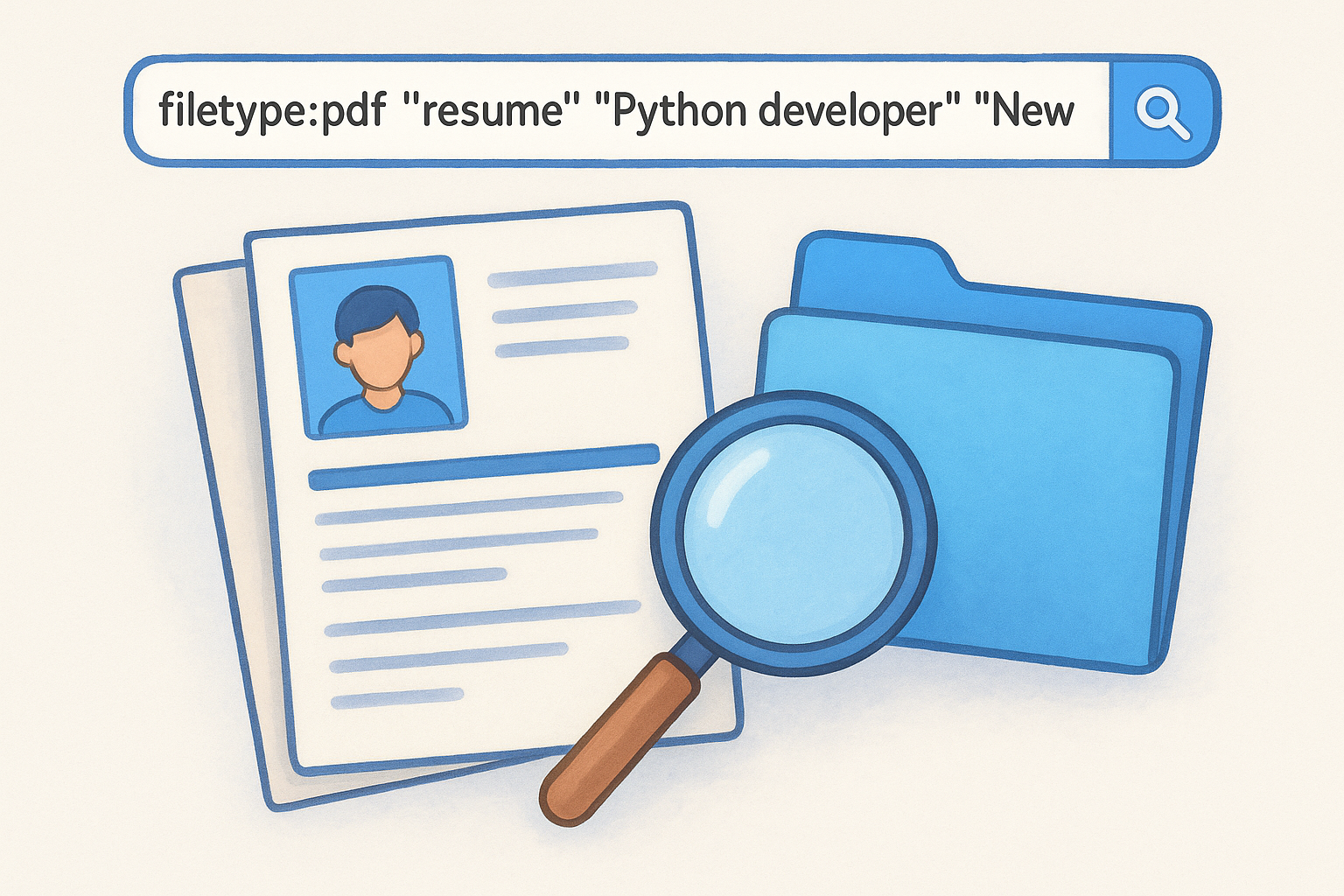
filetype:pdf "resume" "Python developer" "New York"site:github.com "machine learning" "open to work"
Combining filetype:pdf with specific role keywords surfaces candidate documents that never appear inside a traditional recruiting platform.
Where X-Ray Still Works Well and Where It Doesn't
X-Ray performs best for technical roles and niche specialists with detailed public profiles. It falls short for roles where candidates keep a minimal online footprint, such as many operations or finance positions.
How to Turn a Profile Find into a Reachable Lead
Once you locate a profile, scan the bio, personal website link, and any listed email address before reaching for a third-party lookup tool. Many candidates list contact details directly on public pages.
Common Mistakes That Waste Hours
The biggest drain is running searches that are too broad, which floods your results with irrelevant pages. Keep every string tight and role-specific, and check profile activity dates before you write a single outreach message.
Next Steps
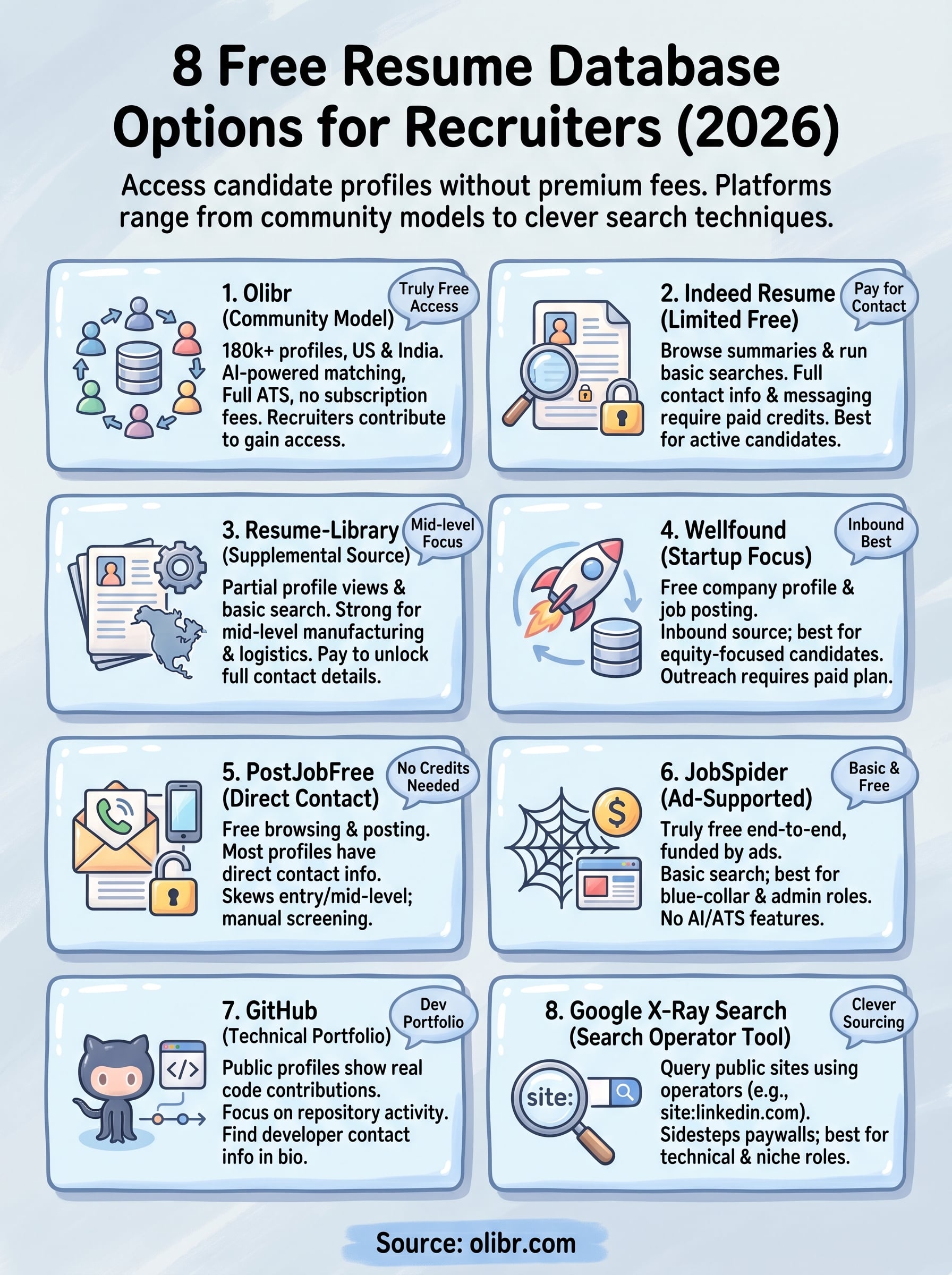
Each platform on this list covers a different slice of the hiring market, so the right choice depends on what roles you're filling and how much manual work you're willing to absorb. GitHub and Google X-Ray take effort but cost nothing. PostJobFree and JobSpider give you direct contact without credits. Most of the others gate their best features quickly once you try to act on a candidate.
If you want a free resume database for recruiters that includes AI-powered matching, a built-in ATS, and no subscription fee, Olibr is worth testing first: the shared pool opens once you contribute your own profiles. The platform gives you 180,000+ searchable candidate profiles across US and India markets without a monthly fee, and contributing your existing resume archive earns you full credits fast. You get the same feature set as every other recruiter on the platform, regardless of company size or hiring volume.
Start searching candidates on Olibr and see how far you get before you consider paying for anything else.
For hiring teams
Search 180,000+ candidate profiles — free.
Olibr is a community-funded recruiting platform: full ATS, AI interviews, and a shared resume database. No per-seat fees.