10 Best ATS and CRM Options for Recruiting Agencies in 2026
If you're running a staffing agency, you already know the pain of juggling tools. One system tracks candidates, another manages client relationships, and a spreadsheet somewhere holds the resumes nobody got back to. Picking the right ats for recruiting agency operations means finding software that handles sourcing, pipeline tracking, and client communication without forcing your team to log into five different dashboards a day.
This guide skips the generic ATS roundups built for corporate HR teams and focuses on what agencies actually need: fast resume parsing, a searchable candidate database, and CRM features that keep placements and client billing on track, the same criteria we used when comparing ATS options for staffing agency desks. We compare pricing, standout features, and real limitations for each option, so you can match a tool to your agency's size and budget instead of guessing from a features page.
You'll find everything from enterprise-grade recruiting agency ats platforms to leaner, budget-friendly picks, including Olibr, which pairs a free ATS with a shared pool of 180,000+ candidate profiles instead of charging per seat. By the end, you'll have a shortlist of the best ats and crm for recruiting that fits how your agency actually sources and places candidates in 2026, not how software vendors assume you do, and you can pair it with our wider ATS software comparison for recruiting teams.
1. Olibr: community-powered ATS and CRM, free with contribution
Olibr takes a different approach to solving the ATS problem than every other tool on this list. Instead of charging per seat or per job posting, Olibr runs on a data-sharing exchange: you contribute the dormant, no-longer-active candidate profiles already sitting in your database, and in return you unlock access to a shared pool of 180,000+ verified candidate profiles sourced by 500+ other recruiting agencies. Most agencies never revisit 90% of the candidates they've sourced once a role closes. Olibr turns that dead weight into a searchable network, while giving you a full ATS and CRM platform at no cost. For agencies tired of paying for a candidate database subscription on top of their ATS license, this model alone is worth a serious look alongside other recruitment agency tools that cost nothing.
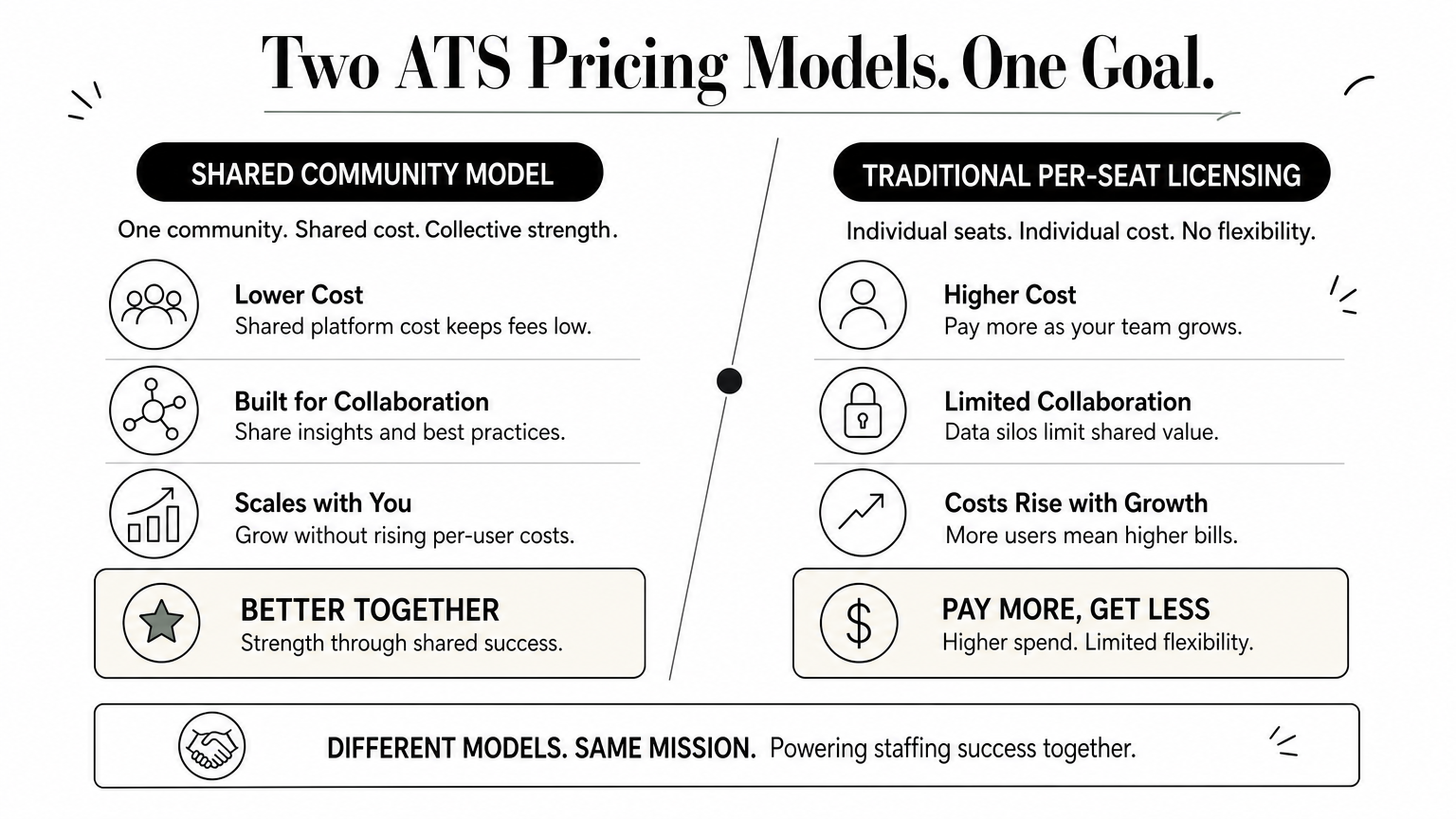
An ATS that pays you back in candidate access, instead of charging you for it, changes the math for small and mid-sized agencies.
Key features
Olibr isn't just a database-sharing gimmick bolted onto a basic tracker. The platform includes the pipeline management, automation, and screening tools agencies expect from a paid recruiting agency ats, plus a few that most competitors charge extra for.
- Shared candidate network: tap a shared talent pool of 180,000+ profiles by skill, experience, and location, contributed by a community of active recruiters
- Full ATS included free: kanban pipeline stages, notes, tagging, and team collaboration without a separate license
- AI matching: ranks candidates against your job description using more than keyword overlap, so you catch strong candidates that a boolean search would miss
- Video interviews scored by AI: expression analysis and scored transcripts let you screen at scale before a human recruiter steps in
- Bulk upload and parsing: import up to 10,000 profiles at once from PDF, DOCX, or CSV files, so migrating an existing database takes hours, not weeks
- Unlimited job postings on an integrated job board with applicant tracking baked in
- Role-based permissions and unlimited team seats, so pricing doesn't punish you for growing headcount
For agencies still running searches manually across spreadsheets and email threads, the AI matching and bulk parsing alone typically cut sourcing time by days per role.
Best for
Olibr suits small to mid-sized agencies and in-house talent acquisition teams who want to stop paying separately for an ATS, a candidate database, and a job board. It's also a strong fit if your team already has a large backlog of old candidate profiles that never turned into placements. Agencies that source similar roles repeatedly (tech, healthcare, sales) benefit most, since the shared pool skews toward active-recruiter niches. If your firm handles retained search, executive placements, or NDA-bound client work where candidate data can't leave your walls, Olibr still works for you: contributing 50 profiles per active user every 30 days keeps access free, and contributed profiles stay private to your company for 30 days before they join the shared pool.
Pricing
Olibr's core model costs nothing. You contribute dormant candidate profiles from your own database, and you get the full ATS, CRM, job board, and candidate search at no charge, with no credit card or trial period required to start. Access is kept by contributing 50 profiles per active user every 30 days. Olibr's AI video interviews and bulk resume parsing run from a wallet you top up (bulk parsing is INR 1 per resume after the first 50 free per company), while skill assessments are free.
| Plan | Cost | Data sharing | Best for |
|---|---|---|---|
| Community (free) | $0 | Contribute dormant profiles | Agencies open to sharing sourcing data |
| Private | Paid, contact for quote | None, full encryption | NDA-bound and retained search firms |
That pricing structure alone sets Olibr apart from every other tool in this roundup, most of which charge a monthly per-user fee regardless of how much of the database you actually use.
2. Bullhorn: enterprise-grade ATS and CRM for staffing firms
Bullhorn has been the default choice for large staffing firms for over a decade, and it shows in how deep the platform goes. This is a full crm and ats software suite built specifically for agency recruiting, not a repurposed corporate HR tool. It handles everything from sourcing to placement to invoicing, and it integrates with hundreds of third-party tools through its marketplace. The tradeoff is complexity: Bullhorn takes real onboarding time, and most agencies bring in a partner to configure it properly before their team can use it well.
Key features
Bullhorn's strength is depth rather than simplicity. Agencies choose it when they've outgrown lighter tools and need a system that scales across multiple offices and business lines.
- Unified ATS and CRM covering the full desk, from candidate sourcing through client relationship management and billing
- Automation workflows that trigger emails, task reminders, and status updates as candidates move through the pipeline
- Reporting and analytics dashboards built for staffing KPIs like time-to-fill and submittal ratios
- Marketplace of integrations connecting to job boards, background check vendors, payroll systems, and sourcing tools
- Mobile app for recruiters managing pipelines and client calls outside the office
Bullhorn rewards agencies that invest the time to configure it properly, and punishes those who don't.
Best for
Bullhorn suits mid-sized to large staffing agencies with dedicated operations or RevOps staff who can manage the setup and ongoing customization. It's a common pick among firms running multiple business lines, such as combining contract staffing with permanent placement, since the reporting scales with that complexity. Smaller agencies or solo recruiters usually find it heavier than what they need, both in cost and in the learning curve required to get real value out of it.
Pricing
Bullhorn doesn't publish flat pricing. Costs are quoted per user based on the modules you select, and most agencies report contracts starting in the low hundreds of dollars per user, per month, with implementation fees on top for larger rollouts.
| Factor | Detail |
|---|---|
| Pricing model | Custom quote, per user, per month |
| Free tier | None |
| Implementation | Often requires a paid onboarding partner |
| Contract length | Typically annual |
Firms evaluating Bullhorn against a free ats for recruiting agency option like Olibr should weigh that ongoing per-seat cost, and why per-seat ATS pricing climbed this high, against the value of Bullhorn's deeper integrations and reporting before committing.
3. Recruiterflow: AI-native ATS built for executive search
Recruiterflow built its reputation among boutique and executive search firms that need sharper candidate matching than a basic keyword filter can offer. The platform leans heavily on AI throughout the workflow, from parsing resumes to ranking candidates against a job's requirements, which makes it feel less like a tracking tool and more like a sourcing assistant. Agencies running retained search desks, where every submission needs to be a near-perfect fit, tend to gravitate toward Recruiterflow because the matching quality directly protects their reputation with clients.

Key features
Recruiterflow's feature set centers on speeding up sourcing without sacrificing match quality, which matters most for firms working smaller, higher-stakes searches rather than high-volume staffing.
- AI-powered candidate matching that scores resumes against job requirements beyond simple keyword overlap, in line with the stronger AI recruiting platforms compared elsewhere
- Built-in CRM for tracking client relationships, business development pipelines, and email sequences
- Chrome sourcing extension that pulls candidate data directly from LinkedIn and other sites into the ATS
- Customizable pipelines tailored to executive search stages, which often differ from standard staffing workflows
- Analytics dashboards tracking recruiter productivity and pipeline health across open searches
Recruiterflow's AI matching earns its keep on searches where a wrong submission costs you the client relationship, not just the placement fee.
Best for
Recruiterflow fits boutique agencies and executive search firms running fewer, higher-value searches rather than high-volume transactional staffing. Firms that bill on retainer and need to show clients a tightly curated shortlist, rather than a long list of loosely matched resumes, get the most value from the AI scoring. Agencies doing high-volume contract or temp staffing, where speed matters more than precision matching, will likely find Recruiterflow's feature set overbuilt for their needs.
Pricing
Recruiterflow prices per user on a monthly or annual basis, with tiered plans that unlock more automation and reporting at higher levels. There's no free tier, and pricing sits in the mid-range compared to enterprise tools like Bullhorn.
| Plan tier | Approximate cost | Notes |
|---|---|---|
| Growth | Contact for quote | Core ATS and CRM features |
| Scale | Contact for quote | Added automation and analytics |
| Enterprise | Custom | Advanced reporting, dedicated support |
Agencies comparing Recruiterflow against a free ats for recruiting agency alternative should factor in that per-seat cost against how much of the AI matching and CRM depth their search volume actually justifies.
4. Manatal: budget-friendly ATS with AI candidate scoring
Manatal built its name on affordability, and it still undercuts most of the platforms on this list while keeping a genuinely useful AI layer on top. The tool targets small agencies and solo recruiters who want candidate scoring and a searchable database without paying enterprise prices for it. Setup takes an afternoon, not weeks, which matters if you don't have an ops team to run implementation. It won't match Bullhorn's depth or Recruiterflow's search-specific workflows, but for the price, Manatal covers the basics of an ats for recruiting agency needs to run a lean desk.
Key features
Manatal keeps its feature set tight and focused on speed rather than depth, which is exactly why smaller teams like it.
- AI candidate recommendation engine that scores and ranks applicants against open roles automatically, much like other AI resume screening options
- Resume parsing that pulls structured data from uploaded files and social profiles, including LinkedIn
- Kanban-style pipeline boards for tracking candidates through each stage of a search
- Built-in CRM for managing client accounts and business development contacts alongside candidates
- Career page builder so agencies can post jobs on a branded site without a separate tool
Manatal proves you don't need an enterprise budget to get AI scoring on your candidate pipeline.
Best for
Small agencies and independent recruiters get the most value from Manatal, particularly those making their first move away from spreadsheets or a free CRM that's stopped scaling. Startups building a recruiting arm from scratch also lean on it, since the low entry cost and fast setup mean a single recruiter can be productive within days. Larger firms running multiple business lines or needing deep custom reporting will likely outgrow Manatal's simpler dashboards faster than they'd like.
Pricing
Manatal's pricing sits at the low end of the market, with monthly plans scaling by user count and feature access rather than by candidate volume.
| Plan | Approximate cost | Notes |
|---|---|---|
| Professional | Low monthly per-user fee | Core ATS, parsing, career page |
| Enterprise | Higher per-user fee | Advanced AI scoring, custom workflows, priority support |
There's a free trial but no permanent free tier, so agencies wanting a genuinely no-cost option long-term, like Olibr's community model, should compare ATS platforms that stay free permanently once the trial period ends.
5. Recruit CRM: combined ATS and CRM with strong search tools
Recruit CRM markets itself as the platform that finally merges applicant tracking and client relationship management into one workspace, and it delivers on that promise better than most tools that claim the same thing. The standout feature is its search function: a Boolean-style search bar that works across resumes, notes, and email threads, so recruiters stop losing candidates buried three tags deep in an old pipeline. Agencies switching from a patchwork of spreadsheets and a bare-bones ATS tend to notice the difference within the first week, since the search alone saves hours that used to go into manually re-sourcing candidates you'd already found once.
Key features
Recruit CRM leans on integrations and search depth rather than trying to out-automate the enterprise players, which keeps the interface approachable for smaller teams.
- Advanced Boolean search across your entire candidate and client database, not just current job postings
- Kanban and list-view pipelines with drag-and-drop stage changes and bulk actions, mapped to whatever recruiting pipeline stages your desk runs
- Email and calendar sync with Gmail and Outlook, so client and candidate communication stays inside the record
- Zapier and native integrations connecting to job boards, LinkedIn RSS, and video interview tools
- Customizable reporting dashboards tracking recruiter activity, submittals, and placement revenue
A recruiting agency ats is only as good as its search bar, and Recruit CRM built its entire pitch around getting that part right.
Best for
Recruit CRM fits small to mid-sized agencies that run both contingency and retained desks and need one system flexible enough for both. Firms placing a high volume of candidates across varied roles benefit most from the search tools, since finding a half-remembered candidate from eighteen months ago becomes a ten-second lookup instead of a lost afternoon. It's also a common pick among agencies searching for the best ats for recruiting agencies that don't want to sacrifice CRM depth just to save money on the ATS side.
Pricing
Recruit CRM prices per user across three tiers, with higher tiers unlocking automation, custom fields, and API access.
| Plan | Approximate cost | Notes |
|---|---|---|
| Pro | Mid-range monthly per-user fee | Core ATS, CRM, search, reporting |
| Business | Higher per-user fee | Automation, custom fields, priority support |
| Enterprise | Custom quote | API access, dedicated onboarding |
There's a free trial but no ongoing free plan, so agencies wanting a zero-cost, no-contract option long-term will still need to weigh Recruit CRM's per-seat fees against community-funded alternatives like Olibr.
6. Zoho Recruit: affordable ATS with a genuine free plan
Zoho Recruit stands out on this list for actually offering a usable free tier, not just a trial that expires in two weeks, which puts it among the free recruiting tools worth reviewing. Part of the wider Zoho software family, it inherits solid integration with Zoho CRM, Zoho Mail, and dozens of other business apps agencies already run. The interface feels a bit more utilitarian than purpose-built staffing tools like Recruit CRM or Recruiterflow, but for agencies watching every dollar of software spend, Zoho Recruit covers the core of what an ats for recruiting agency needs without asking for a credit card upfront.
A free plan that actually works beats a trial that expires before your first placement closes.
Key features
Zoho Recruit's feature list reads like a staffing-focused trim of the broader Zoho ecosystem, which works in its favor for agencies that value consistency across tools.
- Resume parsing and candidate database with searchable fields pulled automatically from uploaded files
- Client and vendor management modules that separate agency-side CRM work from candidate tracking
- Customizable pipelines and hiring stages that adapt to contingency, retained, or contract placement workflows
- Job board posting to multiple boards from a single dashboard, cutting down on repetitive data entry
- Zoho ecosystem integration, syncing directly with Zoho CRM, Books, and Analytics for agencies already on the platform
Best for
Zoho Recruit suits small agencies and solo recruiters who need real functionality on a genuinely free tier, particularly those already using other Zoho products for accounting or email. Agencies in cost-conscious markets, including many small firms weighing a free ATS for startups in India for the first time, often start here because the barrier to entry is close to zero. Firms needing deep executive-search workflows or advanced AI matching will find Zoho's tools comparatively basic next to Recruiterflow or Olibr's AI-driven screening.
Pricing
Zoho Recruit's free plan supports a limited number of users and job postings, which makes it a real option rather than a marketing gesture, though it caps out quickly for growing teams.
| Plan | Approximate cost | Notes |
|---|---|---|
| Free | $0 | Limited users, jobs, and candidate records |
| Standard | Low monthly per-user fee | Expanded limits, basic automation |
| Professional | Mid-range per-user fee | Advanced search, more integrations |
| Enterprise | Higher per-user fee | Custom workflows, advanced analytics |
Agencies that outgrow the free tier's limits should compare the jump in cost against Olibr's model, where the platform stays free regardless of team size as long as you keep contributing candidate data.
7. JobAdder: user-friendly ATS with flexible pricing
JobAdder built its reputation on being the ATS recruiters actually enjoy opening every morning, which sounds like a small thing until you've used one of the clunkier alternatives on this list. The interface favors clarity over feature-cramming, and agencies switching from spreadsheets or an outdated legacy system tend to onboard staff within days rather than weeks. Originally built for the Australian market, JobAdder has since expanded into the US and UK, and it now competes directly with other mid-market recruiting agency ats platforms on both usability and pricing flexibility.
Key features
JobAdder keeps its core feature set practical rather than trying to match the AI depth of tools like Recruiterflow or Olibr, which keeps the learning curve short for new hires.
- Job posting distribution to dozens of job boards and social channels from a single form
- Mobile app built for recruiters who spend half their day outside the office on client visits
- Customizable pipelines with drag-and-drop candidate movement between stages
- Client and contact management tools that keep business development activity next to candidate records
- Marketplace integrations connecting to background check, reference check, and onboarding vendors
The best ATS is the one your team actually opens every day, and JobAdder wins on that front more than most.
Best for
JobAdder suits small to mid-sized agencies that value a clean, low-friction interface over deep customization or AI-driven matching. Recruiters who split their time between the office and client meetings benefit from the strength of the mobile app, which holds up better than most competitors' afterthought mobile experiences. Firms searching for the best ats and crm for recruiting without sacrificing ease of use often shortlist JobAdder specifically because new team members ramp up faster on it than on heavier platforms like Bullhorn.
Pricing
JobAdder prices per user across a few tiers, with the flexibility to scale up as headcount grows rather than forcing a jump to an enterprise contract early.
| Plan | Approximate cost | Notes |
|---|---|---|
| Standard | Mid-range monthly per-user fee | Core ATS, job posting, mobile app |
| Pro | Higher per-user fee | Advanced reporting, more integrations |
| Enterprise | Custom quote | Dedicated support, custom workflows |
There's no permanent free tier, so agencies comparing JobAdder against a no-cost option like Olibr should weigh the per-seat fees against how much the interface simplicity is actually worth to their team.
8. Crelate: advanced search and AI-driven staffing insights
Crelate positions itself as the recruiting platform for agencies that want serious search power without moving to a full enterprise contract. The standout is its Boolean and AI-assisted search, which lets recruiters query across resumes, notes, and even attachments in ways that most mid-market tools can't match. Agencies running specialized desks, like healthcare or engineering staffing, often pick Crelate because the search precision cuts down on the noise you get from generic keyword matching. It sits in an odd middle ground: more powerful than JobAdder or Zoho Recruit, but lighter on implementation overhead than Bullhorn.
Key features
Crelate's toolset leans hard into search and reporting, which makes sense for a platform built around helping recruiters find the right candidate faster rather than just tracking one once found.
- AI-powered search engine that surfaces candidates based on context and skill relevance, not just exact keyword matches
- Visual pipeline and workflow builder letting agencies customize stages per client or job type without developer help
- Built-in CRM for tracking client relationships, contacts, and business development activity alongside candidates
- Analytics and reporting suite covering recruiter performance, submittal ratios, and pipeline velocity
- Talent network portal where candidates can update their own profiles, cutting down on manual data entry
Search quality is the real differentiator between recruiting agency ats platforms, and Crelate built its entire pitch around winning that comparison.
Best for
Crelate fits mid-sized agencies running specialized or niche desks where finding the exact right candidate matters more than processing high volume quickly. Firms that have outgrown basic tools like Manatal but aren't ready for Bullhorn's complexity often land here, since Crelate scales its feature depth without demanding a dedicated ops team to configure it. Agencies searching for the best ats for recruiting agencies with strong search but simpler onboarding than enterprise platforms tend to shortlist Crelate early in their evaluation.
Pricing
Crelate prices per user across a few tiers, with higher tiers unlocking deeper automation and reporting access.
| Plan | Approximate cost | Notes |
|---|---|---|
| Essentials | Mid-range monthly per-user fee | Core ATS, CRM, basic search |
| Professional | Higher per-user fee | AI search, advanced automation |
| Enterprise | Custom quote | Dedicated support, custom integrations |
There's no permanent free plan, so agencies weighing Crelate's search advantage against a zero-cost option like Olibr should factor the ongoing per-seat fee into their total cost of ownership before committing to a contract.
9. Loxo: a massive talent database for recruiting agencies
Loxo built its reputation around one number: a database of hundreds of millions of candidate and contact records that recruiters can tap into without doing all the sourcing themselves. Recruiters who spend half their week finding candidates on LinkedIn tend to notice the difference fast, since Loxo's built-in talent intelligence surfaces contact details and career history that would otherwise take a paid sourcing tool on top of your ATS. The platform pitches itself less as a tracker and more as a recruiting operating system, bundling sourcing, outreach, and pipeline management into one subscription aimed squarely at agencies that live or die by how fast they can fill a search.

A database this large only earns its keep if it actually shortens your sourcing time, and for agencies running high-volume desks, Loxo usually does.
Key features
Loxo leans on its data scale more than any other platform on this list, which shapes almost every feature it ships.
- Talent intelligence database covering hundreds of millions of profiles, searchable by role, skill, and location
- AI-powered sourcing that recommends passive candidates matching an open job, not just those who applied
- Built-in outreach sequencing for email and SMS campaigns to warm up passive candidates before a call
- CRM and pipeline management covering client accounts alongside candidate tracking
- Automated candidate scoring ranking applicants against job requirements as they enter the pipeline
Best for
Agencies running high-volume contingency or contract desks get the most out of Loxo, since the sourcing database cuts down the manual prospecting that eats up a recruiter's day. Executive search firms also use it, particularly when a search calls for candidates who aren't actively job hunting and won't show up through a job board. Smaller agencies with lighter sourcing needs, or firms already happy with a candidate database software they've built internally, may find Loxo's scale more than they need for the price.
Pricing
Loxo prices per user with tiers built around how much of the sourcing database and automation each recruiter needs access to.
| Plan | Approximate cost | Notes |
|---|---|---|
| Professional | Mid-to-high monthly per-user fee | Core ATS, CRM, sourcing database |
| Enterprise | Custom quote | Advanced automation, dedicated support |
There's no free tier, so agencies comparing Loxo's sourcing power against Olibr's free, community-funded candidate pool should weigh the ongoing subscription cost against how much passive sourcing their desk actually requires.
10. Ceipal: cost-efficient ATS with built-in automation
Ceipal built its name in the staffing world by combining an ATS with a full workforce automation layer, covering everything from candidate sourcing through onboarding paperwork and compliance tracking. Agencies running high-volume contract or temp staffing desks tend to gravitate toward Ceipal because it handles the operational grind, background checks, tax forms, timesheets, that most ATS platforms leave to a separate system. Pricing sits below Bullhorn and Loxo, which makes it a common pick for agencies that want enterprise-style automation without an enterprise-sized invoice, and one lever among many to keep cost per hire down.
Key features
Ceipal's toolset stretches beyond typical applicant tracking into the back-office work that staffing agencies usually bolt on through a third-party vendor.
- AI-powered resume parsing and matching that screens large applicant volumes against open roles automatically
- Workforce management tools covering onboarding, compliance documentation, and timesheet tracking for contract placements
- Built-in CRM for managing client accounts and business development pipelines alongside candidate records
- Automated job distribution posting openings across multiple job boards from a single dashboard
- Analytics dashboards tracking recruiter activity, time-to-fill, and submittal ratios across the agency
An ATS that also handles onboarding paperwork saves a staffing desk more hours than one more layer of AI matching ever will.
Best for
Ceipal fits staffing agencies running high-volume contract, temp, or contract-to-hire placements where onboarding and compliance tracking eat up as much time as sourcing does. Firms placing workers across multiple states or countries benefit from the compliance automation, since manual tracking of tax and documentation requirements gets error-prone fast at scale. Agencies focused purely on permanent placement or executive search, where onboarding complexity is lower, will likely pay for automation they don't use often.
Pricing
Ceipal prices per user across a few tiers, with the workforce management and compliance features unlocked at higher plan levels.
| Plan | Approximate cost | Notes |
|---|---|---|
| Core | Mid-range monthly per-user fee | ATS, CRM, basic parsing |
| Business | Higher per-user fee | Workforce automation, compliance tools |
| Enterprise | Custom quote | Advanced analytics, dedicated support |
There's no permanent free tier, so agencies weighing Ceipal's automation depth against a no-cost, no-contract option like Olibr should factor in how much of that back-office automation their placement mix actually requires before signing an annual contract.
Picking the right fit for your agency
Most of these ten platforms do the same basic job: track candidates, manage client relationships, post jobs. What separates them is cost structure and where they put their depth, search power for Crelate, compliance automation for Ceipal, database scale for Loxo. Match that depth to your actual desk, not to whatever features look impressive in a demo. A retained executive search firm needs different tools than a high-volume contract staffing shop, and paying for capability you won't use just eats margin.
If your agency is sitting on years of dormant candidate data and paying separately for an ATS, a database subscription, and a job board, that's the exact problem Olibr was built to solve. You contribute what's already unused, and you walk away with a full ats for recruiting agency platform plus access to a shared pool other firms are actively sourcing from. Start free with a full ATS and the shared candidate pool and see how far your existing database can actually stretch.
For hiring teams
Search 180,000+ candidate profiles — free.
Olibr is a community-funded recruiting platform: full ATS, AI interviews, and a shared resume database. No per-seat fees.