30 Python Programmer Interview Questions and Answers to Know
Hiring a Python developer is easy to get wrong if your interview questions only test syntax memorization instead of real problem-solving ability. If you're a recruiter or hiring manager building a shortlist, you need a reliable set of python programmer interview questions that actually separate candidates who can ship production code from those who just know the buzzwords. This list gives you exactly that, with answers you can use to judge responses on the spot, even if you're not a Python expert yourself.
This article walks through 30 questions covering everything from core language fundamentals like data types and memory management to practical coding scenarios involving decorators, generators, and exception handling. Each question includes a clear answer plus notes on what a strong response looks like versus a weak one, so you can score candidates consistently across your hiring pipeline.
We've organized the questions by difficulty and topic area, moving from basics to advanced concepts like multithreading and framework-specific knowledge. If you're screening dozens of applicants and want to speed things up, pair this list with AI-driven candidate screening to pre-rank resumes before you even schedule a call. Let's get into the questions.
1. Python fundamentals interview questions
Start every interview here, on the same ground as a beginner-level Python question bank. These questions catch candidates who talk a good game but stumble on the basics you'd expect from anyone with real production experience.
What is Python and what are its key features?
Python is a high-level, general-purpose language known for readable syntax and a massive standard library. Look for candidates who mention dynamic typing, automatic memory management, and cross-platform support without prompting.
What is the difference between Python 2 and Python 3?
Python 3 changed print statements to functions, switched to true division by default, and improved Unicode handling. A candidate should know Python 2 reached end of life in 2020, per the Python Software Foundation, and that all new work happens in Python 3.
Is Python an interpreted or a compiled language?
Python compiles source code to bytecode, then an interpreter executes that bytecode line by line. This hybrid model explains why Python runs slower than compiled languages but offers faster development cycles and easier debugging.
A candidate who can explain the bytecode step, not just call Python "interpreted," already stands out from most applicants.
What are Python's built-in data types?
Candidates should rattle off integers, floats, strings, booleans, plus collection types like lists, tuples, sets, and dictionaries. Weak answers stop at two or three types; strong ones explain when to use each.
What is PEP 8 and why does it matter?
PEP 8 is Python's official style guide, covering naming conventions, indentation, and line length. Good hires treat it as a baseline for team readability, not an optional suggestion.
How does Python manage memory?
Memory management relies on reference counting combined with a cyclic garbage collector that cleans up circular references. Familiarity with the gc module signals a candidate who's debugged real memory issues, not just read documentation.
2. Data structures and OOP interview questions
Move next into structures and object-oriented programming, since most mid-level Python interview questions pivot here once the basics are confirmed. This section checks whether a candidate can reason about memory behavior and design, not just recite syntax.
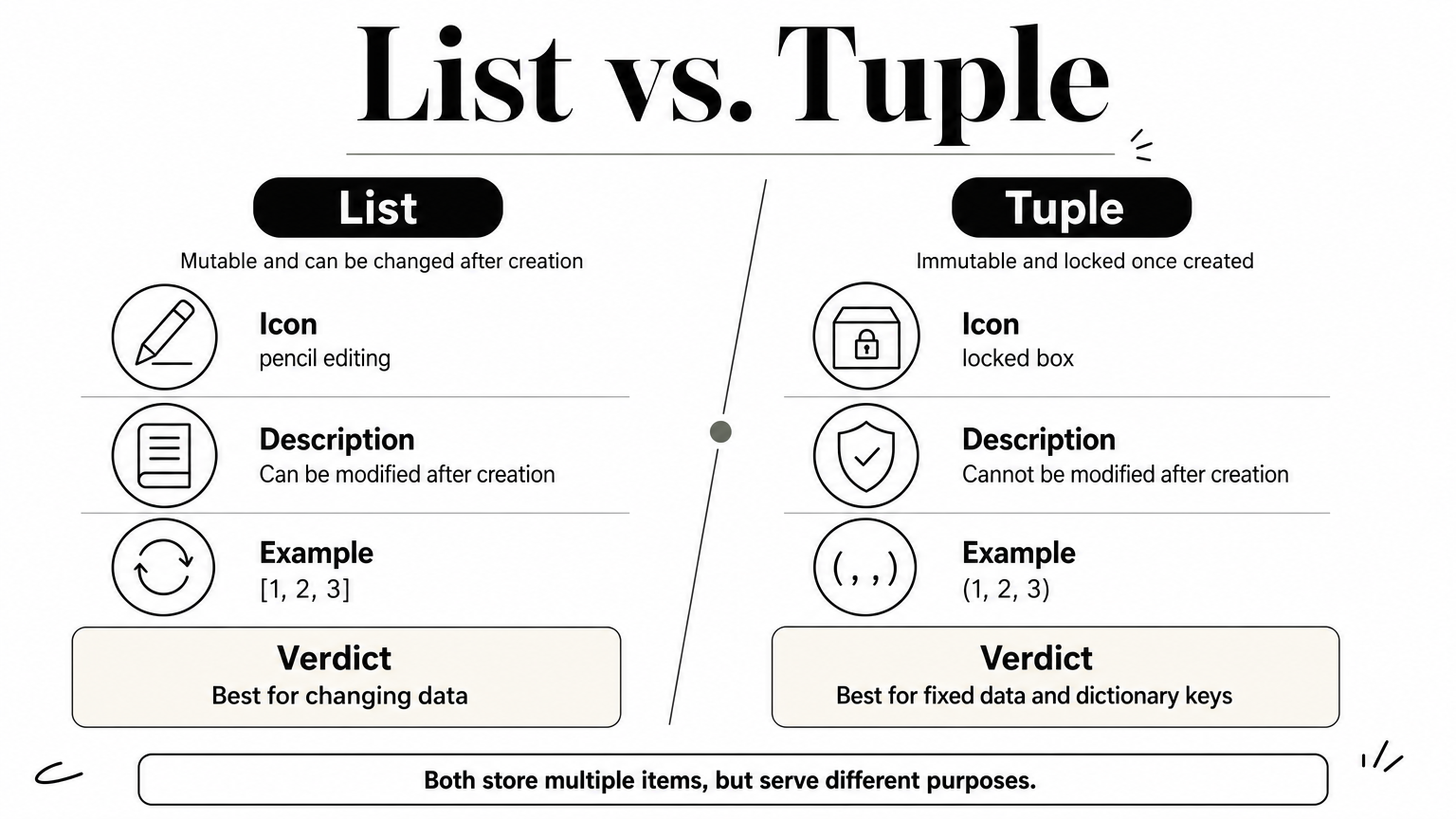
What is the difference between a list and a tuple?
Lists are mutable, tuples are immutable, and that single distinction drives everything else, including why tuples work as dictionary keys and lists don't.
How does a dictionary work in Python?
Dictionaries rely on a hash table internally, mapping each key to a hash code that gives near-constant lookup time regardless of size.
What is the difference between a shallow copy and a deep copy?
Shallow copies duplicate the outer object but still share nested references, while deep copies recursively clone every nested object too.
What are the four pillars of object-oriented programming?
Encapsulation, abstraction, inheritance, and polymorphism make up the four pillars of OOP, and strong candidates back each one with a real example from past work.
A candidate who can't name all four pillars probably learned OOP from a tutorial, not from shipping actual code.
What is the difference between a class method and a static method?
Class methods receive the class itself through cls, while static methods take neither self nor cls, meaning they don't touch instance or class state.
How does method overriding work in Python?
Overriding lets a subclass replace a parent method that shares the same name and signature, which is what makes polymorphism work at runtime.
3. Error handling and file operations interview questions
Good developers write code that fails gracefully, so this section separates candidates who anticipate problems from those who only handle the happy path.
How does exception handling work in Python?
Exception handling uses try and except blocks to catch runtime errors without crashing the whole program. Strong candidates mention catching specific exception types rather than a bare except: that hides bugs.
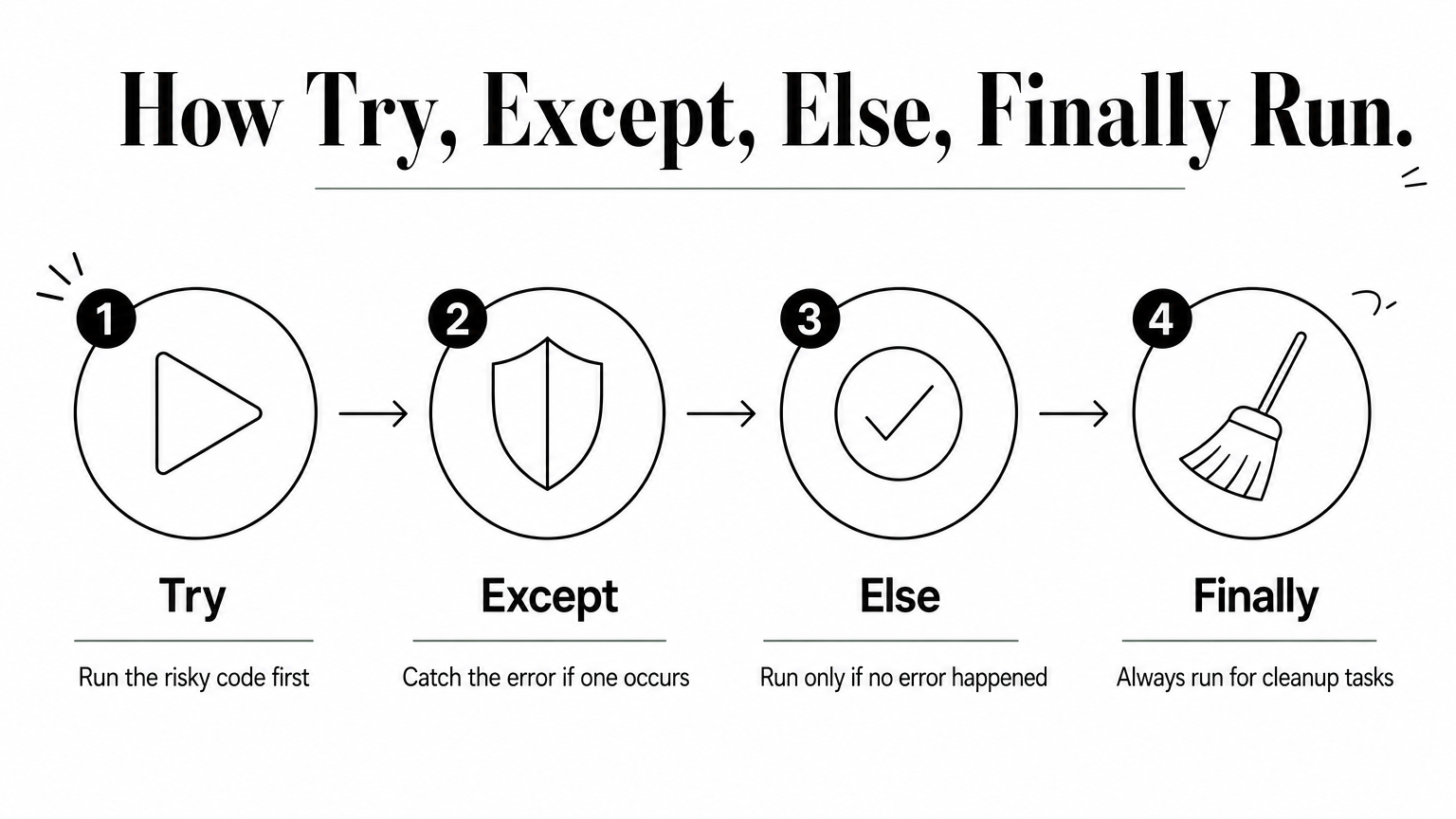
What is the difference between try, except, else, and finally?
The try block runs risky code, except catches errors, else runs only if nothing fails, and finally always executes, usually for cleanup tasks like closing connections.
A candidate who explains why
finallymatters for resource cleanup already thinks like someone who's debugged production incidents.
How do you handle multiple exceptions in one block?
Multiple exception types can sit inside one tuple passed to a single except clause, or stack as separate clauses for different handling logic.
How do you read from and write to a file in Python?
Reading and writing rely on the built-in open() function paired with methods like .read() and .write().
What is the difference between the 'r', 'w', and 'a' file modes?
'r' opens for reading, 'w' overwrites existing content, and 'a' appends without deleting what's already there.
What is a context manager and how does the with statement work?
Context managers use the with statement to guarantee automatic cleanup, closing files or connections even if an exception occurs mid-execution.
4. Advanced Python concepts interview questions
This is where you separate senior candidates from mid-level ones with advanced Python interview questions, since these topics rarely come up unless someone has worked on performance-sensitive code or built reusable libraries.
What are decorators and how do they work?
Decorators wrap a function to extend its behavior without changing its source code, commonly used for logging and authentication checks.
What is the difference between a generator and an iterator?
Generators use yield to produce values lazily, saving memory, while iterators are the broader protocol that generators implement.
Candidates who mention memory savings from generators understand real-world performance tradeoffs, not just definitions.
What is the Global Interpreter Lock and why does it matter?
The GIL allows only one thread to execute Python bytecode at a time, which limits true parallelism in multi-threaded programs.
What are lambda functions and when should you use them?
Lambdas are anonymous, single-expression functions best suited for short, throwaway logic like sorting keys, not complex operations.
What is the difference between *args and **kwargs?
*args collects extra positional arguments into a tuple, while **kwargs gathers keyword arguments into a dictionary.
What are list comprehensions and how do they help performance?
List comprehensions build lists in a single readable line and typically run faster than equivalent for loops due to internal optimization.
5. Coding challenges and problem-solving questions
Recruiters use these prompts to see if a candidate can translate logic into working code under mild pressure, and knowing a few essential Python tips and tricks helps you spot an efficient solution when you hear one.

How do you reverse a string in Python?
Slicing with text[::-1] reverses a string in one line, and candidates should recognize this as Pythonic shorthand rather than reaching for a manual loop first.
How do you check if a string is a palindrome?
Comparing a string to its reversed version with text == text[::-1] confirms a palindrome instantly, showing a candidate connects concepts across questions.
The strongest candidates reuse simple tricks like slicing instead of overengineering every problem.
How do you find duplicates in a list?
Counting occurrences with a dictionary or the collections.Counter class flags repeated values efficiently without nested loops.
How do you swap two variables without a temporary variable?
Python allows a, b = b, a, a tuple unpacking trick that surprises candidates coming from other languages.
How do you find the largest number in a list without built-in functions?
Looping through values while tracking a running maximum tests basic iteration logic without relying on max().
How do you check if a number is prime?
Dividing by every integer up to the square root confirms primality and reveals whether a candidate understands basic optimization.
Getting ready for interview day
Running through these 30 python programmer interview questions gives you a repeatable framework, not a script to read word for word. Watch how candidates explain their reasoning, not just whether they land the correct answer, since that's what tells you they've actually shipped code under real constraints.
Great questions only get you halfway there. You still need a pipeline full of candidates worth asking them to, and most recruiters lose hours sourcing profiles that go stale before a single interview happens. That's exactly the gap a shared candidate network closes, giving you verified Python developers already matched against the skills you're screening for.
Skip the cold outreach, browse verified Python developer profiles by skill and location, and start shortlisting your next Python hire today, free of charge.
For engineers
Find work worth your time.
Live engineering roles across India and the US, matched to your stack. Build a profile recruiters actually discover.