75 Node.js Interview Questions and Answers for 2026
Landing a Node.js role, or hiring for one, comes down to how well you handle the technical questions. If you're prepping for a screen tomorrow or building out a question bank for a senior backend hire, searching interview questions on node js usually turns up scattered lists that skip half the topics interviewers actually ask about, like the event loop, streams, or clustering under load.
This guide fixes that. Below you'll find 75 node js interview questions and answers, organized from core fundamentals to node js advanced interview questions that separate a 2-year developer from someone ready for a lead role. Each answer is written the way you'd explain it in a real interview, not a textbook definition.
We cover callback patterns, async/await, memory management, security, and scaling, then close with scenario-based questions for node js interview questions for experienced candidates. If you're on the hiring side and need to hire Node.js developers, Olibr's recruiters use questions like these inside our AI-scored video interviews to screen Node.js talent faster, and you can pull straight from this list for your next round.
1. Node.js basics and architecture questions
Every Node.js interview starts here, no matter the seniority level. Basic architecture questions weed out candidates who learned Express syntax without understanding what actually runs underneath it, and they set the tone for everything that follows. If you fumble the difference between Node and the browser's JavaScript engine, the interviewer will keep testing at a shallower level for the rest of the session, so it pays to nail this part.
Common questions asked
These show up in almost every set of node js interview questions and answers, from junior screens to senior loops:
- What is Node.js, and why is it single-threaded?
- How does Node.js handle concurrency if it's single-threaded?
- What is the V8 engine, and what role does it play?
- Explain the difference between Node.js and traditional server-side languages like PHP or Java as a backend choice.
- What is libuv, and why does Node.js need it?
- What's the difference between
process.nextTick()andsetImmediate()? - Why is Node.js a good fit for I/O-heavy applications but a poor fit for CPU-heavy ones?
- What is REPL, and how have you used it?
What interviewers are testing
Most interviewers aren't checking whether you memorized a definition, they're checking whether you understand why Node.js was built the way it was. Someone who can explain that Node uses a single thread for JavaScript execution but delegates I/O work to the libuv thread pool shows they've read source-level explanations, not just blog summaries. That distinction matters because it predicts how you'll debug a slow API later, since a candidate who thinks Node is "just async everything" will struggle to explain why a CPU-bound loop freezes the whole server.
If you can explain why Node.js struggles with CPU-heavy work despite being non-blocking, you've already passed the architecture round.
Interviewers also use this section to gauge conceptual depth versus rehearsed answers. Ask a candidate to compare Node.js to a multi-threaded language like Java, and a strong answer references thread-per-request overhead and memory cost, not just "Node is faster." Weak answers repeat marketing language; strong ones cite trade-offs specific to the workload.
Tips for a strong answer
Don't just define terms, connect them to real trade-offs you've seen on the job. When you're asked about single-threading, walk through a concrete scenario:
- Describe a request that hits the event loop (an API call, a file read).
- Explain how libuv's thread pool handles the blocking part.
- Name a case where this breaks down (image processing, heavy JSON parsing, cryptographic hashing).
- Mention the fix (worker threads, offloading to a queue, or a separate microservice).
That structure shows you've hit production issues, not just tutorials. It's also worth referencing the official Node.js documentation if you're asked to cite a source, since interviewers respect candidates who know where to verify details instead of guessing. Keep answers under two minutes; architecture questions are meant to open the conversation, not become a lecture.
2. Event loop and asynchronous programming questions
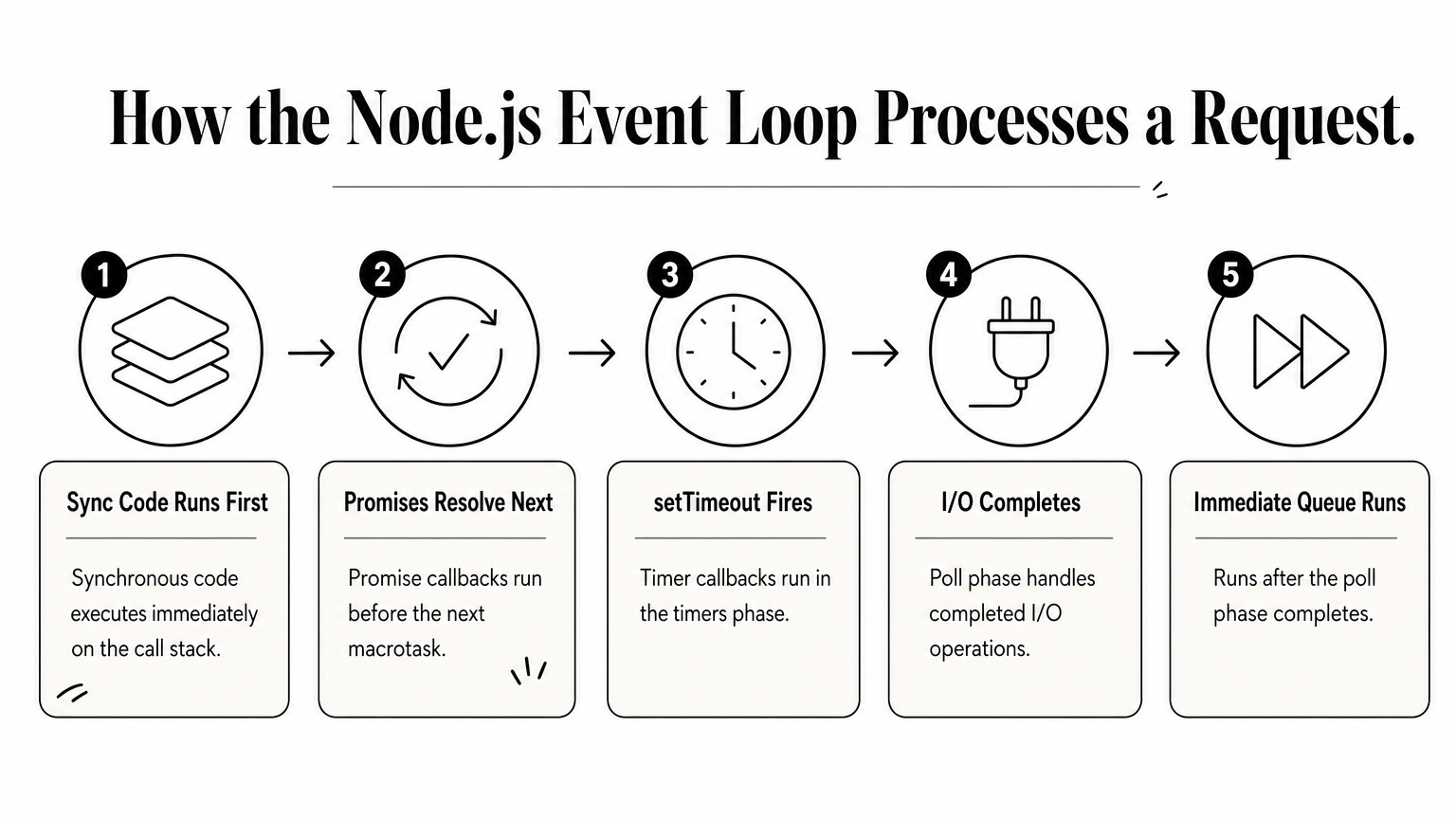
Once basics are covered, interviewers move straight to the event loop, since this is where most real-world Node.js bugs live. Async behavior trips up even experienced developers because it's easy to write code that runs without errors but executes in the wrong order under load, and interviewers know this is where theory and practice diverge fastest.
Common questions asked
These node js questions interview panels lean on heavily, especially for mid-level roles, alongside intermediate JavaScript questions:
- Walk me through the phases of the event loop.
- What's the difference between microtasks and macrotasks?
- How do Promises and
async/awaitfit into the event loop? - What happens if you call a blocking function like
fs.readFileSyncinside a request handler? - Explain callback hell and how you'd refactor it.
- What's the difference between
setTimeout(fn, 0)andsetImmediate(fn)? - How does Node.js handle thousands of concurrent connections with one thread?
What interviewers are testing
Here, interviewers want proof you can trace execution order, not just recite that "Node is non-blocking." A strong candidate can predict console output for a snippet mixing setTimeout, Promise.resolve(), and synchronous code, in the correct order, and explain why. Weak candidates guess.
If you can predict the exact console output of mixed sync, microtask, and macrotask code, you understand the event loop well enough to debug production race conditions.
Interviewers also probe whether you know when async code isn't the right tool, since a candidate who defaults to async/await for CPU-bound work without mentioning worker threads reveals a gap that shows up fast in production incidents.
Tips for a strong answer
Practice tracing execution order on paper before the interview; it's the fastest way to expose gaps. Mention Node's official event loop documentation if asked to cite sources, since it shows you've gone past tutorial-level explanations. Always tie your answer back to a real bug you fixed, like a stalled request queue caused by a synchronous loop, because interviewers remember specifics far longer than definitions.
3. Modules, npm, and package management questions
Module questions catch candidates who've only ever run npm install without knowing what happens underneath. This section of interview questions and answers on node js matters more than it looks, since dependency mismanagement causes a huge share of production outages, from broken builds to security holes buried three layers deep in node_modules.
Common questions asked
Expect these in almost any node js interview questions for experience round, junior through senior:
- What's the difference between CommonJS and ES modules in Node.js?
- How does
require()resolve a module, and what does the module cache do? - What's the difference between dependencies, devDependencies, and peerDependencies in
package.json? - How do you handle version conflicts between two packages that depend on different versions of the same library?
- What is
package-lock.json, and why shouldn't you ignore it? - How would you audit a project for vulnerable dependencies?
- What's the difference between local and global npm packages?
What interviewers are testing
Good answers here reveal whether you treat dependency management as a real engineering task or an afterthought. Someone who can explain semantic versioning ranges (^1.2.3 vs ~1.2.3) and why a careless ^ range broke a build once shows production scars, not textbook knowledge.
A candidate who's never been burned by a bad dependency upgrade usually hasn't shipped much production code.
Hiring managers also watch for whether you know npm audit or tools like npm's own security advisories, since ignoring known CVEs in dependencies is a common real-world failure.
Tips for a strong answer
Reference a specific incident: a broken deploy from an unpinned version, or a vulnerability caught by an audit before it shipped. Structure answers around cause, fix, and prevention rather than just definitions. Tie CommonJS versus ES modules questions to a migration you've actually done, since interviewers value experience-based answers far above textbook recall in this category.
4. Building servers and APIs with Express questions
Express still shows up in most node js developer interview questions because, of all the frameworks used for Node.js app development, it's the one candidates are most likely to have touched on the job. Interviewers use this section to check whether you understand what Express does for you versus what raw Node.js already handles, since plenty of developers copy middleware patterns without knowing why they work.
Common questions asked
Expect these in mid-level and senior rounds alike:
- What does Express add on top of Node's built-in
httpmodule? - Explain middleware and the order in which it executes.
- How do you handle errors globally in an Express app?
- What's the difference between
app.use()andapp.get()? - How would you structure routes in a large Express application?
- How do you validate request bodies before they hit your business logic?
- What's the difference between REST and GraphQL, and when would you pick one over the other?
What interviewers are testing
This round checks whether you can build maintainable route structures, not just working endpoints. A candidate who separates routing, controllers, and validation into distinct layers signals they've worked on a codebase with more than five endpoints. Interviewers also probe middleware ordering, since a misplaced error handler or auth check is a classic bug that breaks security silently.
If your middleware order is wrong, your auth checks might never run, and that's the kind of bug that doesn't show up until production.
Expect follow-up questions about rate limiting, request logging, and versioning APIs, since these separate someone who's built a toy CRUD app from someone who's shipped a real service.
Tips for a strong answer
Walk through a real project structure you've used: routes folder, controllers, middleware, and how errors flow to a central handler. Mention specific middleware you've written, like request validation with a library such as Joi or Zod, rather than just naming Express features in the abstract. If asked about scaling an API layer, reference how Olibr's own ATS and job board route thousands of applicant submissions through structured pipelines, since concrete examples beat generic descriptions every time.
5. Streams, buffers, and file handling questions
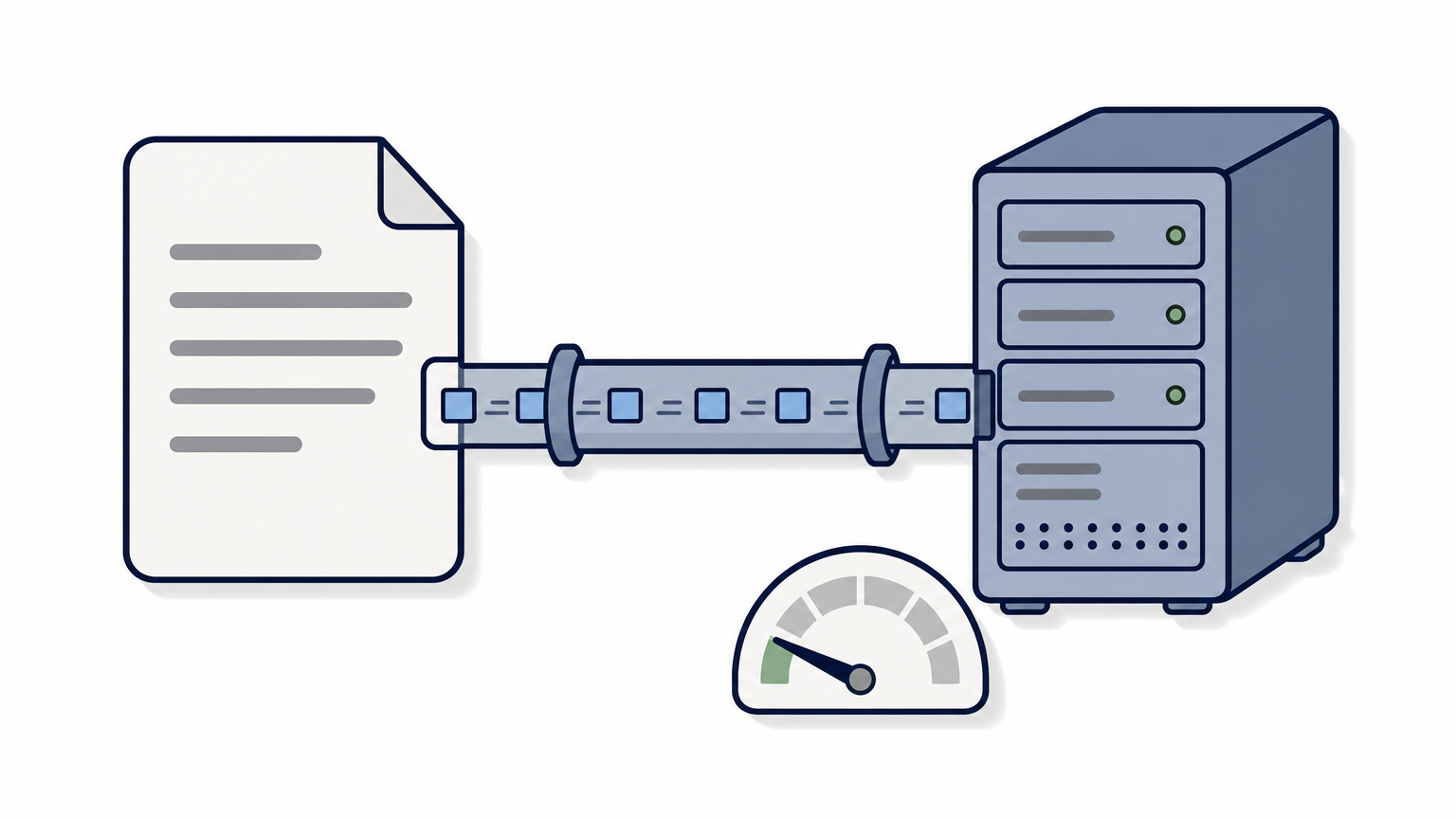
Streams separate developers who've only built small APIs from those who've handled large file uploads or data pipelines in production. This part of interview questions in node js rounds trips up candidates who know streams exist but have never had to reach for one under memory pressure, and interviewers can spot the difference fast.
Common questions asked
These questions test whether you reach for streams by habit or only when forced:
- What's the difference between a Buffer and a stream?
- Name the four types of streams in Node.js and what each does.
- How would you process a 2GB file without crashing the server?
- What's backpressure, and how do streams handle it?
- Explain the difference between
pipe()and manually handlingdataandendevents. - When would you use a Buffer directly instead of a string?
- How do you handle encoding issues when reading a file?
What interviewers are testing
Interviewers want proof you understand memory-safe file handling, not just syntax. Someone who explains that loading a whole file into memory with fs.readFile breaks at scale, while a readable stream processes it in chunks, shows they've hit a real memory ceiling before. Weak candidates confuse buffering with buffering strategy, and can't explain backpressure beyond the word itself.
If you can't explain backpressure, you probably haven't built anything that streamed real production traffic.
Experienced hires also get pushed on Buffer internals, since knowing that a Buffer is raw binary data outside the V8 heap separates someone who's debugged a memory leak from someone reciting a glossary entry.
Tips for a strong answer
Describe a specific case: a CSV import, a video upload, or a log-processing job where you swapped readFile for a stream to fix an out-of-memory crash. Mention Node's own stream documentation if asked for a source, since it signals you've read past a Stack Overflow answer. If the role involves bulk data, tie your answer to a real workload, like Olibr's own bulk profile parsing handling thousands of resumes at once, since that kind of scale is exactly where stream knowledge stops being theoretical.
6. Error handling and callback pattern questions
Error handling separates developers who write code for the happy path from those who've kept a service alive at 3 a.m. This set of interview questions for node js often catches candidates off guard because error handling in an async world doesn't behave like a simple try/catch in synchronous code, and interviewers know exactly where that assumption breaks.
Common questions asked
Expect these questions across junior and senior loops alike:
- What's the error-first callback pattern, and why does Node.js use it?
- How do you handle errors inside a Promise chain versus inside
async/await? - What happens to an unhandled promise rejection in Node.js?
- How would you catch errors thrown inside an
EventEmitter? - What's the difference between operational errors and programmer errors?
- How do you avoid callback hell without switching frameworks?
- Should you crash the process on an uncaught exception, or try to recover?
What interviewers are testing
Good answers show you treat errors as part of the design, not an afterthought bolted on later. Someone who distinguishes operational errors (a failed API call, a timeout) from programmer errors (a null reference bug) demonstrates they've thought about recovery strategy, not just error messages.
If you can't explain the difference between an operational error and a programming bug, you'll either crash servers unnecessarily or hide real bugs behind silent catches.
Interviewers also listen for whether you know that an unhandled rejection can crash a Node process in newer versions, since that single fact trips up plenty of experienced developers who learned Node years ago and never revisited the defaults.
Tips for a strong answer
Walk through a real incident: a swallowed error that hid a bug for weeks, or a missing .catch() that took down a service. Reference centralized error-handling middleware in Express as a pattern you've implemented, not just something you've read about. Mention that Olibr's own applicant tracking pipeline needs airtight error handling since a silent failure there means a lost candidate application, and concrete stakes like that make your answer memorable instead of generic.
7. Database and data management questions
Database questions test whether you can move data efficiently between Node.js and a persistence layer, since a slow query or a bad connection pool setup will sink an otherwise well-written API. This part of node js interview questions and answer sets often gets skipped in prep because candidates assume it's a database-specific topic, but interviewers care specifically about how Node.js handles async data access.
Common questions asked
Questioners usually mix SQL query questions and NoSQL scenarios here:
- How do you manage database connections in a Node.js app under load?
- What's connection pooling, and why does it matter for performance?
- Explain the difference between an ORM like Sequelize/Prisma and a raw query builder like Knex.
- How would you prevent N+1 query problems in a Node.js API?
- What's the difference between SQL transactions and how you'd implement them in Node.js?
- How do you handle a MongoDB connection drop gracefully?
- When would you choose a NoSQL database over a relational one for a Node.js project?
What interviewers are testing
This round checks whether you understand async data access patterns, not just query syntax. A candidate who explains why an unbounded connection pool crashes a database under traffic spikes shows they've operated a service in production, not just built a demo. Interviewers also probe whether you default to an ORM without understanding the raw queries underneath, since that gap shows up the moment performance tuning becomes necessary.
A Node.js developer who can't explain connection pooling has never had a database fall over under real traffic.
Expect follow-up questions on transaction handling, since rolling back a multi-step operation correctly in async code trips up plenty of mid-level developers.
Tips for a strong answer
Describe a real schema decision you made and why, plus a query you optimized after spotting it in slow logs. Mention a specific ORM or driver you've used in production, like Mongoose or Prisma, rather than naming database technologies generically. If you've worked with a platform that stores large candidate or applicant datasets, like Olibr's shared candidate database, reference how indexing and pooling decisions there affect search speed at scale, since that concrete detail beats a textbook answer every time.
8. Security and authentication questions
Security questions separate developers who patch vulnerabilities after a breach from those who design against them from the start. This category shows up in almost every set of node js interview questions for experienced candidates, since junior developers rarely get asked to defend an architecture decision, but senior candidates are expected to explain how they'd stop an attack before it happens.
Common questions asked
Expect a mix of conceptual and scenario-based questions here:
- How do you store and validate passwords securely in a Node.js app?
- What's the difference between JWT and session-based authentication?
- How do you prevent SQL injection and NoSQL injection in a Node.js API?
- What's CSRF, and how do you protect against it?
- How do you handle rate limiting to prevent brute-force attacks?
- What's the role of
helmetmiddleware in an Express app? - How would you securely store API keys and secrets in a Node.js project?
What interviewers are testing
Security questions check whether you treat protection as a built-in requirement, not a feature added after a scare. A candidate who explains bcrypt's salting mechanism, or why JWTs need short expiry plus refresh tokens, shows they've actually implemented auth, not just read about it once.
If you can't explain why storing a JWT in localStorage is risky, you haven't thought through how attackers actually exploit tokens.
Interviewers also test whether you know common OWASP-listed risks, since referencing resources like OWASP's Node.js security guidance signals you keep current on real threats instead of relying on outdated habits.
Tips for a strong answer
Describe a specific vulnerability you caught, whether it was an unsanitized query or a missing rate limiter, and how you fixed it. Reference how Olibr's platform separates private, encrypted candidate data from the shared pool, since that kind of real data-isolation design makes a strong, concrete example when discussing access control at scale.
9. Testing and debugging questions
Testing questions expose whether you write code that's verifiable or just code that happens to work on your machine. This part of node js interview questions and answer sets trips up developers who've never worked somewhere with a CI pipeline enforcing coverage, since writing a test after the fact feels different from designing code to be testable from the start. Interviewers use this section to separate people who ship features from people who ship features that survive contact with production.
Common questions asked
Expect a mix of framework-specific and conceptual questions:
- What's the difference between unit, integration, and end-to-end tests in a Node.js app?
- How do you mock a database call or an external API in a test?
- What tools have you used for testing Node.js apps, and why?
- How do you debug a memory leak in a running Node.js process?
- What's the purpose of the
--inspectflag, and how have you used Chrome DevTools with Node? - How would you test an Express route that depends on authentication middleware?
- What's your approach to testing asynchronous code that involves timers or retries?
What interviewers are testing
This round checks whether you can isolate a bug without guessing, and whether your tests actually catch regressions instead of just satisfying a coverage number. A candidate who describes using heapdump or Chrome's memory profiler to trace a leak shows real debugging instinct, while someone who only names a testing library without explaining mocking strategy reveals shallow exposure.
A test suite that passes but never catches a real regression is worse than no tests at all.
Tips for a strong answer
Walk through a bug you diagnosed using node --inspect or a memory snapshot, not just a framework you know. Mention Jest, Mocha, or Supertest by name if you've used them in production, and describe how you mock external dependencies so tests stay fast and deterministic.
10. Clustering and worker thread questions
Single-threaded doesn't mean single-core, and this section catches candidates who never learned the difference. Interviewers bring up clustering and worker threads to see if you know how to actually use the hardware a server gives you, since a Node.js app running on one core while seven sit idle is a common production mistake nobody notices until traffic spikes.
Common questions asked
These questions show up heavily in node js interview questions for 5 years experience rounds and above:
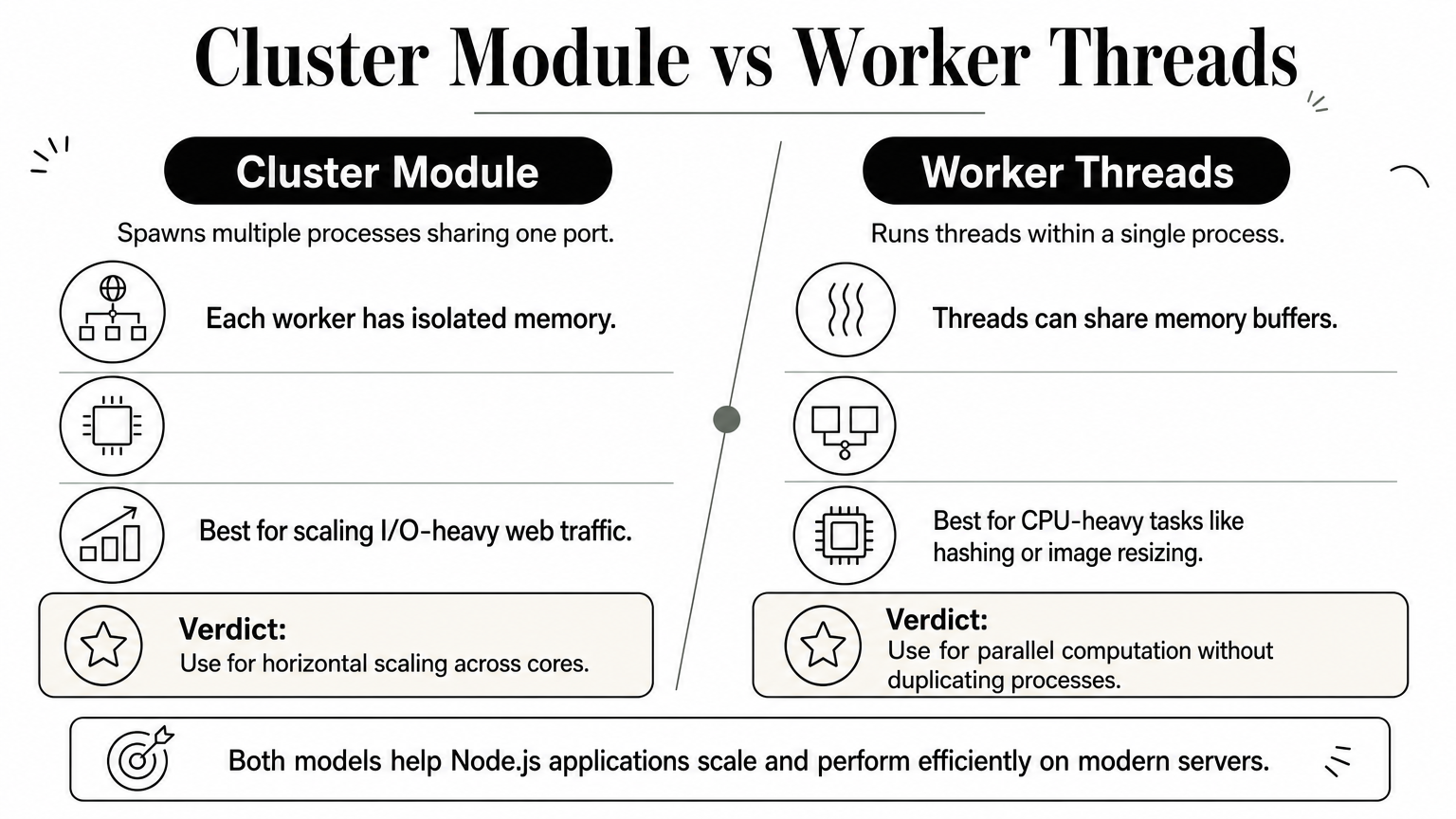
- What's the difference between the
clustermodule and worker threads? - When would you reach for worker threads instead of clustering?
- How does the
clustermodule share a port across multiple processes? - What's the difference between a process and a thread in the Node.js context?
- How do worker threads communicate with the main thread?
- What happens to in-memory state (like a cache) when you run multiple cluster workers?
- How would you handle a worker process crashing in production?
What interviewers are testing
This round checks whether you understand process versus thread isolation, not just that both features exist. A candidate who explains that cluster workers each get their own memory space, meaning an in-memory cache won't sync across them without something like Redis, shows real production exposure. Someone who only says "clustering makes it faster" without naming the tradeoff hasn't run this in front of real traffic.
If you can't explain why an in-memory cache breaks under clustering, you've never actually scaled a Node.js app past one process.
Interviewers also probe whether you pick worker threads correctly for CPU-bound tasks like image resizing or hashing, since defaulting to clustering for that case reveals a gap between horizontal scaling and true parallel computation.
Tips for a strong answer
Describe a specific decision: why you chose PM2's cluster mode over raw cluster module code, or a CPU-heavy task you moved to a worker thread pool instead of blocking the event loop. Reference a crash-recovery strategy you've built, like a master process respawning dead workers automatically. Concrete deployment details beat abstract explanations of the API every time in this category.
11. Performance, scaling, and production questions
Getting an app to work is one thing, keeping it fast under real traffic is another. This section of node js advanced interview questions shows up once interviewers know you can write correct code and want to check whether you can keep that code running smoothly when a thousand requests hit at once instead of ten.
Common questions asked
Expect scenario-heavy questions rather than definitions:
- How would you profile a slow Node.js API endpoint in production?
- What's the difference between vertical and horizontal scaling for a Node.js app?
- How do you find and fix a memory leak that only shows up after hours of uptime?
- What's your strategy for caching (in-memory, Redis, CDN) and when do you pick each?
- How do you handle graceful shutdowns during a deployment?
- What metrics would you monitor to catch performance regressions early?
- How does load balancing work across multiple Node.js instances?
What interviewers are testing
This round checks whether you've operated a service under load, not just deployed one. A candidate who mentions flame graphs, clinic.js, or the Node.js --prof flag to diagnose a slow endpoint shows real debugging habits. Someone who can only say "add more servers" without naming a caching layer or a bottleneck they've actually found reveals shallow production exposure.
A developer who's never profiled a slow endpoint in production is guessing, not engineering.
Interviewers also listen for whether you understand graceful shutdown, since killing a process mid-request during a deploy is a classic cause of dropped user data.
Tips for a strong answer
Describe a specific slowdown you traced back to its root cause, whether it was an unindexed query, a memory leak from unbounded event listeners, or a missing cache layer. Reference monitoring tools you've used, like New Relic or Prometheus, by name rather than in the abstract. If the role involves high applicant volume, mention how a platform like Olibr's AI matching engine needs to stay responsive while ranking thousands of candidate profiles at once, since that kind of scale makes performance tradeoffs concrete instead of theoretical.
12. Questions for experienced Node.js developers
By this stage, interviewers stop asking what a feature does and start asking how you'd handle a mess you didn't create. This section of node js interview questions for experienced candidates, much like senior-level JavaScript questions, leans on judgment calls, legacy code decisions, and tradeoffs that only show up after you've owned a service for a year or more, not just built one from scratch.
Common questions asked
Expect open-ended prompts instead of trivia:
- How would you approach inheriting a legacy Node.js codebase with no tests?
- Describe a time you had to refactor a monolith into smaller services. What broke?
- How do you decide when a feature belongs in Node.js versus offloading it to another service?
- What's your process for reviewing a junior developer's pull request?
- How would you handle a production incident where the root cause isn't obvious?
- What's your approach to versioning a public API without breaking existing clients?
- How do you balance technical debt against shipping deadlines?
What interviewers are testing
These questions probe decision-making under ambiguity, not code recall. A candidate who describes adding tests incrementally around legacy code, instead of demanding a rewrite, shows they can operate inside real business constraints. Interviewers also watch for ownership language, since someone who says "I decided to roll back the deploy" signals more seniority than someone who says "the team decided."
Senior candidates get judged on tradeoffs they've made under pressure, not features they can describe.
Expect follow-ups that dig into consequences, like what happened after a rollback or how a team reacted to a rejected pull request, since vague answers here usually mean the story got exaggerated.
Tips for a strong answer
Pick two or three real incidents before the interview and rehearse them using a clear structure: situation, decision, outcome, lesson. Avoid naming every technology you've touched; instead, go deep on one incident that shows judgment, like a rollback decision or a scope negotiation with a product manager. Interviewers remember specific stories long after they've forgotten a list of frameworks.
13. Advanced Node.js system design questions
System design questions close out most node js advanced interview questions sets because they test whether you can zoom out from code to architecture. Interviewers use this round to see if you can design something that survives real traffic, real failures, and real teams working on it at once, not just something that passes a coding exercise.
Common questions asked
Expect open-ended prompts that ask you to design something end to end:
- Design a URL shortener that handles millions of requests a day using Node.js.
- How would you design a rate limiter that works across multiple Node.js instances?
- Design a notification system that sends emails, SMS, and push alerts without blocking the main app.
- How would you architect a job queue for processing thousands of background tasks?
- Design a real-time chat feature using WebSockets, and explain how you'd scale it horizontally.
- How would you design an API gateway sitting in front of several Node.js microservices?
- What's your approach to handling idempotency in a payment processing endpoint?
What interviewers are testing
This round checks whether you can reason about distributed systems, not just single-server code. A strong candidate names specific tools, like Redis for a distributed rate limiter or BullMQ for a job queue, and explains why that tool fits the constraint. Someone who jumps straight to "add a load balancer" without addressing state, failure modes, or data consistency reveals a gap between writing endpoints and designing systems.
A system design answer that ignores failure scenarios isn't a design, it's a happy-path sketch.
Tips for a strong answer
Start with requirements and constraints before naming a single technology, since interviewers want to see you scope the problem first. Draw the request flow out loud, even without a whiteboard, mentioning where state lives and how you'd handle a component going down. Reference a real system you've built at this scale, since a design paired with a shipped example carries far more weight than a clean diagram with no history behind it.
Getting ready for your Node.js interview
None of these 75 questions matter if you memorize answers without understanding the reasoning behind them. Interviewers spot rehearsed answers fast, so pick five or six categories above where you're weakest, rebuild the concepts from scratch, and practice explaining them out loud to someone who'll push back on vague claims. The candidates who get offers aren't the ones who know every trivia fact about the event loop, they're the ones who can connect a concept to a real bug they've fixed.
Whether you're the one answering these questions or the one asking them, preparation only gets you halfway; the rest comes down to how the conversation actually plays out under pressure. If you're hiring and want to skip building a question bank from scratch, Olibr's AI-powered hiring platform gives you a free ATS plus AI-scored video interviews built around exactly this kind of screening, so you can spend less time writing questions and more time evaluating the answers that matter.
For engineers
Find work worth your time.
Live engineering roles across India and the US, matched to your stack. Build a profile recruiters actually discover.