35 Python Django Interview Questions and Answers to Know
Trying to hire an elite, vetted Django developer sounds simple until you're staring at a resume full of buzzwords with no way to separate real skill from copy-paste knowledge. If you're a recruiter, hiring manager, or technical lead trying to sort strong candidates from weak ones, you need a solid list of python django interview questions that actually test understanding, not just memorization.
This article gives you exactly that: 35 questions and answers covering models, ORM queries, middleware, security, and deployment, the kind of django python interview questions that come up whether you're screening a fresher or a five-year veteran. Each answer explains what a strong response looks like, so you can spot depth versus rote learning even if you're not a Django expert yourself.
We've organized the list from basic concepts to advanced scenarios, making it useful as interview questions for python django roles at any seniority level. If you're screening candidates at scale, pairing this list with Olibr's AI interview screen and candidate matching can turn a static question bank into a repeatable, objective evaluation process across your entire hiring pipeline.
1. Basic Django concepts every fresher should know
Start every screening call here, the same way you'd open with general candidate pre-screening questions before going technical. These questions separate candidates who've built real projects from those who watched a few tutorials and memorized definitions. If you're building a list of python django interview questions for freshers, this section is your foundation alongside a set of entry-level Python questions and answers, and the answers below tell you what a genuine understanding sounds like versus a rehearsed one.

What is Django and why do developers use it?
Django is a high-level Python web framework that handles the repetitive parts of building a website, so developers focus on writing the app instead of reinventing authentication, routing, or database handling. A strong candidate will mention its "batteries-included" philosophy: built-in admin panel, ORM, authentication system, and form handling all ship out of the box. Weaker answers just say "it's a framework for Python websites" without explaining what problem it actually solves. Listen for mentions of rapid development and security defaults like CSRF protection and SQL injection prevention, since that shows the candidate understands why companies choose Django over building from scratch.
What is the MVT architecture in Django?
Django follows Model-View-Template (MVT), a variation on the classic MVC pattern. The model manages data structure and database interaction, the view contains business logic and decides what data to send, and the template handles presentation and rendering to the browser. A candidate who understands this well will explain that Django itself acts as the controller, routing requests between these layers automatically. If someone confuses MVT with MVC and can't explain what's different, that's a sign they've only skimmed documentation rather than built anything.
A candidate who can explain why Django separates data, logic, and presentation understands more about maintainable code than one who's just memorized the acronym.
What is Django ORM?
The Object-Relational Mapper (ORM) lets developers write database queries using Python code instead of raw SQL. Instead of writing SELECT * FROM users WHERE age > 25, a developer writes User.objects.filter(age__gt=25). Strong candidates will point out that the ORM also handles database migrations automatically, tracking schema changes so teams don't manually alter tables. They should also acknowledge the trade-off: the ORM is convenient but can generate inefficient queries if you're not careful, which is a good segue into asking about query optimization later in the interview.
How is Django different from Flask?
This question tests whether a candidate has actually compared the two Python web frameworks or just uses whichever one their last job assigned them.
| Aspect | Django | Flask |
|---|---|---|
| Type | Full-stack, batteries-included | Lightweight microframework |
| Built-in ORM | Yes | No, requires third-party libraries |
| Admin interface | Built-in | Not included |
| Best for | Large apps, content-heavy sites, rapid MVPs | Small APIs, microservices, custom architectures |
| Learning curve | Steeper initially, faster long-term | Easier start, more manual setup later |
Think about what the candidate values in their answer. Someone who says "Django gives you more structure and less decision fatigue for larger teams, while Flask gives you flexibility for smaller, custom builds" understands trade-offs. Someone who just says "Flask is simpler" hasn't thought past surface-level syntax differences.
2. Django project structure and setup questions
Once a candidate clears the basics, check whether they actually know how a Django project is organized on disk. This matters more than it sounds: developers who've only worked inside someone else's boilerplate often can't explain what each file does or why it's there. These django python interview questions reveal whether someone can set up a project from scratch or just clones a template and hopes for the best.
What files make up a Django project structure?
A freshly created Django project has a predictable layout, and a candidate should be able to walk through it without hesitation.
myproject/
├── manage.py
├── myproject/
│   ├── __init__.py
│   ├── settings.py
│   ├── urls.py
│   ├── asgi.py
│   └── wsgi.py
└── myapp/
    ├── models.py
    ├── views.py
    ├── admin.py
    ├── apps.py
    └── migrations/
Good candidates explain the split between the project folder (global configuration) and app folders (self-contained features like a blog or a payments module). Weak candidates can name a file or two but can't explain the relationship between them.
What is the purpose of manage.py?
manage.py is the command-line utility that lets developers interact with the project without writing custom scripts. Running commands like python manage.py runserver, makemigrations, or createsuperuser all go through this file. A candidate who's actually built something will mention that it sets the DJANGO_SETTINGS_MODULE environment variable behind the scenes, pointing Django to the correct settings file before any command executes.
If a candidate has never run
manage.py migrateorrunserverfrom scratch, they haven't really built a Django project.
What does the settings.py file configure?
settings.py centralizes every configuration decision a Django project makes, including installed apps, middleware order, database connection details, static file paths, and security settings like ALLOWED_HOSTS. Strong candidates should mention splitting settings into base.py, dev.py, and production.py files for different environments, a practice that shows they've worked on real deployments rather than just local demos. Someone who's only touched a single unmodified settings.py file has likely never shipped a Django app to production.
3. Django apps, URLs, and views questions
This section separates candidates who understand Django's building blocks from those who've only ever worked inside one massive app.py file. These are the interview questions for python django roles that test structural thinking, not just syntax recall.
What is the difference between a Django project and an app?
A project is the entire website or configuration, while an app is a self-contained module that handles one specific feature, like blog posts, payments, or user profiles. Strong candidates explain that apps are meant to be reusable across projects, and a single project can contain many apps working together. If someone can't explain why Django encourages breaking functionality into apps rather than one giant codebase, they've likely never scaled a project past a tutorial.
How does URL routing work in Django?
Django maps incoming requests to views through a URL dispatcher defined in urls.py. Each pattern connects a URL path to a view function or class.
from django.urls import path
from . import views

urlpatterns = [
    path('jobs/', views.job_list, name='job_list'),
    path('jobs/<int:pk>/', views.job_detail, name='job_detail'),
]
Candidates should mention include() for wiring app-level URLs into the main project file, and named URL patterns for reversing URLs in templates instead of hardcoding paths.
What is the difference between function-based and class-based views?
Function-based views (FBVs) are plain Python functions that take a request and return a response, offering explicit control and readability for simple logic. Class-based views (CBVs) wrap that logic into reusable classes with built-in methods for handling GET, POST, and other HTTP verbs. Good candidates will say CBVs reduce repetition for CRUD-heavy apps but can feel harder to trace for newcomers.
The best answer isn't "CBVs are better" or "FBVs are simpler," it's knowing which one fits the situation.
What are generic class-based views?
Generic CBVs like ListView, DetailView, and CreateView handle common patterns, listing objects, showing one record, or processing a form, with minimal code. Experienced developers use these to avoid rewriting boilerplate for standard database operations, then override specific methods only when custom behavior is needed.
4. Django models and database design questions
Database design questions reveal whether a candidate thinks about data integrity before writing code or just bolts on fields as the app grows. These python django interview questions matter most for roles touching production databases, where a wrong field type or missing constraint can cause real data problems months later.
What is a model in Django?
A model is a Python class that maps directly to a database table, with each attribute representing a column. Django generates the SQL to create, alter, and query that table automatically based on the model definition. Strong candidates explain that models also carry business logic through custom methods and properties, not just field definitions, and that every model should inherit from django.db.models.Model.
What is the difference between null=True and blank=True?
This trips up a lot of otherwise solid candidates, so it's worth pressing on.
| Option | Controls | Applies to |
|---|---|---|
| null=True | Whether the database column can store NULL | Database level |
| blank=True | Whether the field is required in forms | Validation level |
A candidate who explains that null=True alone doesn't make a form field optional, and that you usually need both together for CharFields, understands Django's validation layers rather than guessing at syntax.
Confusing null and blank is one of the fastest ways a candidate reveals they've never debugged a real form submission error.
How do ForeignKey, OneToOneField, and ManyToManyField differ?
A ForeignKey creates a many-to-one relationship, like many job applications linked to one recruiter. OneToOneField restricts that relationship to exactly one match on each side, commonly used for extending a user profile. ManyToManyField allows both sides to relate to multiple records, like candidates linked to multiple skill tags. Candidates should mention on_delete behavior, since forgetting to set it correctly can silently break data integrity.
What are Django's model inheritance styles?
Django supports three inheritance patterns: abstract base classes for sharing fields without creating a separate table, multi-table inheritance for creating a linked table per subclass, and proxy models for changing Python-level behavior without touching the schema. Candidates who can explain when to pick each option, rather than defaulting to abstract classes out of habit, show deeper database design thinking.
5. Django ORM and query optimization questions
Performance questions like these separate developers who've only worked with small datasets from those who've watched a real app slow to a crawl under production load. Anyone answering these python django interview questions well has probably debugged a slow endpoint at 2 a.m. and knows exactly what causes it, which makes this a good point to mix in senior-level Python questions and answers.
What is the difference between filter() and get()?
filter() returns a QuerySet, a collection of matching objects, even if that collection is empty or has just one result. get() returns a single object directly, but raises DoesNotExist if nothing matches and MultipleObjectsReturned if more than one record fits the criteria. Candidates who default to get() everywhere without handling those exceptions haven't thought through what happens when the database doesn't return exactly one row.
What is the difference between select_related() and prefetch_related()?
select_related() follows foreign key and one-to-one relationships using a SQL join, pulling related data in a single query. prefetch_related() handles many-to-many and reverse foreign key relationships by running a separate query and joining the results in Python. Strong candidates know which one applies to which relationship type instead of guessing or using both everywhere out of caution.
What is the N+1 query problem and how do you fix it?
The N+1 query problem happens when code loops through a queryset and triggers a new database hit for each related object, turning one page load into hundreds of queries.
# Bad: triggers one query per candidate
for candidate in Candidate.objects.all():
    print(candidate.recruiter.name)

# Good: one query total
for candidate in Candidate.objects.select_related('recruiter'):
    print(candidate.recruiter.name)
If a candidate can't spot an N+1 problem in a code sample, they've never profiled a slow Django app in production.
What do F() and Q() objects do?
F() lets you reference a model field's value directly inside a query, useful for comparisons or updates without pulling data into Python first, like incrementing a counter atomically. Q() objects build complex lookups with OR, AND, and NOT logic that plain keyword filtering can't express. Candidates who mention avoiding race conditions with F() show they've dealt with concurrent updates on a live system, not just a tutorial project.
6. Django templates and static files questions
Front-end integration questions like these show whether a candidate can bridge Python logic with what actually renders in a browser. These python django interview questions matter for any role touching customer-facing pages, since a developer who mishandles static files often ships a broken-looking site to production.
What are Django templates and how do they work?
Templates are HTML files with embedded Django Template Language (DTL) tags that let you insert dynamic data, loop through lists, and apply conditional logic without writing raw Python in the markup.
<ul>
  {% for job in jobs %}
    <li>{{ job.title }} - {{ job.location }}</li>
  {% endfor %}
</ul>
Strong candidates explain that DTL is deliberately limited compared to plain Python, forcing separation between logic and presentation. They should also mention context dictionaries, the mechanism views use to pass data into a template for rendering.
How does template inheritance simplify development?
Inheritance lets a project define one base.html file with shared elements like the navbar and footer, then child templates extend it and override specific blocks.
{% extends "base.html" %}
{% block content %}
  <h1>Job Listings</h1>
{% endblock %}
Candidates who've built anything beyond a single-page demo will describe this as essential for keeping a consistent layout across dozens of pages without copy-pasting HTML. Someone who's never used {% extends %} or {% block %} has probably only ever built a one-template toy project.
A candidate who can't explain template inheritance has never had to maintain a site with more than one page.
How are static and media files managed in Django?
Django separates static files (CSS, JavaScript, images bundled with the code) from media files (user-uploaded content like resumes or profile photos). Static files get collected into one folder via collectstatic for production serving, usually through a CDN or a tool like WhiteNoise, while media files need MEDIA_ROOT and MEDIA_URL configured separately. A candidate who confuses the two, or doesn't know that Django's development server doesn't serve either efficiently in production, hasn't deployed a real project past localhost.
7. Django forms and admin interface questions
Forms and admin tooling are where a lot of Django's productivity claims get tested in practice. These python django interview questions show whether a candidate can build a usable data-entry workflow quickly, or whether they'd spend days reinventing something Django already ships for free.
What is the difference between Forms and ModelForms?
A plain Form class defines fields manually and requires the developer to handle saving data to the database themselves. A ModelForm generates form fields automatically from a model definition, and its .save() method writes directly to the database without extra glue code. Strong candidates explain that ModelForms still let you override fields, add custom validation with clean_<fieldname>() methods, or exclude specific fields entirely. Someone who says "they're basically the same thing" hasn't actually built a form-heavy app, since the time savings from ModelForms show up fast once you're managing a dozen models.
What does the Django admin interface do?
The admin interface is an auto-generated dashboard for creating, editing, and deleting database records, built entirely from model definitions with almost no extra code. Registering a model with admin.site.register(MyModel) is enough to get a working CRUD interface, complete with search, filtering, and pagination. Candidates should mention that this is meant for internal staff use, not public-facing pages, and that relying on it as a customer interface is a common beginner mistake.
An interviewer should worry if a candidate has never touched the Django admin, since it's usually the fastest way to verify data during development.
How do you customize the Django admin panel?
Customization happens through ModelAdmin classes, which control what fields display, how they're searched, and what actions are available.
from django.contrib import admin
from .models import Candidate

class CandidateAdmin(admin.ModelAdmin):
    list_display = ('name', 'skill', 'location')
    search_fields = ('name', 'skill')
    list_filter = ('location',)

admin.site.register(Candidate, CandidateAdmin)
Experienced developers will also mention inlines for editing related models on the same page, and custom admin actions for bulk operations like exporting selected records. Look for candidates who treat the admin panel as a real tool worth configuring, not just a default screen they never touch.
8. Django authentication and security questions
Security questions matter for any role touching user data, and Django's built-in protections mean a candidate has fewer excuses for shipping something insecure. These python django interview questions show whether someone understands the defaults they're relying on or just trusts the framework blindly without knowing why it works.
How does Django's authentication system work?
Django ships with a built-in authentication framework handling user registration, login, logout, and permission checks through the django.contrib.auth app. It stores users in a User model, hashes passwords automatically using PBKDF2 by default, and manages sessions to keep people logged in across requests. Strong candidates mention login_required decorators and permission classes for restricting views, and they should know Django never stores plain-text passwords under any circumstance.
What is a custom user model and when do you need one?
A custom user model replaces Django's default User model with one tailored to the app, adding fields like phone number or company name, or switching the login field from username to email. Experienced candidates know this decision has to happen before the first migration runs, since swapping user models mid-project on an existing database is painful and often requires a full rebuild. Someone who's hit this problem in production will warn you about it unprompted.
A candidate who's never dealt with a mid-project user model swap probably hasn't shipped a Django app that outgrew its original assumptions.
What is a CSRF token and how does Django use it?
Cross-Site Request Forgery protection stops attackers from tricking a logged-in user's browser into submitting unwanted requests. Django generates a unique CSRF token per session and requires it in every POST form via {% csrf_token %}, rejecting requests that don't include a valid match. Candidates should explain this is enabled by default through middleware, not something developers bolt on manually.
What other security features does Django provide?
Beyond CSRF, Django defends against SQL injection by parameterizing ORM queries automatically, escapes output in templates to prevent XSS attacks, and enforces HTTPS settings like SECURE_SSL_REDIRECT in production. The Django security documentation covers the full list, and a candidate who references it unprompted signals real familiarity, not just interview prep.
9. Django middleware, signals, and session questions
Middleware and signals questions catch candidates who understand Django's request lifecycle beyond the view layer. These python django interview questions test whether someone can explain what happens before a request even reaches their code, which matters for debugging weird production behavior nobody can reproduce locally.
What is middleware and how does it process requests?
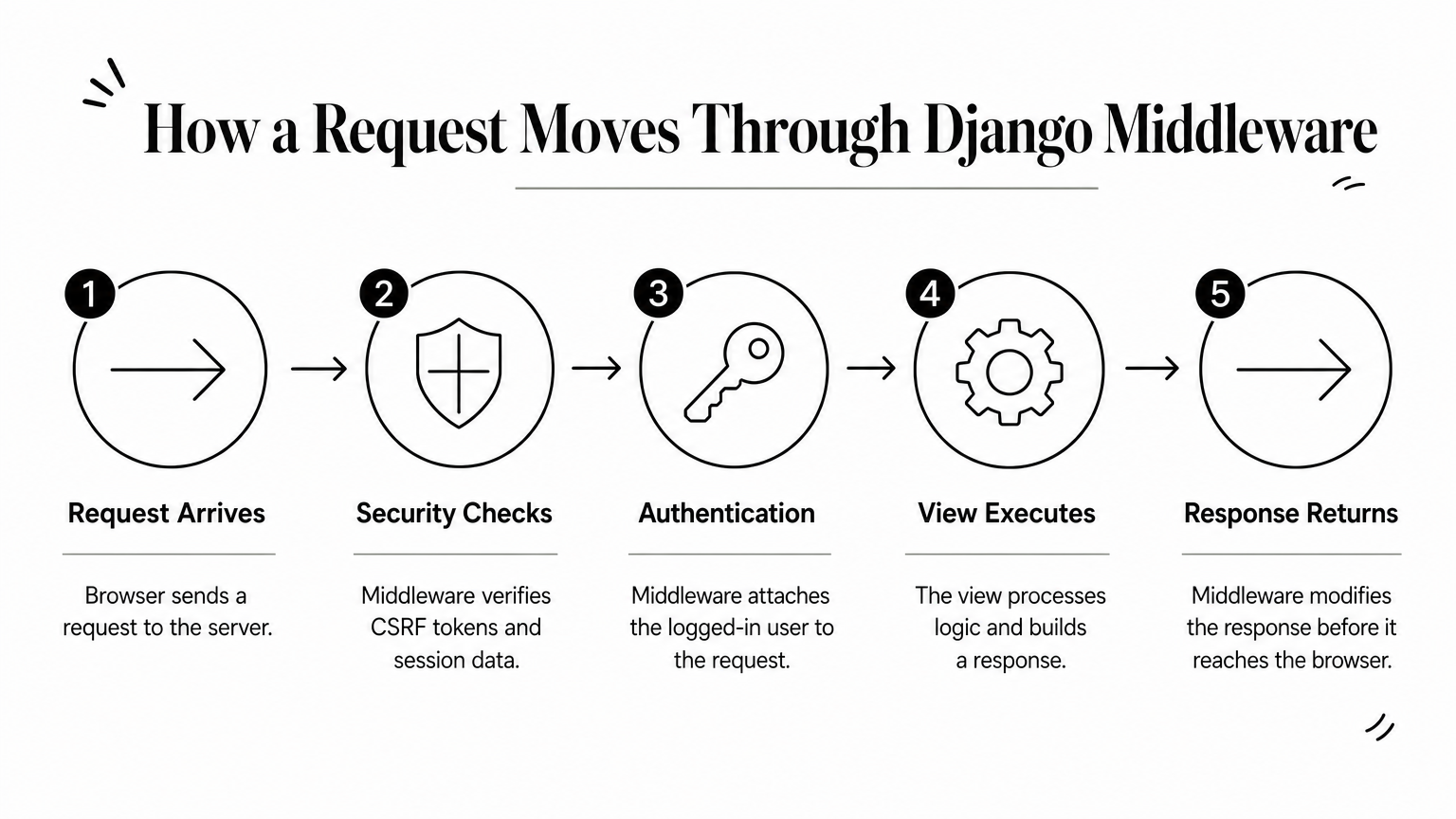
Middleware is a chain of components that sits between the web server and the view, processing every request on the way in and every response on the way out. Each piece of middleware can inspect, modify, or reject a request before it reaches the view, or alter the response before it goes back to the browser. Strong candidates mention that middleware order in settings.py matters, since authentication middleware has to run before anything checking request.user. Someone who's written custom middleware for logging, rate limiting, or request timing has clearly worked past beginner-level Django.
If a candidate can't explain why middleware order matters, they've never debugged a request that failed silently before reaching their view.
What are Django signals used for?
Signals let different parts of an app communicate without direct coupling, firing a notification when something happens, like post_save triggering after a model instance saves. A common use case sends a welcome email whenever a new candidate profile gets created, without cramming that logic into the model or view itself. Experienced candidates will caution that overusing signals makes code harder to trace, since the triggering logic isn't visible where the save actually happens. That trade-off awareness matters more than just knowing the syntax.
How do sessions and cookies work in Django?
Django stores session data server-side by default, using the database, cache, or file system, and sends the browser only a session ID cookie to reference it. This keeps sensitive data off the client, unlike storing everything directly in a cookie. Candidates should mention SESSION_COOKIE_AGE for controlling expiration and SESSION_COOKIE_SECURE for forcing HTTPS-only transmission. Anyone who's configured session backends for a high-traffic app, switching from database sessions to Redis for performance, demonstrates real production experience rather than textbook knowledge.
10. Django REST Framework and testing questions
Most hiring today isn't for plain Django sites anymore, it's for APIs backing a mobile app or a separate frontend, the same territory where teams weigh Django against Node.js for backend development. These python django interview questions test whether a candidate can build and reason about that layer, not just render HTML pages.
What is Django REST Framework and why use it?
Django REST Framework (DRF) is a toolkit built on top of Django that turns models and views into JSON APIs, adding features like browsable API pages, authentication classes, and permission handling out of the box. Teams reach for it instead of hand-rolling API responses because it saves weeks of repetitive work around serialization, pagination, and error formatting. A candidate who says "you could technically return JSON from a regular view, but DRF handles validation and content negotiation for you" understands why the library exists rather than treating it as a mandatory add-on.
What is serialization and why does it matter for APIs?
Serialization converts complex data types, like Django model instances, into formats such as JSON that a frontend or mobile app can consume, and it works in reverse to validate incoming data before saving it. DRF's ModelSerializer mirrors ModelForm, generating fields automatically from a model and reducing boilerplate.
from rest_framework import serializers
from .models import Candidate

class CandidateSerializer(serializers.ModelSerializer):
    class Meta:
        model = Candidate
        fields = ['id', 'name', 'skill', 'location']
Strong candidates mention that serializers also handle validation logic, rejecting malformed data before it ever touches the database.
A candidate who can't explain serialization has never actually shipped an API another team consumed.
What is the difference between WSGI and ASGI?
WSGI is the traditional interface Django uses to handle synchronous requests, one at a time, per worker. ASGI extends that to support asynchronous code, WebSockets, and long-lived connections, which matters for real-time features like chat or live notifications. Candidates who know Django added native async support and can explain when ASGI actually matters, versus when WSGI is still perfectly fine, show they've kept up with the framework rather than learning it once and stopping.
Preparing for your Django interview
These 35 questions won't turn a weak candidate into a strong one, but they'll stop you from mistaking rehearsed answers for real experience. The pattern to watch for is consistent: candidates who've shipped production code explain trade-offs and war stories, while candidates who've only followed tutorials recite definitions. Use the follow-up prompts in each section, ask for a code example, ask what broke, ask why they chose one approach over another.
Running this list on every candidate manually gets tedious once you're screening dozens of applicants a month. That's where structured screening pays off. Instead of scheduling calls just to repeat the same python django interview questions, you can run candidates through scored assessments and let the transcripts do the filtering for you. If you're hiring developers regularly, shortlist Django developers from 180,000+ verified profiles on Olibr and pick people who've already been screened on the fundamentals covered here.
For engineers
Find work worth your time.
Live engineering roles across India and the US, matched to your stack. Build a profile recruiters actually discover.