25 JavaScript Coding Interview Questions and Answers for 2026
If you're staring down a javascript coding interview questions search at midnight before an interview, you already know the stakes. Hiring managers and recruiters use these exact questions to separate candidates who understand JavaScript from those who just memorized syntax, and the gap shows up fast when a panelist asks you to explain closures or debug a hoisting issue live on a whiteboard.
This list gives you 25 real interview questions for 2026, each with a clear answer or code solution, covering everything from array methods and async/await to prototypal inheritance and event loop mechanics. No filler, no theory dumps, just the questions that actually get asked in technical screens right now.
We built this guide from the recruiter's side too. At Olibr, we help hiring teams screen JavaScript talent at scale using AI-powered video interviews and scored transcripts, so we know exactly which questions separate strong candidates from weak ones. Whether you're prepping for your next interview or building your own screening rubric, this list works both ways.
1. Beginner JavaScript fundamentals questions
Every javascript coding interview questions list starts here because interviewers use fundamentals to filter out candidates fast. These five questions show up in nearly every phone screen, and fumbling them signals you learned JavaScript from tutorials rather than real projects (for more practice, work through our full set of beginner JavaScript interview questions).
What is the difference between var, let, and const?
var is function-scoped and gets hoisted with a default value of undefined, while let and const are block-scoped and sit in a "temporal dead zone" until the line executes. const prevents reassignment of the binding itself, not mutation of objects or arrays it points to.
How does JavaScript handle type coercion?
JavaScript automatically converts values between types when operators expect a specific type, so "5" + 3 becomes "53" but "5" - 3 becomes 2. This implicit conversion trips up candidates who forget that the + operator prioritizes string concatenation over addition, so it helps to know the JavaScript data types involved cold.
What is the difference between == and ===?
The == operator coerces types before comparing, while === checks both value and type without conversion.
Use
===by default; reach for==only when you deliberately want type coercion.
How do you check if a variable is an array?
Array.isArray(value) is the reliable method, since typeof returns "object" for arrays too. Avoid instanceof Array, which breaks across different execution contexts like iframes.
What are template literals and how do they work?
Template literals use backticks instead of quotes and let you embed expressions directly inside strings with ${} syntax, plus write multi-line strings without concatenation. They're standard in modern codebases, and interviewers expect you to reach for them over string concatenation.
2. Array and string manipulation questions
Once fundamentals are out of the way, interviewers move to hands-on array and string manipulation problems that test whether you actually know the built-in methods, not just the theory behind them. These five questions dominate whiteboard and live-coding rounds.
How do you reverse a string in JavaScript?
Convert the string to an array, reverse it, then join it back, since strings themselves have no native .reverse() method.
const reverseString = str => str.split('').reverse().join('');
How do you check if a string is a palindrome?
Compare the string against its reversed version after normalizing case and stripping non-alphanumeric characters. This normalization step is what separates a working solution from one that fails on real input.
A palindrome check that ignores punctuation and case is the version interviewers actually want to see.
How do you remove duplicates from an array?
Wrap the array in a Set and spread it back out: [...new Set(arr)]. It's a one-liner, and interviewers expect you to know it cold.
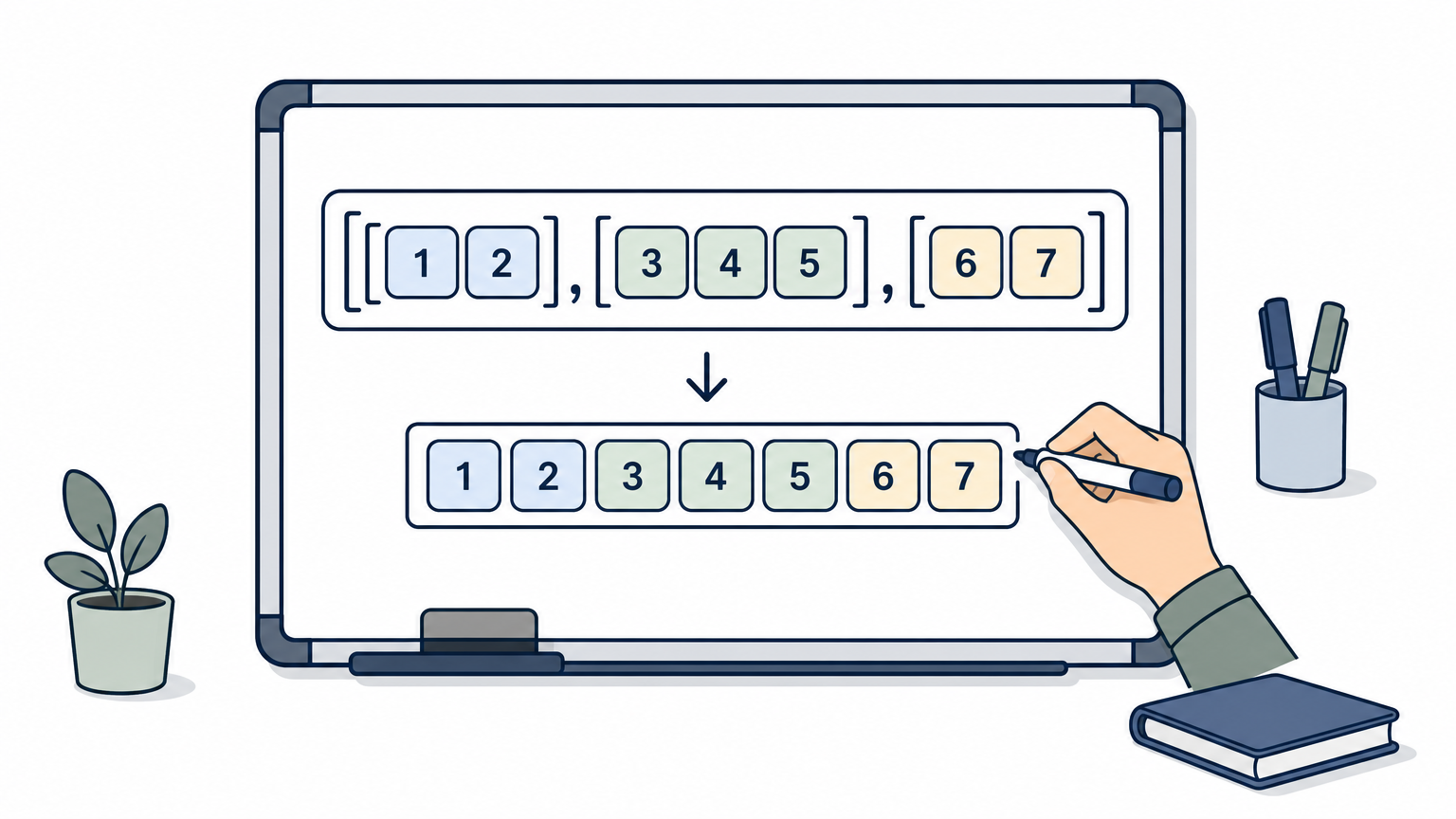
How do you flatten a nested array?
Use arr.flat(Infinity) for arbitrary nesting depth, or write a recursive reduce function if the interviewer blocks built-in methods.
How do you find the largest number in an array?
Math.max(...arr) handles most cases, but switch to reduce() for very large arrays where spreading risks a stack overflow.
3. Functions, closures, and scope questions
This section is where javascript coding interview questions get conceptual, and interviewers use it to test whether you understand scope, not just syntax. Miss these and it signals you've never debugged a real closure bug in production, which is exactly the territory covered by our mid-level JavaScript question bank.
What is a closure and how would you use one?
A closure is a function that remembers variables from its outer scope even after that scope has finished executing. Use closures for private state, like counters or memoized results, without leaking variables into the global scope.
A closure is just a function with a memory of where it was born.
What is the difference between function declarations and expressions?
Declarations get hoisted fully and can be called before they appear in code; expressions are not hoisted the same way and throw errors if called early.
How does the this keyword behave in different contexts?
this depends on how a function is called, not where it's defined, except in arrow functions, which inherit this from their enclosing scope.
What is debouncing and how do you implement it?
Debouncing delays execution until input stops for a set time, commonly used on search boxes.
function debounce(fn, delay) {
  let timer;
  return (...args) => {
    clearTimeout(timer);
    timer = setTimeout(() => fn(...args), delay);
  };
}
How do you write a recursive function to calculate factorial?
Recursion calls a function within itself until it hits a base case, which for factorial is n === 0.
4. Asynchronous JavaScript and promises questions
Asynchronous code is where most javascript coding interview questions separate strong candidates from average ones, because it demands you reason about timing, not just syntax. Interviewers use this section to check whether you understand what happens behind the scenes when code doesn't run top to bottom.
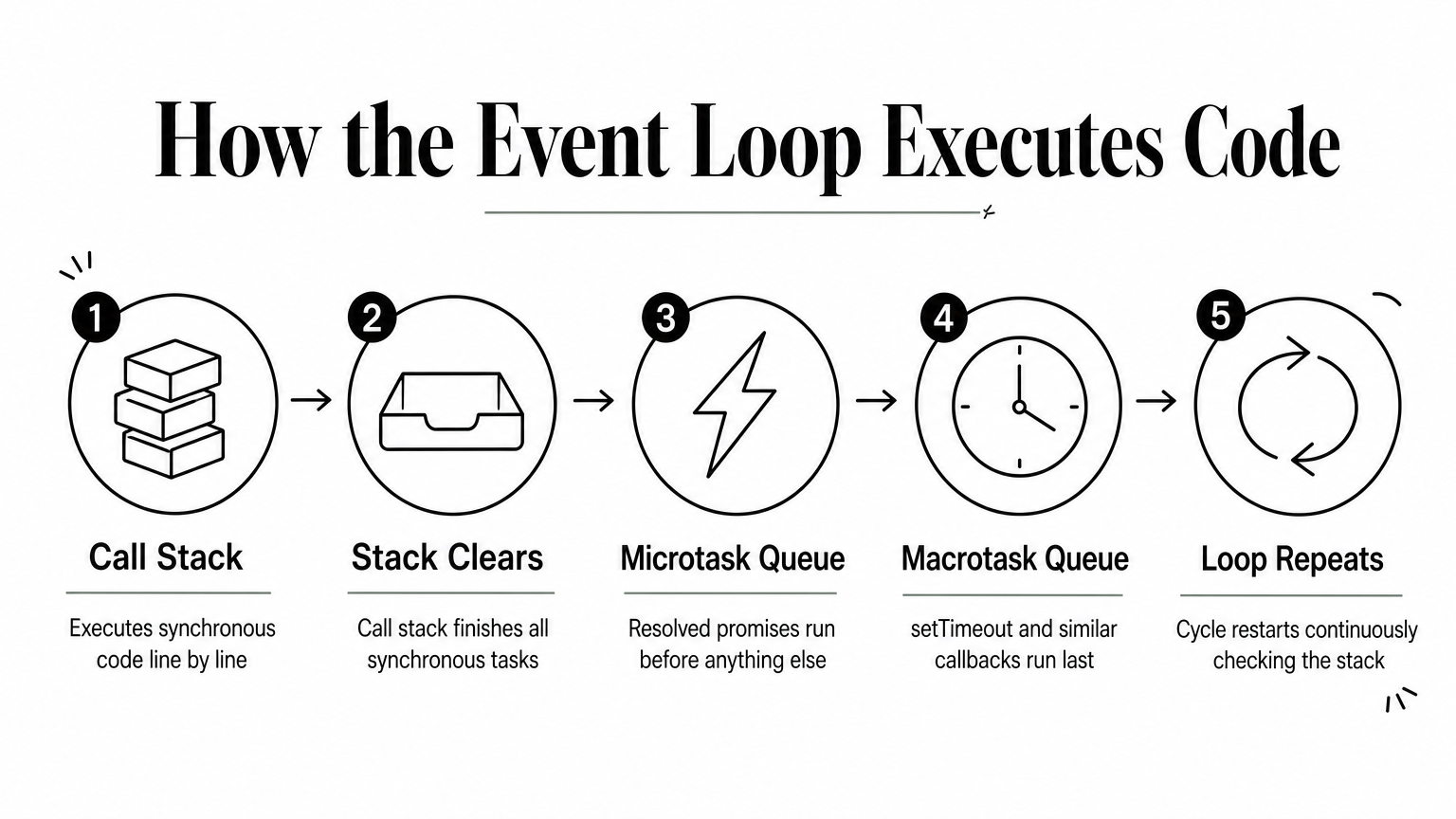
What is the event loop and how does it work?
The event loop checks the call stack, and once it's empty, pulls tasks from the callback queue or microtask queue to execute. Microtasks, like resolved promises, always run before the next macrotask, such as a setTimeout callback.
If you can't explain the event loop, you can't explain why your async code ran out of order.
How do promises differ from callbacks?
Promises avoid callback hell by chaining .then() calls instead of nesting functions, and they handle errors through a single .catch() rather than repeated error checks.
How do you use async/await to handle asynchronous code?
async/await is syntactic sugar over promises, letting you write asynchronous code that reads like synchronous code while still returning a promise underneath.
How do you implement Promise.all() from scratch?
function promiseAll(promises) {
  return new Promise((resolve, reject) => {
    let results = [], count = 0;
    promises.forEach((p, i) => {
      Promise.resolve(p).then(val => {
        results[i] = val;
        if (++count === promises.length) resolve(results);
      }).catch(reject);
    });
  });
}
What is the difference between setTimeout and setInterval?
setTimeout runs a function once after a delay, while setInterval repeats it indefinitely until you call clearInterval.
5. Objects, prototypes, and ES6+ questions
Senior interviewers use this final set to check whether you understand JavaScript's object model, not just array tricks, and it overlaps heavily with our JavaScript questions for experienced developers. These questions reveal whether you've read the spec or just copied patterns from Stack Overflow.

How does prototypal inheritance work in JavaScript?
Objects inherit properties through a prototype chain, where a lookup that fails on the object itself walks up to Object.getPrototypeOf() until it finds a match or hits null. Classes in ES6 are syntactic sugar over this same mechanism.
What is the difference between deep and shallow copying an object?
A shallow copy duplicates top-level properties but still references nested objects, while a deep copy clones every nested level so changes don't leak back to the original.
A shallow copy only protects you one level deep, everything nested still shares memory with the original.
How do you implement a deep equality check between two objects?
Recursively compare each key and value, checking types and nested structures rather than relying on ===, which only checks reference equality for objects.
What are JavaScript generators and when would you use them?
Generators use function* syntax and yield to pause and resume execution, useful for lazy sequences or custom iterators.
How do destructuring and the spread operator simplify code?
Destructuring extracts values from arrays or objects into variables in one line, while the spread operator expands them back out, both cutting boilerplate significantly.
Turning practice into interview confidence
Memorizing 25 answers won't save you if an interviewer changes the wording or asks a follow-up you didn't rehearse. Real interview confidence comes from understanding why each answer works, not just reciting it, so revisit the questions above and explain them out loud to yourself or a friend until the logic feels automatic rather than scripted.
Once you're comfortable with these fundamentals, the next step is getting in front of the right roles. AI-powered screening is becoming standard at companies hiring JavaScript developers, and practicing with real questions now means you won't freeze when a recruiter runs you through a live coding round or a scored video interview. If you're actively job hunting, create your free candidate profile and let our AI match you to JavaScript roles where hiring teams are already looking for someone with exactly your skill set.
For engineers
Find work worth your time.
Live engineering roles across India and the US, matched to your stack. Build a profile recruiters actually discover.