SQL and PL/SQL Interview Questions and Answers to Know
If you're screening candidates for a database or backend role, you already know that generic resume keywords don't tell you whether someone can actually write a working query under pressure. That's where a solid list of interview questions on sql and pl sql earns its keep, whether you're the one asking or coaching a hiring manager on what to listen for. Get this right and you cut down on bad technical hires fast.
This article gives you a practical, ready-to-use set of SQL and PL/SQL questions and answers, ranging from joins and indexing to cursors, triggers, and exception handling. You'll find questions calibrated for junior, mid-level, and senior candidates, so you can match difficulty to the role instead of guessing, and our wider library of technical interview questions and answers covers the other stacks on your team.
We built this list from real screening rounds, not textbook theory, because that's what actually separates strong candidates from ones who memorized syntax. If you're managing volume hiring for database or backend roles, pairing this question bank with AI-powered video interviews and scoring on a platform like Olibr saves hours per requisition while keeping your evaluation consistent across every candidate in your pipeline.
1. Basic SQL concepts and syntax questions
Every interview should start here, even for candidates with ten years of experience, and a quick refresher on SQL basics for managing databases helps if you're coaching a non-technical hiring manager. Basic SQL questions filter out people who've leaned on tools like phpMyAdmin or ORMs without ever understanding what's happening underneath. If someone stumbles on fundamentals, it's a signal worth flagging before you invest more interview time.
Sample questions to ask
- What's the difference between
WHEREandHAVING? - Explain
DISTINCT,GROUP BY, and how NULL values behave in aggregations. - What's the difference between
DELETE,TRUNCATE, andDROP? - How do primary keys differ from unique constraints?
- Write a query to find the second-highest salary in a table.
What a strong answer looks like
Strong candidates explain trade-offs, not just definitions. Someone who understands WHERE versus HAVING will tell you that WHERE filters rows before grouping and HAVING filters after aggregation, then give you a real example instead of reciting a textbook line. On the salary question, watch for candidates who mention LIMIT/OFFSET, DENSE_RANK(), or a subquery approach, and who can explain why they'd pick one over another depending on duplicate values.
A candidate who can explain why a query works, not just recite the syntax, is the one worth moving forward.
Why it matters for the role
Basic SQL and PL/SQL interview questions exist to protect you from a specific hiring risk: someone who's copied queries from Stack Overflow for years without building real understanding. That gap doesn't show up in a resume, and it rarely shows up in a take-home test where candidates have unlimited time and search access. It shows up the moment you ask them to explain their own query out loud.
This is also the round where you calibrate difficulty. Junior candidates should nail these questions cleanly. If a senior candidate hesitates on GROUP BY behavior with NULLs, that's a bigger red flag than the same hesitation from someone two years into their career.
2. SQL joins, queries, and data manipulation questions
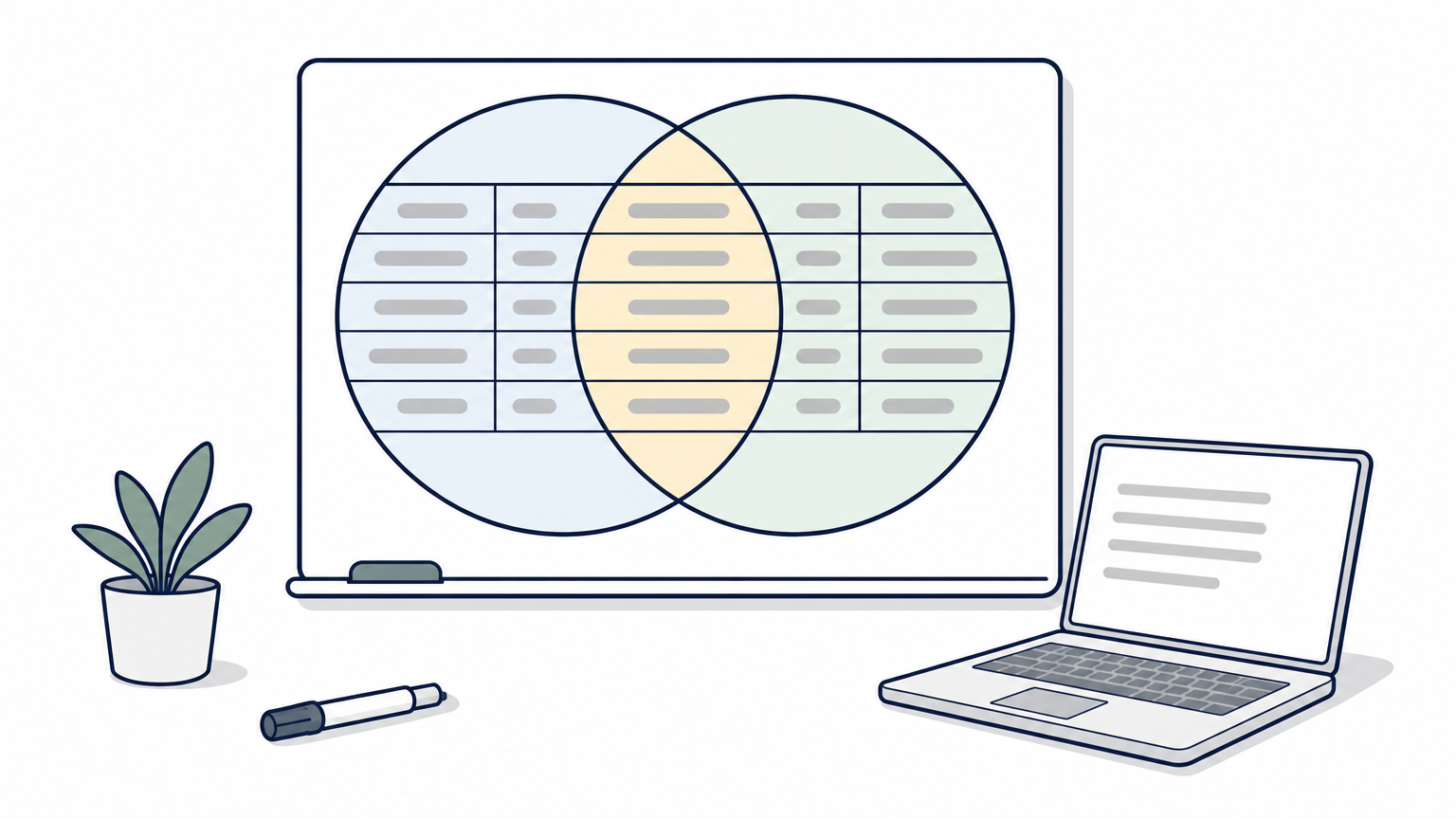
Joins separate candidates who can query a single table from candidates who can actually work with relational data, and if you're hiring on the analytics side, this set of SQL questions aimed at data analysts covers similar ground. Most real production databases involve five or more related tables, so this is where you find out if someone can navigate that complexity without help.
Sample questions to ask
- What's the difference between
INNER JOIN,LEFT JOIN, andFULL OUTER JOIN? - Write a query to find duplicate records in a table.
- How would you update rows in one table based on matching values in another?
- Explain the difference between a correlated and a non-correlated subquery.
What a strong answer looks like
Good candidates draw the join before they write it, sketching which rows survive and which drop out. On duplicates, listen for GROUP BY with HAVING COUNT(*) > 1, plus a mention of window functions like ROW_NUMBER() for cleanup. These SQL query interview questions also reveal whether someone can reason about performance, not just correctness, especially on the update-across-tables scenario.
If a candidate can't explain what happens to unmatched rows in a join, they'll write buggy reports in production.
Why it matters for the role
Join logic errors cause silent data problems, duplicate counts, missing records, inflated totals, that surface weeks later in a client report, not during code review.
3. PL/SQL fundamentals and block structure questions
PL/SQL is where Oracle-heavy shops separate candidates who've only touched plain SQL from those who can build actual logic inside the database, which is why pre-vetted PL/SQL developers are worth screening differently. This is a natural pivot point in any set of interview questions on sql and pl sql, since the two skills test different muscles entirely.
Sample questions to ask
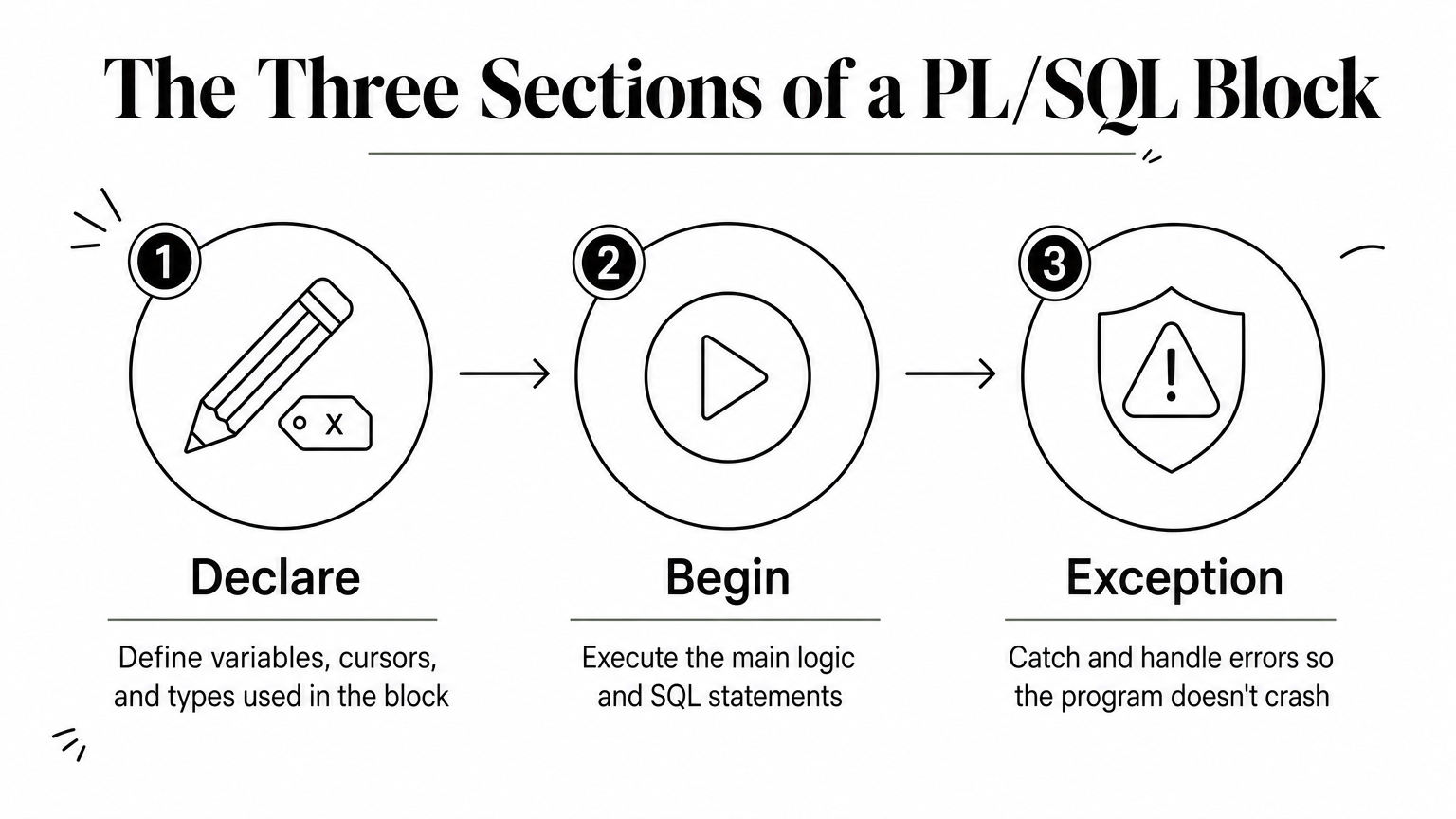
- What are the three sections of a PL/SQL block, and which are optional?
- How does
%TYPEand%ROWTYPEhelp with maintainability? - What's the difference between an implicit and explicit cursor?
- How do you handle exceptions inside a PL/SQL block?
What a strong answer looks like
Confident candidates walk through the DECLARE, BEGIN, and EXCEPTION sections without prompting, and explain why the exception block matters for production code that can't just crash silently. On cursors, listen for someone who knows when an implicit cursor is enough versus when they need explicit control over fetching rows one at a time.
A candidate who treats exception handling as optional hasn't shipped production PL/SQL code.
Why it matters for the role
Block structure questions catch candidates who've written scripts but never built maintainable procedures. That gap turns into fragile code your team inherits later.
4. Stored procedures, functions, and triggers questions
Stored procedures and triggers show whether a candidate can build reusable, production-safe logic instead of one-off scripts. This is where you find out if someone understands the difference between code that runs once in a console and code that runs thousands of times a day inside a live application.
Sample questions to ask
- What's the difference between a stored procedure and a function?
- When would you use a trigger, and what are the risks of overusing them?
- How do you pass parameters IN, OUT, and IN OUT in a procedure?
- Write a trigger that prevents a salary update below a certain threshold.
What a strong answer looks like
Solid candidates explain that functions must return a value and can be used in SQL statements, while procedures don't have that restriction. On triggers, listen for caution, not enthusiasm. Someone who's maintained real systems will mention that too many triggers make debugging painful, since logic gets scattered across the database instead of living in one visible place.
A candidate who loves triggers more than they distrust them probably hasn't cleaned up after one gone wrong.
Why it matters for the role
Badly designed triggers cause cascading failures that are hard to trace, since one update silently fires three others.
5. Advanced and scenario-based SQL and PL/SQL questions
Senior roles need more than syntax recall. This tier tests whether a candidate can reason through messy, real-world situations where the textbook answer doesn't quite fit. Advanced SQL and PL/SQL interview questions show you who can debug a slow report at 6 PM without paging the whole team, and if your stack runs on MySQL, these advanced MySQL questions for senior candidates work the same tier.
Sample questions to ask
- How would you optimize a query that's timing out on a 10-million-row table?
- Walk me through how you'd design a PL/SQL package for batch processing nightly records.
- What's the difference between
ROWIDandROWNUM, and when would each matter? - Given a deadlock scenario, how would you diagnose and resolve it?
What a strong answer looks like
Experienced candidates start by asking clarifying questions instead of jumping to a fix. On the timeout scenario, listen for indexing strategy, execution plan analysis, and whether they'd consider partitioning. On deadlocks, they should mention checking session locks before touching code.
Candidates who ask what's actually slow before proposing a fix are the ones who've debugged real production systems.
Why it matters for the role
These scenarios separate people who've only studied for interviews from people who've actually been paged at 2 AM.
Turning these questions into a better hiring process
Questions alone won't fix a slow, inconsistent hiring process. The real gap is scale, running the same rigorous SQL and PL/SQL evaluation across twenty candidates instead of two, without your senior engineers burning a week on interviews. That's the practical limit most teams hit once volume picks up.
Olibr closes that gap. An automated technical screening interview scores every candidate against the same technical rubric, so you get consistent evaluation instead of whoever happened to interview well on a Tuesday. Pair that with a free ATS and access to a shared pool of 180,000+ verified profiles, and you're screening SQL talent faster without adding headcount to your recruiting team.
If you're hiring for database or backend roles right now, stop rebuilding this process from scratch every quarter. Hire vetted SQL developers in India already screened against real technical criteria, and see the difference in your next round of interviews.
For engineers
Find work worth your time.
Live engineering roles across India and the US, matched to your stack. Build a profile recruiters actually discover.