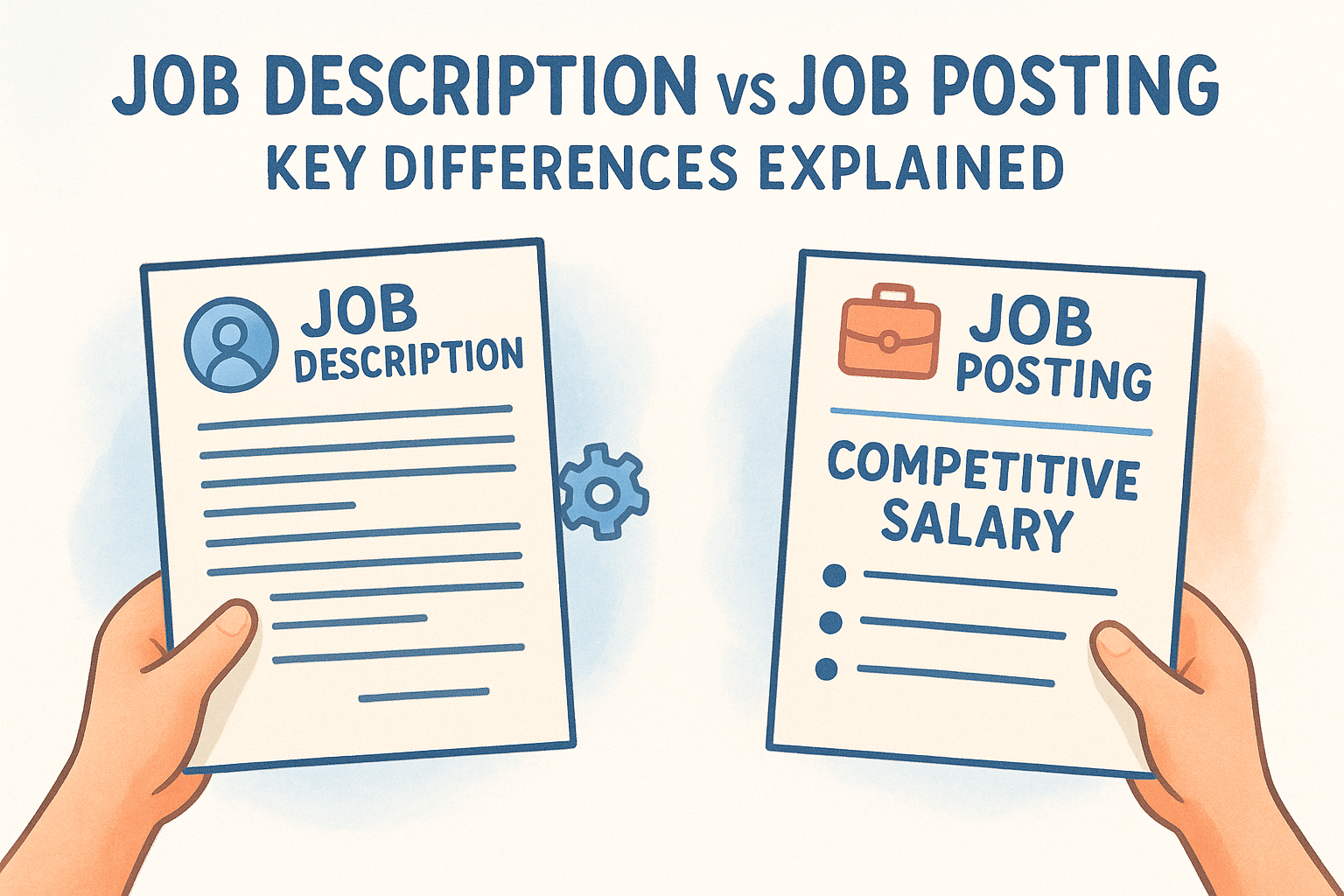
Job Description vs Job Posting: Key Differences Explained
Recruiters often use the terms job description vs job posting interchangeably, and that mix-up costs them candidates. One is an internal document that defines a role's responsibilities, requirements, and reporting structure. The other is a public-facing pitch designed to sell the opportunity to qualified talent. Treating them as the same thing leads to bland listings that attract the wrong applicants or, worse, no applicants at all.
Understanding the distinction matters because each document serves a different audience and a different purpose. A job description keeps your hiring team aligned. A job posting brings the right people to your pipeline. When recruiters conflate the two, they end up copying internal HR language into an external ad, and wondering why response rates are low.
This article breaks down exactly how these two documents differ, when to use each one, and how to turn a solid job description into a compelling job posting that attracts quality candidates. At Olibr, where recruiters post jobs and search a shared database of 180,000+ candidate profiles, free in return for contributing profiles of their own, we see firsthand how the way a role is presented directly impacts who applies, and how fast you hire.
Job description vs job posting at a glance
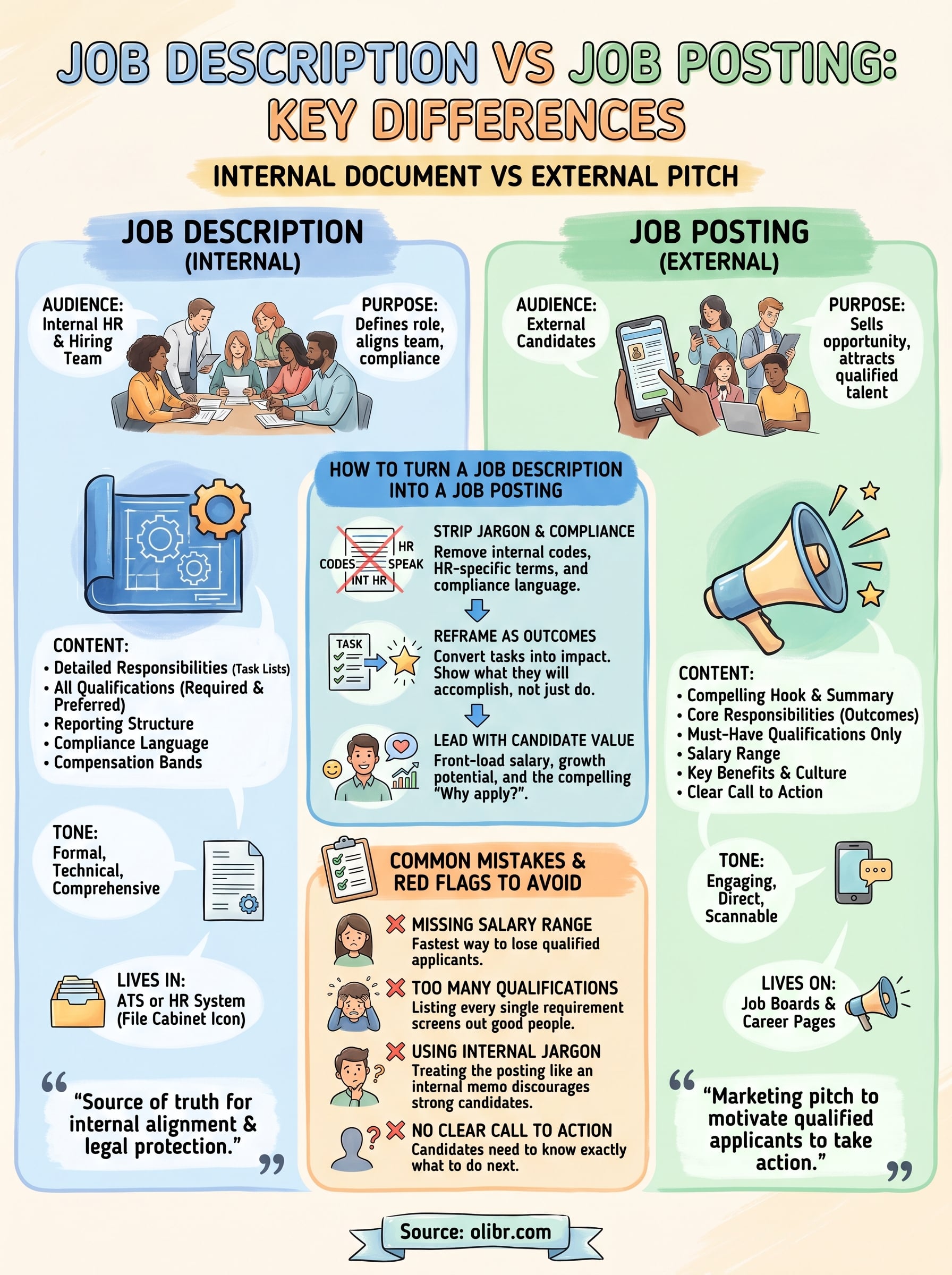
The simplest way to understand the job description vs job posting distinction is to think about audience. A job description is written for your internal team, while a job posting targets candidates who have no idea who you are yet. Both documents cover the same role, but they serve entirely different goals and live in very different places across your hiring workflow.
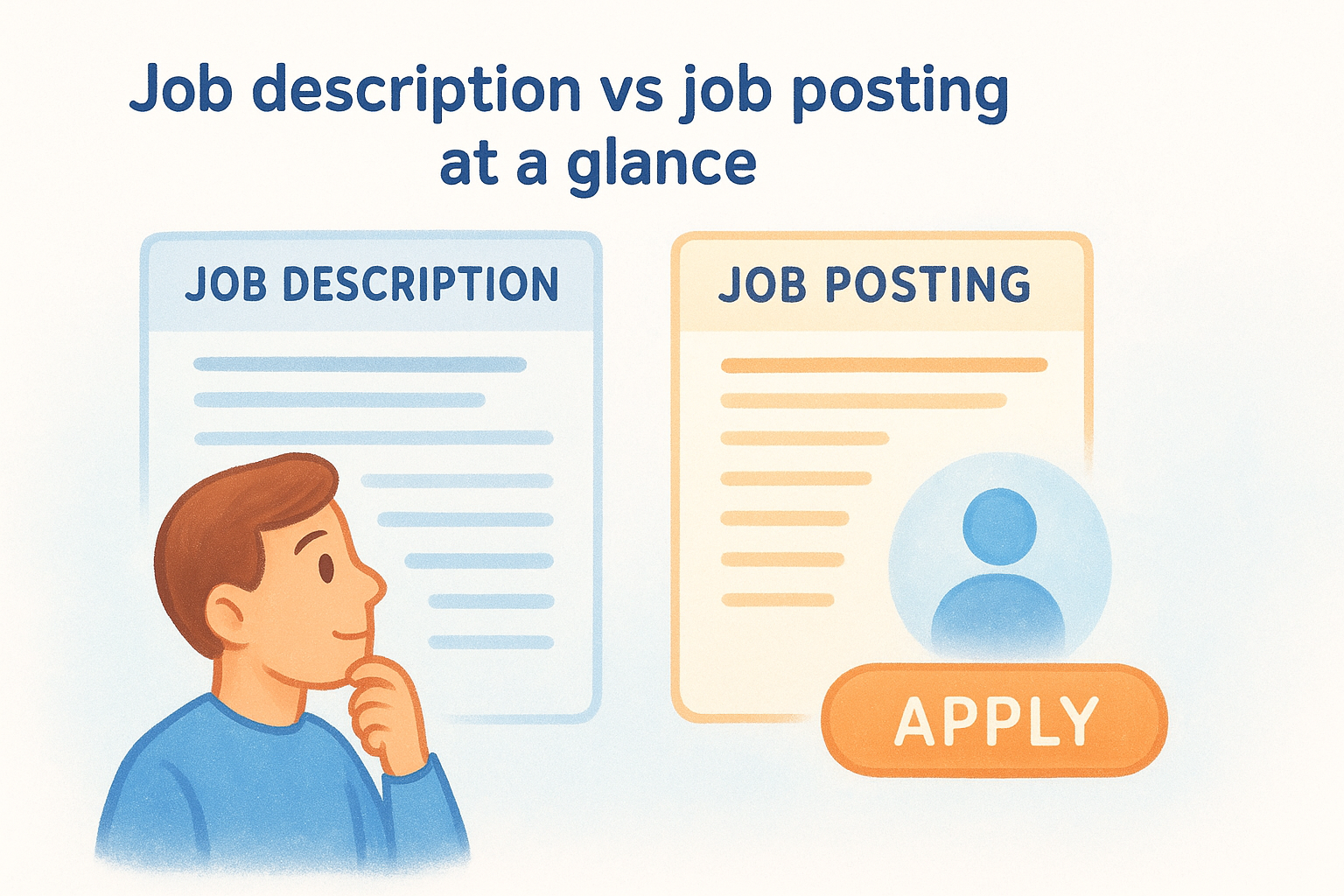
| Factor | Job Description | Job Posting |
|---|---|---|
| Audience | Internal HR and hiring team | External candidates |
| Tone | Formal and technical | Engaging and direct |
| Purpose | Define the role clearly | Attract qualified applicants |
| Length | Comprehensive | Concise and scannable |
| Lives in | Your ATS or HR system | Job boards and career pages |
The job description
A job description is a formal internal document that your HR team and hiring managers use to align on what the role actually requires. It captures duties, qualifications, reporting lines, compensation bands, and any compliance language your organization needs. Think of it as the source of truth your team refers back to throughout the entire hiring process, from drafting the posting to extending the final offer.
A well-written job description protects your organization legally and keeps every stakeholder aligned before a single candidate applies.
The job posting
Your job posting takes the core information from your job description and reframes it for a public audience. You strip out internal jargon, lead with what makes the role worth applying for, and write in a tone that speaks directly to the candidate you want to hire. Your goal is to motivate qualified people to take action, not to document every operational detail the role involves. The posting is marketing; the description is documentation.
What a job description should include
A job description works as your internal blueprint for a role. Before you write a single word of your external posting, your team needs to agree on what the position actually requires, who it reports to, and what success looks like in the first 90 days. Get this document right, and everything downstream becomes easier.
Core components
Your job description should cover the job title, department, and reporting structure clearly at the top. Below that, list the primary responsibilities in order of priority, not alphabetically or randomly. Follow that with required qualifications and preferred qualifications as two distinct sections, along with any licensing or certification requirements specific to your industry.
Separating required qualifications from preferred ones prevents you from screening out candidates who could genuinely do the job well.
Compensation and compliance details
Include the salary range or compensation band your organization has approved for the role. Many teams skip this step, but including it reduces mismatches later in the process and speeds up offer negotiations considerably. Your description should also capture any legal or compliance language your HR or legal team requires, such as equal employment opportunity statements, physical demand disclosures, or travel expectations tied to the role.
What a job posting should include
A job posting flips the perspective entirely. Where your internal document defines the role for your team, a job posting sells the opportunity to candidates who have never heard of you. Every line you write should answer the question applicants ask first: "Why would I want this job?" Lead with what makes the role compelling, not with bullet points lifted straight from your HR system.
Hook and role summary
Your posting should open with a short, direct hook that describes what the person in this role actually accomplishes. Follow that with a concise two-to-three sentence summary that gives candidates enough context to self-select in or out before reading further.
Write directly to the candidate you want to hire. Skip org-chart language, internal acronyms, and anything that only makes sense to people already inside your company. Candidates skim postings fast, so front-load the details that matter most to them.
The job description vs job posting distinction is sharpest here: your posting should read like a conversation, not a compliance document.
Body and closing details
Cover the core responsibilities and must-have qualifications clearly, include the salary range, and close with a brief culture and benefits section. A complete posting body includes:
- Three to five prioritized responsibilities
- Required qualifications only (not preferred)
- Salary range
- Key benefits
How to turn a job description into a job posting
Once your internal document is solid, converting it into a posting is straightforward. The job description vs job posting conversion process comes down to three moves: cut internal language, reframe responsibilities as outcomes, and lead with what the candidate gains.
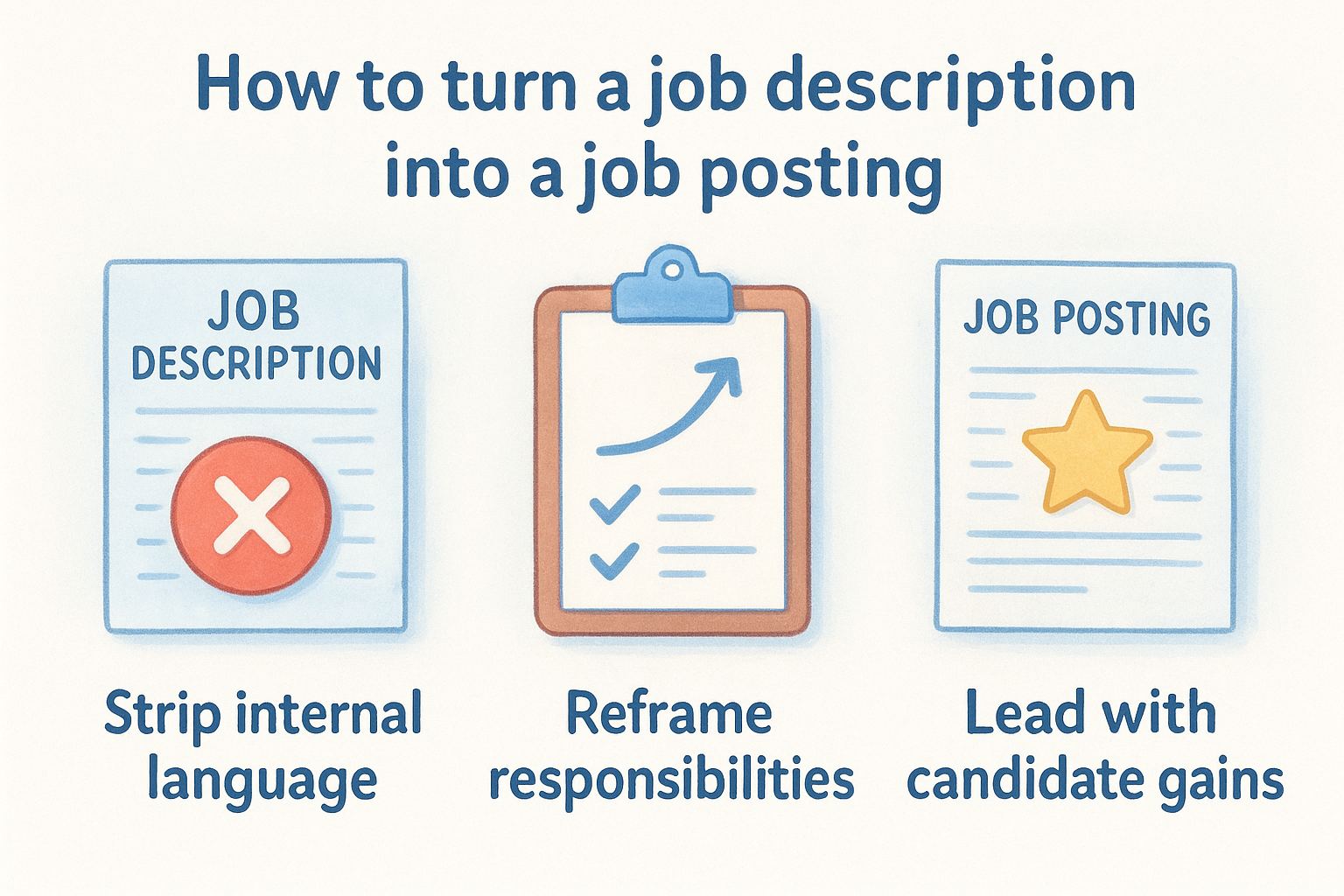
Strip, reframe, and prioritize
Start by removing compliance language, internal codes, and HR-specific terminology that candidates will never recognize. Then take your list of duties and rewrite them as outcomes: instead of "manages quarterly reporting," write "you'll own the numbers that shape our growth decisions." Candidates respond to impact, not task lists.
Reframing responsibilities as outcomes is the single fastest way to improve application quality without changing your actual requirements.
Qualifications need the same treatment. Keep only the requirements that would genuinely cause you to reject a candidate, and cut the rest. Trimming preferred qualifications from your posting reduces self-selection bias and widens your applicant pool without lowering your bar.
Lead with the candidate's perspective
Put the most compelling reason to apply in your first two sentences. Salary, growth potential, or the problem the role solves all work well here. Close your posting with a clear call to action that tells candidates exactly what to do next. Strong posting openers typically lead with one of these:
- The direct impact the role has on the business
- The salary range and growth path
- A specific problem the candidate will own and solve
Common mistakes and red flags to watch for
Most job description vs job posting confusion shows up in execution, not planning. Recruiters copy internal text into job boards and wonder why applicant quality and response rates drop. Catching these patterns before you publish keeps your pipeline clean and your time-to-hire short.
Mixing up the audience
The most common error is treating your posting like an internal document. Compliance language, internal codes, and HR jargon tell candidates you're not thinking about them. Candidates skim fast, and they skip listings that read like policy memos rather than genuine opportunities.
Your posting is marketing material, not documentation. Write it that way.
Watch for these signs that your posting is stuck in description mode:
- Duties listed as tasks, not outcomes or impact
- Required and preferred qualifications lumped into one long list
- Salary range missing or buried at the end
Red flags that discourage strong candidates
Skipping the salary range is the fastest way to lose qualified applicants before they even finish reading. Strong candidates have options, and listing every possible qualification pushes away people who meet 80% of your criteria but assume they don't qualify. Keep your requirements focused on genuine deal-breakers only.
Watch for these additional red flags before you post:
- No clear call to action at the end of the posting
- Job title that doesn't match standard industry terms candidates actually search for
Final checklist before you publish
Understanding the job description vs job posting distinction is only useful if you act on it before your listing goes live. Run through this checklist before you hit publish to catch the most common errors that cut into your applicant quality.
- Salary range included and visible early in the posting
- Job title matches standard industry search terms
- Responsibilities written as outcomes, not task lists
- Required and preferred qualifications listed separately
- Internal jargon and compliance language removed
- Clear call to action at the end
One final check: read your posting as a candidate, not as the recruiter who wrote it. If anything feels like it belongs in an HR binder rather than a job ad, cut it. Every improvement you make before publishing saves you screening time later.
Ready to put your improved posting in front of 180,000+ candidate profiles at no cost? Start hiring on Olibr and see how fast the right applicants find you.
For hiring teams
Search 180,000+ candidate profiles — free.
Olibr is a community-funded recruiting platform: full ATS, AI interviews, and a shared resume database. No per-seat fees.