How To Write A Job Posting That Attracts Top Candidates
A poorly written job posting doesn't just sit there quietly, it actively costs you. It pulls in unqualified applicants, buries your listing under better-written competitors, and drags your hiring cycle past the 45-day mark. Learning how to write a job posting that actually converts is one of the highest-leverage skills a recruiter can develop, yet most postings still read like a copy-paste from an internal requirements doc.
The difference between a job post that attracts top candidates and one that gets scrolled past often comes down to structure, clarity, and intent. It's not about stuffing in every requirement or writing corporate poetry. It's about communicating what the role actually offers and what you genuinely need, so the right people self-select in and the wrong ones move on.
This guide breaks down the full process step by step, from crafting a headline that earns clicks to writing descriptions that convert passive browsers into applicants. We built Olibr to help recruiters hire smarter and faster with AI-powered matching and a free ATS, but even the best tools work better when your job posting does its job first. Here's exactly how to write one that does.
What a job posting needs to include
Before you learn how to write a job posting that converts, you need to know what every strong posting is built from. Most failed postings aren't missing information; they're missing the right information in the right order. Candidates scan job postings in seconds, so your structure determines whether they read on or move on. A complete posting has six core components: job title, summary, responsibilities, requirements, compensation, and logistics.
Job title and summary
Your job title is the single most important line in the posting. It appears in search results and determines whether someone clicks through at all. Keep titles specific and searchable: "Senior React Developer" works; "Coding Ninja Level 5" does not. Avoid internal codes or inflated titles that mean nothing outside your company walls.
The job summary is your 3-5 sentence pitch. It should tell candidates what the company does, what this role contributes to, and why someone would want it.
Write the summary in second person, speaking directly to the candidate. A strong summary covers what the company does in one sentence, what problem this role solves, and what makes the opportunity worth their time. Don't lead with your company history; lead with the candidate's experience.
Role responsibilities and requirements
Responsibilities should reflect what the person actually does day-to-day, not a wish list assembled by a committee. Aim for 5-8 bullet points that describe real tasks in plain language. If the role involves managing three engineers, say that. If it requires writing SQL queries daily, say that too.
Your requirements section needs a clear split between what's mandatory and what's a bonus. Combining them into one undifferentiated list is one of the most common mistakes recruiters make, and it discourages qualified candidates who don't check every box. Use two distinct lists:
- Must-have: Skills, experience, or credentials that are genuinely non-negotiable for day-one performance
- Nice-to-have: Qualities that would help but won't disqualify a strong candidate who lacks them
This separation alone tends to increase application rates from qualified candidates, especially from groups that self-screen out when facing long requirement lists with no clear priority order.
Compensation and company context
Listing a salary range is no longer optional if you want competitive applicants. Candidates increasingly skip postings without pay transparency, and several US states now require it by law. A concrete range like "$95,000-$115,000" signals that you respect a candidate's time and removes friction from the top of your funnel.
Company context belongs at the bottom of the posting, not the top. Candidates care about the role first. A short paragraph covering your team size, product stage, and one or two concrete benefits (remote policy, equity, PTO structure) closes the posting on a strong note. Keep it factual and skip the superlatives. Saying your culture is "fast-paced and collaborative" tells a candidate nothing; saying your team of 12 ships a product update every two weeks tells them something real.
Step 1. Define the role and screening criteria
Before you write a single word of copy, you need a clear internal picture of what this role actually is. Most vague or bloated job postings trace back to skipped groundwork at this stage. Pull in the hiring manager, review the performance expectations for the first 90 days, and get alignment on what "qualified" means before you start drafting.
Map the role to real outcomes
Start by listing 3-5 concrete outcomes you expect from this hire in their first six months. This forces clarity on what the role exists to do and gives you the raw material for writing responsibilities that reflect actual work. If the goal is "reduce customer churn by 10%," that tells you far more about the role than a job title alone.
Defining outcomes first prevents the common mistake of writing a job posting that describes a person rather than a job.
For example, a Customer Success Manager role might have these first-90-day outcomes:
- Onboard 15 new enterprise accounts per quarter
- Maintain a 90%+ renewal rate across assigned accounts
- Deliver quarterly business reviews for top-tier clients
Set your hard and soft screening criteria
Once you know the outcomes, you can work backward to determine what skills and experience actually predict success in achieving them. Separate your criteria into two groups before you write anything public-facing.
| Criteria type | Definition | Example |
|---|---|---|
| Hard requirement | Non-negotiable for day-one performance | 3+ years in B2B SaaS customer success |
| Preferred qualifier | Useful but not a dealbreaker | Experience with Salesforce or HubSpot |
Keeping this table internally ensures your screening process stays consistent across reviewers and prevents scope creep from turning your posting into a 20-item checklist. When you know how to write a job posting that converts, it starts here, with documented criteria that every stakeholder has agreed on before the posting goes live.
Step 2. Write each section with clarity
Now that you have your criteria locked in, you can start writing. The goal at this stage is plain, direct language that a candidate can read in under two minutes and still walk away knowing exactly what the job is. Avoid padding each section to seem more substantial; every sentence should pull weight.
Lead with the job title and summary
Your job title needs to match what candidates actually search for. Use the most common, recognizable version of the role, not what your internal org chart calls it. Write your summary paragraph in second person, covering what the company does, what this role solves, and what makes it worth a candidate's time, in that order and in three to five sentences.

A strong summary answers "why would I want this job?" before a candidate even has to ask.
Here's a simple summary template you can adapt:
[Company name] builds [product/service] for [target customer].
As a [Job Title], you will [core contribution to the team or product].
This role is right for you if you want to [meaningful outcome or opportunity].
Write responsibilities and requirements that reflect reality
Responsibilities should describe what the person does in a typical week, not a fantasy version of the role. Limit your list to 6-8 bullets, each starting with an action verb: "Manage," "Build," "Analyze," "Lead." This keeps the list scannable and accurate.
For requirements, revisit the split you built in Step 1 and carry it directly into the posting. Write two clearly labeled lists: one for non-negotiable skills and one for preferred qualifications. Keep each bullet to one idea. If a requirement needs two sentences to explain, it probably belongs in the responsibilities section instead.
When you think about how to write a job posting that holds together across every section, the test is simple: could a strong candidate read your draft and immediately know if they qualify? If the answer is no, cut, clarify, or restructure until it is.
Step 3. Add pay, location, and logistics
Candidates make quick decisions based on pay, location, and work arrangement before they even finish reading your responsibilities section. Skipping this information doesn't create intrigue; it creates friction that sends qualified candidates to a competitor's posting. This is the part of how to write a job posting that most recruiters rush, and it's one of the clearest signals of how much you respect a candidate's time.
State the salary range
Pay transparency builds trust immediately. List a specific range rather than phrases like "competitive salary," which tell a candidate nothing. A range like "$85,000-$100,000 base salary" anchors expectations and filters out candidates whose needs fall far outside what you're offering, saving everyone time.
Postings with salary ranges consistently attract more qualified applicants than those without, and several US states now require disclosure by law.
If your range varies based on experience, state that in one sentence: "Compensation depends on experience and will be confirmed during the interview process." That's honest and still gives the candidate a concrete reference point to work from.
Specify location and work arrangement
Remote, hybrid, and on-site mean different things to different candidates, so be precise. Don't just say "hybrid." State the exact expectation, such as "two days per week on-site at our Chicago office" or "fully remote, US time zones only." Candidates with relocation constraints or visa requirements make decisions based on this detail, and vague language wastes both of your time.
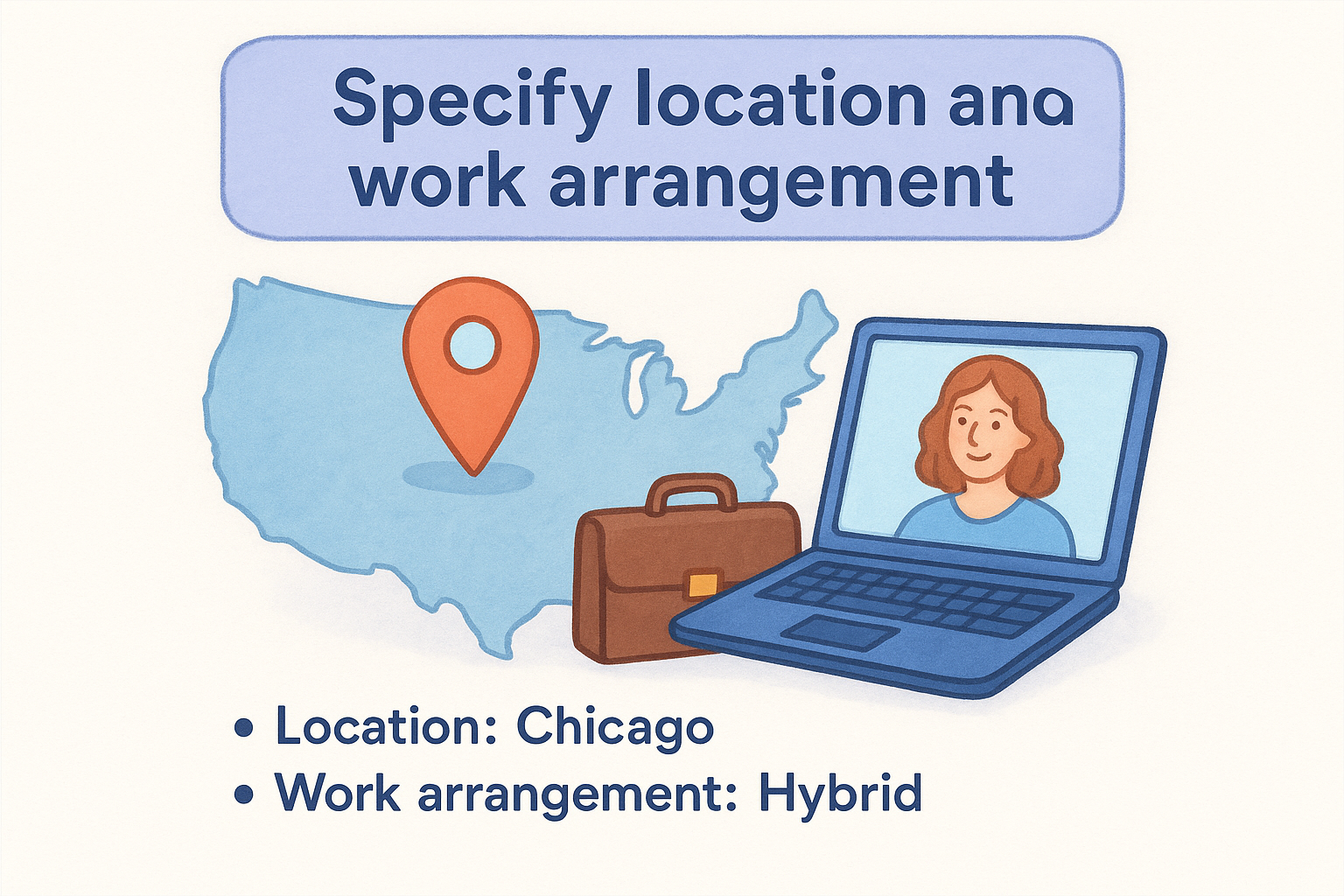
Here is a simple logistics block you can drop directly into any posting:
Location: [City, State] | [Remote / Hybrid / On-site]
Work arrangement: [e.g., 3 days on-site per week]
Visa sponsorship: [Yes / No]
Start date: [Immediate / Month, Year]
Contract type: [Full-time / Contract / Part-time]
Cover benefits and application steps
Benefits details belong in this section, not buried in your company summary. List the three to five that actually differentiate your offer: equity, parental leave, learning stipends, or health coverage. Then close with clear application instructions so a candidate knows exactly what to submit and what happens after they apply.
Step 4. Edit for inclusivity and SEO
You've written your draft. Now you need to review it twice: once for the humans reading it and once for the search engines surfacing it. These two passes work together. A posting that ranks well but repels qualified candidates wastes the click. A posting that reads well but never surfaces in search results wastes the writing. Knowing how to write a job posting means caring about both.
Remove biased language
Gendered and coded language quietly filter out strong candidates before they ever apply. Words like "rockstar," "aggressive," "dominant," or "ninja" skew toward male applicants based on documented research. Phrases like "recent graduate" or "10+ years of experience required" can create age-related barriers that limit your candidate pool and, in some cases, raise legal exposure.
Replacing exclusionary language with plain, outcome-focused phrasing typically increases application rates from underrepresented groups without reducing applicant quality.
Run your draft through a simple scan using the checklist below. For each flagged term, replace it with a neutral, behavior-based alternative:
| Biased term | Neutral replacement |
|---|---|
| Rockstar / Ninja | Skilled / Experienced |
| Aggressive | Results-driven |
| Young and energetic | Motivated |
| Must have 10+ years | Strong background in |
| Recent graduate preferred | Early-career candidates welcome |
Optimize for search
Job title SEO follows the same logic as any other search query. Candidates type specific terms into job boards and Google, so your title needs to match what they actually search for. Use the most common version of the role title, add a seniority level, and skip internal branding.
Your job description body should naturally repeat the core role title two to three times across the posting, in the summary, responsibilities, and requirements sections. This is not about stuffing keywords; it is about using the same language your ideal candidate uses when they search. Check that your location terms are spelled out in full, since candidates search "Remote Software Engineer New York" not abbreviations, and search engines surface results accordingly.
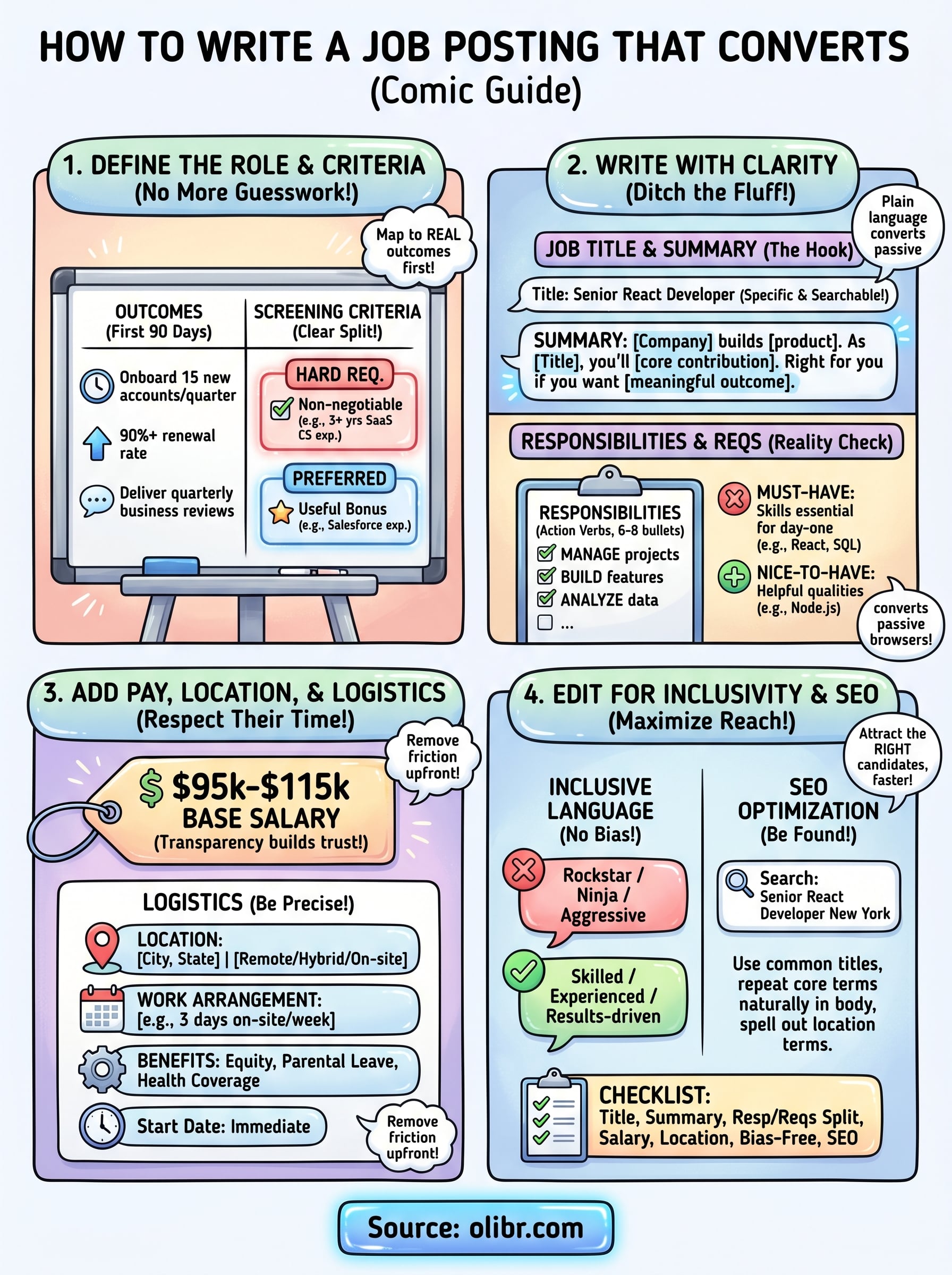
Final Checklist
You now have a complete picture of how to write a job posting that pulls in qualified candidates instead of noise. Before you hit publish, run through these eight checks:
- Job title matches what candidates actually search for
- Summary answers "why would I want this job?" in 3-5 sentences
- Responsibilities are limited to 6-8 action-verb bullets
- Requirements are split into must-have and nice-to-have
- Salary range is specific and visible
- Location and work arrangement are clearly stated
- Biased or exclusionary language has been removed
- Core role title appears 2-3 times naturally in the body
Every item on this list ties to a real hiring outcome: more qualified applicants, shorter review cycles, and fewer mismatched hires. Skipping any one of them creates the exact friction that sends strong candidates to a competitor's posting instead of yours.
Post your next job on Olibr and let the AI-powered matching surface the right candidates before your inbox fills with the wrong ones.
For hiring teams
Search 180,000+ candidate profiles — free.
Olibr is a community-funded recruiting platform: full ATS, AI interviews, and a shared resume database. No per-seat fees.